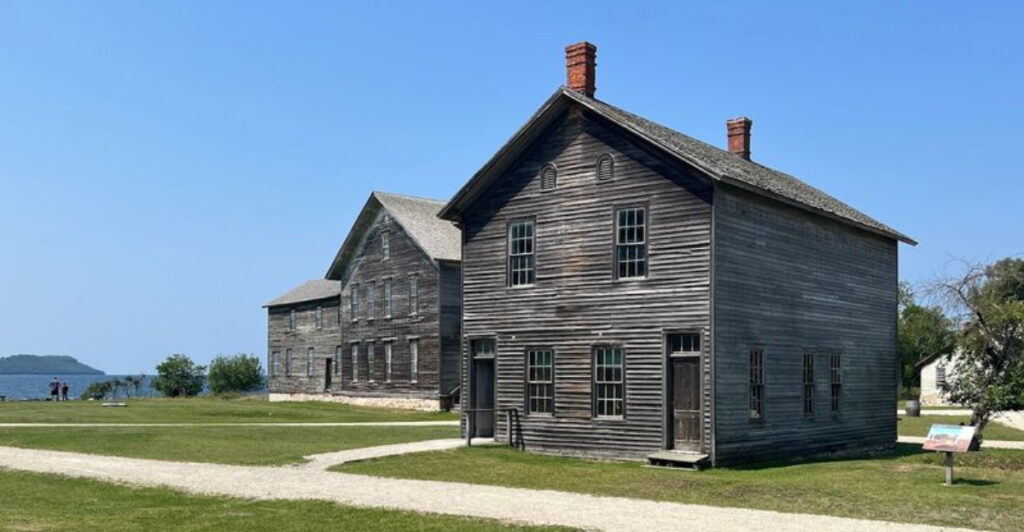
Most ghost towns feel like scattered ruins and imagination doing half the work, but this Upper Peninsula site is different. Along the rocky shoreline of Big Bay de Noc, Fayette Historic State Park preserves an entire 19th-century iron-smelting village with limestone buildings, towering furnace stacks, quiet streets, and a harbor that still feels frozen in time.
Abandoned in 1891, the village remains in remarkable condition, making a walk through the park feel less like reading history and more like stepping straight into it. For curious families, history lovers, photographers, and anyone who likes their Michigan adventures with a little mystery, Fayette is the kind of place that makes the past feel surprisingly close.
A Shoreline That Stops You Cold
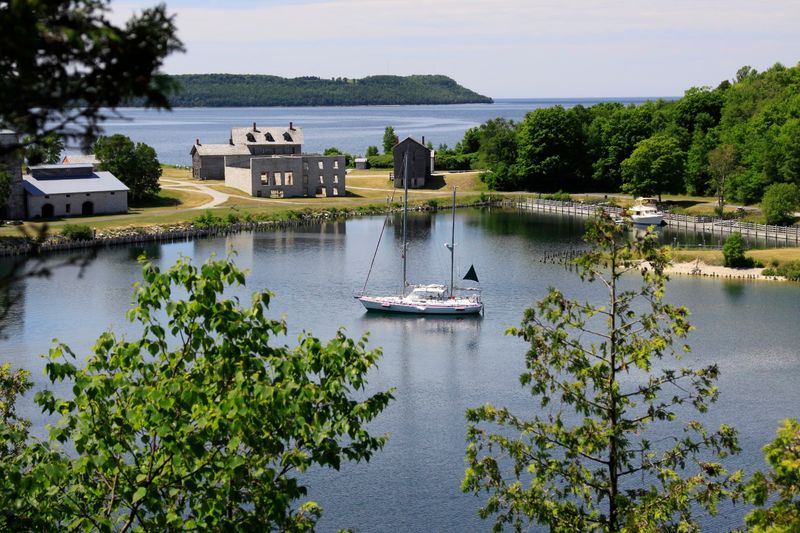
The first view of Snail Shell Harbor hits differently than most scenic overlooks. Standing at the bluff edge above Fayette, you look down at water so clear and blue-green it seems almost tropical — except the ruined limestone buildings and iron furnace stacks along the shoreline remind you exactly where you are and exactly what century this place belongs to.
The harbor itself is small and sheltered, carved naturally into the Stonington Peninsula’s dolomite cliffs. That geography is precisely why the Jackson Iron Company chose this location in 1867.
The deep, protected water allowed large schooners to dock and load pig iron for transport to markets further south. Today, recreational boats still anchor here in summer, floating peacefully beside a shoreline that hasn’t changed much in over a century.
The color contrast between the pale limestone ruins and the vivid blue water is striking enough to photograph from almost any angle. Early morning light turns the harbor surface into something close to hammered silver.
By midday, the water shifts toward jade green in the shallows and deep cobalt further out. Photographers and painters make the pilgrimage to this overlook specifically for that color shift.
A short hiking trail runs along the bluff and drops down toward the waterline, giving visitors ground-level access to the harbor’s edge. From that lower vantage point, the furnace complex looms overhead against the sky, and the scale of the original operation becomes much clearer.
The town wasn’t tiny — at its peak, roughly 500 people lived and worked here. That number is hard to picture until you’re standing at the base of the bluff, looking up at the full industrial skyline the Jackson Iron Company left behind.
Iron Furnaces Frozen in Time
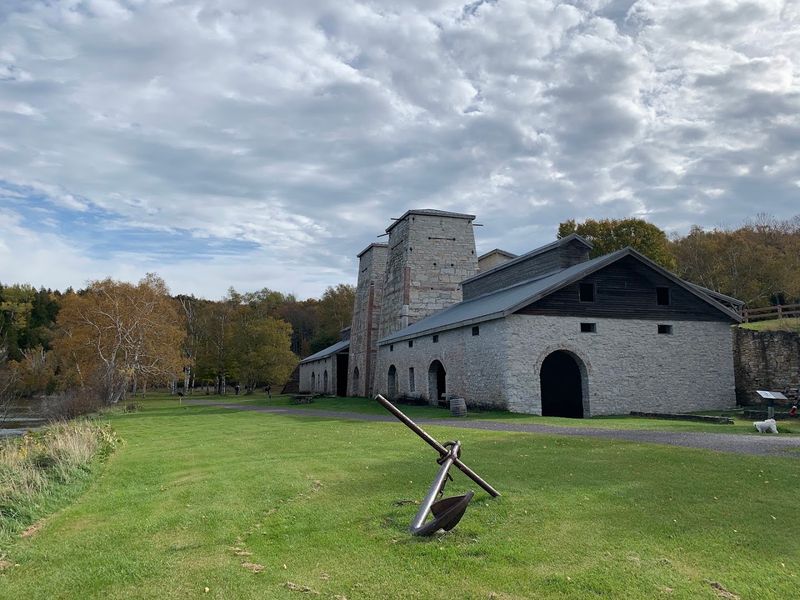
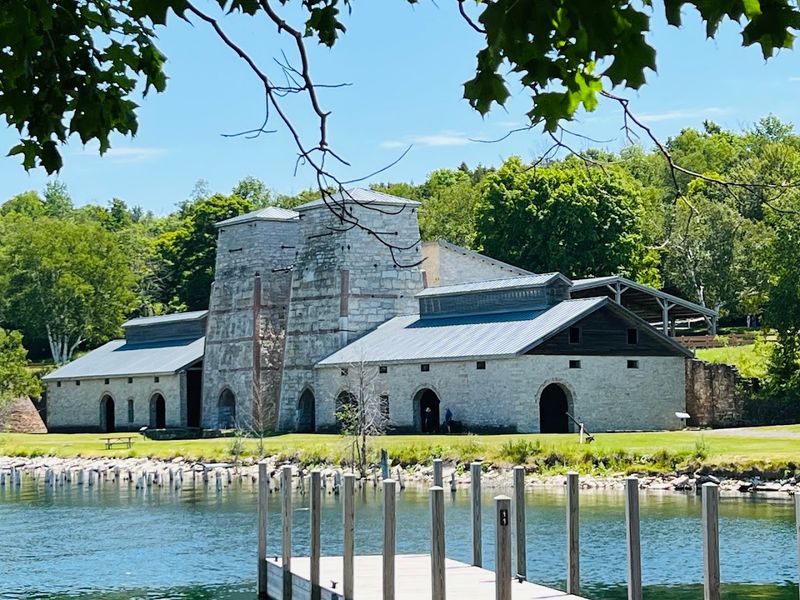
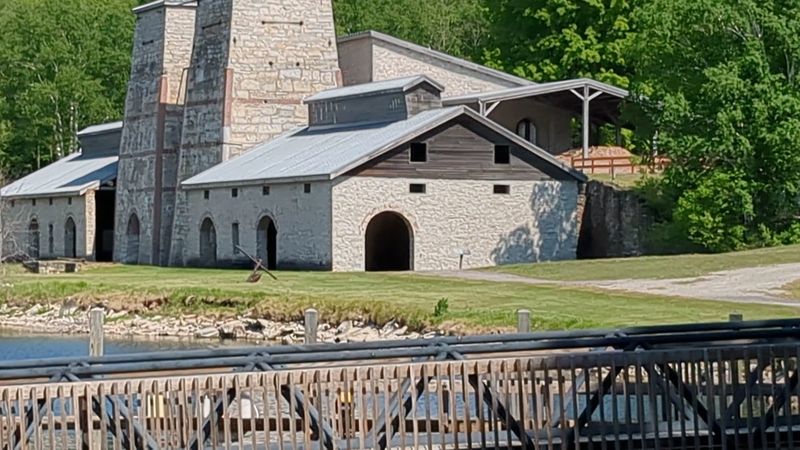
Most industrial ruins from the 1800s have crumbled beyond recognition. At Fayette, the two main charcoal iron furnaces still stand nearly intact, their arched limestone throats open to the sky just as they were when workers last fired them in 1891.
Visitors can walk directly up to the base of these structures and look straight up through the stack openings — a perspective that makes the raw scale of 19th-century iron production immediately physical.
The furnaces operated by burning massive quantities of hardwood charcoal to reach temperatures high enough to smelt raw iron ore into usable pig iron. Surrounding forests were systematically cut and converted to charcoal to feed the operation.
That relentless demand for fuel was ultimately one reason the company shut down — the local timber supply was exhausted, and newer coke-fueled furnaces elsewhere made the Fayette operation economically unworkable. The shutdown came quickly.
Workers left, buildings were locked, and the town simply stopped.
What makes the furnace complex particularly interesting is how much supporting infrastructure survived alongside the main stacks. The engine house, the casting shed, and portions of the ore storage buildings remain largely intact.
Interpretive panels positioned throughout the complex explain each structure’s role in the smelting process, so visitors leave with a working understanding of how the whole system functioned rather than just a vague impression of old stone walls.
The Michigan state park system deserves real credit for maintaining these structures without over-restoring them. The weathered limestone, the rusted iron hardware embedded in the walls, and the moss creeping up the lower courses all stay in place.
That restraint keeps the site honest. You’re looking at a real industrial ruin, not a reconstructed theme park version of one.
Twenty-Two Buildings Still Standing on the Original Footprints
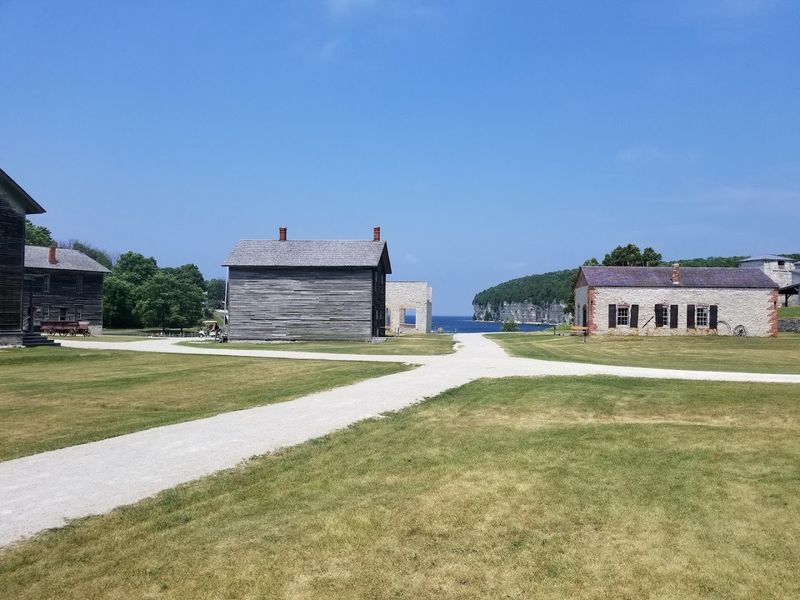
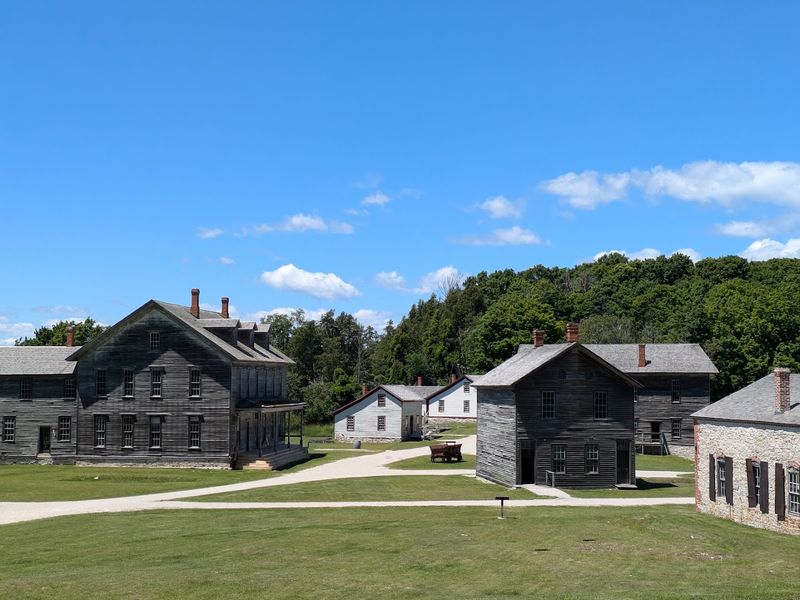
Fayette is not a partially preserved site. The park contains twenty-two historic structures, many of them still standing on their original foundations exactly where they were built between 1867 and 1891.
That number is remarkable for any ghost town, but especially one that was essentially abandoned overnight when the iron company pulled out.
The building lineup covers the full social and economic range of the original community. There’s the company hotel, which housed visiting businessmen and traveling merchants.
The superintendent’s house sits slightly apart from the worker housing, reflecting the clear class distinctions of the era. A machine shop, a doctor’s office, a company store, and a bathhouse all still occupy their original lots.
Walking the short main path through the village, you pass through the full infrastructure of a functioning 19th-century industrial company town in roughly ten minutes.
Several buildings have been carefully stabilized and partially furnished with period-appropriate items. The hotel interior, for instance, gives a clear picture of what accommodations looked like for travelers in the 1880s — simple, functional, and nothing like what the company superintendent enjoyed at his considerably larger residence nearby.
Those contrasts between structures tell a social story that no single building could tell alone.
The preservation quality varies building to building, which actually adds to the experience. Some structures are fully accessible and interpreted.
Others are stabilized ruins you observe from outside. That variation keeps the site from feeling artificially uniform.
A few foundations are marked where buildings no longer stand, filling in the town’s original footprint on the landscape. The overall effect is a complete picture of a working community rather than a curated selection of the most photogenic survivors.
That completeness is what separates Fayette from most comparable historic sites.
The Human Story Behind the Shutdown
Behind every abandoned building at Fayette is a person who left it behind. The Jackson Iron Company employed hundreds of workers at peak operation — many of them immigrants from Scandinavia, England, and Canada who came to the Upper Peninsula specifically for industrial work.
They built lives here: families, routines, social structures. Then in 1891, the company determined the operation was no longer profitable and shut everything down with relatively little warning.
Workers and their families had to relocate quickly, taking what they could carry and leaving the rest. That abrupt departure is part of why so much survived.
There was no slow decline during which buildings were gradually stripped for materials. The town simply closed, the keys were handed over, and nature was left to work slowly on the edges while the core structures held.
The park’s interpretive program does a solid job of humanizing the site. Museum exhibits in the visitor center use photographs, tools, and personal accounts to sketch out what daily life looked like for a furnace worker’s family in the 1880s.
Work shifts ran around the clock when the furnaces were active. The noise and heat of the operation were constant.
Housing was company-owned, the store was company-run, and wages often cycled directly back to the company through rent and purchases — a classic company town arrangement that gave workers limited economic independence.
That context changes how you look at the buildings. The neat rows of worker housing aren’t just charming old structures — they represent a specific power dynamic between employer and laborer that was common across industrial America.
Fayette makes that history visible in a way that purely textbook accounts cannot. Standing inside a worker’s dwelling, the dimensions of that life become concrete rather than abstract.
How to Get the Most Out of a Visit to Michigan’s Upper Peninsula Gem
Fayette rewards visitors who slow down. The temptation is to walk the main path quickly, glance at the furnaces, and head back to the car — but that approach misses the best parts of the site.
Budget at least three hours to do the place justice, and plan to visit the interpretive museum in the visitor center before walking the town. The exhibits provide context that makes every building more legible once you’re out on the trail.
The park operates a small campground with sites overlooking the harbor, and staying overnight is genuinely one of the better ways to experience Fayette. Mornings are quiet and cool, the harbor light is spectacular before 8 a.m., and the crowds that arrive midday in peak summer have not yet appeared.
Evening light on the limestone bluffs is equally impressive. Day visitors who arrive early get a version of the park that feels almost private.
Kayaking is permitted in Snail Shell Harbor, and paddling the shoreline from water level offers a completely different perspective on the furnace complex and the bluffs. Rentals are not available on-site, so plan to bring your own equipment or arrange a rental from a nearby outfitter before arriving.
The harbor is calm and well-protected, making it manageable for paddlers of moderate experience.
The park also includes several hiking trails beyond the historic district. The longer routes pass through second-growth forest and reach additional shoreline views along the Garden Peninsula.
Wildlife is present — white-tailed deer are common near the campground in early morning, and the surrounding waters attract loons and mergansers through the warmer months. Fayette works equally well as a half-day cultural stop or a full multi-day outdoor basecamp depending on what you want from the trip.
Practical Details Worth Knowing Before You Go
Fayette Historic State Park is located at 4785 II Road in Garden, Michigan, on the Garden Peninsula about 17 miles south of the town of Garden. The drive down the peninsula is part of the experience — the road narrows, the forest closes in, and by the time the park entrance appears, you’re already well removed from anything resembling a busy tourist corridor.
The relative remoteness is a feature, not a drawback.
Access requires a Michigan Recreation Passport, which is the standard state park vehicle entry permit. Day passes are available at the park entrance for visitors who don’t already have the annual version.
The historic district and interpretive museum are open seasonally, generally from mid-May through mid-October, with peak staffing and programming concentrated in the summer months. Visiting outside that window means the buildings and museum will be closed, though the grounds and trails remain accessible year-round.
The campground offers both modern sites with electrical hookups and rustic sites for tent campers. Sites near the harbor fill quickly in July and August, so reservations through the Michigan DNR system are strongly recommended for summer weekends.
The campground has restroom and shower facilities, making it comfortable for families and groups who want more than a primitive experience.
Cell service on the Garden Peninsula is limited and unreliable, so downloading offline maps and any park information before leaving a larger town is a practical step. The nearest significant services — gas stations, grocery stores, and restaurants — are in the town of Manistique, roughly 35 miles to the west.
Arriving with a full tank and enough food and supplies for your stay removes any logistical friction and lets the park be the focus of the trip rather than supply runs.