The first hint that Cattus Island is not a typical Jersey Shore stop comes before you even park. Cattus Island Boulevard narrows beneath a canopy of trees, the houses begin to thin out, and Toms River’s suburban bustle quietly drops away.
Then the road ends at 530 acres of salt marsh, pine woods, sandy shoreline, and broad water views that feel wonderfully out of place this close to town. There are no beach-tag booths, boardwalk arcades, or traffic officers waving cars toward expensive lots.
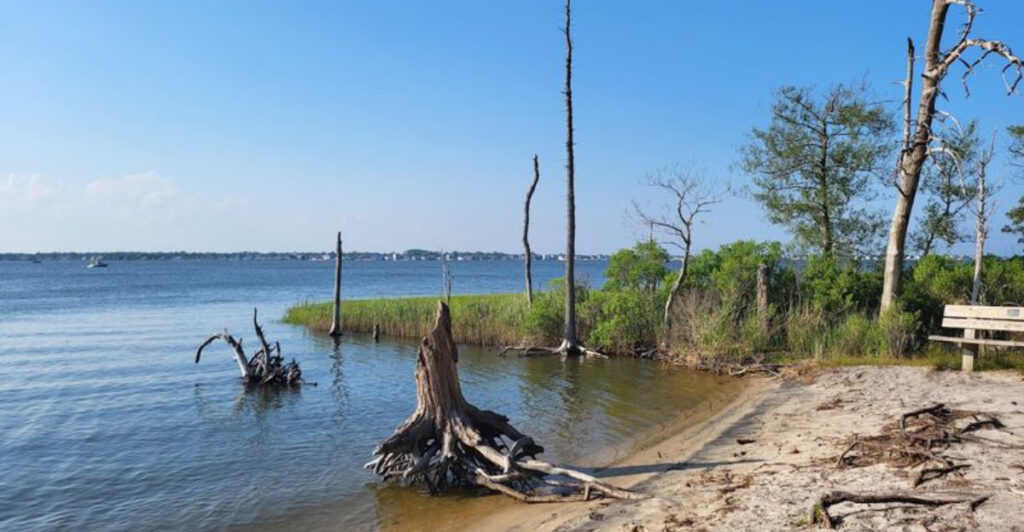
Instead, wooden paths skim across wetlands, ospreys circle above nesting platforms, and driftwood collects along the edge of Barnegat Bay. The park’s seven miles of trails are flat enough for an easy family walk but varied enough to make an afternoon disappear quickly.
Best of all, Cattus Island often feels spacious even when the rest of Ocean County is having one of those everybody-had-the-same-idea Saturdays.
Cattus Island County Park Is Toms River’s Wildest Hidden Escape
A few miles can make a ridiculous difference in Toms River. One moment, you are passing shopping centers and residential streets; the next, you are standing beside a tidal marsh where the loudest interruption may be an osprey calling overhead.
Cattus Island County Park sits at 1170 Cattus Island Boulevard on a broad peninsula extending into the northern reaches of Barnegat Bay.
Its 530 protected acres preserve one of the area’s most substantial salt-marsh landscapes, an especially striking pocket of wildness considering how densely developed the surrounding section of Ocean County has become.
The park is not built around a single headline attraction. Its appeal comes from the way several landscapes overlap: maritime forest filled with oak and pine, freshwater wetlands tucked beneath the trees, open salt marsh crossed by tidal channels, and natural shoreline facing the bay.
Walk for half an hour and the scenery can shift from a shaded path layered with pine needles to an exposed boardwalk with almost nothing between you and the sky. That changing terrain also helps spread people out.
Families may stay near the playground and environmental center, casual walkers often follow the main path toward the water, and birders peel off toward quieter marsh overlooks. Even when the parking area looks moderately busy, the trails rarely feel like a parade route.
Cattus Island also has the pleasant practicality of a county park. Admission and parking are free, restrooms are available at the environmental center, and benches appear at well-chosen spots rather than only where somebody remembered to install one.
It feels maintained without being overly polished, which is exactly right for a place where tangled reeds, crooked pines, and weather-bleached trees are part of the attraction.
Seven Miles of Easy Trails Wind Through Salt Marsh and Pine Forest
The trail map looks more complicated than the walking actually feels. Colored loops and connectors branch from a broad central route, allowing visitors to build anything from a quick 1.5-mile wander to a nearly full tour of the peninsula.
The Red and Yellow loops are each roughly 1.6 miles, while the Blue loop runs about 1.5 miles. More ambitious walkers can combine the Red, Yellow, Blue, Blue-and-White, Orange, and main trails into a perimeter-style route approaching 6.7 miles.
Nobody will mistake it for a mountain hike. Cattus Island is remarkably level, with surfaces that alternate among packed sand, gravel, pine needles, wood chips, and short boardwalk sections.
The trade-off for having no hills is that low areas can become muddy after rain or unusually high tides, so shoes that can survive a little marshy mess are smarter than pristine white sneakers. The Red Trail quickly introduces the park’s wetland character, slipping through marsh grass and passing views of osprey platforms.
The Yellow Trail feels more enclosed, zigzagging through wooded wetlands and crossing small bridges. Farther out, the Blue and Orange sections deliver more open water and shoreline scenery.
The unmarked main trail acts as the park’s backbone and provides the simplest route for anyone who would rather stroll than study every blaze. Trail junctions make it easy to shorten the day without retracing the entire route, a useful feature when walking with children whose enthusiasm suddenly expires two miles from the car.
Pick up a printed map from the kiosk or center before setting out; Ocean County notes that its online maps are updated frequently, and the paper version removes the need to negotiate weak phone service while standing at a three-way junction.
Boardwalks Lead to Quiet Beaches and Sweeping Barnegat Bay Views
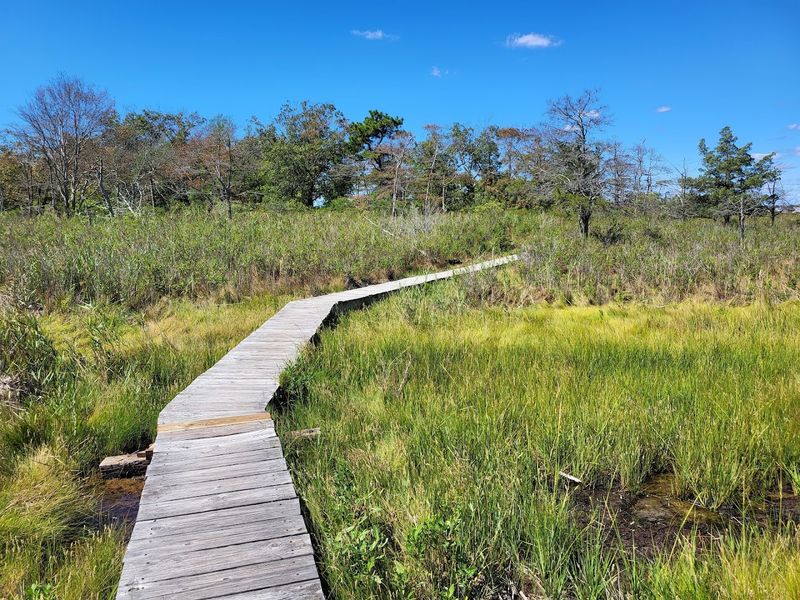
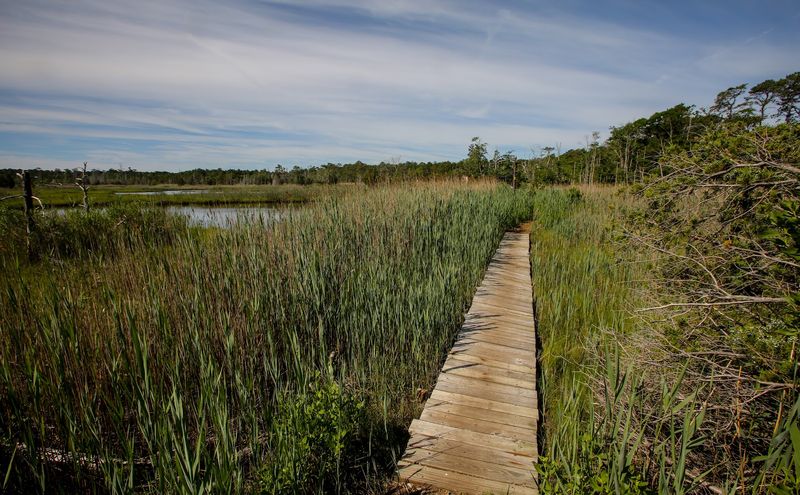
The trees open with little warning, and suddenly the world becomes horizontal. Marsh grasses stretch toward Silver Bay, narrow creeks catch pieces of the sky, and wooden walkways carry visitors across ground that would otherwise be ankle-deep and ecologically fragile.
Cattus Island’s boardwalks are not the wide, snack-lined kind associated with the Jersey Shore. These are narrow passages through reeds, built for slow walking, birdwatching, and stopping every few yards because the view has changed again.
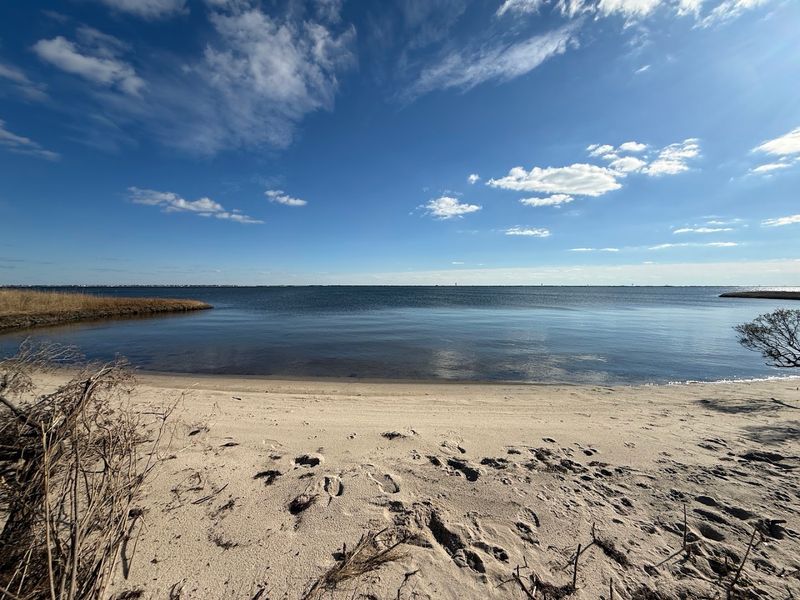
Near the Cooper Environmental Center, a 1,000-foot wheelchair-accessible boardwalk offers an easy look across the salt marsh without requiring a longer trail outing. Deeper in the park, the main route continues toward natural bay beaches where sand, shells, exposed roots, and driftwood replace umbrellas and concession stands.
These shoreline pockets are better understood as places to walk, sit, photograph, and watch the water than as traditional swimming beaches. There are no lifeguard chairs, changing pavilions, or neatly groomed rows for towels.
That absence is the entire point. The bay remains the main event, shifting from gray-blue to bright silver depending on the clouds and time of day.
Boats move quietly in the distance, while the low profile of the surrounding land makes the sky look unusually large. Page’s Point and Yellowbank are among the park’s named shoreline areas, and Yellowbank offers particularly broad views over Silver Bay.
Erosion has affected these exposed edges, prompting a living-shoreline restoration effort intended to protect wetlands and habitat rather than harden the coast with a conventional seawall. It is a subtle reminder that the beaches here are not static scenery.
They belong to a moving, tidal landscape that looks different with every season, storm, and turn of the light.
Ospreys Herons and Ghost Trees Give the Landscape Its Wild Edge
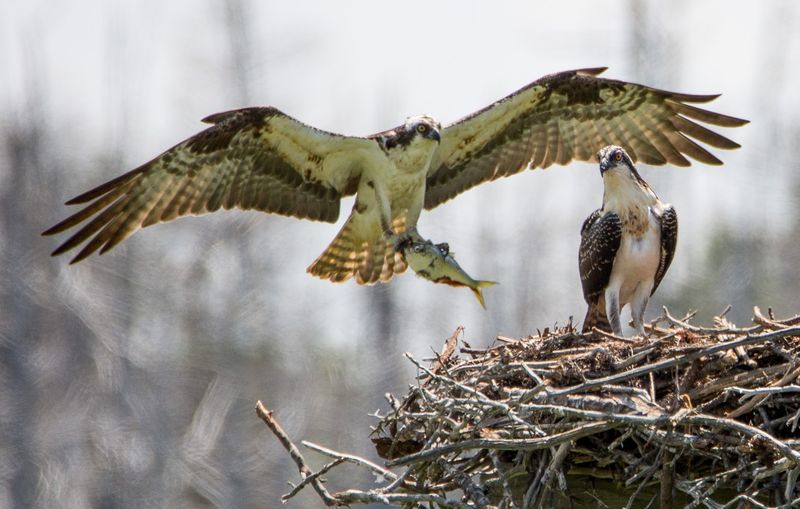
Look up first. Ospreys are among the park’s most visible residents, especially from spring into summer, when the large fish-eating raptors return to nesting platforms rising above the marsh.
Their shape is easy to recognize once you know it: long, narrow wings held with a noticeable crook and a pale underside broken by dark markings. They often patrol the bay before dropping toward the water with considerably more drama than anything else happening on the trail.
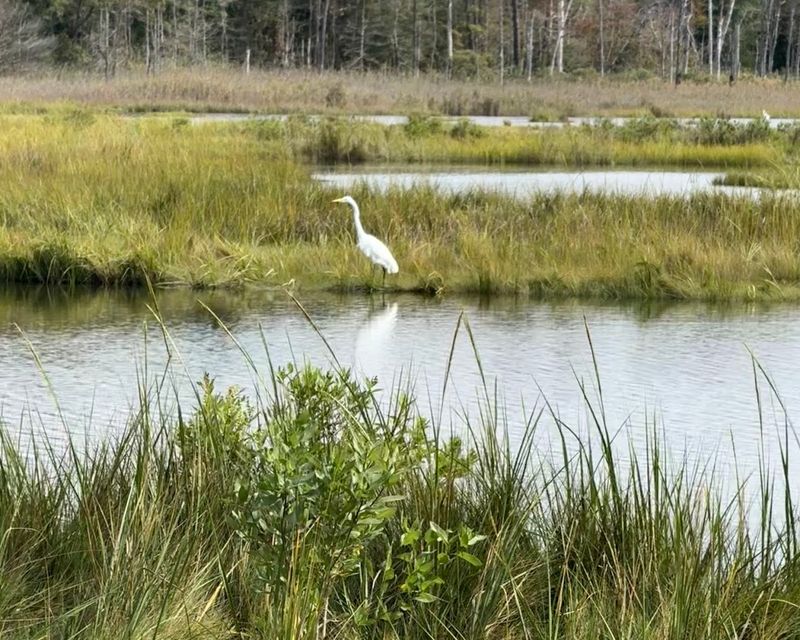
Great blue herons work at the opposite speed. They stand along shallow channels with almost comical patience, barely moving until a fish ventures within striking distance.
Egrets, shorebirds, ducks, and smaller songbirds add movement at different heights, turning a casual walk into an accidental birding trip. Bringing binoculars is worthwhile, although several sightings may happen close enough that even an unprepared visitor gets a good look.
The park’s strangest figures never move at all. Pale trunks and bare branches rise from wet ground and shallow water, creating the ghost-forest scenery that gives parts of Cattus Island an eerie edge.
These dead trees are more than moody photo subjects. Atlantic white cedar depends on freshwater conditions, and saltwater entering formerly fresher areas can kill the trees while leaving their rot-resistant trunks standing for years.
Along New Jersey’s coast, ghost forests have become a visible sign of saltwater intrusion and rising seas. At Cattus Island, they also sharpen the contrast between living marsh grass, dark green pines, and bleached wood.
On a bright afternoon, the scene can look sculptural. Under low clouds, it feels almost prehistoric.
Either way, it prevents the park from becoming merely pretty. Cattus Island is beautiful because it is active, changing, and occasionally a little unsettling.
The Cooper Environmental Center Brings the Barnegat Bay Ecosystem Indoors
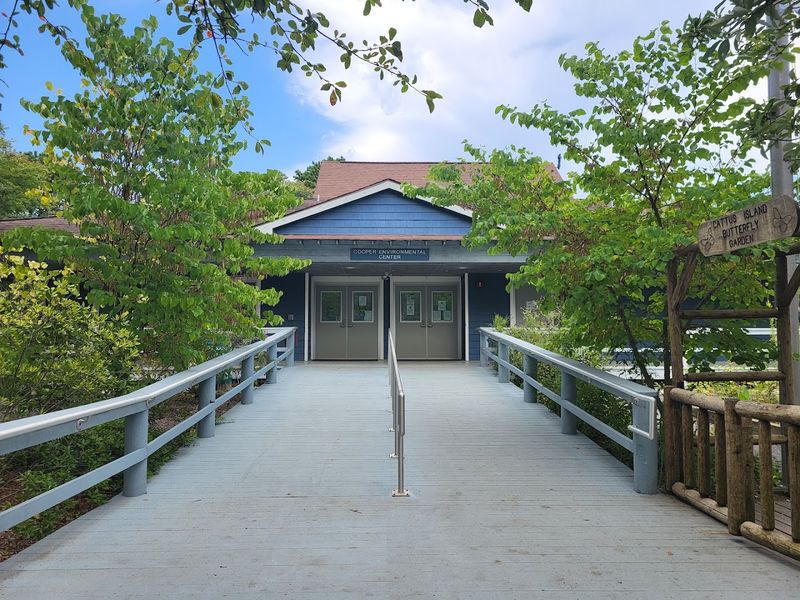
After an hour outside, the Cooper Environmental Center makes everything you just walked through easier to understand. The accessible nature center sits close to the main parking area and functions as the park’s practical and educational hub, with restrooms, trail information, and exhibits focused on Cattus Island and Barnegat Bay.
This is not a room filled with faded posters and one lonely taxidermied duck. The renovated displays include a live-view osprey camera, a bird observation area, a walk-through habitat tree and tunnel, a children’s activity corner, and collections of living reptiles and fish.
The osprey feed is especially useful when a nest is active because it reveals the domestic side of birds that otherwise appear as distant silhouettes over the marsh.
Nearby tanks and enclosures introduce visitors to animals that may remain hidden during a walk, giving younger guests something more concrete than an adult repeatedly whispering, “I think I saw a turtle.” Outside the center, the butterfly garden adds another compact habitat to the visit.
Native plants attract pollinators from roughly mid-May through mid-October, though the garden remains open throughout the year. The county also runs environmental programs at Cattus Island, including nature walks and seasonal sessions centered on subjects such as returning ospreys, reptiles, carnivorous plants, hummingbirds, and marsh ecology.
Many weekend nature walks are scheduled at 2 p.m. and offered free, though program calendars can change. The center’s regular hours in 2026 are 8:30 a.m. to 4 p.m.
Monday through Friday and 10 a.m. to 4 p.m. on Saturdays and Sundays, excluding major holidays. That makes it easy to place the indoor stop at either end of the visit: begin with a map and a wildlife preview, or finish by finally identifying the creature that splashed into the marsh and refused to reappear.
What to Know Before Visiting Cattus Island County Park in 2026
Cattus Island rewards a little preparation, though nothing here requires expedition-level planning. The park opens at 7 a.m. and closes on a seasonal schedule tied roughly to available daylight, with evening closing times ranging from 5 p.m. in winter to 8 p.m. during the longer spring and summer days.
Because those times shift several times during the year, checking the current Ocean County listing before a late visit is sensible. Parking and general park admission are free.
The main lot places visitors beside the Cooper Environmental Center, playground, picnic area, accessible boardwalk, and several trail entrances, making it the most convenient starting point. Bring water, insect repellent, and sun protection even for a short outing.
The open marsh offers little shade, mosquitoes can be assertive during warm, still weather, and ticks are possible in the grassy and wooded sections. After heavy rain, expect mud and standing water in low areas.
A printed trail map is useful, particularly for anyone combining several colored loops rather than following the main path to the bay and back. Well-behaved dogs are allowed in Ocean County parks but must remain leashed, and owners are expected to clean up after them.
Early morning is usually the best window for active birds and softer light over the marsh. Late afternoon gives the bay and ghost trees a warmer glow, but visitors should leave enough time to return before the gates close.
Winter should not be dismissed; bare branches improve water views, insects retreat, and the stark marsh can be more atmospheric than the lush summer version. Cattus Island is not a place to rush through for one famous overlook.
Its character emerges slowly in boardwalk creaks, flashes of white egret wings, briny air, and the unexpected sight of an empty bench facing miles of open water.