
Perched right at the foot of the Mackinac Bridge in Mackinaw City, Colonial Michilimackinac is one of Michigan’s most layered and surprising historical sites. Built as an 18th-century fur trading fort, the reconstructed stockade pulls visitors straight into a world of British soldiers, French traders, and Native American culture.
Muskets fire, bread bakes over open flames, and real archaeologists dig for artifacts that are still being uncovered today. Whether you’re a history enthusiast or just looking for something genuinely interesting to do on a Michigan road trip, this place delivers far more than expected.
Walking Into a Reconstructed 1770s Stockade
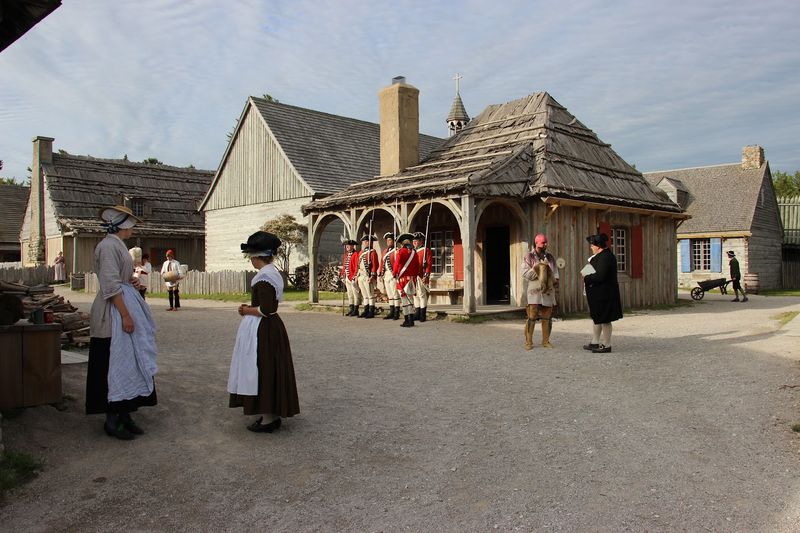
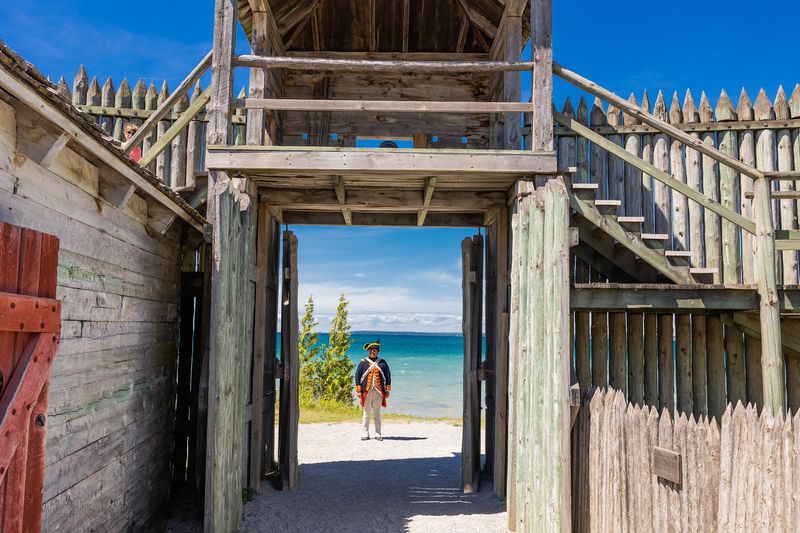
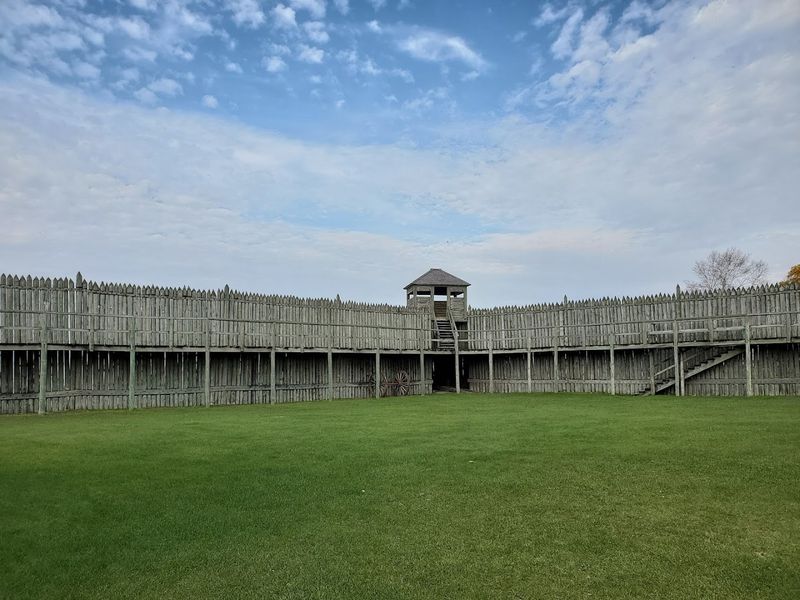
The first thing that stops people in their tracks is the sheer scale of the wooden palisade walls. Tall, sharp-tipped logs form a tight perimeter around a village that looks like it was lifted directly from the 1770s.
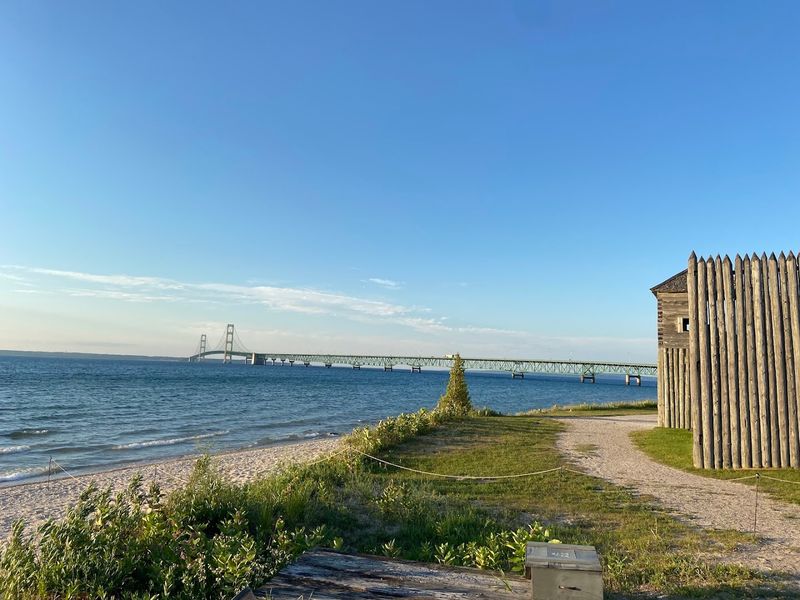
Standing outside the gate, the contrast between the modern Mackinac Bridge visible in the background and the rough-hewn fort in the foreground is genuinely striking.
Colonial Michilimackinac is a reconstructed version of a real fort that once stood on this exact ground. The original structure served as a French and later British military post and fur trading hub.
Archaeologists have been carefully excavating the site since 1959, and the reconstruction is guided by what those digs have uncovered over the decades.
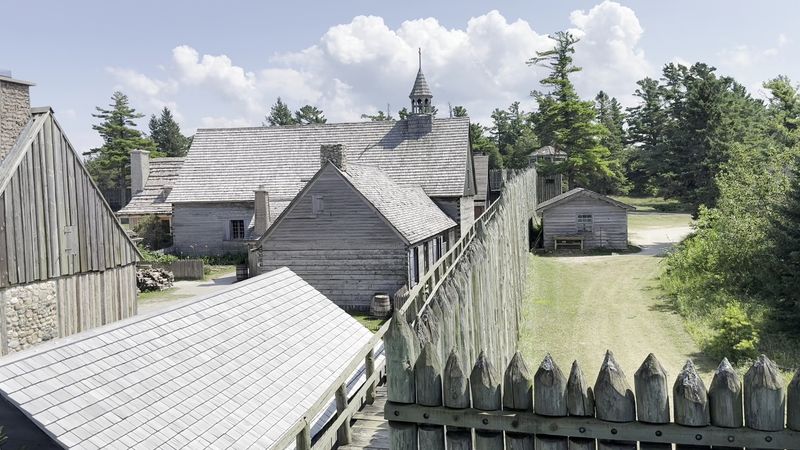
Once through the entrance, the layout opens up into a compact but densely packed colonial village. Multiple buildings line the interior, each representing a different aspect of daily life from that era.
Soldiers’ barracks, a fur trader’s home, a church, and a powder magazine are all part of the circuit.
Maps provided at the entrance mark 22 points of interest across the site. Visitors can move at their own pace, which means spending extra time in spots that catch attention without feeling rushed through the rest.
The gravel paths are easy to navigate, and accessibility options including mobility scooters are available at no extra cost.
Signage throughout the site is detailed without being overwhelming. Written panels, short video stations, and physical exhibits work together to explain not just what happened here, but why it mattered.
The fort functioned as a crossroads of cultures, and that complexity comes through clearly from the first few minutes inside.
Reenactors Who Actually Know Their History
A colonial woman crouches beside an open fire, carefully tending to a cake baking in a Dutch oven. A British soldier nearby explains the weight of his musket and the daily discipline required of garrison life.
A fur trader describes the different canoe designs used to transport beaver pelts across the Great Lakes. These are not performances in the theatrical sense — they are sustained, knowledge-driven conversations that happen throughout the day.
The historic interpreters at Colonial Michilimackinac are a standout feature of the experience. Staff members are deeply versed in the social, military, and economic history of the Straits of Mackinac region, and their enthusiasm for the subject comes through naturally.
Visitors who ask follow-up questions tend to get answers that go well beyond the basics.
The range of perspectives on offer is worth noting. The fort’s history involves French colonists, British military forces, and multiple Indigenous nations, particularly from the Algonquin tradition.
Some reenactors represent Native voices and share history from that vantage point, including stories told inside a traditional Nasaogan structure located just outside the fort walls.
Seven scheduled demonstrations take place throughout each day. These include musket firing, artillery displays, and cooking demonstrations that give visitors a sensory connection to the period beyond just reading about it.
The cannon demonstration is consistently one of the most popular, and the sound alone makes an impression.
Visiting on a weekday after the Labor Day holiday tends to mean fewer crowds while the full roster of interpreters remains active. Even on slower days, every building has someone present and engaged.
The interpreters treat each visitor as someone genuinely worth talking to, which changes the entire rhythm of the visit.
The Active Archaeological Dig That Changes Every Season
Most history museums display what has already been found. Colonial Michilimackinac is still finding things.
The archaeological excavation program here has been running continuously since 1959, making it one of the longest-running digs of its kind in North America. That ongoing work means the site is not a finished product — it is an active research site that visitors can watch in real time.
Archaeologists work within the fort grounds during the operating season, carefully sifting through layers of soil that have preserved colonial-era artifacts for over two centuries. Fragments of pottery, trade beads, animal bones, military hardware, and structural remnants have all been recovered from the site.
Each find contributes to a more detailed understanding of how people actually lived here.
The dig area is viewable by visitors, and staff are typically on hand to explain what they are doing and why a particular layer of soil matters. For kids especially, watching a real excavation unfolds a layer of curiosity that no exhibit panel can replicate.
The idea that history is still being pulled out of the ground beneath your feet makes the past feel genuinely close.
The powder magazine is another highlight connected to the site’s physical history. It is one of the original structures that survived a British attempt to burn the fort, and standing inside it carries a different weight than walking through a reconstruction.
The walls have absorbed centuries of weather and conflict.
Artifacts recovered from the dig are incorporated into exhibits throughout the site, creating a direct link between the excavation happening outside and the displays inside. The result is a museum where the collection is literally growing each summer, which gives repeat visitors a reason to come back and see what is new.
Musket Fire, Cannons, and Daily Demonstrations
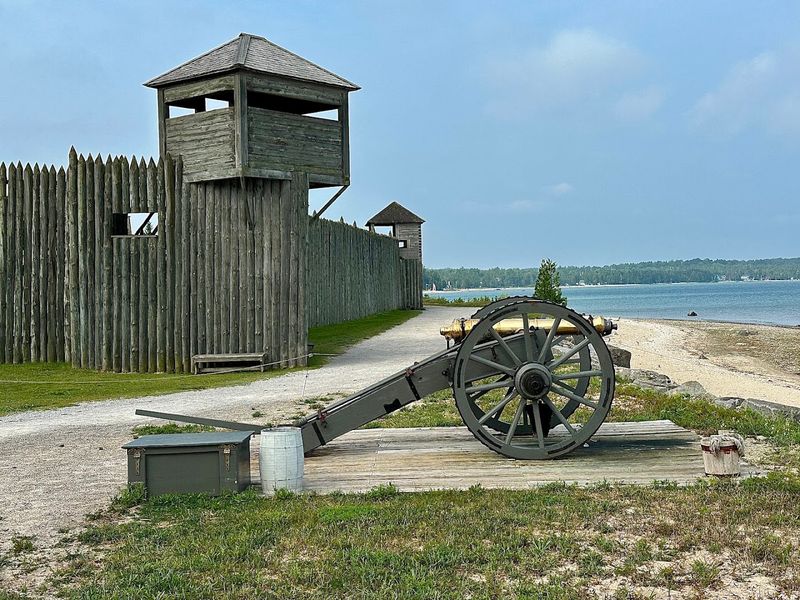
Few things command attention at a historical site quite like a cannon being fired. At Colonial Michilimackinac, artillery demonstrations are a scheduled part of the daily program, and the crack of the cannon echoes across the fort grounds and out toward the Straits of Mackinac.
For visitors who have never seen black powder artillery up close, the experience is hard to forget.
Musket demonstrations run on a similar schedule and give visitors a close look at the mechanics of 18th-century firearms. Interpreters walk through the loading process step by step — a sequence that involved multiple precise actions before a single shot could be fired.
Understanding that process reframes how people think about colonial-era battles and military discipline.
Seven demonstrations are spread across the day, which means visitors do not need to rush or plan their route around a single event. Arriving in the morning and returning after lunch, as some visitors do, allows enough time to catch multiple demonstrations without feeling like the day is being managed by a schedule.
Beyond the firearm displays, cooking demonstrations over open hearths show the practical side of daily life inside the fort. Watching period recipes prepared using only the tools available in the 1770s connects visitors to the human rhythms of colonial life in a way that written exhibits cannot fully achieve.
The smell of woodsmoke and baking bread adds a sensory layer that lingers.
Children respond strongly to the demonstrations, partly because of the noise and spectacle, and partly because interpreters invite questions and often direct answers toward younger visitors in accessible language. School groups and family visits tend to cluster around these events, and the energy during demonstrations is noticeably higher than in the quieter exhibit spaces.
Plan to arrive a few minutes early for the cannon firing.
Michigan’s Fur Trade History Told From Every Angle
Before Michigan was a state, before it was a territory, the Straits of Mackinac were one of the most strategically important waterways in the entire continent. Beaver pelts drove an economy that connected Indigenous hunters in the Great Lakes region to European markets thousands of miles away.
Colonial Michilimackinac sat at the center of that network, and the fort’s exhibits trace that trade with impressive specificity.
Inside the fur trader’s home, the reconstruction shows how merchants lived and worked within the fort. Trade goods like glass beads, metal tools, and cloth were exchanged for pelts, and the exhibit lays out the economics of those transactions in terms that make the scale of the fur trade click into place.
Visitors come away understanding why this particular patch of Michigan shoreline mattered so much to so many competing powers.
The relationship between European traders and Indigenous nations is handled with care throughout the site. Exhibits acknowledge the complexity of those interactions rather than flattening them into a simple narrative of exchange.
The Algonquin presence at the site, including the Nasaogan structure outside the fort walls, reflects a deliberate effort to represent Indigenous history as more than a backdrop to European colonization.
Canoe and boat displays explain the transportation network that made the fur trade function. Different vessel types served different purposes depending on the route, the cargo, and the season.
That logistical detail helps visitors picture the actual movement of goods and people across a vast and often dangerous landscape.
The films shown at the start of the visit — roughly 20 minutes — do solid work establishing this context before visitors enter the fort. Watching them first makes the rest of the site significantly more legible, especially for younger visitors or anyone coming in with limited background knowledge on the period.
Planning Your Visit to Mackinaw City’s Most Underrated Attraction

Colonial Michilimackinac opens at 9:30 AM every day of the week and runs until 7 PM during the main season, which spans spring through fall. That extended evening window makes it possible to visit after other activities without feeling rushed.
Tickets are priced around $16 for adults, which is a reasonable entry point given that most visitors spend between two and four hours on site.
Free parking is available directly at the site, which is a genuine convenience given the busy nature of Mackinaw City during peak summer months. Restrooms are located both at the entrance and inside the fort, so there is no need to leave mid-visit for basic needs.
Dogs on leashes are welcome at the site, which makes it a more flexible option for visitors traveling with pets.
The welcome center sits right beneath the approach to the Mackinac Bridge, and the sound of vehicles crossing overhead is a strange and oddly memorable detail. Entering through the gift shop and walking down toward the fort gives first-time visitors a gradual sense of transition from the modern world into the reconstructed one.
Staff at the welcome center are consistently described as helpful and genuinely engaged with visitors.
A family week pass is available and worth considering for anyone planning to visit both Colonial Michilimackinac and Fort Mackinac on Mackinac Island. The combined pass saves money and pairs two complementary historical experiences that cover different periods and perspectives of the same region’s history.
Visiting after Labor Day significantly reduces crowd density while the full interpretive staff remains on duty. May visitors should be aware of midges — small harmless insects that swarm near the water during late spring.
They do not bite, but they can be thick in the air during certain weather conditions. A light jacket handles both the bugs and the lakeside breeze.
Why This Fort Stands Apart From Other Living History Sites
Living history sites exist across the country, but Colonial Michilimackinac occupies a specific niche that is harder to replicate than it might appear. The combination of active archaeology, trained interpreters, period demonstrations, and a genuinely significant historical location creates an experience where every layer reinforces the others.
Remove any one element and the visit becomes more ordinary.
The site’s 4.7-star rating across more than 6,000 reviews reflects consistent execution rather than occasional excellence. Visitors who arrive skeptical about admission prices tend to leave feeling the value was clear.
The range of things to engage with — from short films to hands-on demonstrations to quiet exhibit spaces — means different types of visitors find their own entry point into the history.
Children connect with the demonstrations and the visible archaeology. Adults with a deeper interest in history tend to gravitate toward the interpreters and the more detailed exhibit panels.
The fort is genuinely dog-friendly, accessible for visitors with mobility needs, and structured in a way that rewards both fast walkers and slow wanderers equally.
The physical setting adds something that cannot be manufactured. Standing inside a reconstructed 18th-century fort with the Mackinac Bridge rising in the background and the Straits of Mackinac stretching out beyond the walls is a genuinely unusual visual experience.
The juxtaposition of eras is stark in the best possible way.
Colonial Michilimackinac earns its place as one of Michigan’s most complete historical attractions not through spectacle alone but through depth. The history here is layered — military, commercial, cultural, and Indigenous — and the site makes a serious effort to present all of it honestly.
That seriousness, paired with genuinely engaging programming, is what separates a good historical site from a great one.