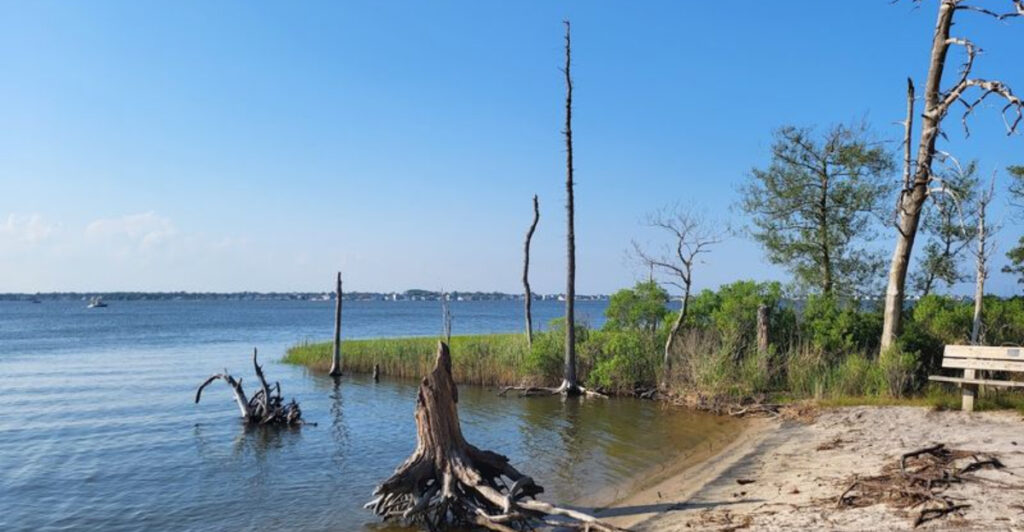
A bleached tree trunk lies twisted across the sand, its roots lifted toward the sky like antlers. Beyond it, bare branches rise from the shallows while an osprey circles over a dark ribbon of bay water.
There are no boardwalk games humming nearby, no beach-tag checker approaching, and no rows of umbrellas blocking the horizon. The scene feels better suited to a remote inlet in Maine than a park hidden behind the neighborhoods of Toms River.
This is Cattus Island County Park, a 530-acre peninsula where pine woods, tidal marshes, sandy coves, and Barnegat Bay meet in wonderfully untidy fashion. Its seven miles of mostly level trails lead past weathered driftwood, quiet observation points, and a ghost forest shaped by the changing coastline.
Despite the wild scenery, the park is easy to reach, free to explore, and manageable even for casual walkers. It is the Jersey Shore with the volume turned all the way down.
Cattus Island County Park Feels Worlds Away From the Jersey Shore
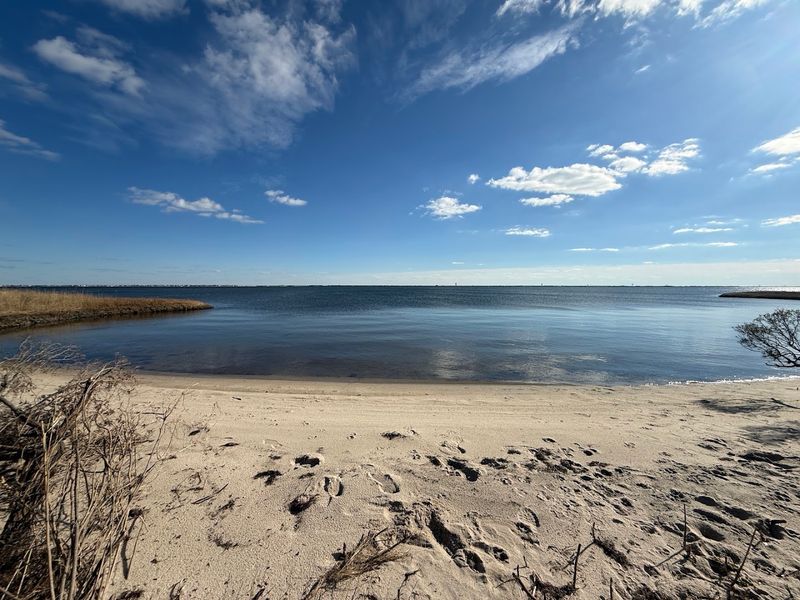
The transformation begins before you have even parked. Cattus Island Boulevard leaves the busier Toms River roads behind and slips into a corridor of trees, with the surrounding neighborhoods gradually disappearing from view.
By the time you reach the main lot at 1170 Cattus Island Boulevard, the familiar Shore soundtrack of traffic, beach bars, and amusement rides has been replaced by wind moving through pine branches and birds calling from the marsh.
Cattus Island is technically a peninsula rather than a far-flung island, so no bridge, ferry, or heroic navigation is required.
That accessibility is part of the fun. You can be running errands near Route 37 and, a few turns later, find yourself looking across a broad expanse of salt marsh that feels almost entirely removed from town.
The park protects roughly 530 acres along Silver Bay and the wider Barnegat Bay ecosystem, with forest, marsh, and open water packed remarkably close together. The Cooper Environmental Center sits beside the main parking area and makes a useful first stop, especially for first-time visitors.
Its exhibits introduce the fish, reptiles, birds, plants, and tidal habitats found throughout the park without turning the experience into homework. Inside are live native animals, children’s activities, bird-viewing areas, and an osprey camera that offers a close look at one of the park’s most famous residents.
Restrooms are also located inside, which is worth remembering before committing to one of the longer trail combinations. Outside, a butterfly garden filled with native and cultivated plants softens the transition between the building and the wilder landscape.
From there, the trails quickly pull you into woods and marshland. The park does not try to imitate a polished waterfront attraction.
Its appeal comes from letting crooked shorelines, sandy paths, tidal creeks, and wind-shaped trees remain the main event.
Seven Miles of Quiet Trails Wind Through Forest Marsh and Bay
Seven miles sounds ambitious until you see the terrain. There are no steep climbs waiting around the bend and no rocky ridges demanding specialized boots.
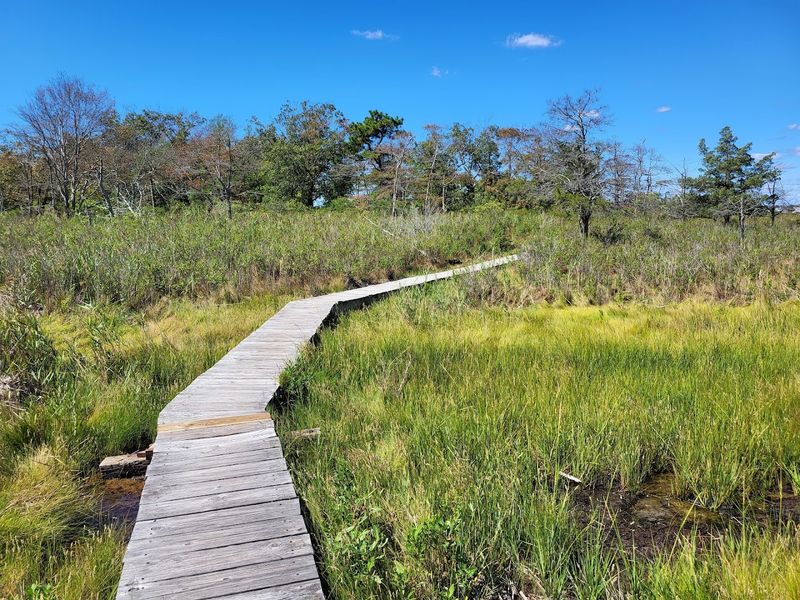
The routes at Cattus Island are almost entirely level, passing over sand, pine needles, packed earth, wood chips, and wooden boardwalks. The biggest challenge is deciding how far you feel like wandering before turning back.
Color-marked trails allow visitors to build anything from a brief leg-stretcher to a nearly full tour of the peninsula. The Red, Yellow, and Blue loops are each manageable on their own, while linking them with the main trail can produce walks of more than five or six miles.
The unmarked central route acts as the park’s backbone, connecting the environmental center with beaches, overlooks, side loops, and the far reaches of the property.
Maps are generally available near the center or trail kiosk, and grabbing one is smarter than trusting your sense of direction after every marsh crossing starts looking beautifully similar.
The landscape changes often enough to keep an easy walk interesting. One stretch passes beneath tall pines and American hollies, where the ground feels springy with fallen needles.
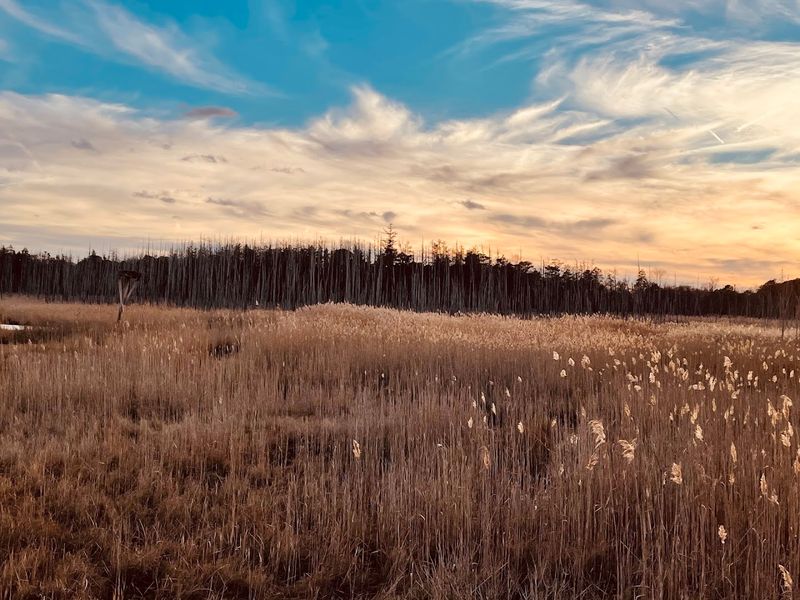
Another emerges beside tawny marsh grasses with almost no shade. Boardwalks cross wetter ground, and short side paths reveal views of Mosquito Cove, Silver Bay, and narrow tidal channels that expand and shrink with the tide.
A 1,000-foot accessible boardwalk provides a barrier-free option near the environmental center, picnic grove, and marsh. Cyclists are limited to designated routes and the main fire road, while walkers can explore the smaller loops.
After heavy rain, some sections become muddy or hold shallow water, so this is not the day for treasured white sneakers. The flat terrain makes Cattus Island especially good for an unhurried outing.
There is no summit to conquer and no pressure to chase a dramatic finish. The payoff arrives in smaller moments—a sudden bay view between tree trunks, an osprey nest above the marsh, or a sandy trail that simply keeps going toward the water.
Driftwood Beaches Bring a Touch of Coastal Maine to Barnegat Bay
Forget the wide, carefully groomed sand of Seaside Heights or Point Pleasant Beach. The shoreline here is narrower, rougher, and much more interesting.
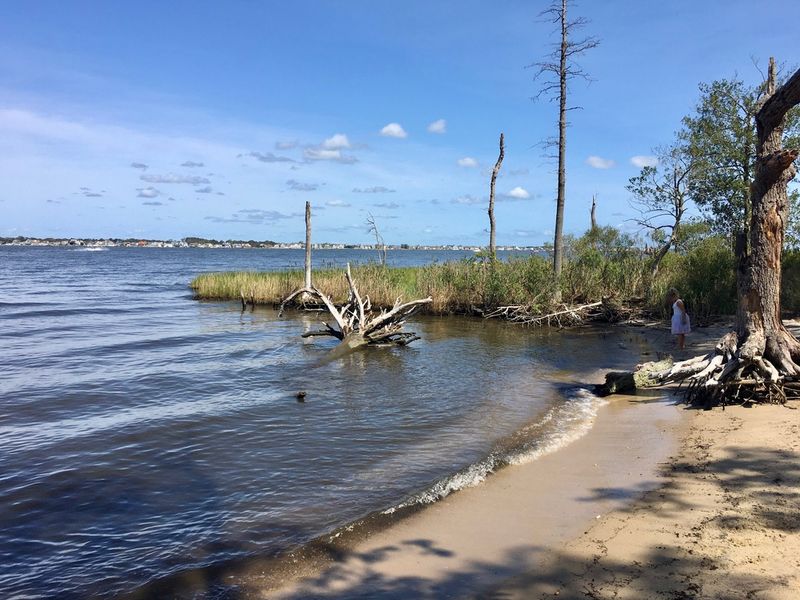
Waves and tides deposit branches, root systems, shells, reeds, and entire sun-bleached trunks along the edge of the bay. Some pieces of driftwood are small enough to step over.
Others sprawl across the beach like the remains of enormous wooden sea creatures. That untamed shoreline is where the coastal Maine comparison begins to make sense.
Pine trees crowd close to the sand, dark bay water replaces the bright Atlantic surf, and twisted timber frames distant views across Silver Bay. On a gray or windy day, the resemblance becomes especially convincing.
The air smells of salt and damp wood, gulls hang in the breeze, and the weathered shoreline looks as though it has been left alone for years. Several routes reach sandy areas, but the beach near the end of the main trail provides one of the park’s most satisfying destinations.
Picnic tables offer a place to sit while looking across the water, and the walk required to reach this point helps keep the atmosphere quieter than at beaches positioned beside parking lots.
You may encounter anglers, photographers, birders, or families inspecting shells, but the experience rarely resembles a conventional Jersey Shore beach day.
Swimming is prohibited, and that restriction matters. These are natural bay edges rather than guarded recreation beaches, with changing tides, submerged branches, soft ground, and sensitive marsh habitat nearby.
Think of them as places for walking, wildlife watching, photography, and sitting beside the water rather than spreading out for an afternoon of swimming and sunbathing. The driftwood changes with storms and tides, so the shoreline never presents exactly the same arrangement twice.
A log that served as a perfect bench on one visit may be gone on the next. Another tree may have fallen, exposing a tangled root system polished by water and sand.
That constant rearranging gives the coast its rough-edged character and keeps it from ever feeling manufactured.
The Haunting Ghost Forest Is the Park’s Most Unforgettable Sight
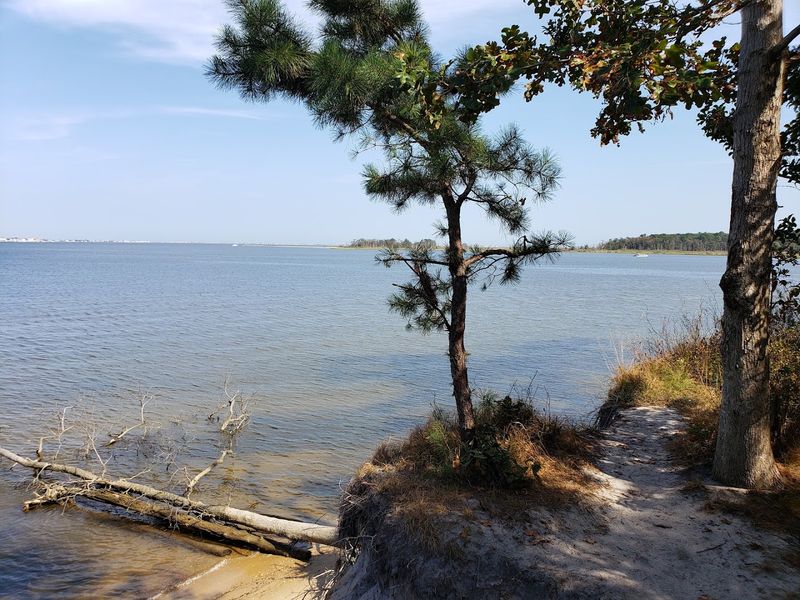
At first, the dead trees look like ordinary storm damage. Then the trail opens and reveals an entire stand of them—gray trunks rising without leaves, bark, or shade, their bare limbs stretched over marsh grass and shallow water.
It is an arresting scene, made stranger by how abruptly it appears beside living forest. These skeletal stands are known as ghost forests.
They form in low coastal areas when saltwater increasingly reaches ground once occupied by freshwater-dependent trees. Salt can enter through repeated tidal flooding, storm surges, or the movement of brackish groundwater.
Trees weakened by prolonged exposure stop producing healthy growth and eventually die, while salt-tolerant marsh plants begin taking over the wetter land beneath them. Cattus Island offers a particularly clear view of that transition.
Green woods remain only a short distance away, but nearer the shoreline, dead trunks stand among reeds and open water. The result is not a preserved forest in the traditional sense.
It is a landscape caught in the process of becoming something else. The visual effect depends heavily on the weather and tide.
Bright afternoon sun turns the trunks almost white against blue water. Overcast skies bring out their darker, moodier side.
At high tide, some appear to rise directly from the bay; at lower water, mud, exposed roots, and marsh vegetation become more visible. Birds frequently use the bare branches as open perches, adding movement to a scene that otherwise feels remarkably still.
It is tempting to treat the ghost forest only as a dramatic photo backdrop, but it also tells a larger coastal story. Rising water and saltwater intrusion are converting low-lying woodland into marsh across many parts of the Mid-Atlantic.
The trees at Cattus Island make that process visible without an interpretive diagram. They show exactly where the forest once stood and where the bay’s influence is now reaching.
That combination of beauty and unease is what lingers. The driftwood beaches may provide the park’s Maine-like scenery, but the ghost forest gives Cattus Island a character entirely its own.
Ospreys, Herons, and Terrapins Make Every Walk a Wildlife Adventure
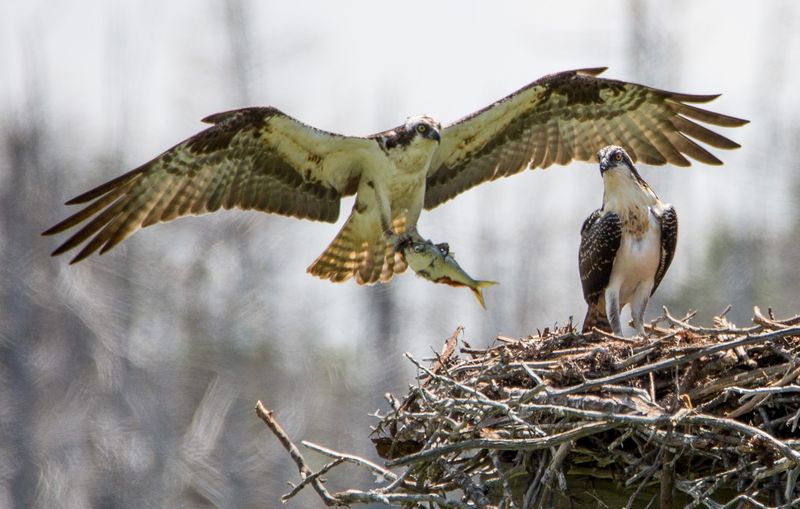
Spring announces itself here with a very large delivery of sticks. Ospreys return to nesting platforms around the park and begin rebuilding their bulky homes, flying back and forth with branches clutched in their talons.
By summer, adults can often be seen fishing over Barnegat Bay while young birds test their wings near the nests. The park’s mixture of salt marsh, forest, coves, and open bay attracts far more than its signature raptors.
Great blue herons stalk the shallows with slow, deliberate steps, while snowy egrets search tidal pools and marsh edges. Belted kingfishers may rattle overhead before dropping toward the water.
Songbirds fill the wooded sections during spring migration, and colder months bring a different collection of ducks and other waterfowl. Patience beats speed when looking for wildlife.
A quiet pause beside a marsh channel is more productive than marching along while carrying on a loud conversation. Watch exposed branches for perched birds, scan osprey platforms before assuming they are empty, and check the waterline for movement.
Even fiddler crabs can turn a patch of mud into miniature rush hour when the tide is right. Diamondback terrapins are among the park’s most distinctive residents.
These brackish-water turtles inhabit coastal marshes and may be seen swimming through channels, basking near the water, or crossing land during nesting season. Drivers should remain especially alert on park roads in late spring and early summer, when female terrapins may leave the marsh in search of sandy nesting ground.
They should not be handled unless they are in immediate danger from traffic, and anyone helping one cross should move it only in the direction it was already traveling. The Cooper Environmental Center adds useful context by displaying live animals native to Ocean County and explaining how the marsh food web fits together.
Wildlife sightings are never guaranteed, which keeps the park from feeling like an outdoor zoo. Some visits produce a close osprey flyover and a heron at the water’s edge.
Others offer only distant calls, ripples in a creek, and the suspicion that something has just disappeared into the reeds.
What to Know Before Visiting This Hidden Toms River Escape
Cattus Island County Park is located at 1170 Cattus Island Boulevard in Toms River. The park generally opens at 7 a.m. each day, while closing time shifts throughout the year based on available daylight.
Posted closing times may range from around 5 p.m. during the darkest part of winter to approximately 8 p.m. in spring and summer. Check the entrance sign before starting a long loop; a peaceful sunset walk becomes less relaxing when your car is waiting behind a closed gate.
The Cooper Environmental Center is generally open during daytime hours, with weekday and weekend schedules that may differ. Admission to both the center and the park is free.
Restrooms are available inside the building, and the accessible boardwalk, picnic areas, playground, and shorter trails make the preserve workable for mixed-age groups. Stronger walkers can connect multiple loops into a half-day outing.
Bring water even though the terrain is easy. Much of the marsh and beach route is exposed to sun and wind, and the longer combinations cover more distance than they initially seem to.
In warm weather, insect repellent is useful. Ticks are present in New Jersey’s wooded and grassy areas, so stay near the center of marked trails, avoid brushing through tall vegetation, and conduct a thorough tick check afterward.
Sunscreen matters too, particularly on open boardwalks and sandy shoreline sections. Dogs must remain leashed, and visitors should follow all posted conservation rules.
Swimming, fires, smoking, and alcoholic beverages are prohibited. Waterproof footwear is helpful after rain, but ordinary walking shoes are sufficient during dry conditions.
A printed map from the kiosk is preferable to improvising once you are deep among the loops. Early mornings bring softer light and more bird activity, while late afternoons make the bay and dead trees especially photogenic.
Winter strips the landscape down to its bones, spring brings returning ospreys, summer fills the marsh with motion, and autumn colors the wooded trails.
The park never requires a beach badge, a boardwalk budget, or a carefully planned itinerary—just enough time to follow the path until suburban Toms River feels surprisingly far away.