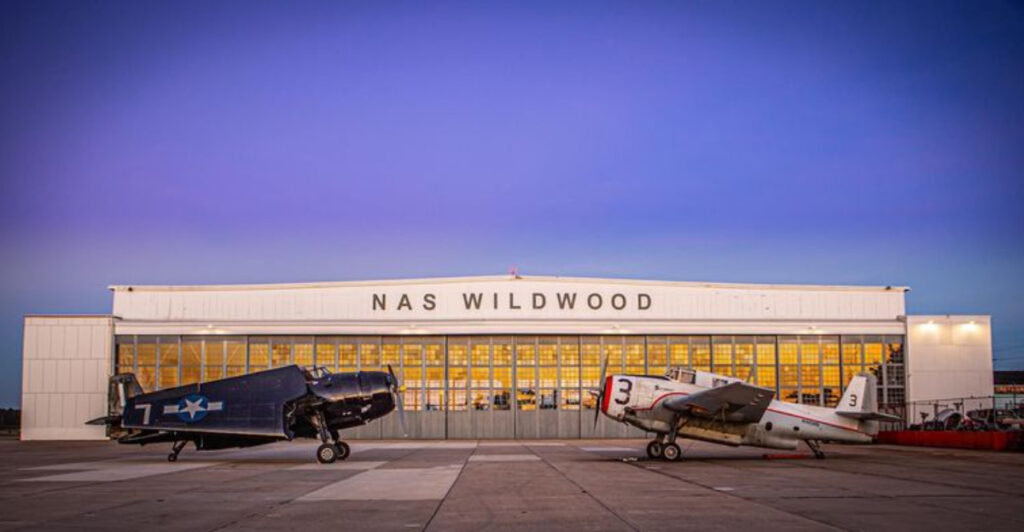
A hulking F-14 Tomcat waits behind the enormous doors of a wooden hangar near Cape May, looking as though it could roll onto the runway at any moment. Around it stand helicopters, propeller planes, military vehicles, exposed engines, and aircraft spanning decades of aviation history.
This is the Naval Air Station Wildwood Aviation Museum, but the building holding the collection is every bit as fascinating as the machines inside. Hangar No. 1 was constructed during World War II and once supported the young naval aviators training for dangerous assignments in the Pacific.
Today, visitors can examine historic aircraft at close range, settle into select cockpits, explore interactive displays, and climb inside a real air traffic control tower.
It is a wonderfully unexpected find near the Jersey Shore, especially for travelers who assume Cape May County’s biggest attractions all involve beaches, boardwalks, or Victorian houses.
A World War II Hangar Hides Near the Cape May Shore
Drive a few miles inland from Cape May’s beachfront, and the scenery changes quickly. Victorian inns and busy Shore roads give way to the open grounds of Cape May Airport in Lower Township.
Sitting at 500 Forrestal Road is Hangar No. 1, a massive wooden structure that has been standing since 1942. Its weathered exterior may look relatively plain from the parking lot, but step through the doors and the scale of the place becomes clear.
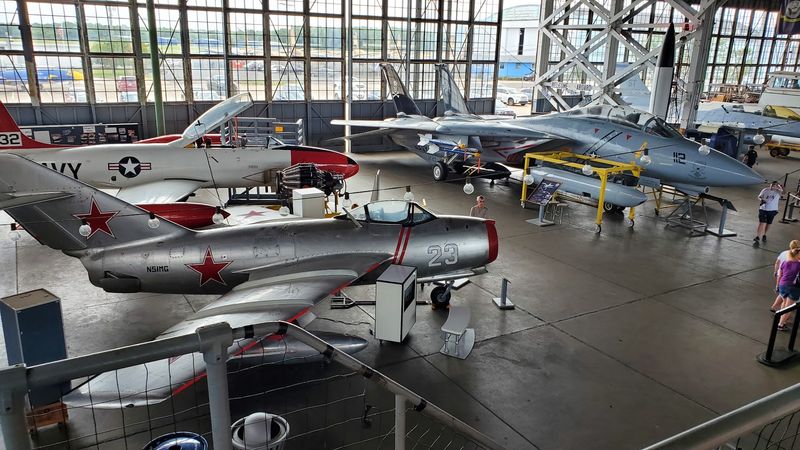
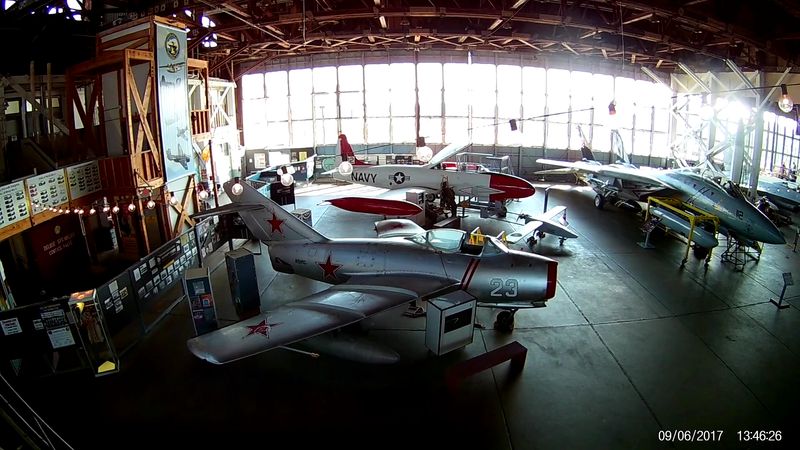
Aircraft are spread across an immense open floor beneath exposed timber trusses, with enough room left over for military vehicles, engines, exhibits, and interactive displays. The U.S.
Navy assembled the double-wide hangar from a kit delivered by railroad during World War II. Built for speed and utility rather than architectural glory, it stretches approximately 290 feet long and 219 feet wide, with a height of 51 feet.
Twelve towering telescoping doors once allowed aircraft to move in and out of its two main bays. It was one of several standardized wooden hangars constructed for the Navy, but most of those buildings have disappeared or been dramatically altered.
Hangar No. 1 is now listed on both the New Jersey and National Registers of Historic Places. It is the only intact building remaining from the original wartime construction campaign at Naval Air Station Wildwood, making it much more than a convenient roof over the museum’s collection.
The hangar is one of the primary exhibits. Its survival was never guaranteed.
After years of commercial use and eventual neglect, Dr. Joseph Salvatore and his wife, Patricia Anne, acquired the building from Cape May County for $1 in the 1990s. The NAS Wildwood Foundation then began the long process of restoring it.
When the museum opened in 1997, a nearly forgotten wartime structure gained an entirely new purpose without losing the character that makes it remarkable.
Naval Pilots Once Trained Here for Battles in the Pacific
Imagine the sound around this airfield in October 1944, when nearly 17,000 takeoffs and landings occurred in a single month.
Engines roared from morning into the night, ground crews hustled between aircraft, and young pilots repeatedly practiced the maneuvers they would soon have to perform under far more dangerous conditions.
At its busiest, the station accommodated as many as 200 aircraft and became one of the Navy’s key training centers for fighter and dive-bomber squadrons. Naval Air Station Wildwood was commissioned on April 1, 1943.
For much of the war, its main responsibility was preparing dive-bomber crews for service in the Pacific Theater. Pilots trained in aircraft such as the Douglas SBD Dauntless, Curtiss SB2C Helldiver, and Vought F4U Corsair.
Practice targets were positioned in Delaware Bay and along the Atlantic coast, allowing crews to sharpen their bombing skills before joining carrier air groups overseas. Landing practice was especially demanding.
Naval aviators needed to place an aircraft onto the short, moving deck of an aircraft carrier, often in poor weather and with little room for correction. Training fields gave pilots a chance to rehearse approaches and touch-and-go landings, including exercises at night.
Mistakes could be deadly even before anyone reached combat. Between 1943 and 1945, 129 crashes occurred during training connected to NAS Wildwood.
Forty-two aviators lost their lives. The museum preserves that part of the station’s story rather than presenting the war years as a simple parade of impressive machines.
Photographs, uniforms, equipment, and personal artifacts put individual faces behind the statistics and explain why the station mattered. That human story gives the museum its emotional weight.
Visitors can admire the ingenuity behind a fighter plane while also understanding what was being asked of the people who flew it. The hangar ultimately serves as a memorial to those 42 aviators, ensuring that the dangers they faced over South Jersey are not reduced to a footnote.
More Than 20 Historic Aircraft Fill the Enormous Space
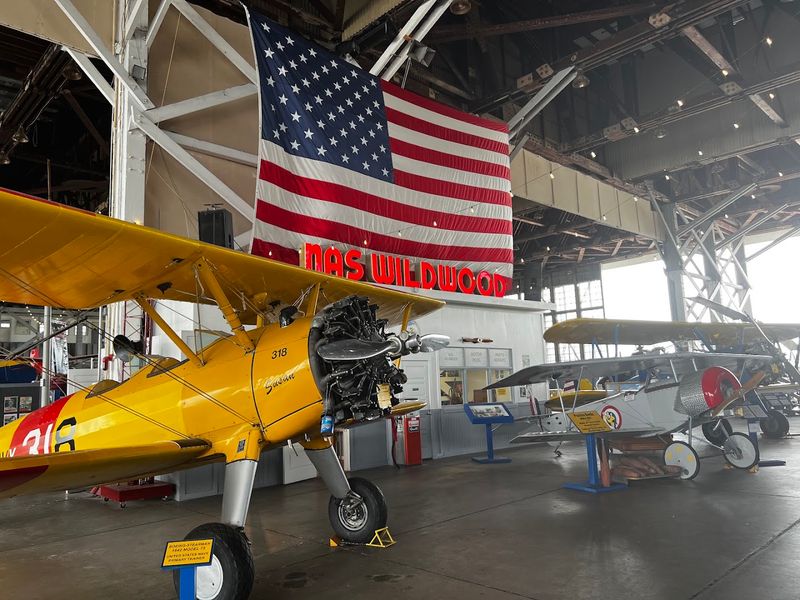
The collection jumps across eras rather than staying locked in World War II. Propeller-driven trainers share the floor with Cold War jets, helicopters, experimental designs, and aircraft that remained in service into the modern age.
The museum’s collection includes more than 25 historic airplanes, jets, and helicopters, so there is plenty to examine even if you cannot tell an aileron from an altimeter.
Among the most important World War II aircraft is a TBM-3E Avenger, a rugged torpedo bomber developed by Grumman and built in huge numbers by General Motors.
Its folded wings provide a useful reminder that naval aircraft had to fit into the limited storage space aboard carriers. Nearby, the F6F-3 Hellcat represents one of the most successful American carrier fighters of the war.
Its blunt, powerful appearance stands in sharp contrast to the sleeker jets that followed. The jet collection traces the rapid technological changes that reshaped aviation after 1945.
Visitors may encounter aircraft such as the T-33 Shooting Star, MiG-15, A-4 Skyhawk, A-7 Corsair II, F-5 Tiger II, F-16 Fighting Falcon, and F-14 Tomcat. Seeing so many designs together makes it easy to notice how wings, engines, cockpits, and intended missions evolved across the decades.
Rotorcraft bring another layer to the collection. The Bell UH-1 Iroquois, better known as the Huey, is instantly associated with the Vietnam era.
A bright orange HH-52A Seaguard reflects the lifesaving work of the U.S. Coast Guard, while smaller helicopters and gyrocopters show some of the more unusual directions aviation engineers explored.
Complete aircraft are only part of the story. Exposed piston and jet engines let visitors look beneath the outer skin and appreciate the complicated machinery required to leave the ground.
Military vehicles, boats, uniforms, radios, photographs, and support equipment fill the spaces between the planes, creating a fuller picture of aviation history than a lineup of polished aircraft alone could provide.
The F-14 Tomcat Is an Undeniable Showstopper
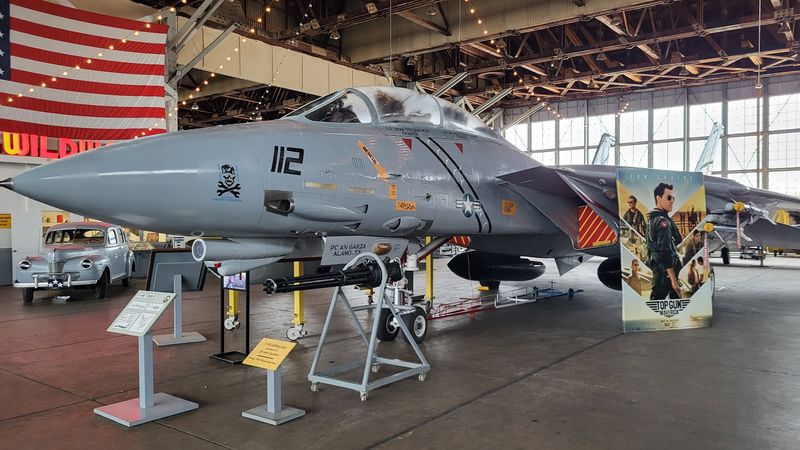
Some aircraft command attention before you know anything about them, and the Grumman F-14 Tomcat is firmly in that category. Its wide stance, twin tails, and enormous variable-sweep wings give it a presence that photographs struggle to capture.
On a screen, it looks fast. From a few feet away, it looks almost impossibly large. The F-14 first flew in 1970 and entered U.S. Navy service in 1974.
It was designed as a fleet-defense fighter capable of intercepting enemy aircraft at long range while also holding its own in close combat.
Its wings could extend for lower-speed flight and sweep backward at higher speeds, creating the unmistakable silhouette that made the Tomcat one of the most recognizable military jets ever built.
Two crew members occupied the cockpit. The pilot sat in front, while the radar intercept officer worked from the rear seat, managing the aircraft’s powerful radar and weapons systems.
The Tomcat could carry the long-range AIM-54 Phoenix missile, allowing it to engage multiple threats at distances that were extraordinary for the era. Later versions also took on precision strike and reconnaissance duties, proving that the aircraft could adapt well beyond its original mission.
Popular culture made the F-14 a celebrity, but standing beside one strips away some of the Hollywood gloss. The landing gear is heavy and complicated because it had to absorb repeated carrier landings.
The twin engines dominate the rear of the aircraft. Every surface reflects the practical demands of operating from a ship, where salt water, tight quarters, and punishing landings were part of normal life.
The Tomcat was retired from U.S. Navy service in 2006, ending more than three decades of carrier operations.
At NAS Wildwood, it remains a natural gathering point. Children recognize it as the coolest plane in the room, aviation enthusiasts study its details, and nearly everyone pauses for a photograph. Even surrounded by more than 20 other aircraft, the F-14 has no trouble stealing the scene.
Hands-On Exhibits Bring Aviation History to Life
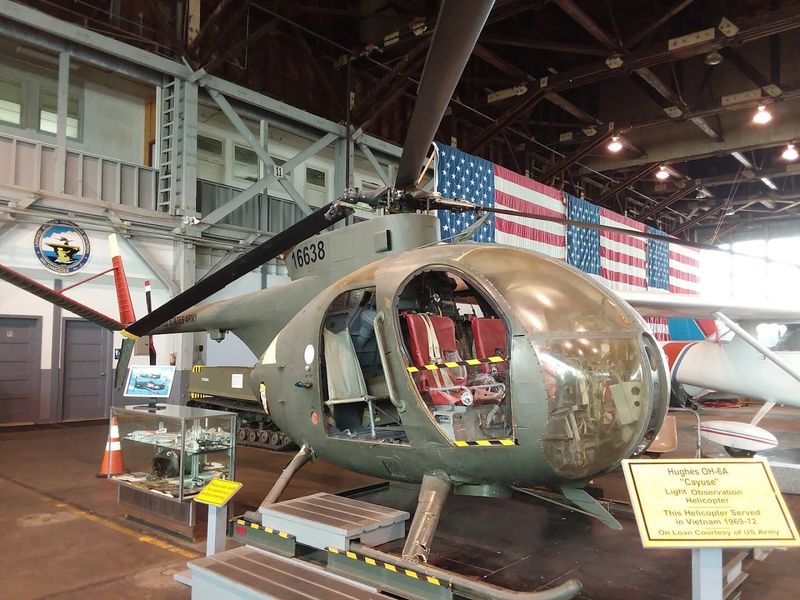
“No touching” is not the guiding philosophy everywhere inside this museum. While some aircraft and artifacts naturally need to remain protected, select displays invite visitors to climb aboard, sit behind controls, and discover just how cramped a working cockpit can be.
That physical access makes the experience especially good for families, because children are allowed to do more than shuffle past signs and peer over ropes. Selected airplanes, helicopters, and military vehicles are open for exploration.
A child can settle into a cockpit, wrap both hands around the controls, and immediately start imagining a mission. Adults tend to have the same reaction, although they may be slightly less willing to admit it.
Jeeps and other vehicles add variety for anyone whose interests lean more toward engines and wheels than wings. One of the most memorable features is a genuine air traffic control tower that visitors can climb.
From the top, the hangar floor looks completely different. Aircraft that seemed enormous at ground level become part of a sprawling mechanical landscape, and the elevated view helps convey just how much equipment fits inside the building.
Radio-related elements add another playful connection to the people who coordinated activity on a busy military airfield. Interactive STEM displays explain the science of flight without turning the museum into a classroom assignment.
Engines are opened for inspection, mechanical components are displayed where visitors can study them, and cockpit instruments reveal how much information pilots once had to process without modern digital screens.
A recreated 1940s room, period photographs, wartime memorabilia, and radio displays bring attention back to the daily lives surrounding the aircraft.
Even the introductory film offers a clever touch. Visitors can watch it while sitting in actual airplane seats, learning how the hangar arrived by rail as a kit and how the neglected building became a museum.
Exhibits change as new artifacts arrive or restoration work progresses, but the underlying appeal stays the same. This is aviation history experienced at arm’s length rather than from behind a distant glass case.
Plan a Visit to This Overlooked Cape May County Museum
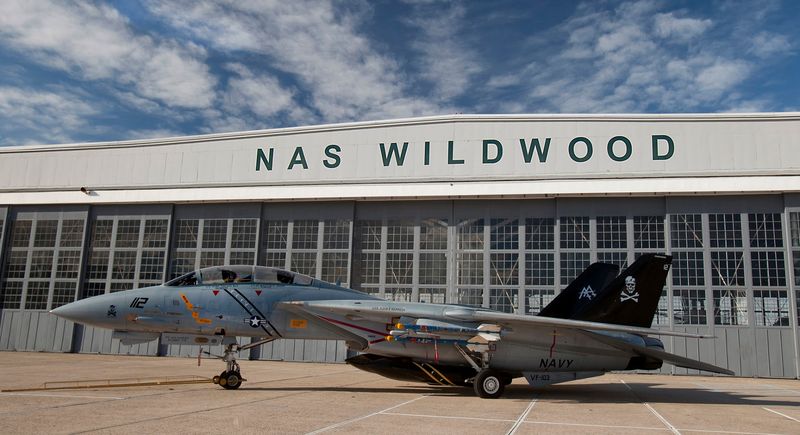
A beach forecast full of clouds can work nicely in your favor here. The Naval Air Station Wildwood Aviation Museum is about a 15-minute drive from downtown Cape May and roughly 20 minutes from the Wildwood Boardwalk, making it an easy addition to a Shore trip without consuming the entire day.
Free parking is available at the museum, and visits are self-guided, so no one has to race through the F-14 display to keep up with a tour group. The museum is located at 500 Forrestal Road in Cape May, within the Cape May Airport complex in Lower Township.
From March through December, it is open daily from 10 a.m. to 4 p.m. During January and February, it operates Monday through Friday from 10 a.m. to 4 p.m. and closes on weekends.
Holiday closures apply, so checking the schedule before a long drive is sensible. General admission is $16 for adults and $12 for children ages 3 through 12.
Children younger than 3 and active-duty U.S. military members are admitted free. Veterans receive a $2 discount, and tickets can be purchased inside the museum gift shop.
The building is wheelchair-accessible, leashed dogs are welcome, and the collection can be explored at an unhurried pace. One practical detail matters more than it might seem: Hangar No. 1 is not climate controlled.
The open wooden structure can be hot in summer and chilly during the colder months, so clothing should match the outdoor temperature. That lack of polished indoor comfort is part of the experience, though.
Visitors are standing in an authentic 1942 military hangar, not a modern building designed to imitate one. The setting also makes it possible to build a full Cape May County day around the visit.
Beaches, restaurants, wineries, and historic Cape May are all nearby, yet the museum feels removed from the usual Shore routine. Inside those towering doors, the boardwalk fades away and New Jersey’s wartime aviation history takes over.