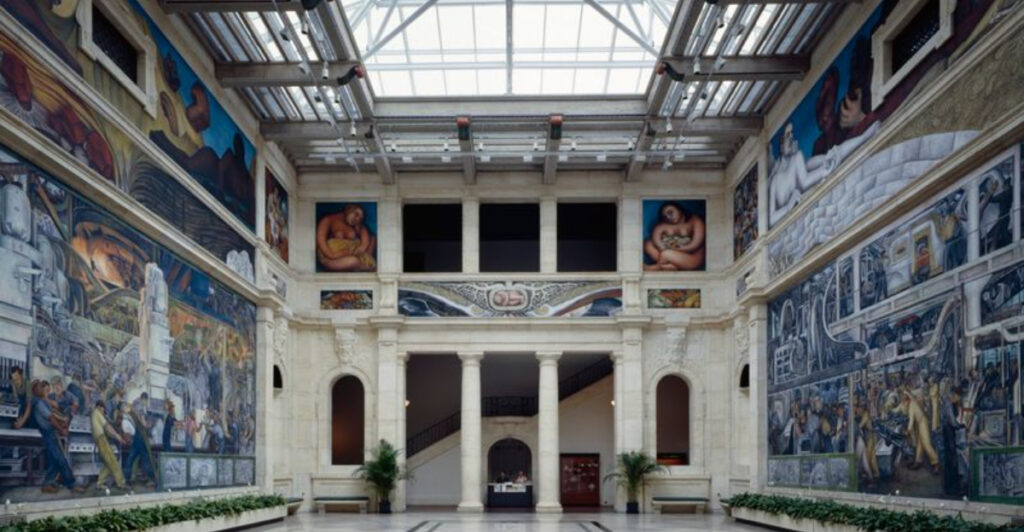
Few Detroit landmarks make the city’s industrial story feel as immediate as these walls. Inside the Detroit Institute of Arts, Diego Rivera’s Detroit Industry Murals turn factory work, machinery, human effort, and raw materials into a sweeping visual tribute to the people who helped build the city.
The scale alone is powerful, but the details are what make the mural court unforgettable: workers in motion, machines with real force, and a rhythm that makes industry feel almost alive. For anyone trying to understand Detroit beyond the skyline, this Michigan masterpiece lets the city’s past speak in color, motion, and unmistakable detail.
A Room Where Factories Rise Up the Walls
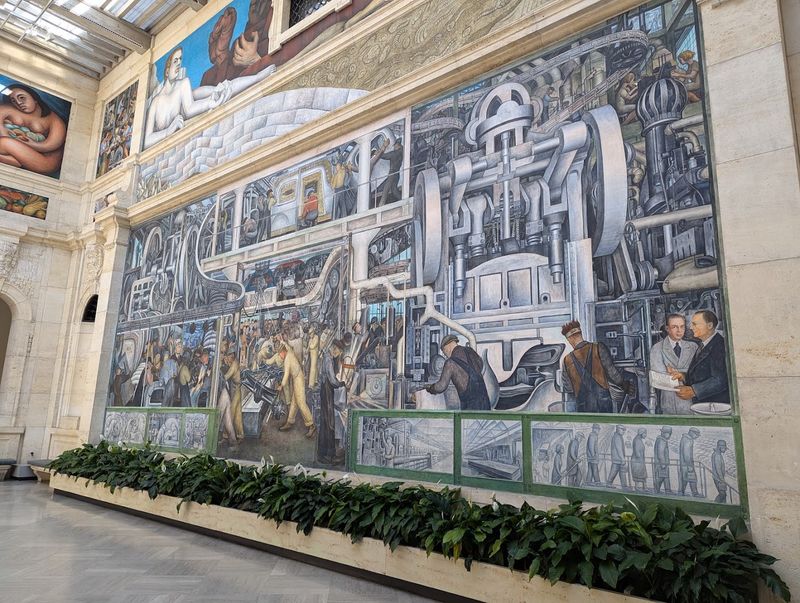
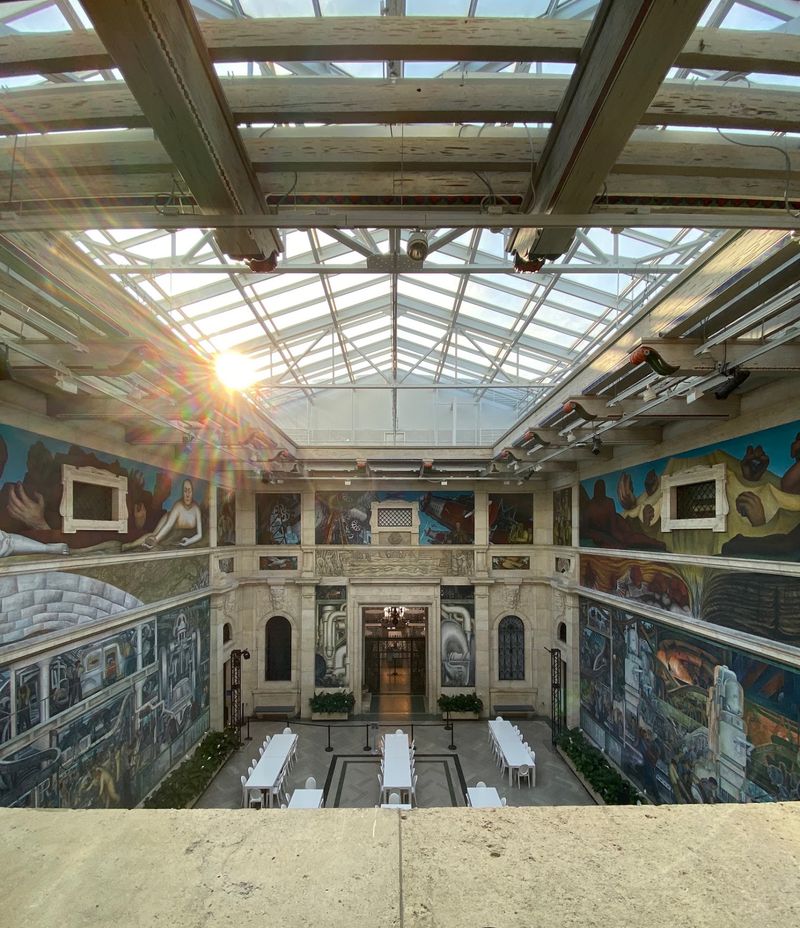
Walking into Rivera Court is a little like stepping inside a machine that learned how to tell stories. The murals do not sit quietly in frames.
They climb across the walls from floor to ceiling, wrapping the room in busy scenes of men, tools, engines, smoke, steel, and motion.
The first surprise is scale. Photographs can show the colors and shapes, but they flatten the experience.
In person, the painted workers look powerful, the factory equipment seems to rumble, and every wall pushes the eye toward another scene packed with action.
Rivera designed the court so the room itself becomes part of the artwork. Instead of one main picture, there is a full environment.
Turning your head changes the story, because each wall connects to the next and keeps the industrial rhythm moving around you.
That size matters for a simple reason. Detroit was a city built by large ideas, large plants, and large workforces, so a small painting would never have captured that energy.
The murals match the scale of the subject, which helps the city’s manufacturing history feel immediate instead of distant.
Young visitors often notice the bold colors first, while older viewers may focus on the machines or the workers’ faces. Both reactions make sense.
Rivera balanced giant forms with close details, so the murals can be read from across the room or studied inch by inch.
If time is short, do not rush through the space as if it were a hallway between galleries. Stand in the center for a minute before moving closer.
That pause lets the whole room settle into view, and it becomes easier to understand why these walls are not just decoration. They are one of Detroit’s clearest visual records of labor, industry, and ambition.
Muscle, Steel, and Motion in Every Direction
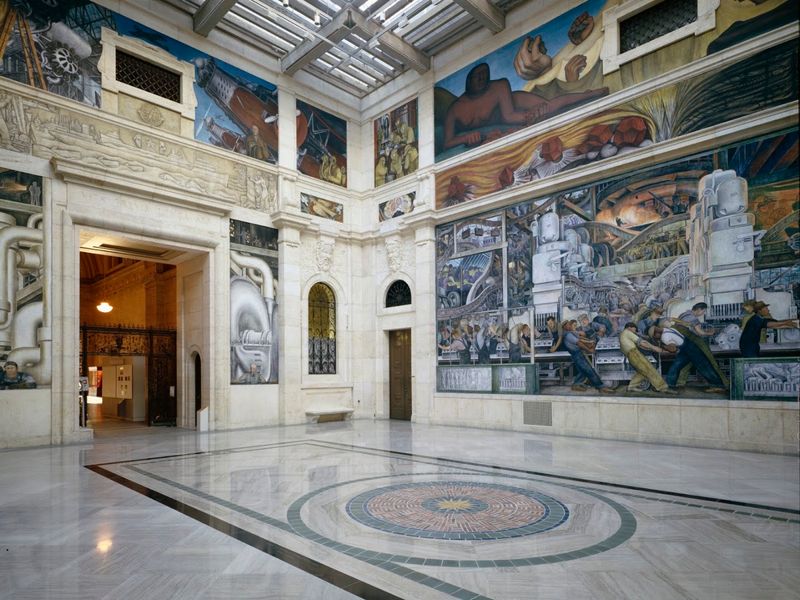
At first glance, the murals seem crowded, but the chaos quickly starts to make sense. Rivera painted industry as a giant moving system, where human hands, raw materials, and machines all depend on one another.
The walls are full of action, yet the action has structure.
Look closely and the workers are never just background figures. Arms lift, bend, guide, and control.
Bodies lean into hard tasks. Rivera gives physical labor a heroic presence, not by making it fancy, but by showing how much strength, focus, and timing it takes to keep an industrial world running.
Machines receive the same careful attention. Pipes curve across the scenes, metal parts interlock, and belts and engines push the eye through the composition.
Nothing appears random. Even a viewer who has never stepped inside a factory can see how production depends on repetition, coordination, and precision.
One reason the murals stay so gripping is the push and pull between person and machine. Rivera does not paint workers as tiny dots lost in metal.
He also does not pretend the machines are harmless props. Both are powerful.
Both shape the scene. That tension gives the murals their energy.
Kids may compare the images to giant comic-book panels, while adults often connect them to Detroit’s car-making history. Either way, the visual message lands clearly.
Industry is not shown as an abstract idea. It is a chain of hard jobs performed by real bodies in real spaces.
A good way to experience this section of the court is to pick one worker and follow the nearby tools, belts, or parts across the wall. Doing that turns the painting into a process map.
Suddenly, the mural stops being just a dramatic artwork and starts reading like a visual explanation of how modern manufacturing worked in Detroit at its peak.
Detroit, Michigan in Paint, Not Postcard Form
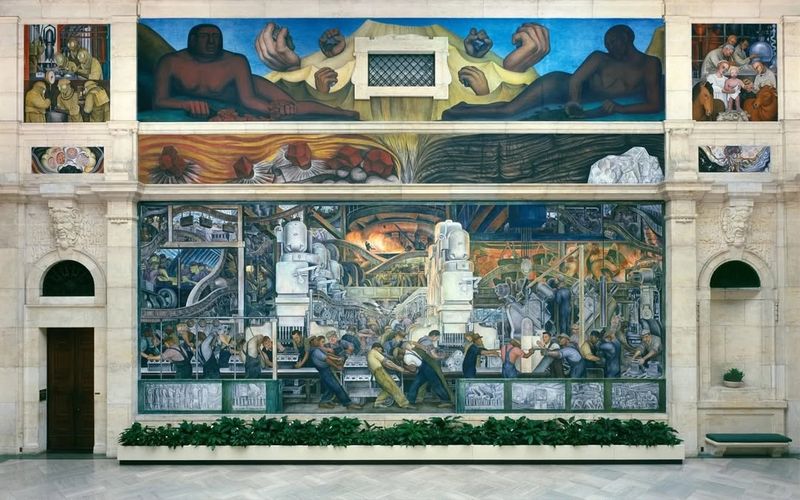
Some city art aims for pretty views, famous buildings, or skyline pride. Rivera took a different route.
He painted Detroit through its industrial backbone, showing the labor, systems, and materials that powered the city instead of offering a neat postcard version.
That choice gives the murals unusual honesty. There are no attempts to hide the grit of production.
Heat, pressure, crowded equipment, and repetitive work all appear as part of the story. Detroit comes across as a place made through effort, engineering, and constant motion.
The result is deeply local. Even without reading a label, the scenes connect to the city’s manufacturing identity.
Auto production, metalworking, and large-scale industrial labor shaped Detroit’s growth, and Rivera translates that history into images that are easy to read from a distance yet rich enough to study for a long time.
Another striking point is how the murals link the city to the natural world. Raw materials enter the process, are transformed by labor and machinery, and emerge as finished products.
Rivera does not isolate industry from the world around it. He shows production as part of a bigger chain, from resources to human skill to modern technology.
For readers used to hearing Detroit discussed only through rise or decline, the murals offer a fuller picture. They remind viewers that the city’s identity was built by workers, planners, inventors, and factory systems operating at a massive scale.
That broad view gives the murals lasting power.
When visiting, it helps to think of the court as a portrait of a city rather than a single event. A portrait can include pride, strain, complexity, and contradiction all at once.
Rivera understood that. He painted Detroit as active, complicated, and productive, which is far more interesting than a simple booster image hanging quietly on a museum wall.
The Human Story Behind the Fresco
Big machines grab attention fast, but the human story keeps the murals alive. Rivera filled the court with workers whose bodies carry the strain of production.
Hands grip tools, shoulders hunch forward, and faces stay focused on the task in front of them. Labor is not decorative here.
It is central.
That emphasis makes the murals more than a celebration of industry. They also act as a record of who made industrial success possible.
The paintings push viewers to notice skill, repetition, teamwork, and the physical cost of making complex products on a factory floor.
Rivera was known for creating public art that connected everyday people to larger social and historical themes. In Detroit, that approach fit the subject perfectly.
A city powered by manufacturing could not be explained honestly without placing workers at the center of the image.
There is also a quiet lesson in how the figures are arranged. Nobody stands alone for long.
People work in groups, lines, and linked motions. One task leads to another, and each worker becomes part of a broader industrial chain.
That visual structure turns labor into a shared effort rather than a string of isolated jobs.
For students, the murals offer a clear way to talk about history without getting lost in dates. They show that economic growth depends on people as much as machinery.
For adults, they raise enduring questions about work, value, and how cities define progress.
A thoughtful visit includes spending a few minutes on the faces, not just the giant forms. Expressions are often calm, concentrated, or tired rather than dramatic.
Rivera trusted posture and placement more than theatrical emotion. That choice makes the workers read as capable professionals doing demanding jobs, which gives the murals much of their dignity and force inside the museum’s grand setting.
Small Details That Change the Whole Experience
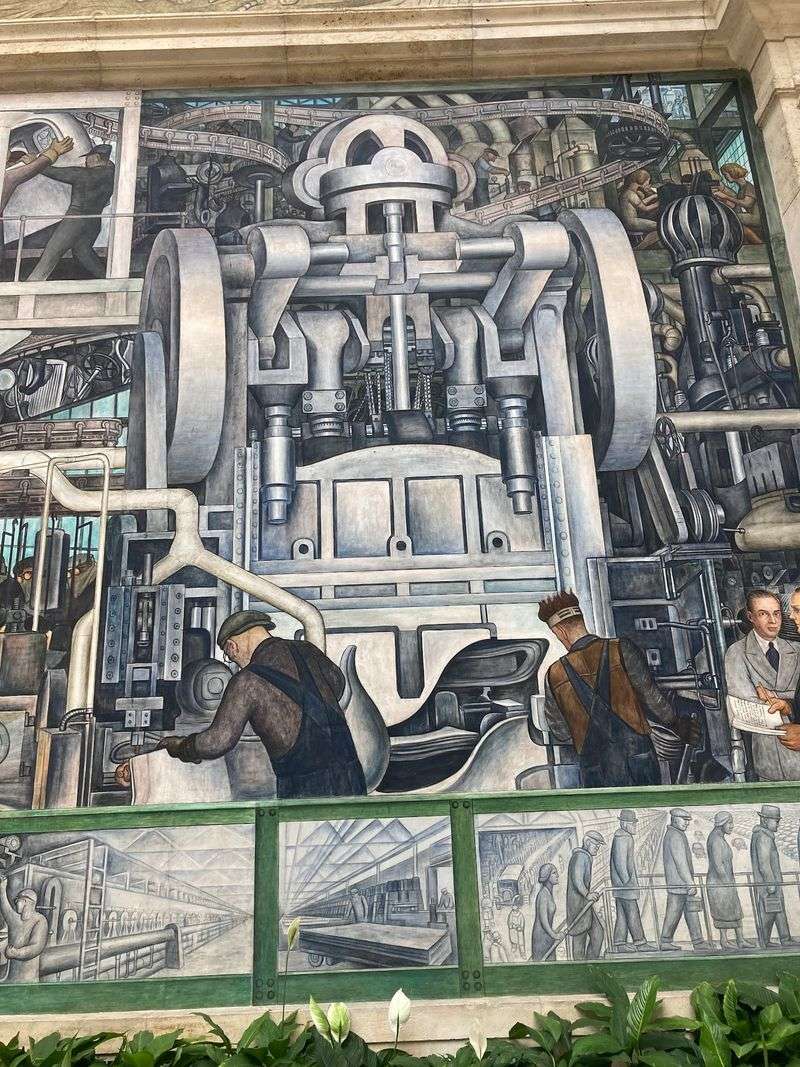
Standing back gives the murals their power, but moving in closer reveals their cleverness. Tiny details shift the experience from impressive to fascinating.
A hand on a tool, a pipe bending through the scene, or the arrangement of parts on a production line can suddenly explain how carefully Rivera built the entire court.
One of the best surprises is how readable the fresco remains at different distances. From far away, the murals deliver big shapes and bold movement.
Up close, those giant scenes break into smaller visual clues that guide the eye through processes, relationships, and repeated actions.
Color plays a major role here. Rivera uses earthy tones, cool metal shades, and stronger accents to separate bodies, equipment, and background spaces.
That color planning helps crowded areas stay understandable instead of turning into visual noise.
There is also rhythm in the way forms repeat. Curved pipes echo arms and backs.
Rows of parts mirror rows of workers. Mechanical order and human movement bounce off each other across the walls.
Once noticed, that rhythm makes the murals seem even more alive.
Families and first-time museum visitors often enjoy this stage most because it turns looking into a game of discovery. Spotting one small feature leads to another.
A viewer may begin with a machine and end up studying a face, then drift to a nearby section that connects the whole process together.
Practical advice helps here. Give the murals two rounds.
First, take in the room from the center. Second, walk the edges slowly and choose a few sections for close study.
That simple change in pace creates a much richer visit than snapping one wide photo and moving on. Rivera packed the walls with meaning, and many of the smartest choices only appear when the eyes slow down enough to notice the smaller parts holding the giant story together.
How to See Rivera Court Without Rushing Past It
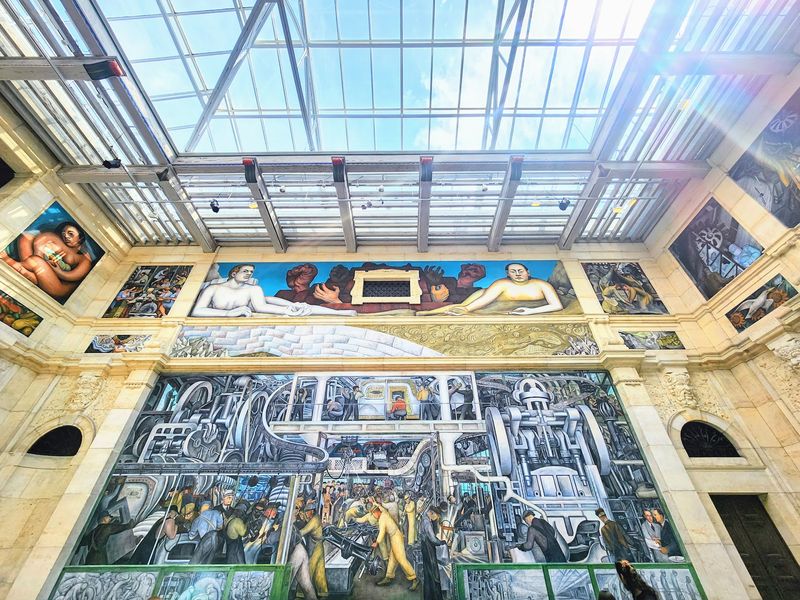
Plenty of museum spaces reward a quick walk-through. Rivera Court is not one of them.
The murals need time because they are built like a visual conversation. The room speaks in large statements first, then follows up with smaller clues, hidden links, and repeating patterns.
A smart visit begins in the middle of the court. That spot gives a balanced view of the surrounding walls and lets the whole cycle register at once.
Starting too close can make the experience feel fragmented, as if the murals are only separate scenes instead of one connected statement about labor and industry.
After that first look, circle the room slowly. Choose one wall, then another, and notice how Rivera shifts the mood and density from section to section.
Some areas feel packed and mechanical, while others allow more breathing room. Those pacing changes help control how the eye moves through the narrative.
If visiting with kids or anyone new to large murals, try a simple challenge. Pick out workers, tools, colors, and repeated shapes, then compare how they appear across different walls.
That turns the room into an active search instead of a passive stop, and it helps younger viewers stay curious.
Timing matters too. The Detroit Institute of Arts is a large museum, and Rivera Court can get attention from nearly everyone passing through.
Arriving with at least a few uninterrupted minutes makes a huge difference. Twenty minutes is a solid baseline.
Longer is better if the schedule allows.
Another useful tip is to avoid treating the murals as a bonus feature after racing through other galleries. They are a centerpiece.
Build the visit around them. A slower approach reveals how Rivera used the entire room to tell Detroit’s industrial story with scale, structure, and human presence.
Once the court has been given real attention, the rest of the museum often reads differently too, because the murals sharpen the way viewers notice labor, history, and craft in other works nearby.
Why the Murals Still Matter in Detroit Today
Nearly a century after they were painted, the Detroit Industry Murals still speak clearly. That is not because factories look exactly the same today.
It is because the murals ask lasting questions about work, technology, pride, and the people inside large economic systems.
Modern viewers can read them in several ways at once. They are historical documents tied to Detroit’s manufacturing power.
They are major works of public art by Diego Rivera. They are also a visual reminder that progress is never just about products.
It is also about workers, materials, knowledge, and social values.
The murals stand out because they avoid easy answers. Industry appears productive and impressive, but also intense and demanding.
Human skill looks essential, yet machinery dominates much of the space. That complexity keeps the room relevant.
New generations can step in and connect the imagery to current conversations about labor, automation, and who benefits from technological change.
There is local meaning here as well. Detroit is often discussed in headlines through extremes, either celebrated for resilience or reduced to decline.
Rivera’s murals cut through that oversimplified frame. They present the city as a place of making, building, organizing, and striving, which gives a stronger foundation for understanding its past and present.
For travelers, the murals offer something rare. They are not interchangeable with famous artworks in any other city.
The subject, the setting, and the scale are deeply tied to Detroit. Seeing them at the Detroit Institute of Arts connects art history to place in a direct and memorable way.
Leave the court with one final thought. These walls do not just preserve an old industrial chapter.
They keep that chapter active by inviting each new visitor to look harder at the relationship between human effort and modern life. That ongoing conversation is exactly why the murals remain one of Michigan’s most important works of art.
Share this story