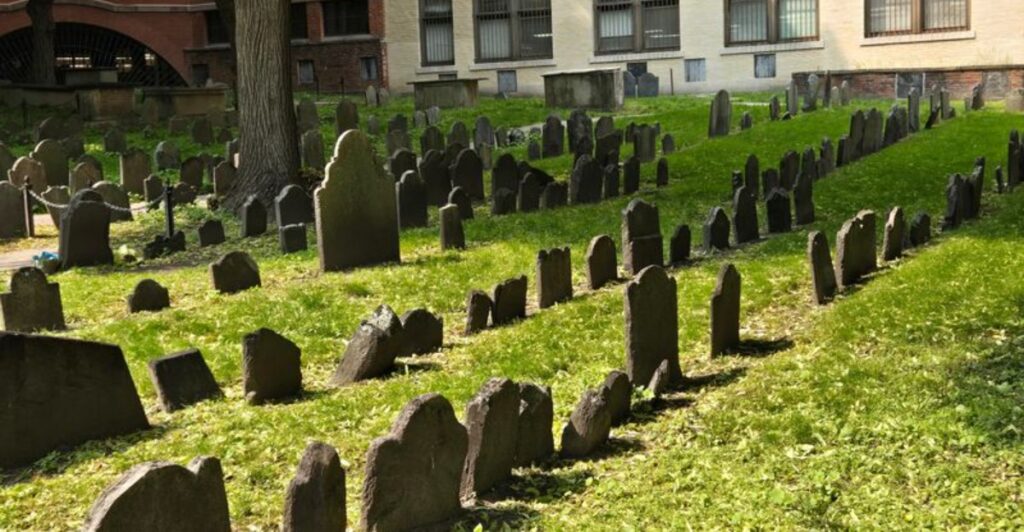
Along busy Tremont Street, a stone gateway opens onto one of Boston’s best-known historic burial grounds. Paul Revere, Samuel Adams, and John Hancock rest here, surrounded by weathered markers and stories that reach back before the American Revolution.
Granary Burying Ground is a popular Freedom Trail photo stop, though no verified ranking proves it is the most photographed. Step inside, and the famous names are only the beginning.
A Stone Gateway Between Traffic and Three Centuries
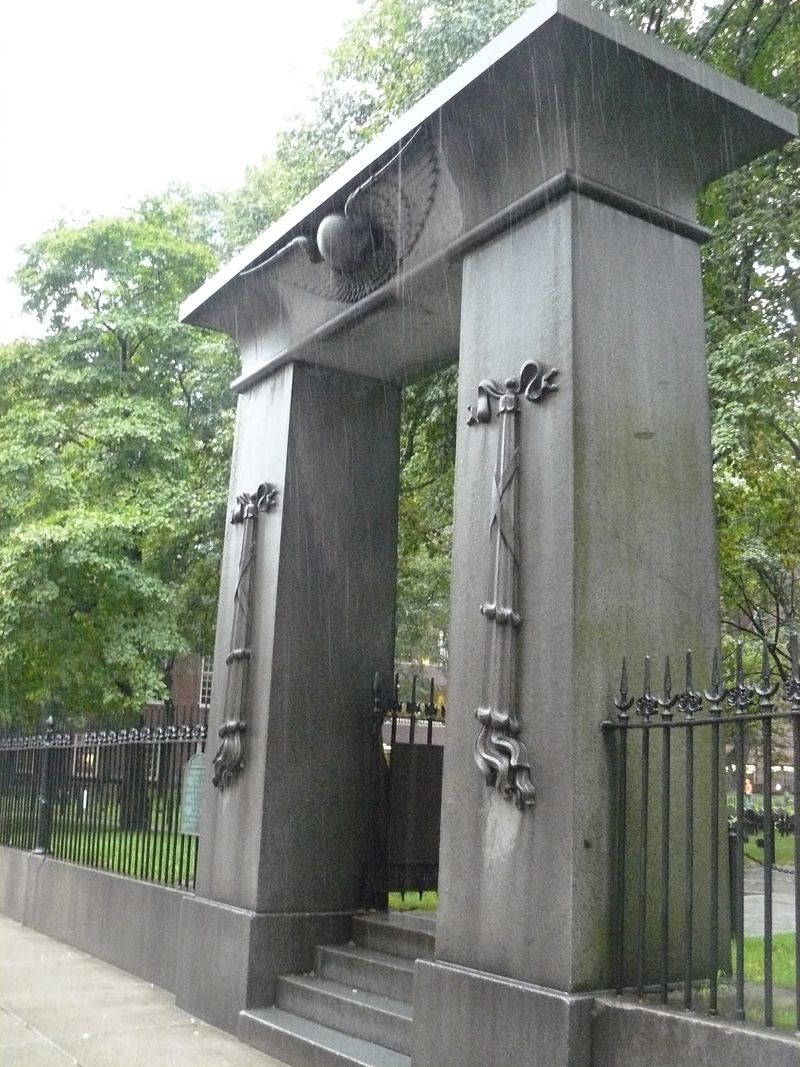
Traffic rolls past the fence while rows of old gravestones stand just beyond it. That close meeting of everyday Boston and colonial history gives Granary Burying Ground its strongest first impression, without needing a guide to explain the scene.
The cemetery was established in 1660, making it Boston’s third oldest burying ground. Its name comes from a nearby grain storage building that once served the town, not from anything grown among the graves.
Look at the entrance before heading inside. The granite gateway, added in 1840 and designed by architect Isaiah Rogers, uses an Egyptian Revival style that looks very different from the thin colonial stones behind it.
That difference is useful: the burial ground is not a single frozen moment. Its markers, monuments, paths, and entrance reflect changes made over centuries as Boston grew around this small patch of land.
From the sidewalk, you can frame the gate with the cemetery beyond it. Once inside, turn back briefly to see how closely the street presses against the boundary, with modern movement still visible through the ironwork.
Keep the title’s promise in perspective, too. The famous patriots are buried beneath the ground, but this is not an underground attraction, and there are no public passages leading down to their graves.
You explore at ground level, reading markers and following paths. The contrast comes from knowing that people linked to the nation’s founding rest under a site bordered by an active city street.
Before moving toward the famous monuments, give your eyes a minute to adjust to the smaller details. Uneven stone tops, patches of lichen, and the spacing between markers tell you that this place rewards a slower look than its busy address might suggest.
Start with the wide view, then narrow your attention to one stone beside the path.
Revere, Adams, and Hancock Share a Massachusetts Address
Three names can turn a casual walk into a history lesson: Paul Revere, Samuel Adams, and John Hancock. All are buried here, but their stories extend well beyond the short labels most people remember from school.
Revere was a skilled silversmith as well as the rider tied to the warning of April 1775. His grave area includes an old marker and a later memorial, so do not assume every visible stone dates from his lifetime.
Samuel Adams helped organize resistance to British rule and later became governor of Massachusetts. Finding his burial place connects political speeches and public protests to a real person who lived and worked in Boston.
Hancock’s tall monument is easier to spot than many surrounding markers. The wealthy merchant and patriot became famous for his bold signature on the Declaration of Independence, but he also served as president of the Continental Congress and governor.
Use the posted information to locate each site rather than following the largest crowd. Tour groups can gather around one grave while another nearby remains easy to approach and read.
At each stop, compare the size and age of the memorial with the person it honors. A grand monument may reflect later efforts to celebrate a historical figure, rather than the appearance of the original burial place.
That distinction keeps the visit interesting instead of turning it into a quick hunt for recognizable names. You are seeing both the patriots’ resting places and the ways later generations chose to remember them.
Give others room to read and take photographs, especially where the paths narrow. Never step across graves to get a closer angle, even if a marker looks only a few feet away.
Before leaving this part of the grounds, choose one fact beyond each person’s famous headline. Those details make the names much easier to separate.
The Boston Massacre Memorial Changes the Story
A shared memorial shifts attention away from celebrated leaders and toward people killed in a street confrontation. The victims of the Boston Massacre are buried at Granary, placing a turning point of the Revolution beside the graves of its better-known organizers.
On March 5, 1770, British soldiers fired into a crowd in Boston. Five people died from the shooting or their wounds: Crispus Attucks, Samuel Gray, James Caldwell, Samuel Maverick, and Patrick Carr.
Attucks, who had African and Indigenous ancestry, became a powerful symbol in later accounts of the struggle for liberty. His presence here also opens a wider conversation about whose contributions receive attention in the nation’s founding story.
The event happened years before the Declaration of Independence. Standing at the memorial helps you follow the growing conflict as a series of human losses and political choices, rather than one sudden break with Britain.
Read all five names if the inscription is clear enough. Giving each person a moment prevents the group from becoming just another familiar phrase on a school timeline.
The burial marker also commemorates Christopher Seider, a boy killed shortly before the massacre. His death heightened tensions in Boston, showing how closely linked these events were in the weeks before the shooting.
For families, this stop needs a gentler pace than a race between famous graves. Explain that the memorial honors people who died during public unrest, then let children ask questions without turning the setting into a dramatic performance.
A guide can help unpack the competing accounts and political messages that followed the violence. Even without one, the marker provides a clear reason to look beyond the best-known patriot names.
Leave space around anyone reading quietly. This corner of the burial ground is best approached as a shared grave and memorial first, and a photograph opportunity only after that.
Winged Skulls Turn the Stones Into a Picture Book
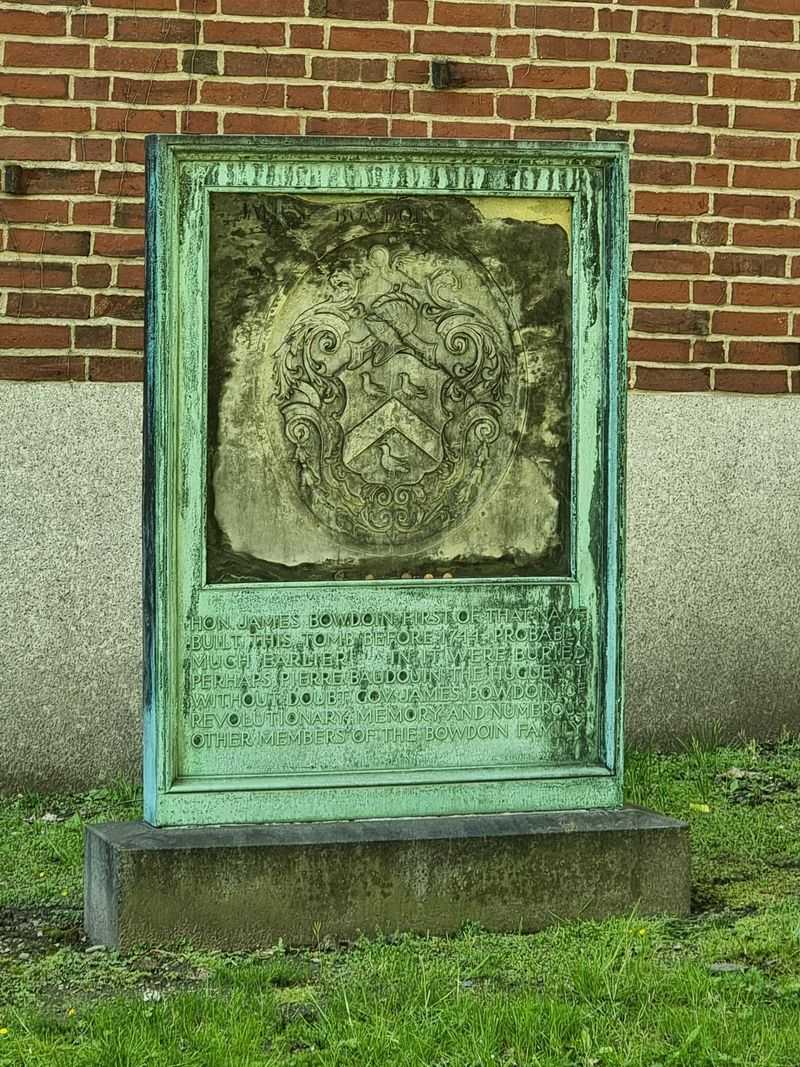
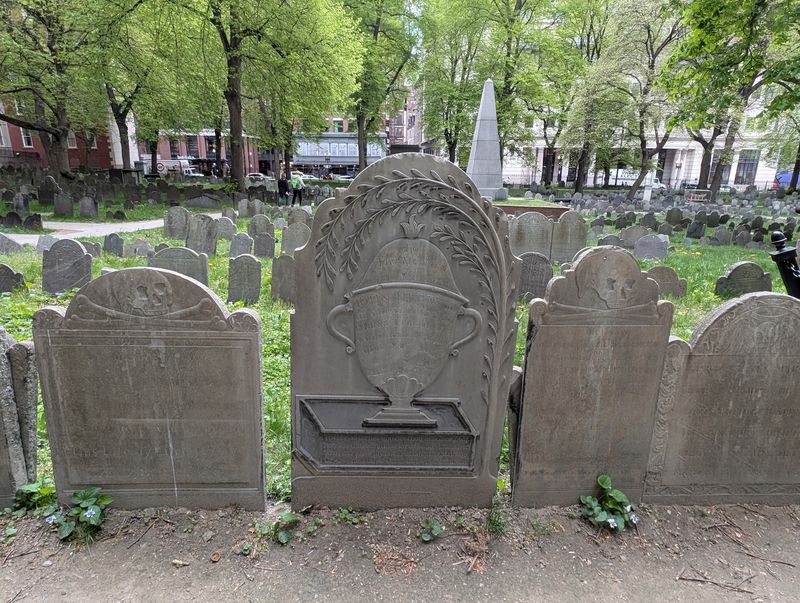
Look above the lettering, and a tiny carved face may be staring back at you. Granary’s older gravestones carry symbols that once helped people think about death, faith, and what might follow a human life.
Winged skulls, often called death’s heads, appear on colonial markers. They can look startling today, but they served as reminders of mortality rather than decorations meant to frighten passersby.
Other stones show winged faces, sometimes described as soul effigies or cherubs. Later designs may include urns and willow branches, reflecting shifts in taste and in the ways families expressed grief.
You do not need to identify every carving to enjoy the details. Pick two stones visible from the same path and compare their shapes, borders, lettering, and central images.
One may have a narrow rounded top and tightly packed words. Another may carry a broad carved border, with a face that looks almost cheerful despite the solemn purpose of the stone.
These differences reveal the work of individual stonecutters as well as changing styles. The cemetery becomes a record of local craft, not merely a collection of names and dates.
Light can make the carvings easier or harder to read. If an inscription disappears in bright glare, try viewing it from another permitted position rather than touching the surface or stepping onto the grass.
Never rub a stone, trace its letters, or use chalk to bring out an image. Old slate can split and wear away, and a photograph is a much safer souvenir than any contact with the carving.
For a simple observation game, ask younger companions to find a pair of wings, a border pattern, and two different letter styles. Keep the search on the paths and avoid treating graves as playground equipment.
Finish with one close photograph showing the carving and the stone’s weathered edges together.
The Franklin Monument Honors the Parents, Not Benjamin
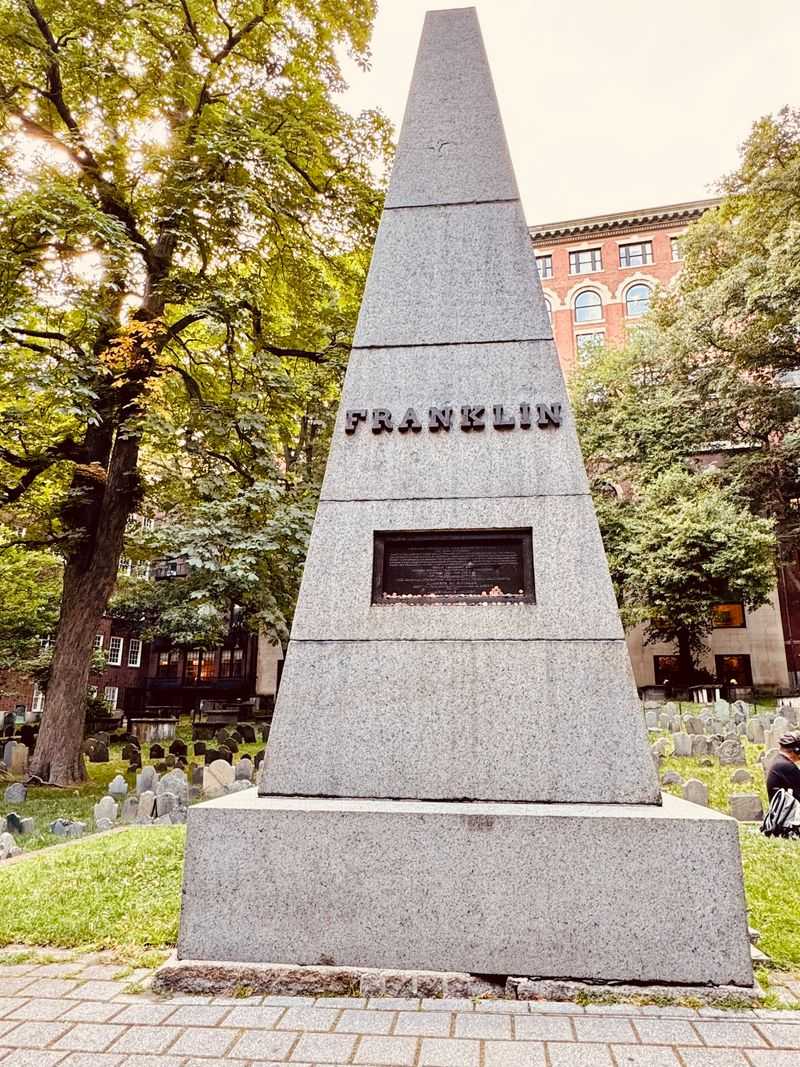
The large Franklin monument invites an easy mistake: Benjamin Franklin is not buried here. The memorial honors his parents, Josiah and Abiah Franklin, while Benjamin’s own grave is in Philadelphia.
That correction does more than settle a trivia question. It brings the focus back to the family and city that shaped Franklin before he became a printer, inventor, writer, and public figure.
Benjamin was born in Boston in 1706. His father worked as a candle and soap maker, a reminder that the founding era included ordinary trades and households alongside the political leaders who dominate history books.
The granite obelisk now marking his parents’ burial place was erected in 1827. Like several prominent memorials at Granary, it belongs to a later period of remembrance rather than the original moment of burial.
Its size makes it a useful visual landmark as you move through the grounds. Pause where you can see the tall monument and the much smaller stones around it without blocking the path.
The contrast points toward an important truth about this cemetery. Famous connections draw attention, but thousands of other people are buried here, including children, craftspeople, merchants, and members of families whose names may mean nothing to you.
Not every burial has a surviving individual marker. The number of people laid to rest exceeds the number of stones, so an open-looking patch should never be mistaken for unused ground.
Read a nearby ordinary marker after visiting the Franklin memorial. A name, an age, or a family relationship can shift the experience from national history to the daily lives that supported a growing town.
Some inscriptions are difficult to make out, and guessing is less useful than admitting the words have weathered away. Let the surviving details guide your attention.
The tallest monument supplies the famous surname; the surrounding stones supply the neighborhood.
A Better Photograph Starts With a Little Patience
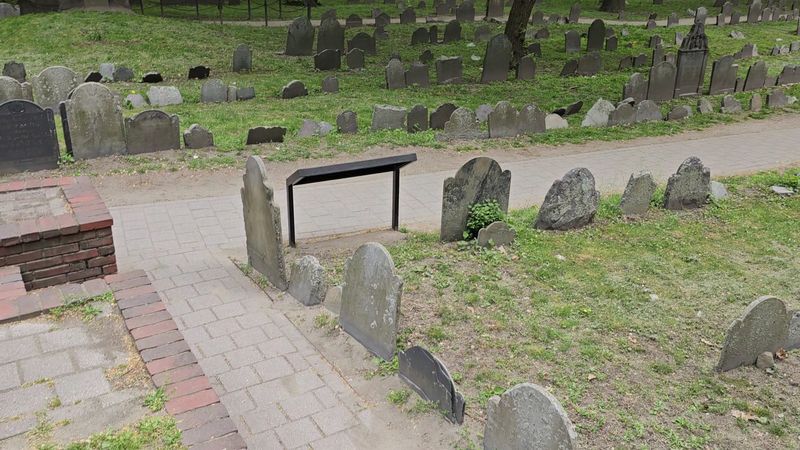
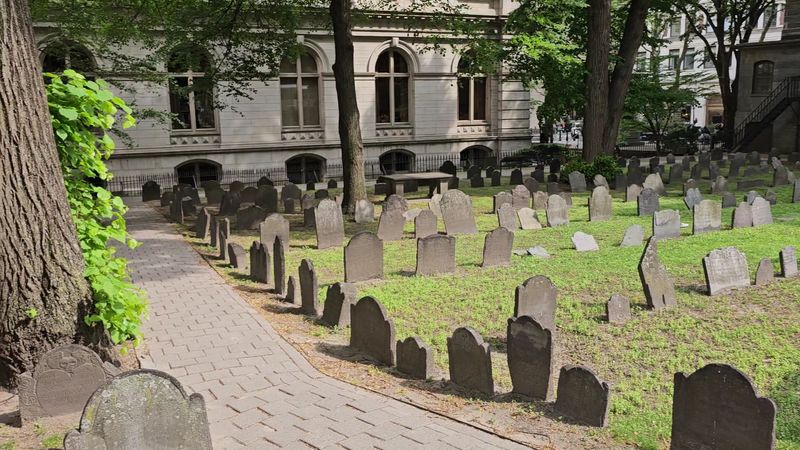
A phone camera can capture the famous name in seconds, but the stronger picture usually includes its surroundings. Rows of slate, tree trunks, and buildings beyond the boundary show why Granary looks so distinctive within downtown Boston.
Begin with three different scales: the whole setting, a recognizable memorial, and a close detail. That approach gives your photos variety without requiring dozens of nearly identical pictures of the same grave.
For the broad view, stay on a path and let several rows of stones overlap in the frame. The uneven heights create depth, while a glimpse of the city helps establish the location.
When photographing a memorial, include enough space to show its shape. A tight crop of a name may be useful as a record, but it loses the difference between a small original marker and a later monument.
Carved surfaces often show more clearly when light reaches them from the side. Conditions change with weather, season, and tree cover, so look at the actual stone rather than assuming one hour always produces the best result.
If a group gathers in front of your subject, wait or photograph another feature. The burial ground offers enough detail that a blocked view does not need to become a competition for space.
Avoid framing strangers closely without permission, especially when they are reading or reflecting. Step aside after taking your picture so someone else can see the inscription without looking around your shoulder.
Do not rearrange objects, move coins, lean on markers, or cross the grass for a cleaner angle. A respectful photograph records the place as it is instead of changing it for the camera.
Before putting your phone away, take one image without a famous name in it. A worn carving against an urban background can explain Granary’s character just as clearly as a patriot’s monument.
Plan Around the Gate, Not Just the Freedom Trail
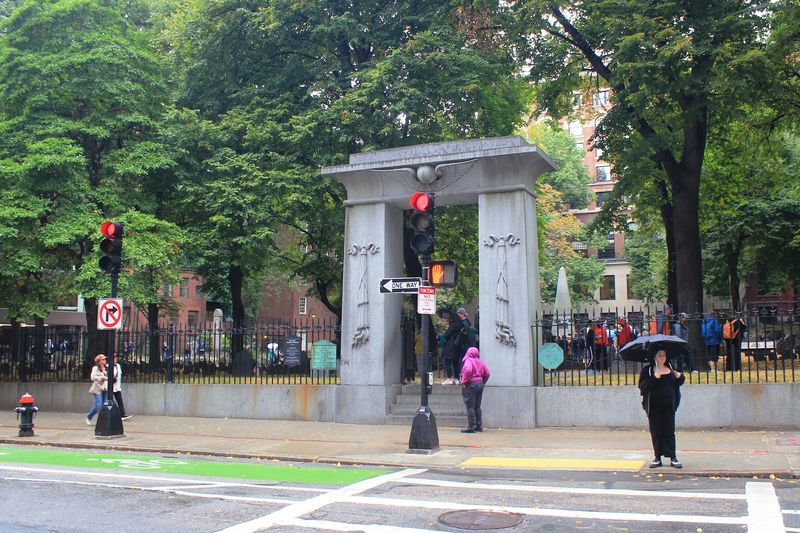
Arriving late can leave you looking through the fence instead of walking among the markers. The supplied hours list Granary Burying Ground as open daily from 9 a.m. to 4 p.m., so build your visit around the gate’s closing time.
Check current city information before setting out, since schedules and temporary closures can change. Admission to the burial ground is free, although a guided walking tour may have its own charge and booking rules.
The address is Tremont Street, Boston, Massachusetts 02108. Park Street station is nearby, making public transit a practical option if you want to avoid hunting for downtown parking.
Allow about thirty to forty-five minutes for a focused visit. You can see several major memorials more quickly, but reading inscriptions and looking at carvings takes longer than walking the short distances between them.
A weekday morning may give you more room to move, though school groups and tours can arrive at any time. If the entrance area is crowded, begin with an open section of path and return to the busiest markers later.
Wear comfortable shoes with dependable grip. Old paths, fallen leaves, and wet surfaces deserve attention, especially when your eyes are busy searching for names instead of watching your footing.
Anyone with mobility concerns should check current access information before visiting. Historic grounds can present uneven surfaces and route limitations, and a nearby entrance does not guarantee that every grave is equally easy to approach.
Choose a guided visit if you want help connecting people and events. For an independent walk, use the signs, keep a few key names in mind, and leave room for an unexpected inscription.
Above all, treat the grounds as a cemetery rather than a shortcut or outdoor exhibit. Stay on designated paths, keep voices considerate, and finish your visit before staff need to close.
📍 Tremont St, Boston, MA 02108, United States