Most people don’t expect one of New Jersey’s most memorable Gothic buildings to be tucked into Navesink, perched above the bayshore in Monmouth County, looking as if it took a wrong turn from the English countryside and decided to stay.
But that is exactly the charm of All Saints’ Memorial Church, better known locally as the Stone Church.
It is small, dramatic, a little mysterious, and built from a material that sounds made up until you see it for yourself: peanut stone.
This local conglomerate rock, found around the Navesink Highlands and Sandy Hook Bay region, gives the church walls their knobby, pebbled texture and ties the building so closely to the land that it feels less constructed than unearthed.
Add in Gothic Revival design, deep local family history, a hillside cemetery, and national landmark status, and you get the kind of place that makes even lifelong New Jersey people stop and say, hold on, how did I not know about this?
A Stone Church That Feels Older Than Time
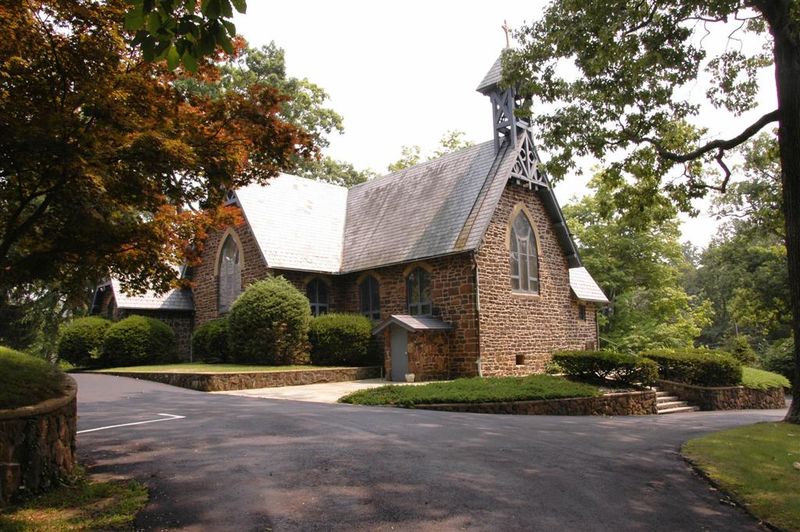
The first thing this chapel does well is mess with your sense of time. On paper, All Saints’ Memorial Church dates to the early 1860s, with services tracing back to 1861, construction beginning in 1863, and the building completed in 1864.
In person, though, it feels older than that by several centuries. Part of that comes from the Gothic Revival design, of course, with its steep roof, pointed archways, and compact, storybook proportions.
But the real magic trick is the stone itself. The walls are built from local peanut stone, a rough, pebbly material that formed millions of years ago and still carries the visual memory of ancient shorelines, compressed sediments, and shell fragments.
That texture makes the church look as if it rose out of the hill instead of arriving by wagon and workforce. The National Park Service nomination even described the place as an “exquisite little English Gothic Church,” noting its warm-tinted local stone and intimate setting.
That language still fits. Unlike grand cathedrals that announce themselves from blocks away, this one draws you in with scale, detail, and atmosphere.
It doesn’t tower over the landscape. It belongs to it.
That may be why the building has such staying power in local memory. It’s not flashy.
It’s rooted. You can read the nineteenth century in its plan and craftsmanship, but you can also read something much older in the stone surface itself, which is where the chapel earns its unusual sense of age.
New Jersey has no shortage of historic churches, but very few feel quite this geologic. The result is a building that gives you two timelines at once: one measured in parish records and family names, the other in prehistoric rock.
That combination is hard to fake and even harder to forget.
Why Peanut Stone Gives This Chapel Its One-of-a-Kind Look
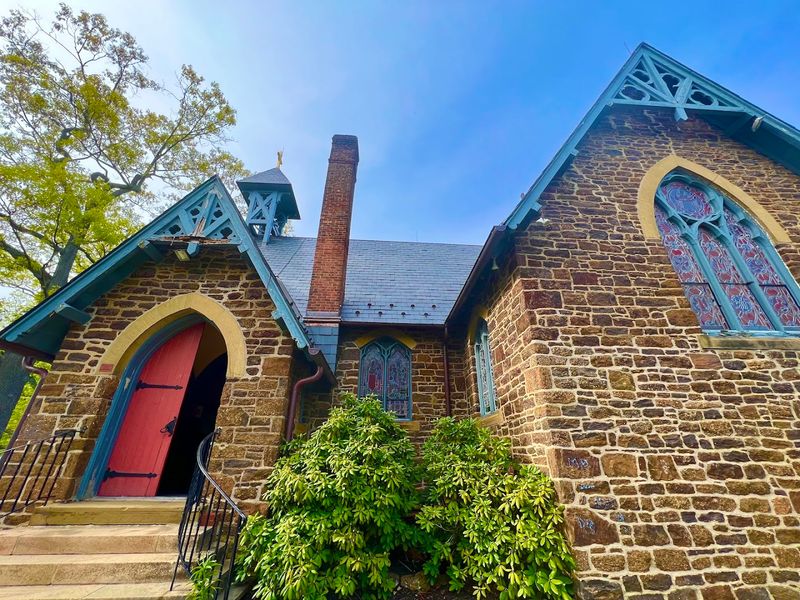
Forget smooth brownstone or tidy brick courses. What makes this church instantly recognizable is that wonderfully lumpy exterior.
Peanut stone, the nickname used for the local conglomerate rock in the Navesink Highlands area, looks exactly like something a kid would point at and blurt out before anyone else could be polite about it. The pebbles bulge from the surface.
The texture catches light in uneven ways. Up close, the walls have more personality than most entire buildings.
According to the story that inspired this piece, the stone formed roughly 11 million years ago from compacted pebbles, shells, and sediment in the Sandy Hook Bay and Navesink region, which explains why the material doesn’t merely decorate the church but makes it feel physically connected to the local ground beneath it. That matters.
Plenty of historic buildings are “of their place” in a vague, brochure-friendly way. This one is of its place in a literal sense.
The builders used stone from the surrounding landscape, which means the chapel’s skin is inseparable from regional geology. It also changes the mood of the architecture.
Gothic design can sometimes come off as fussy when done with highly finished material, but peanut stone brings in irregularity, warmth, and a certain rugged honesty.
The National Park Service described the church as built with native materials, and that choice gives the whole complex a grounded, almost handmade feel, even though its design pedigree is serious.
In New Jersey terms, this is a perfect meeting of elegance and earthiness. It has old-world lines, but it never feels imported or precious.
Instead, it reads as local, tactile, and a little delightfully strange. That is a big reason the chapel stays in your mind.
You are not just admiring a church. You are looking at Monmouth County geology turned into architecture, one rough, pebbled wall at a time.
The Gothic Revival Vision Behind a New Jersey Landmark
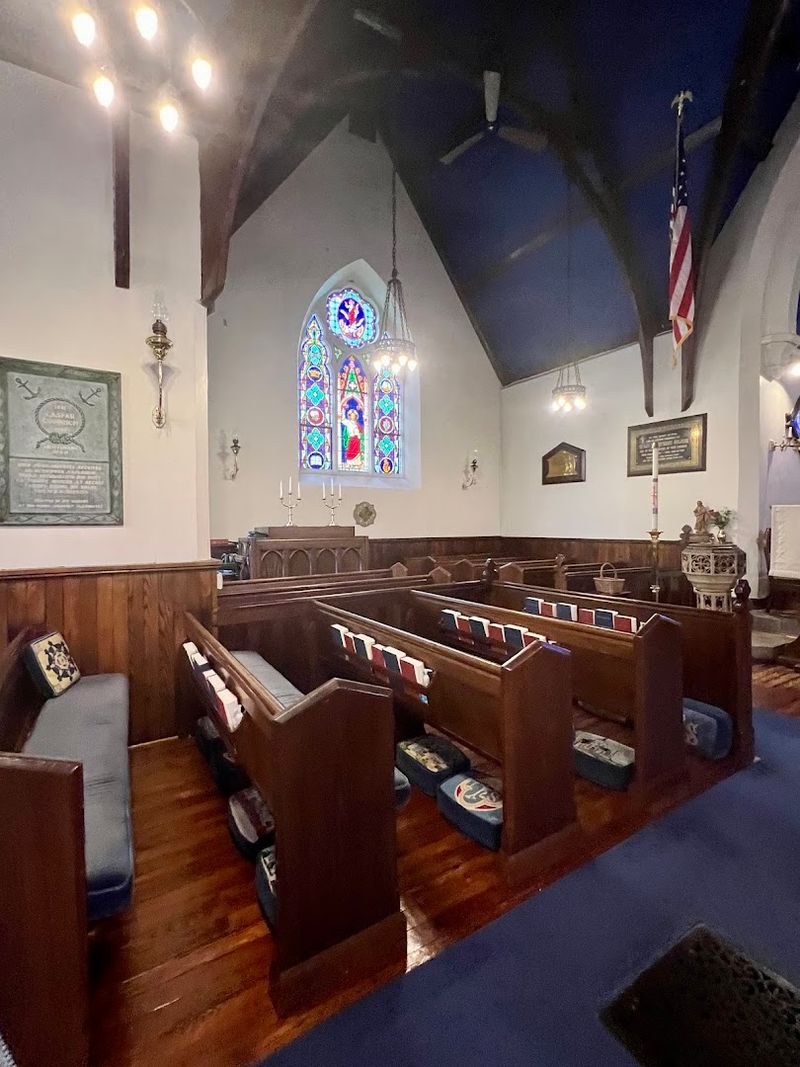
This little church did not happen by accident. Its design is tied to one of the major names in nineteenth-century American church architecture: Richard Upjohn, with the All Saints complex also linked by church history sources to Richard M.
Upjohn, his son. The family name matters because Upjohn was one of the strongest interpreters of Gothic Revival architecture in the United States, best known for Trinity Church in Manhattan and for helping establish a distinctly American taste for ecclesiastical design rooted in English precedent.
At Navesink, that bigger architectural story gets scaled down beautifully. Instead of producing a monument that tries to dominate the shoreline, the design works like a compact rural parish church, intimate and carefully proportioned.
The National Park Service nomination notes the complex was conceived in a manor-house tradition transplanted from England and patterned in part after the Stephens family church on the Isle of Wight.
That backstory explains why the site feels less like a standalone building and more like a whole little world: church, parish house, rectory, barn, carriage structures, cemetery, and surrounding grounds all speaking the same visual language.
The church itself leans into Gothic essentials without overdoing them. There is the steeply pitched roof, the elaborate main Gothic arch, the eastward orientation of the altar, and a polygonal chancel that adds grace without turning the place into a grand urban spectacle.
Upjohn understood something that still reads clearly today: a modest country church should feel reverent, yes, but also warm and human in scale. That balance is where All Saints really wins.
It has enough design intelligence to satisfy architecture people and enough atmosphere to charm everyone else. Even if you never use the phrase “Gothic Revival” in regular life, you can feel the intention here.
Every angle, arch, and material choice was working toward a specific mood, and more than 160 years later, it still lands.
How Local Craftsmanship Shaped Every Wall and Arch
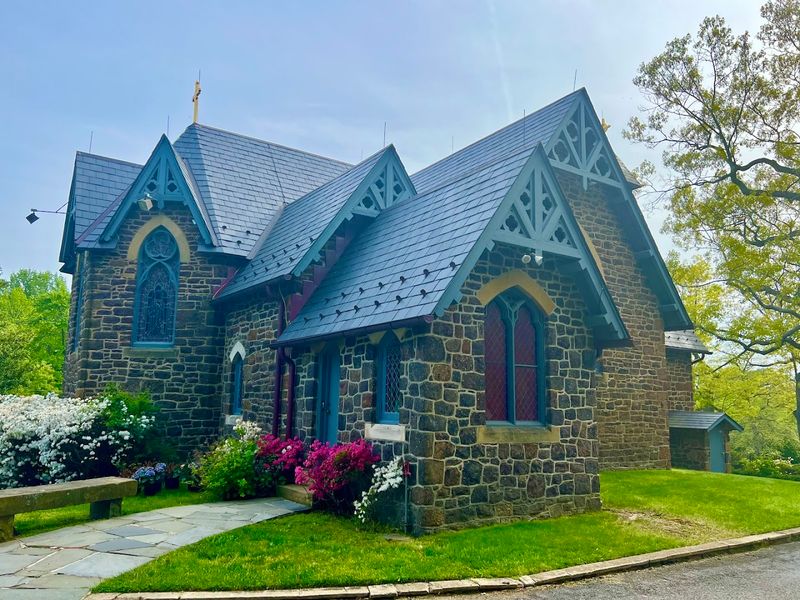
What keeps this place from feeling like a museum piece is the unmistakable sense of human labor in it. For all the talk of architects, design movements, and landmark designations, the church still comes across as something made by hands, not just drafted on paper.
The parish’s own history ties its founding to local religious services in the old Riceville schoolhouse and to the efforts of the Stephens, Milnor, and Edgar families, who pushed the project from idea to reality in the early 1860s. That origin story matters because it explains why the building feels personal rather than institutional.
The chapel was constructed as a memorial to Jennette E. Stephens Edgar and shaped by families whose names became woven into the life of the church, the grounds, and the cemetery.
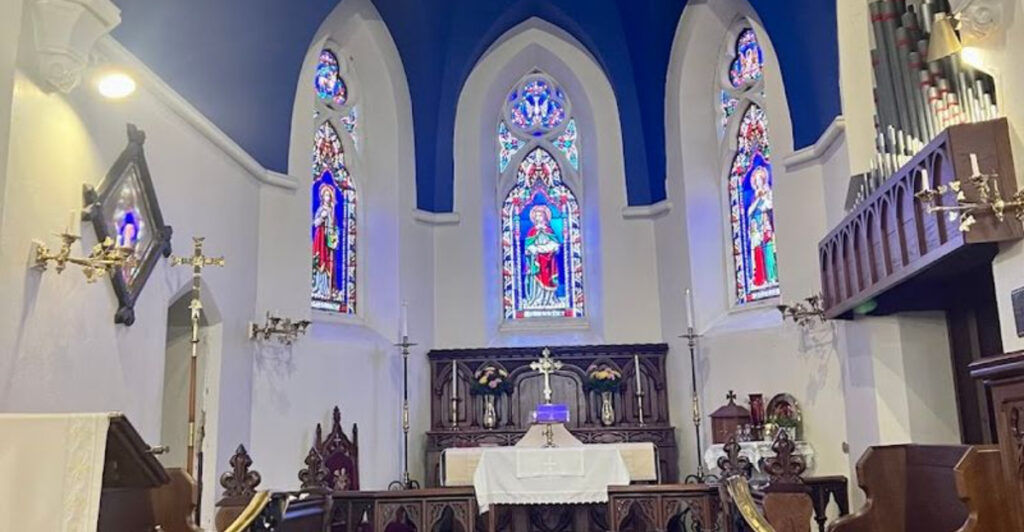
The physical details reinforce that intimacy. The National Park Service describes uncoursed fieldstone walls, ornate barge boards, multiple entrances, richly colored glass, and carved interior elements that fit the modest scale of the building instead of overwhelming it.
None of that reads as mass-produced. The roughness of the stone, the trim in sandstone, the slate roof, the woodwork, and the simple but deliberate arrangement of the interior all suggest craftsmanship that respected both material and setting.
Even the site’s evolution has a hand-built rhythm to it. First came the church, then the parish house in the mid-1860s, then the rectory and barn around 1870, then carriage sheds before 1890.
The result is a campus that grew in layers rather than arriving all at once as a packaged historic district. That slow accumulation gives the place texture.
You can imagine different crews, seasons, and decisions folded into the property over decades. In a state where so much building history has been erased, remodeled, or paved around, All Saints still feels touchable.
You can see where people shaped it, maintained it, and cared enough to keep the details intact. That kind of craftsmanship has a pulse, and this place still has one.
The Quiet Beauty of the Church Grounds and Cemetery
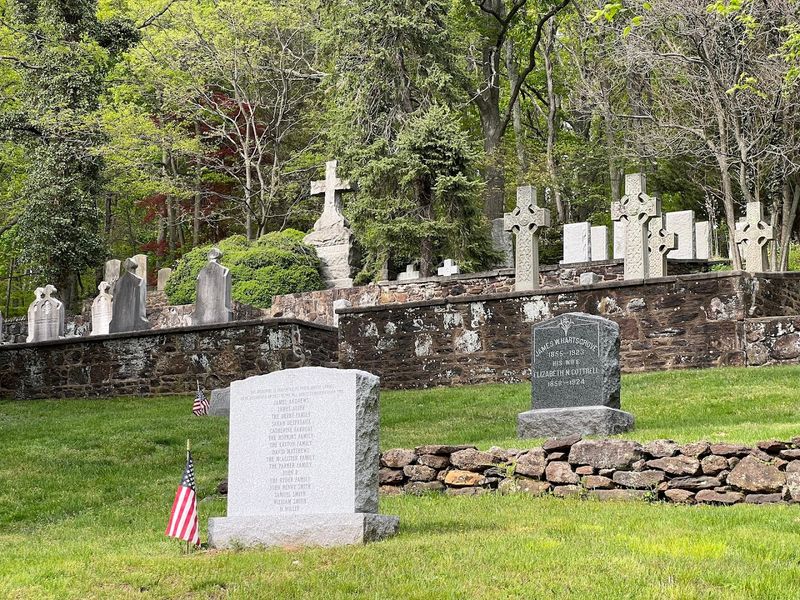
The church itself is the headline, but the grounds are what complete the mood. All Saints is not just a single handsome building sitting on a lot.
It is a preserved six-acre complex in the Navesink section of Middletown that includes the parish house, rectory, barn or carriage structures, retaining walls, and a hillside cemetery that deepens the site’s sense of continuity.
The New Jersey Historic Trust notes the tiered cemetery on the side of the hill, the retaining wall system, and the broader property as part of what makes the place one of the best-preserved sites of its kind.
The church’s own history page adds another layer by describing the cemetery in English landscape style, in keeping with the rural cemetery movement that became popular in the mid-nineteenth century. That is exactly the right frame for this setting.
The site is orderly without feeling stiff. It has memorials and mausoleums, but it also has the softer, more atmospheric quality that comes from a landscape designed to be walked through and contemplated rather than merely fenced off and ignored.
The cemetery contains graves of founding families and other local families, and in 1915 the graves from the old Reformed church in Highlands were reinterred here, with an obelisk marking their memory. That means the grounds hold more than one thread of local history.
They function as a kind of quiet archive, where family story, church history, architecture, and landscape design overlap.
This is the sort of place where even people who do not usually care about cemeteries suddenly start paying attention to stone carving, slope, tree cover, and the way the complex reveals itself in layers as you move through it.
The mood is not spooky in the cheap Halloween sense. It is reflective, calm, and richly textured.
In a region full of movement and water views and summer traffic, that hush feels especially striking. It gives the chapel room to breathe and gives visitors a reason to linger.
Why This Navesink Treasure Deserves More Attention
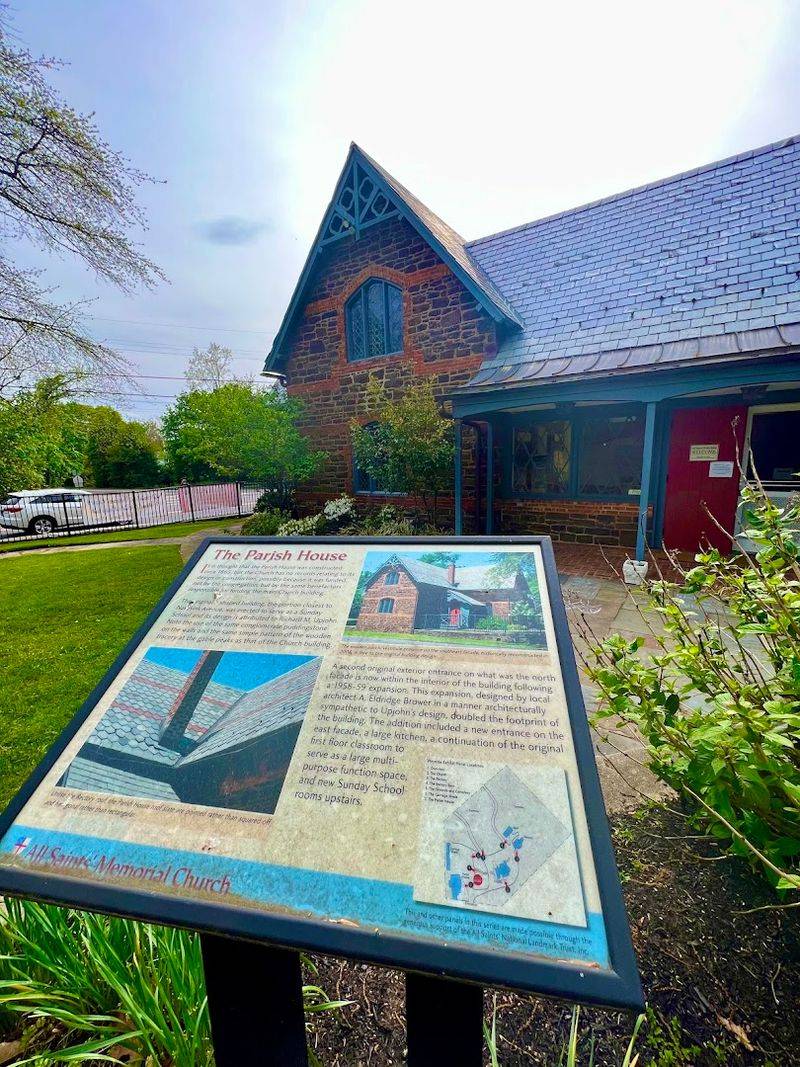
The case for caring about this church is actually pretty simple. It is architecturally significant, geologically unusual, remarkably well preserved, and deeply local all at once.
Those qualities are rare enough individually. Seeing them all packed into one modest Monmouth County site is what makes All Saints’ Memorial Church special.
The complex was placed on the New Jersey State Register of Historic Places in 1973, added to the National Register in 1974, and designated a National Historic Landmark in 1987, a level of recognition reserved for places with national importance. That status is not just ceremonial.
It reflects how unusually intact the site remains, from the main church to its associated buildings and grounds. New Jersey’s preservation agencies have continued supporting the complex with grants for maintenance work, including roof preservation, which tells you this is not nostalgia for nostalgia’s sake.
It is active stewardship. Yet despite all that, the church still feels under the radar compared with flashier historic destinations.
Maybe that is because it does not market itself through spectacle. It is not a mansion with velvet ropes or a boardwalk landmark with fries and neon.
It is subtler than that. You have to notice texture, setting, proportion, and the odd little thrill of learning that the stone under your fingertips is tied to ancient local geology.
But that is exactly why it deserves more attention. It rewards curiosity.
For New Jersey readers especially, it offers one of the best kinds of local discovery: a place that feels both surprising and completely of here. You come away reminded that the state’s most interesting sites are not always the loudest ones.
Sometimes they are the buildings that have been quietly holding onto their stories for generations, waiting for the rest of us to look up from the usual list of attractions and finally give them their due.
Share this story