At 9200 Atlantic Avenue in Margate, there’s a 90-ton elephant staring out toward the ocean with painted toenails, a room inside her belly, and a staircase hidden in one of her legs. That sounds like something a Shore town would invent for a parade weekend and then quietly retire.
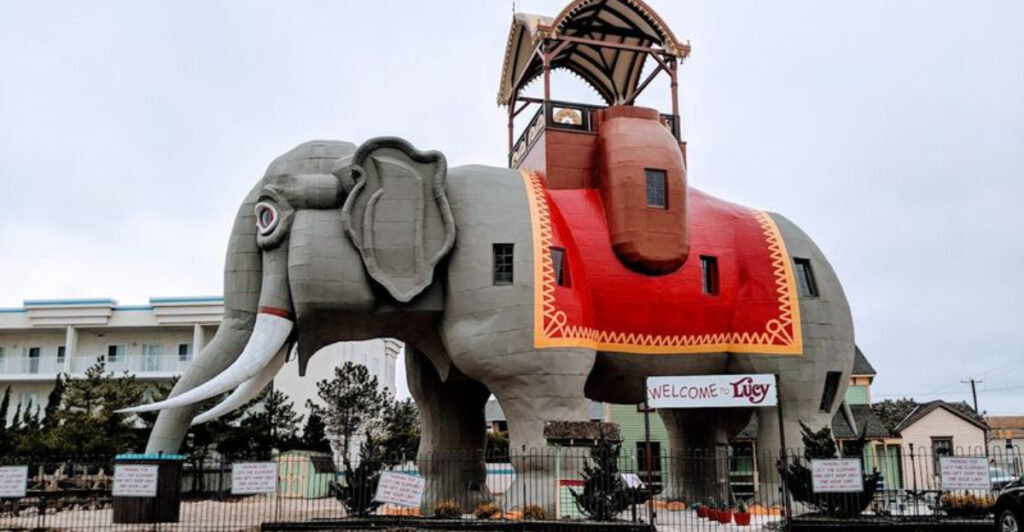
Instead, Lucy has been here since 1881, surviving salt air, storms, neglect, a near-demolition, and one very dramatic move down the street. She stands six stories tall, weighs about 90 tons, and remains the only survivor of the three elephant-shaped buildings created by developer James V.
Lafferty. Today she’s a National Historic Landmark, but she still feels less like a museum piece and more like one of New Jersey’s great local characters.
You don’t just look at Lucy from the sidewalk, either. You can walk up through her, hear the story, peek out through her eyes, and climb onto the howdah on her back for the kind of view that makes the whole thing feel even stranger in the best possible way.
Lucy the Elephant is the Jersey Shore landmark you have to see at least once
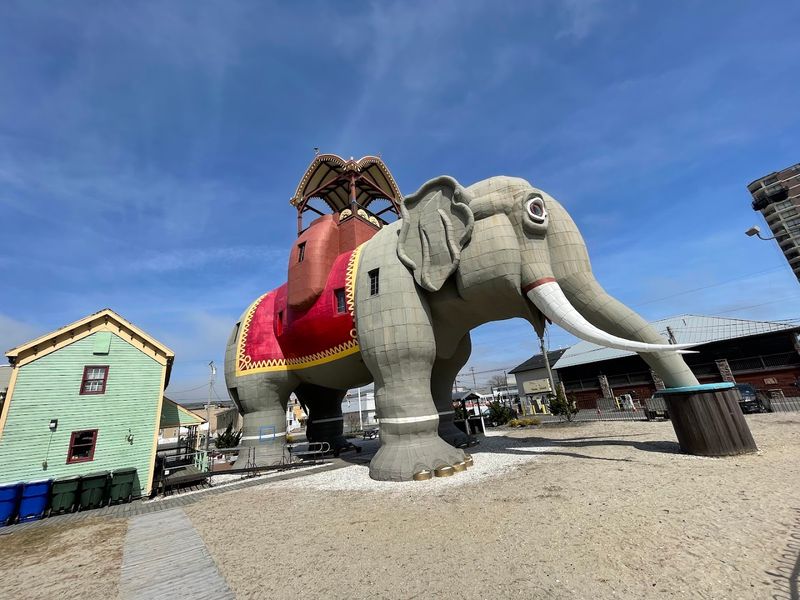
Some Shore landmarks are famous because they’re polished. Lucy is famous because she’s gloriously odd.
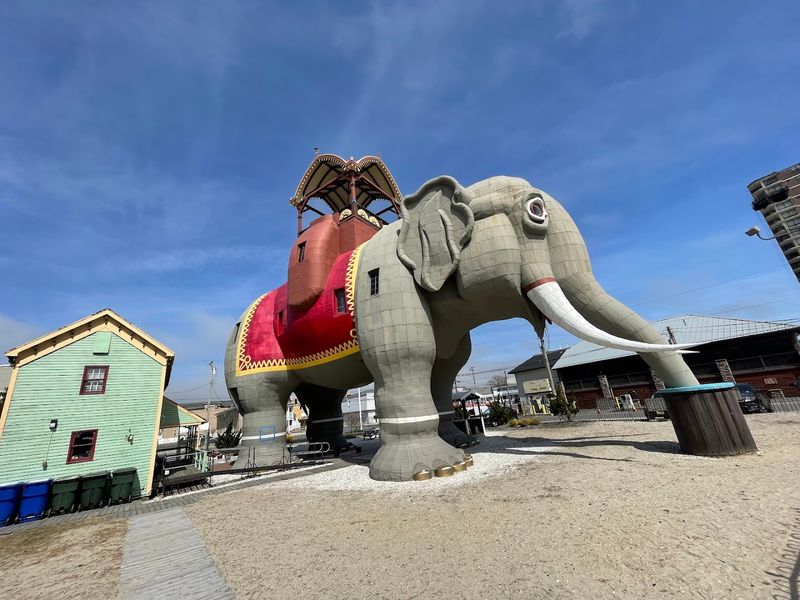
She rises 65 feet above the sand-line streets of Margate, clad in sheet metal, with 22 windows and a silhouette so unmistakable that nobody needs directions beyond “you’ll see the elephant.”
She is both a roadside attraction and a piece of serious preservation history, which is exactly the kind of combination New Jersey does well.
The state’s historic preservation program calls her a rare example of a nineteenth-century architectural folly, while locals treat her like a neighbor who just happens to weigh as much as a small fleet of trucks.
Part of the fun is where she sits. Margate is only a few miles south of Atlantic City, but the mood is different here.
The casinos and neon are off in the distance; Lucy gets the beach breeze, bike traffic, and families wandering over in flip-flops. From the outside, she’s wonderfully theatrical.
From up close, the details make her better: the curved body, the giant tusks, the painted feet, the knowledge that the entrance is literally through one of her legs. The grounds and gift shop are free to visit, which means plenty of people stop for photos even if they do not take the tour.
What makes Lucy worth more than a quick picture is that she never feels generic. Plenty of coastal attractions could be swapped with one another if you changed the sign.
Not this one. There is only one six-story elephant on the Jersey Shore, only one surviving Lafferty elephant anywhere, and only one place where local preservationists decided the reasonable response to a threatened landmark was to save the giant elephant building.
That combination of absurdity, affection, and determination is a huge part of her appeal.
Why a giant elephant was built in Margate in the first place
Lucy did not begin as a whimsical art project. She was built to sell land.
In 1881, James V. Lafferty of Philadelphia constructed what was originally called Elephant Bazaar to attract prospective buyers to what was then South Atlantic City.
The railroad stop sat right beside her, so visitors could arrive, climb up, and look out over nearby lots from her howdah before deciding whether to invest in shore property. In other words, Lucy was nineteenth-century real-estate marketing at full volume.
That origin story explains a lot about her shape. Lafferty even patented the idea of an animal-shaped building in 1882.
The patent description reads like a delightfully overcommitted piece of Victorian ingenuity: hollow legs containing stairs, a body divided into rooms, and an upper story in the form of a howdah serving as an observatory. Lucy was not meant to be a statue.
She was meant to function as a building, a spectacle, and a sales pitch all at once. That is why she has rooms, windows, stairs, and a trunk that was designed as more than decoration.
She was also part of a brief larger idea. Lafferty built three elephant structures, but Lucy is the only one that still survives.
That makes her feel even more specific to the Shore’s early booster era, when seaside towns were trying to stand out and novelty was part of the business model. Today, that sales gimmick reads like folk architecture with a sense of humor, but at the time it was practical ambition dressed up as an elephant.
And honestly, it worked. More than a century later, people still pull over for the same basic reason Lafferty hoped they would: because the sight of a giant elephant by the beach is too strange to ignore.
How Lucy survived more than a century of storms change and near-demolition
Salt air is not gentle on anything, let alone a wood-frame, tin-clad elephant planted near the Atlantic. Lucy remained in use into the twentieth century, but years of harsh marine weather and deferred maintenance wore her down badly.
By 1969, she was nearly derelict, and the land beneath her had been sold to developers. Demolition was on the table.
For a landmark that now feels inevitable, survival was anything but guaranteed. The rescue came from locals.
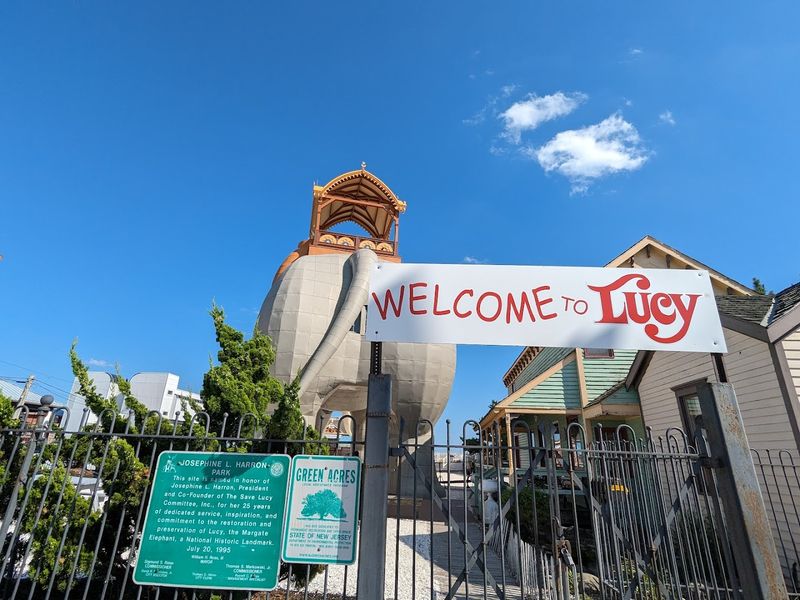
In 1970, the newly formed Save Lucy Committee took over, raised money, and arranged to move the entire structure to city-owned property a few blocks away. Lucy’s birthday is now celebrated on the Saturday closest to July 20 because that was the date she made the move in 1970.
She ended up roughly 100 yards from her original location, which sounds modest until you remember that the thing being moved was a six-story elephant. The relocation was only the beginning.
By 1974, Lucy reopened to the public after twelve years, and in 1976 she was designated a National Historic Landmark. Restoration work continued long after that.
Preservation funding in recent years has supported exterior and interior work, including cladding replacement, repainting, and repairs tied to moisture damage. That long timeline matters because it shows Lucy was not “saved” once.
She has been saved repeatedly, in phases, by people willing to keep doing expensive, unglamorous preservation work. That stubborn maintenance is part of the story now.
Lucy survives because generations of people decided the giant beach elephant was worth real money, real labor, and real civic energy. New Jersey has plenty of beloved landmarks.
Very few required this level of literal holding together.
What it is like to climb inside Lucy and step out onto her back
The first thing to know is that going inside Lucy is not a wander-at-will situation. Tours are guided only, and they run every 45 minutes during business hours, with the tour itself lasting about 20 to 25 minutes.
Current general admission is modest, and the grounds and gift shop are free to visit, which makes Lucy easy to work into a Margate stop whether you want the full experience or just a look around. Inside, the experience is part history lesson and part wonderfully odd architectural tour.
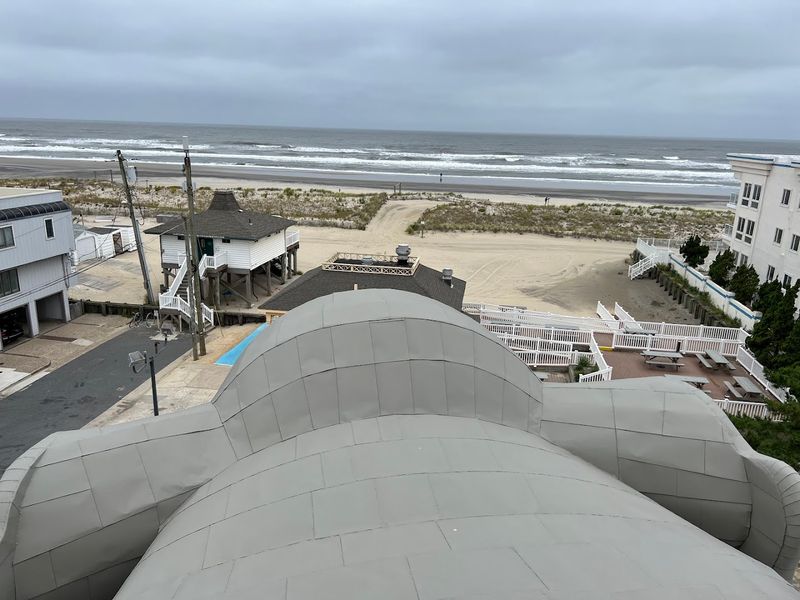
Visitors watch a short video about Lucy’s past, see artifacts connected to her construction and preservation, and then get the payoff: the chance to look out through Lucy’s eyes and climb up to the howdah on her back. That last part is what makes the tour memorable even for people who think they’re mainly coming for the joke of it.
From the top, you get a wide view around Margate, with the beach, ocean, nearby homes, and wider shoreline spread out around you. The route matters too.
Entering through one of Lucy’s legs is exactly as charmingly weird as it sounds. You feel the building’s age and ingenuity at once, because this is not a modern attraction made to imitate an old one.
It is the actual nineteenth-century structure, restored and reinforced, still doing the job it was designed to do: lift people up for a better look. The body contains museum space, while the howdah functions as the elevated lookout that was always central to the concept.
There is also something very Jersey about the contrast between the silliness of the premise and the seriousness of the experience. You go in expecting novelty.
You come out thinking about design, preservation, and how bizarrely satisfying it is to stand on the back of an elephant beside the Atlantic.
The surprising chapters of Lucy’s life as a tavern home and tourist draw
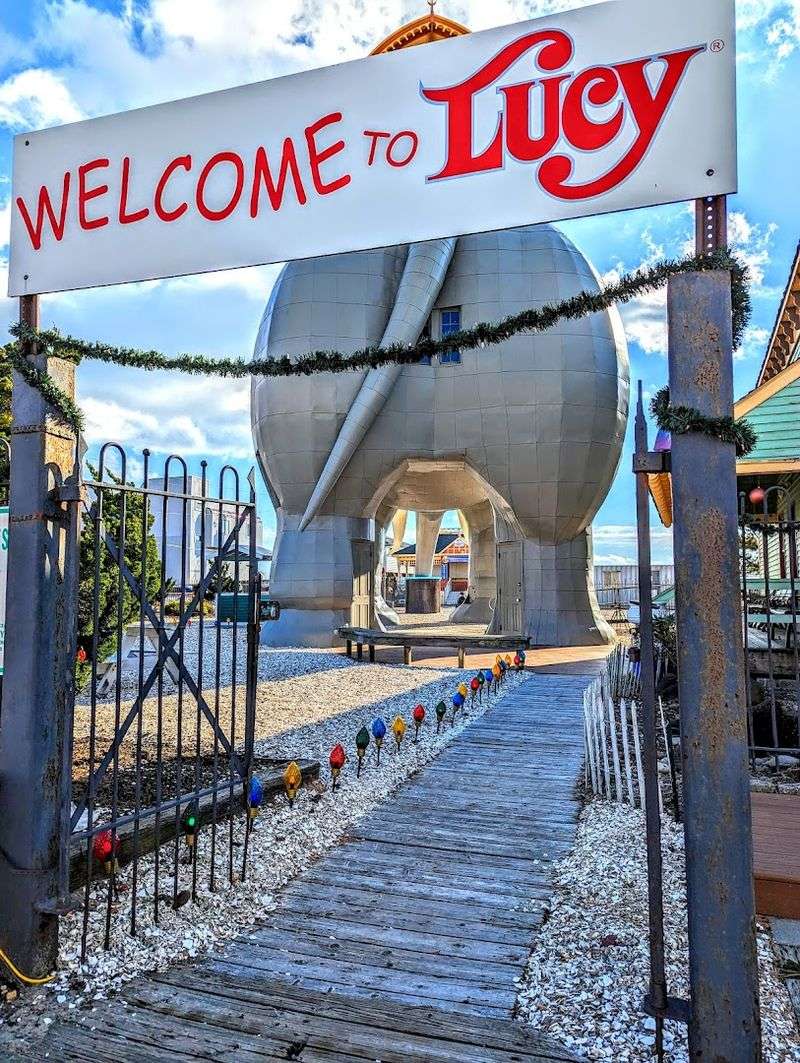
Lucy’s biography gets much weirder once you move past the construction date. After James Lafferty sold the structure in 1887, the next big shift came in 1902, when it was renamed Lucy the Elephant and turned into a tavern.
A year later, Lucy became the summer home of a British doctor and his family. So yes, this landmark has been a sales office, a tavern, a seasonal residence, a near-ruin, and a museum-quality attraction, which is a résumé few buildings can match.
That mix of uses makes Lucy feel less like a preserved oddity and more like a building that kept adapting to whatever the Shore needed. There is something very early-New Jersey-coast about that.
Resorts and shore towns were growing, land speculation was booming, summer visitors were pouring in, and buildings that caught attention had value. Lucy never stopped being a spectacle, but spectacle alone does not explain her longevity.
She stayed around because people kept finding ways to use her. Even some of her quirks have stories attached.
Her name stuck even though, technically, the elephant’s physical features suggest Lucy would be male. Her toenails are painted every July ahead of her birthday celebration, with the pedicure color chosen by visitors and fans online.
There is even a “J” painted on one toenail, commonly said to honor either builder James Lafferty or Josephine Harron, one of the figures associated with saving Lucy from demolition. These details sound small, but they show how a historic structure becomes local folklore.
That is why Lucy works on more than one level. She is significant enough for landmark status and preservation grants, but familiar enough to have birthday parties and painted nails.
Not many places can hold those two identities at once without feeling forced. Lucy makes it look easy.
Why this six-story elephant still feels so unmistakably New Jersey
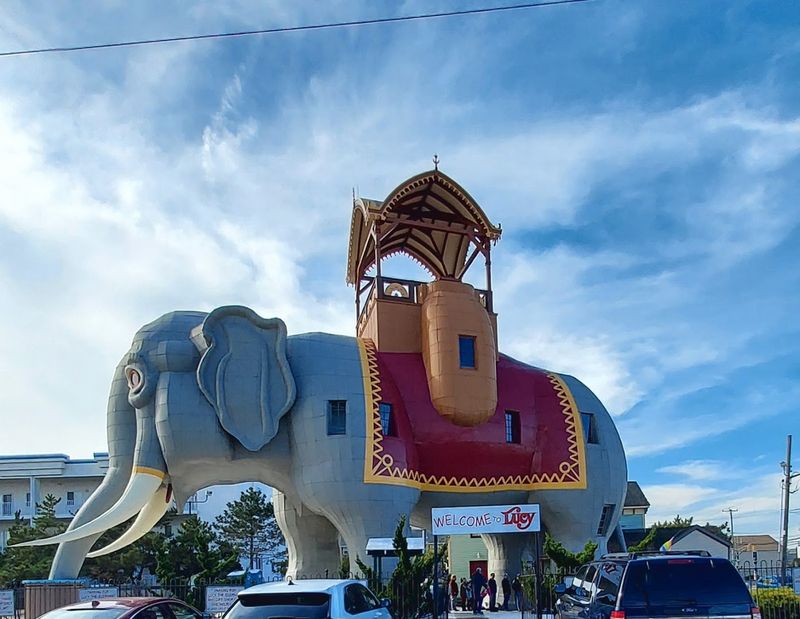
There are bigger attractions nearby. Atlantic City’s skyline is right up the coast, and the Jersey Shore has no shortage of boardwalk staples, beach rituals, and oversized claims to fame.
Yet Lucy still holds her ground because she captures a very specific New Jersey talent: turning a practical idea into a local legend without sanding off the weirdness. She was built to market property, not to become a sacred monument.
New Jersey simply looked at that giant elephant and decided that was even better. She also feels local because the details are so concrete.
She is not hidden in a theme park or recreated in a visitor center. She is right there in Margate, near the beach, with regular guided tours and a gift shop on the grounds.
Tens of thousands of visitors pass through every year, but the place still reads like a Shore stop rather than a slick national attraction. That balance matters.
Lucy is famous, but she is still comfortably embedded in the rhythms of the neighborhood around her. Then there is the attitude she inspires.
Nobody encounters Lucy and responds with polite appreciation. People grin.
They take pictures from ridiculous angles. They tell out-of-town relatives, “No, seriously, you can go inside.” Even the history has that same Jersey energy: threatened with demolition, the town rallied; needing repairs, people found the money; needing a new spot, they moved the elephant down the street.
It is hard to imagine a more fitting Shore icon than a landmark that is simultaneously improbable, beloved, and tougher than it looks.
By the time you leave, Lucy stops feeling like a novelty and starts feeling like proof that New Jersey’s best landmarks are the ones with a little nerve, a little history, and absolutely no interest in being ordinary.
Share this story