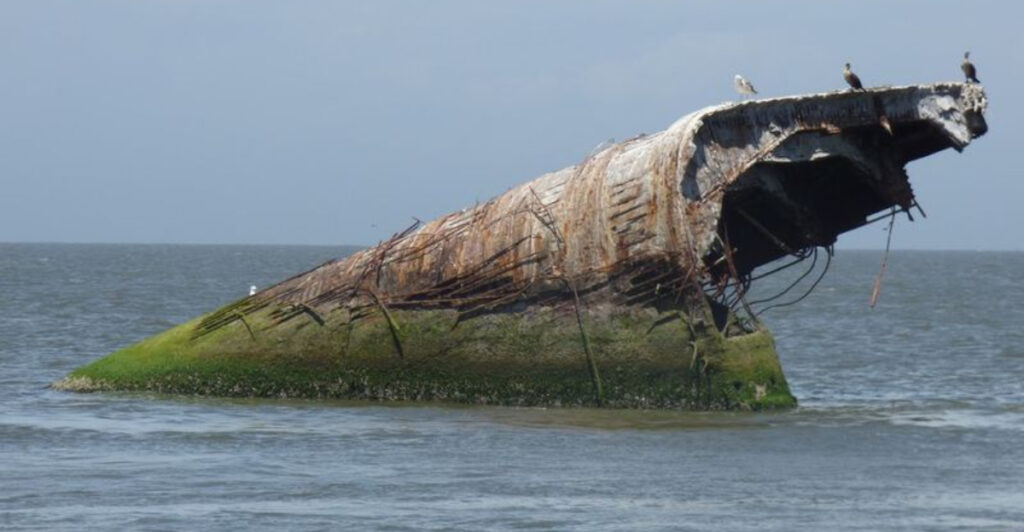
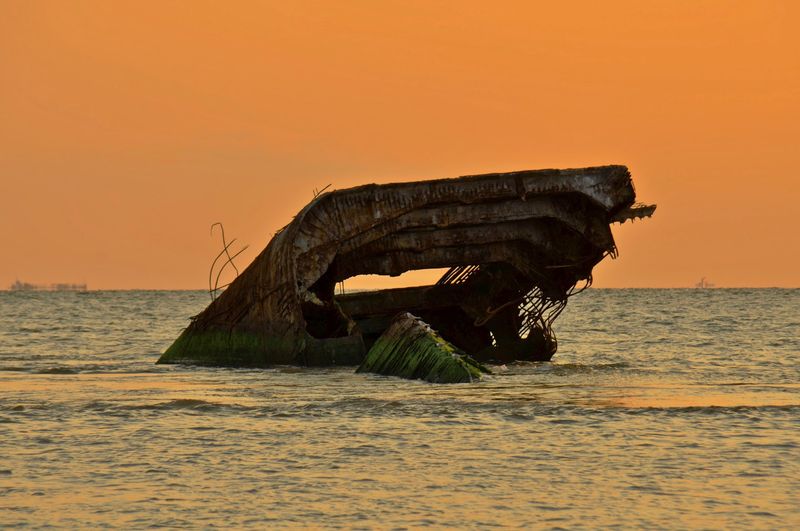
About 150 feet off Sunset Beach, the remains of a concrete ship rise out of the Delaware Bay like something the tide forgot to finish taking. It does not look polished, preserved, or museum-ready.
It looks broken. That is the point.
The SS Atlantus has been sitting off Cape May Point since 1926, slowly cracking apart in the saltwater while beachgoers hunt for Cape May diamonds, watch the sun drop over the bay, and point at the strange gray skeleton offshore. New Jersey has plenty of boardwalks, lighthouses, diners, and shore-town legends, but this one feels different.
It is not hidden in a dusty archive or tucked behind a velvet rope. It is right there from the sand, battered by weather, birds, waves, and time.
A ship built for wartime urgency somehow became one of the Shore’s strangest, most stubborn landmarks.
The Ghostly Wreck That Still Haunts Sunset Beach
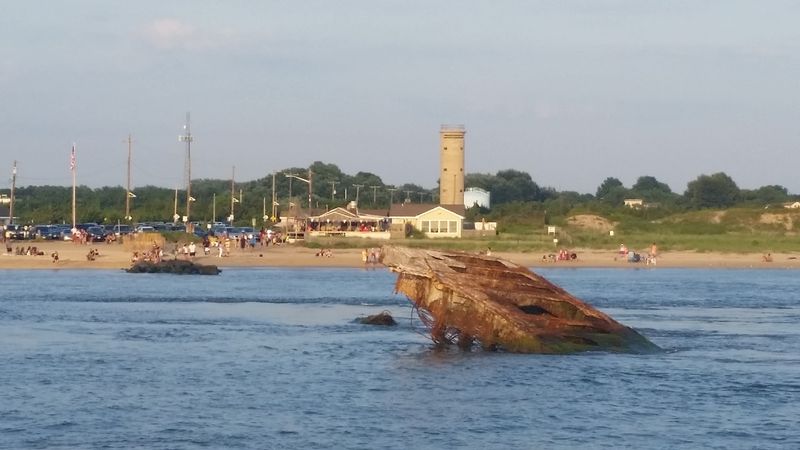
Sunset Beach already has a slightly end-of-the-world feeling, in the best possible Jersey way. It sits at the edge of Cape May Point, facing the Delaware Bay instead of the open Atlantic, so the water feels calmer, flatter, and moodier than the surf beaches a few miles away.
The sand is mixed with smooth little quartz pebbles people call Cape May diamonds, and on summer evenings, crowds gather for the flag ceremony while the sky does its big orange-and-pink routine over the water. Then, just offshore, there is that hulking wreck.
The SS Atlantus is not a pretty shipwreck. That is what makes it so memorable.
From the beach, it looks like a dark, jagged strip of concrete and rust sitting low in the bay, especially visible when the tide and light cooperate. It is close enough that you do not need binoculars to know something strange is out there, but far enough away to keep its mystery intact.
You can stand there with an ice cream, a bag from the gift shop, or wet shoes full of pebbles and still feel like you are looking at a leftover piece of another century. Locals tend to explain it with a casual “that’s the concrete ship,” as if concrete ships are a normal thing to have lying around.
Visitors usually do a double take. A concrete ship sounds like a joke until you learn that the Atlantus was part of a real World War I-era experiment, built when steel was scarce and the country was trying almost anything to move cargo across the water.
It did not become famous because it won a battle or crossed the world in glory. It became famous because it got stuck, stayed stuck, and slowly turned into Cape May’s most unusual silhouette.
How a Concrete Ship Ended Up Stranded off Cape May
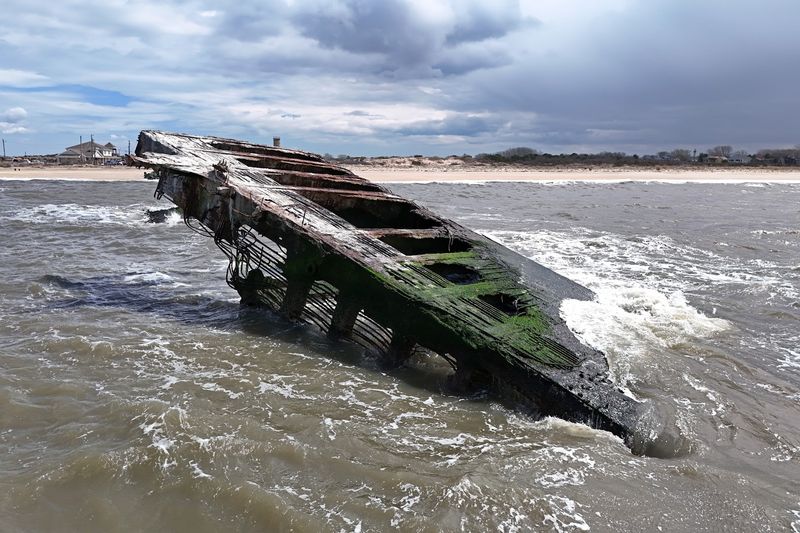
The short version is almost too New Jersey to improve on: a businessman tried to turn a retired concrete ship into part of a ferry terminal, and the bay had other plans. In 1926, Colonel Jesse Rosenfeld bought the SS Atlantus with the idea of using it near Cape May Point as part of a ferry connection between New Jersey and Delaware.
This was decades before today’s Cape May-Lewes Ferry began carrying cars and passengers across the bay, but the basic dream was similar. Cape May wanted a practical link to the other side, and Rosenfeld thought old ships could help make it happen.
The plan was wonderfully odd. The Atlantus was supposed to be sunk in place and used as part of a landing structure.
Other ships would help form a protected slip where ferries could dock. Instead of building everything from scratch with traditional materials, the project would reuse hulks as a kind of maritime foundation.
It was ambitious, thrifty, and just weird enough to feel believable along the Shore, where half the best stories start with somebody saying, “I have an idea.”
The Atlantus arrived at Cape May Point in June 1926, but before the project could become the transportation breakthrough Rosenfeld had imagined, the ship broke free and ran aground near Sunset Beach. Accounts differ on the exact sequence of towing, storms, and refloating attempts, but the result is not in dispute: the ship ended up offshore, battered and immovable, and the ferry scheme faded.
People tried to move it. The bay did not cooperate.
Eventually, the Atlantus stopped being a failed ferry-terminal component and started becoming a landmark. What began as a practical plan turned into a permanent accident, which is often how the Shore gets its best lore.
The Strange Wartime Experiment Behind the SS Atlantus
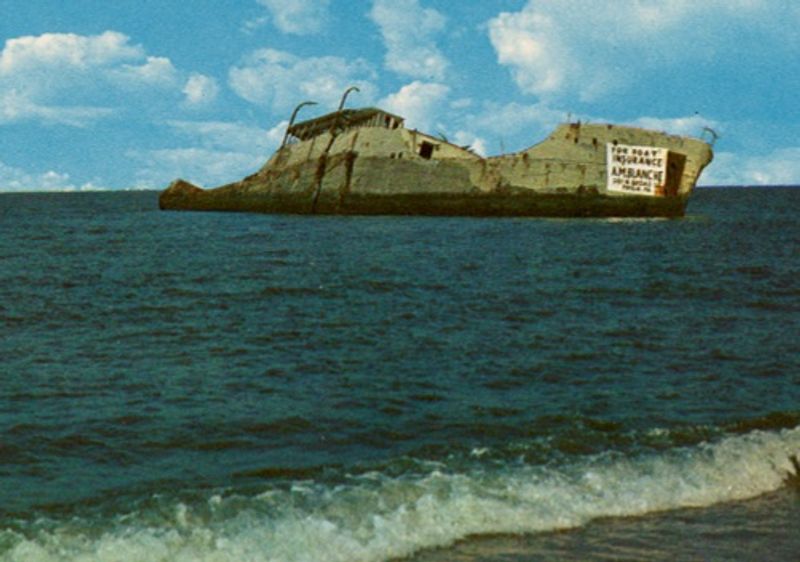
Before it was Cape May’s concrete ghost, the Atlantus was part of a much bigger problem. During World War I, the United States needed ships, and steel was in short supply.
Concrete was cheaper and more available, so the government backed an experimental fleet of concrete vessels. The idea sounds absurd now, mostly because most of us hear “concrete” and picture sidewalks, parking garages, and that one backyard patio nobody wants to replace.
But reinforced concrete can float if it is shaped properly, just like steel can sink if it is shaped badly. The Atlantus was built by the Liberty Ship Building Company in Brunswick, Georgia, and launched in December 1918, just after the war had ended.
That timing mattered. The ship had been designed for wartime need, but by the time she was ready, the emergency had passed.
Instead of becoming a heroic workhorse of the war effort, she had a short working life. She was big enough to make an impression: roughly 260 feet long, with a beam of about 43 feet.
That is not a little experimental dinghy. It was a serious vessel, built at serious expense, with the very serious hope that concrete could help solve a national shipping crunch.
The experiment did not take over the maritime world, but it left behind a few durable oddities. The Atlantus became the most famous of them largely because she found such a public resting place.
There is something funny and a little melancholy about that. A ship designed during a national emergency, launched too late to matter, retired young, sold cheap, and dragged north for a second life somehow became more beloved as a wreck than she ever was as a working vessel.
That is not failure exactly. It is just a very strange kind of afterlife.
Why the Shipwreck Became a Jersey Shore Landmark
A landmark does not always need a gift shop snow globe, though Sunset Beach has never been shy about souvenirs. Sometimes a landmark only needs to be visible, strange, and easy to explain in one sentence.
The Atlantus checks all three boxes. It is a concrete shipwreck off the beach.
That is enough to make almost anyone stop walking. Sunset Beach helped make it famous because the setting does half the work.
This is not a wreck hidden miles offshore where only divers and boat captains know its coordinates. It sits close to land, in the same view as beach chairs, gulls, sunset watchers, and families searching the pebbles for Cape May diamonds.
The wreck becomes part of the outing without asking much from anybody. You park, walk over, look out, and there it is.
The ship also benefits from Cape May’s appetite for layered history. This is a town where Victorian houses, World War II lookout towers, lighthouse climbs, old hotels, and maritime stories all sit comfortably together.
The Atlantus fits right in because it is not just “old.” It is odd. It gives people something to point at while they ask the best kind of travel question: “Wait, what is that?” Over the years, the wreck has been photographed, written about, and folded into local memory.
It has served as a backdrop, a curiosity, and a reminder that not every historic site gets restored into neatness. Some are left to weather honestly.
The Atlantus does not need polish. Its appeal is that it is visibly losing a long argument with the bay and somehow still holding on.
What Visitors Can Still See from the Beach Today
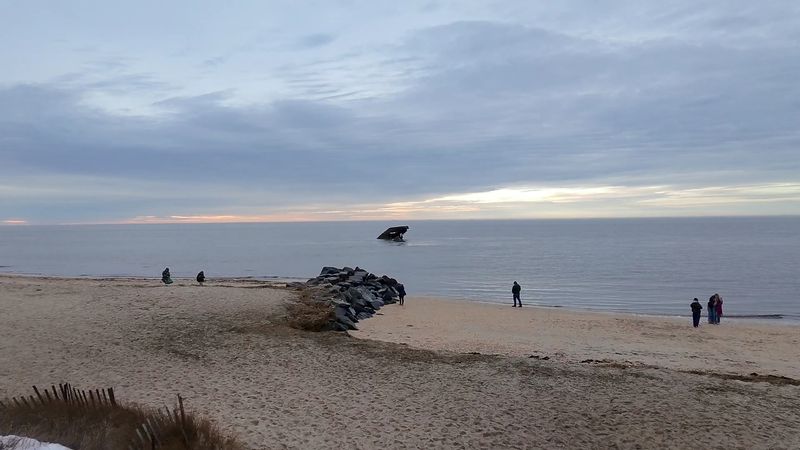
On a clear day, the SS Atlantus is easy to spot from Sunset Beach, but it does not look the way it did in old postcards. Do not expect a full ship sitting upright like a movie prop.
What remains is broken, low, and uneven, with sections that appear and disappear depending on tide, weather, and light. Parts of the wreck are submerged, and the visible pieces have been reduced by decades of storms, corrosion, and wave action.
That actually makes seeing it feel more personal. You are not visiting a frozen exhibit.
You are catching a relic in the middle of its slow vanishing act. The best views tend to come when the bay is calm and visibility is decent.
Sunset, naturally, gives the whole scene extra drama, though it also brings more people. In summer, the area can feel lively rather than lonely, with families moving between the beach, the shops, mini golf, and the evening flag ceremony.
In the off-season, the place has more room to breathe, and the wreck can feel especially stark against a gray bay. The beach itself is different from the classic soft-sand stretches along the Atlantic side of Cape May.
Sunset Beach is known for its pebbles and Cape May diamonds, those smooth quartz stones that wash down from the Delaware River and get polished by the bay. People bend over for them by the handful, then look up and remember there is a century-old concrete ship sitting offshore.
There is no admission fee to stand on the beach and look at the Atlantus. That simplicity is part of the charm.
You do not need a tour guide, a ticket window, or a dramatic soundtrack. Just bring decent shoes if you plan to walk the pebbly shoreline, and give yourself enough time to let your eyes adjust to what you are seeing.
At first it is a shape. Then it is a wreck. Then it is a story.
The Slow Disappearance of a Century-Old Relic
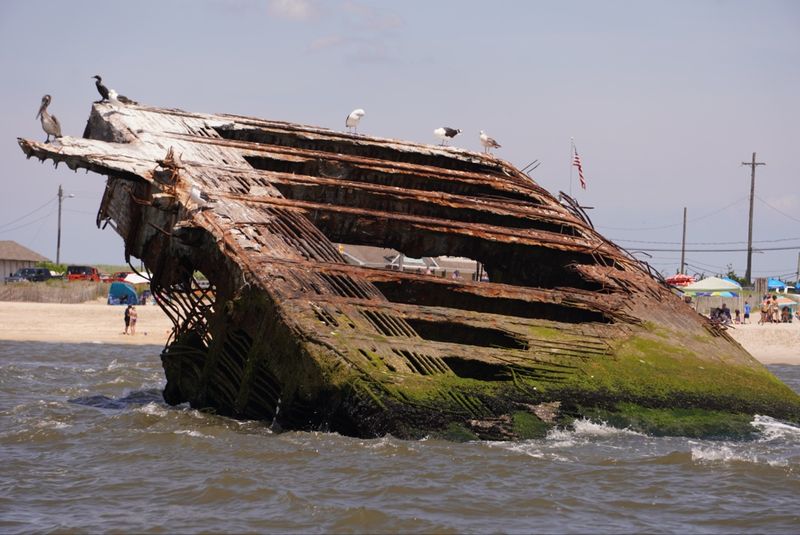
The Atlantus is not being restored, and that is part of the ache of it. Every year, the bay takes a little more.
Concrete sounds permanent until saltwater, freeze-thaw cycles, storms, and time start working on it for 100 years. The ship has split into sections, with some pieces only visible at low tide and others now fully underwater.
What people see from Sunset Beach today is a fraction of what earlier generations saw. That slow disappearance gives the wreck its haunting quality.
It is not haunted in the Halloween sense, at least not officially. No ghost captain needs to pace the deck.
The mood comes from watching a man-made thing lose its shape in public, decade after decade, while everyone keeps folding it into their beach day. Children who once saw a larger wreck brought their own children back to see a smaller one.
Photos from different eras show the ship shrinking into the bay like a memory being rubbed thin. There is a practical side to leaving it alone, too.
The Atlantus is offshore, deteriorated, and part of the marine environment now. Birds perch on it. Sea life gathers around it. Removing or rebuilding it would change the very thing people find compelling. Its value is not in looking new. Its value is in being stubbornly, beautifully ruined.
Cape May has tidier historic attractions, and it has grander ones. The lighthouse is easier to understand. The Victorian district is prettier. The beaches are more useful. But the Atlantus has a hold on people because it feels unfinished. It is a failed ship, a failed ferry plan, a successful landmark, and a vanishing object all at once.
From Sunset Beach, it still watches the bay, lower than it used to be, but not gone yet.