Standing tall on West Grand Boulevard, the Fisher Building is one of Detroit’s most dazzling pieces of architecture. Built in 1928, this Art Deco tower was designed to impress, and nearly a century later, it still does exactly that.
From its golden exterior to its marble-lined corridors, every corner of this building tells a story. Whether you love history, architecture, or just want to see something genuinely special, the Fisher Building delivers in ways that are hard to put into words.
The Golden Exterior That Stops You in Your Tracks
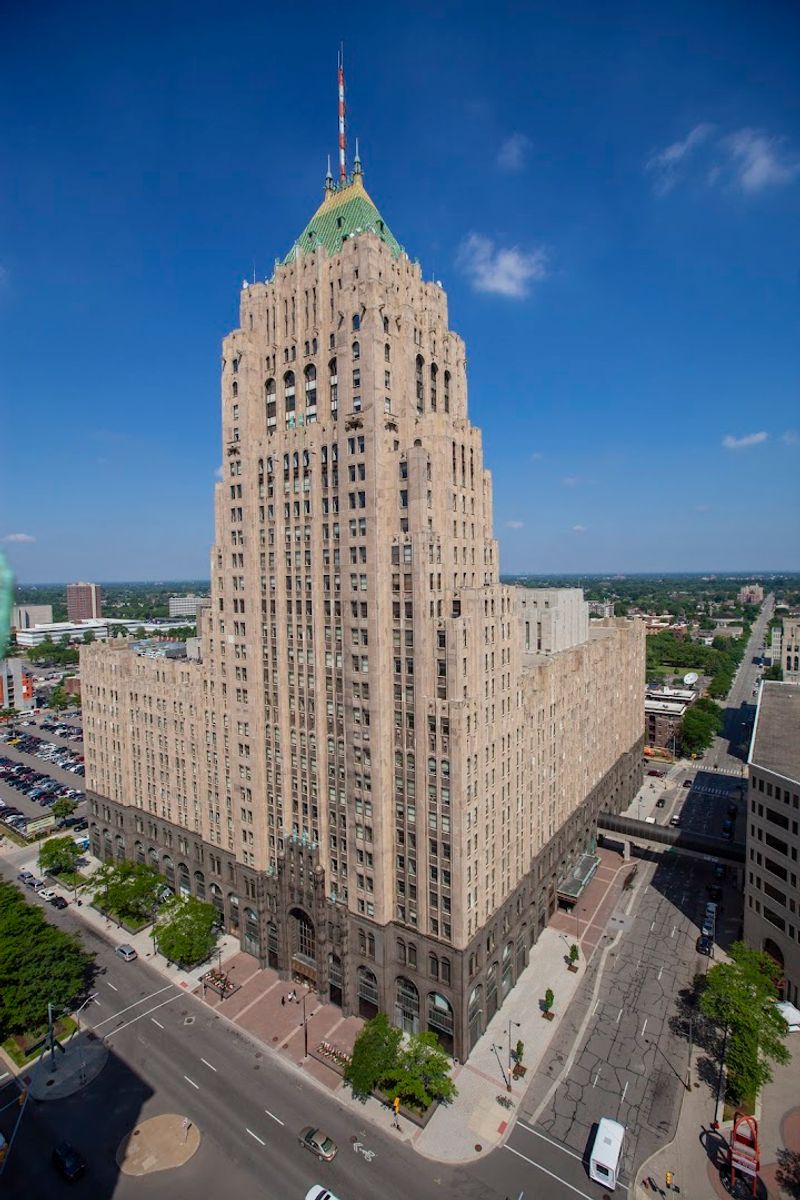
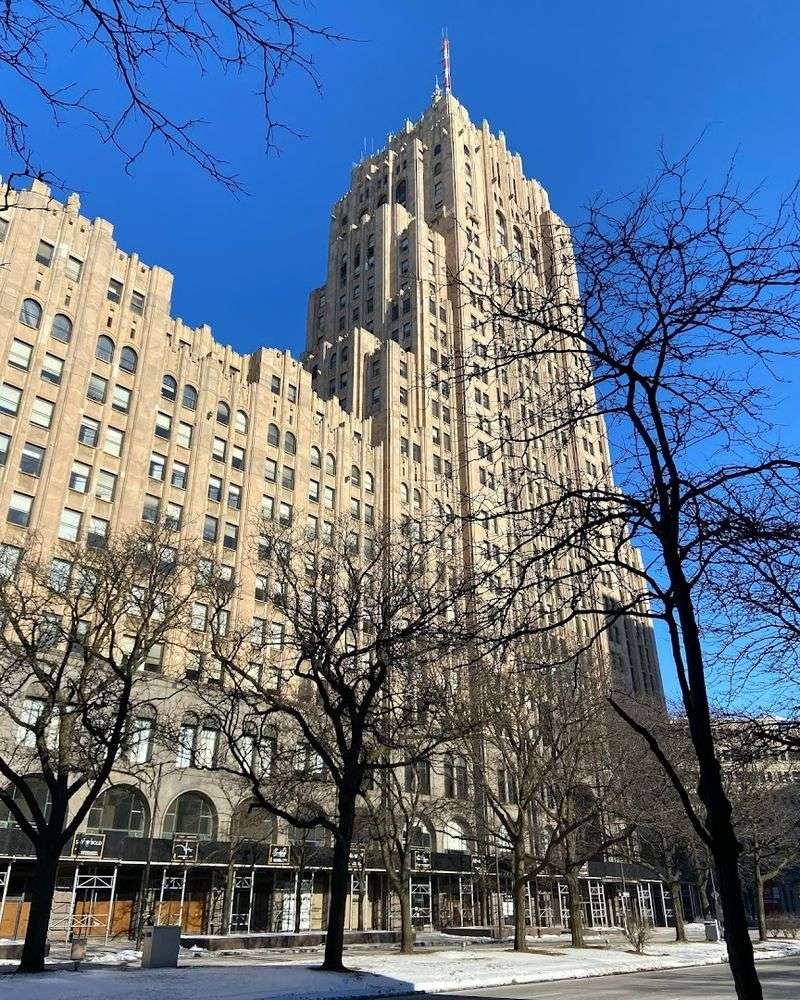
Before you even step inside, the Fisher Building earns your full attention. The exterior is clad in a warm golden-toned terra cotta that catches the light differently depending on the time of day.
Early morning gives it a soft amber glow. Late afternoon turns it almost bronze.
It is the kind of building that makes you slow your car down just to get a second look.
The tower rises with that signature Art Deco confidence — bold vertical lines, geometric ornamentation, and a presence that feels both serious and theatrical at the same time. Architects Albert Kahn and his team clearly wanted this structure to announce itself without apology.
Mission accomplished.
Standing at street level and looking straight up is one of those small, free pleasures that Detroit offers better than almost any other American city. The building does not blend into the skyline.
It punctuates it. First-time visitors often stop on the sidewalk to photograph it before they even realize they are doing it.
The neighborhood surrounding the building, known as New Center, adds to the overall impression. Wide boulevards, older brick buildings nearby, and a sense of scale that feels more European than Midwestern.
One visitor described getting “Italian vibes” from the details, and that comparison actually makes sense once you are standing there in person.
Even with some ongoing construction visible at certain entrances, the exterior commands respect. The patina of age has not dulled it.
If anything, the building looks like it knows exactly what it is — a landmark that was built to last, and has.
Marble Floors and Ceilings That Feel Almost Impossible
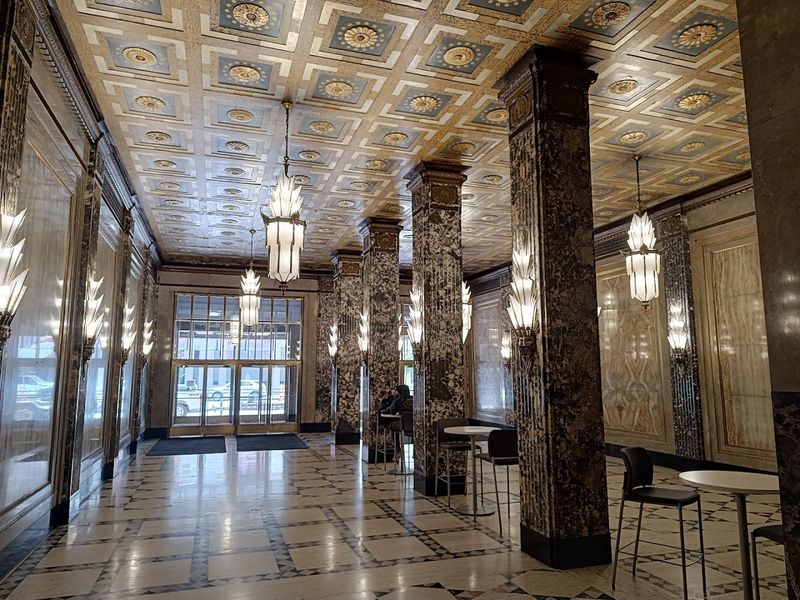
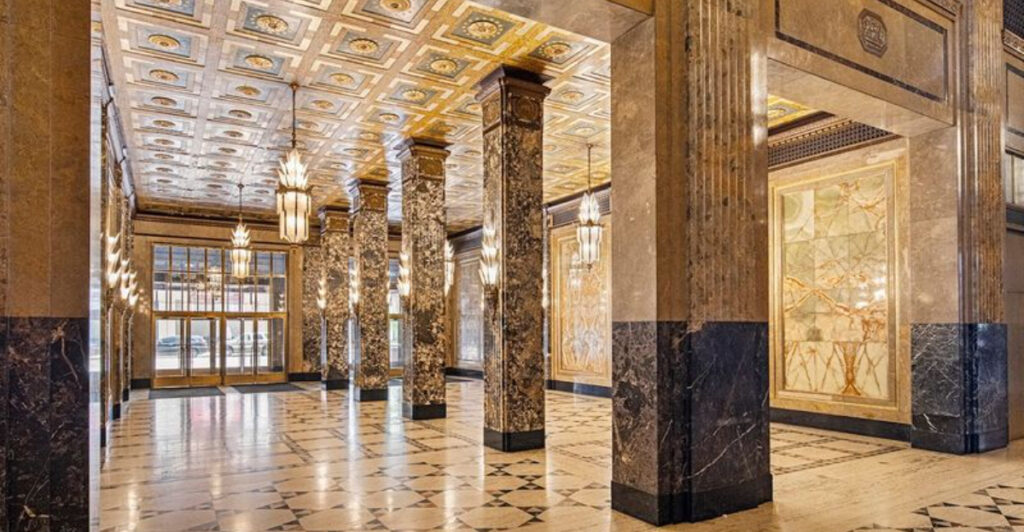
Walking through the main lobby of the Fisher Building is the architectural equivalent of opening a book and realizing it is going to be really, really good. The marble underfoot comes from multiple countries, each slab chosen deliberately, each vein of color part of a larger visual conversation happening across the entire floor plane.
Look down, then look up. Both directions reward the effort.
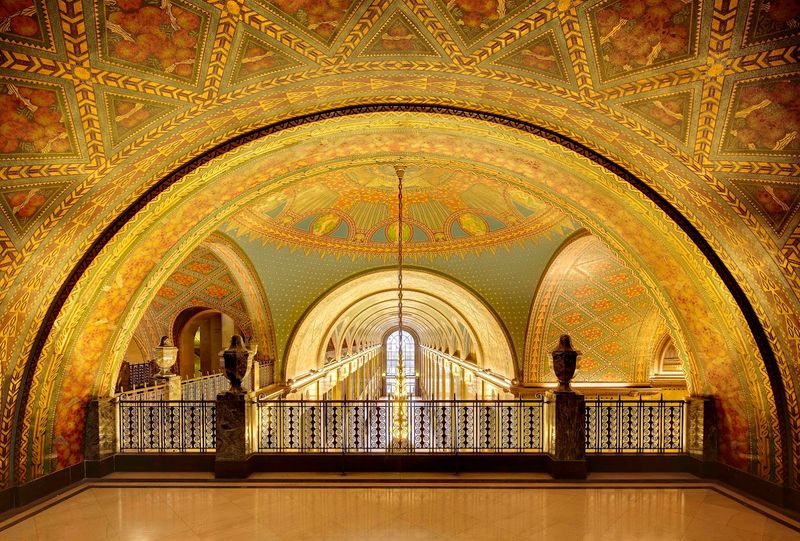
The painted ceilings stretch overhead with geometric patterns, gilded details, and colors that still feel vivid despite their age. It is the kind of craftsmanship that slows people down mid-stride without them fully understanding why at first.
The scale of the lobby is another thing that photographs simply cannot prepare you for. Images make it look impressive.
Being inside it makes you feel genuinely small in the best possible way. The proportions were designed to create exactly that sensation — a kind of civic grandeur that was common in 1920s public architecture and is almost entirely absent from modern construction.
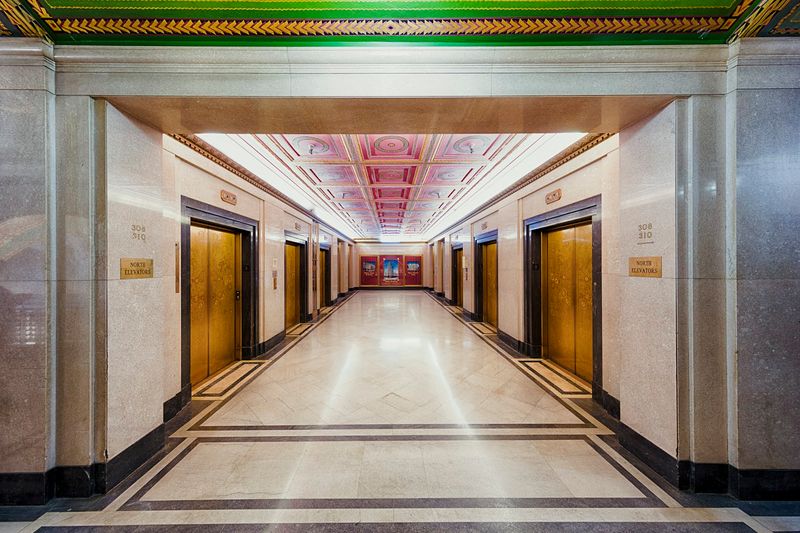
Different corridors within the building have distinct visual personalities. One hallway might lean into rich, dark stone.
Another opens up with lighter marble and brass fixtures that bounce warm light around. Visitors who take the time to wander rather than rush tend to notice that each section feels almost like a separate room in a very large, very elaborate museum.
What makes all of this land so effectively is that it is not roped off or behind glass. You can walk across those floors.
You can stand directly beneath those ceilings. The building invites contact rather than just observation, which makes the whole thing feel genuinely alive rather than preserved and distant.
Free Entry — No Ticket Required to Wander
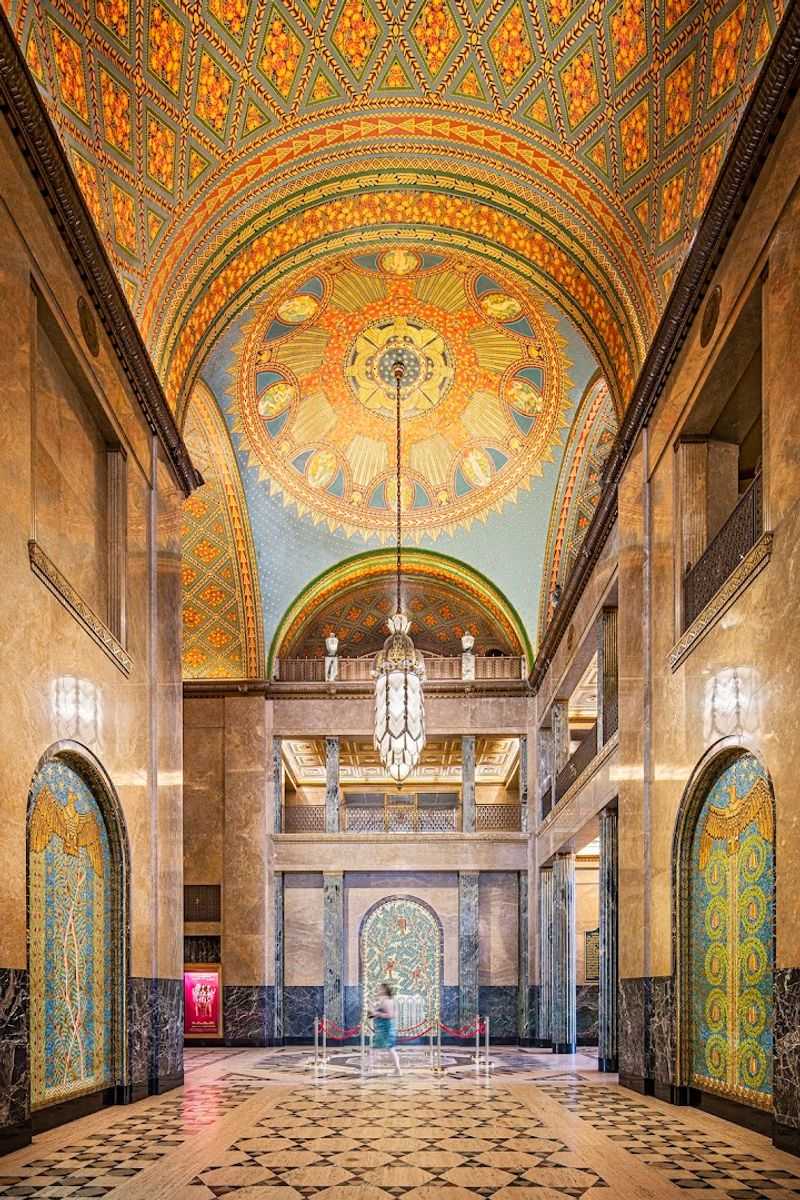
Here is something that surprises a lot of first-time visitors: walking into the Fisher Building costs nothing. The lobby and main corridors are open to the public during regular hours, and nobody stops you at the door to ask for a ticket or a reservation.
You simply walk in.
That openness changes the whole dynamic of a visit. There is no pressure to rush through and feel like you got your money’s worth.
You can spend fifteen minutes or an hour and a half, depending entirely on how deep you want to go. Some people pop in during a lunch break.
Others make an afternoon of it.
The building is generally open from early morning until late evening, which means it fits into a surprisingly wide range of schedules. Whether you are an early riser who wants to see the lobby in quiet morning light or someone ending a night out who wanders in on a whim, the timing tends to work out.
Free access also makes the Fisher Building one of the more democratic landmarks in Detroit. It does not ask you to be a certain kind of visitor or arrive with a specific agenda.
Families with kids, architecture students, tourists from out of state, and longtime Detroit residents all move through the same corridors without any hierarchy of access.
That said, if you want a deeper look at the building’s history and the upper floors that are not accessible during a casual walk-through, guided tours are available through Pure Detroit, the shop located on the first floor. Those tours run for roughly an hour and offer context that significantly changes how you see everything around you.
Worth considering if you have the time to spare.
The Fisher Theatre: Where Broadway Comes to Detroit
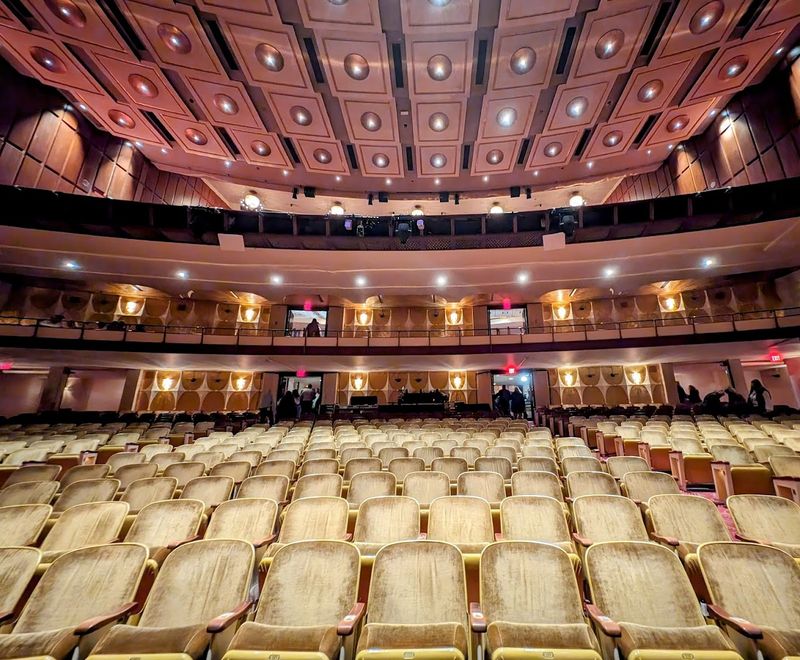
Tucked inside the building is one of the most beautiful performance spaces in the Midwest. The Fisher Theatre has been hosting major productions for decades, and its interior is the kind of place that makes you feel like the show has already started before a single performer takes the stage.
The theater’s design leans into the same Art Deco vocabulary as the rest of the building, but with an added layer of drama suited to live performance. Ornate details frame the stage.
The ceiling draws your eye upward in a way that feels intentional and almost ceremonial. Even the seats feel like they were chosen with care rather than efficiency.
Broadway touring productions regularly make the Fisher their Detroit home, which means the programming tends to be genuinely high-caliber. Recent visitors have caught everything from celebrated musicals to dramatic plays, and the consistent feedback is that the theater itself elevates whatever is on stage.
One visitor saw a production based on the life of Alicia Keys and mentioned that the building added an extra layer of occasion to the whole night.
Parking around the Fisher is reportedly easier than you might expect for a major theater in a city environment. Multiple visitors have noted that getting in and out is less stressful than comparable venues, which is a small but meaningful detail when you are trying to enjoy an evening out.
Even if you are not there for a show, the lobby areas near the theater are worth a look. The detailing around the theater entrance gives you a preview of what is inside without requiring a ticket.
Check the Fisher Theatre’s schedule ahead of any Detroit trip — catching a show here is a genuinely different kind of night out.
Guided Tours That Change How You See the Whole Building
Wandering the Fisher Building on your own is rewarding. Taking a guided tour of it is something else entirely.
Pure Detroit, the shop located on the ground floor, offers tours that bring in a level of historical context and behind-the-scenes access that a casual walk-through simply cannot match.
The tours include stops on upper floors that are not open to the general public, which alone makes them worth the time. Seeing the building from different elevations shifts your understanding of its scale and its original purpose.
What looks like elegant decoration at ground level reveals additional layers of intentionality when you start to understand the thinking behind the choices.
Tour guides at the Fisher have earned specific praise in visitor reviews. One guest called out a guide named Jacob by name, describing him as genuinely knowledgeable, funny, and clearly passionate about the building’s history.
That kind of personal enthusiasm tends to make historical information stick in a way that reading a placard never quite does.
The tours reportedly last around an hour, which is enough time to cover significant ground without feeling rushed. Groups tend to stay small enough that you can actually hear what is being said and ask questions without fighting for attention.
Several visitors have noted that the tour reframed details they had walked right past during their initial self-guided exploration.
Saturday tours have been mentioned by multiple visitors as a reliable option, though checking ahead for current availability and scheduling makes sense before planning around it. For anyone with even a passing interest in architecture or Detroit history, the guided tour format transforms the Fisher Building from an impressive backdrop into a place you actually understand — and that shift matters more than it might sound.
Shops, Coffee, and a Bookstore Worth Browsing
The Fisher Building is not just something to look at. It is also a place to actually spend time in, partly because the ground floor has been slowly filling with shops and small businesses that make lingering feel natural rather than forced.
A Born in the D shop is one of the more locally beloved stops, carrying Detroit-themed goods that lean toward quality rather than tourist novelty. There is also a bookstore, a clothing boutique, a convenience store, and what one visitor described as an old-style pharmacy that felt like a genuine throwback.
The mix is eclectic in a way that reflects the building’s own personality — a little formal, a little unexpected.
Coffee is available inside the building as well, which matters more than it might seem. Having a place to sit down with a cup of something warm and look around at the architecture from a stationary position changes the whole pace of a visit.
You stop rushing from detail to detail and start actually absorbing where you are.
Some visitors have noted that the shops lean on the pricier side, which is worth knowing ahead of time if you are on a tight budget. But browsing costs nothing, and the shops themselves tend to be thoughtfully curated rather than generic.
The retail presence is still growing — the building is in the middle of a slow, ongoing renewal — so each visit might reveal something that was not there before.
The overall vibe on the ground floor is unhurried. People move at a pace that matches the architecture, which is to say they take their time.
It is the kind of place where you might go in planning to spend twenty minutes and find yourself still there an hour later, coffee in hand, wondering what you missed.
A Location That Connects You to Detroit’s Broader Story
The Fisher Building does not exist in isolation. Its address on West Grand Boulevard places it in Detroit’s New Center neighborhood, an area that carries its own weight in the city’s larger history.
The boulevard itself is wide and tree-lined, built during an era when Detroit had serious ambitions about what a world-class American city should look like.
From the Fisher Building, the Motown Museum is roughly a twelve-to-fifteen minute walk away. That proximity is not a coincidence — this part of Detroit was once a hub of cultural and commercial energy, and traces of that history are still visible in the buildings that surround the area.
Knowing that context makes standing in front of the Fisher feel like standing at an intersection of multiple important stories.
The neighborhood is in a visible state of transition. Some blocks feel fully revitalized.
Others are still working through it. But the Fisher Building itself functions as an anchor point — something stable and significant around which renewal keeps orienting itself.
A slow but real residential and commercial momentum is building in the area, and visitors who pay attention will notice small signs of it.
Getting to the Fisher is straightforward whether you are driving in from the suburbs or navigating from downtown Detroit. Parking options in the area are generally described as plentiful, which removes one of the common friction points of visiting urban landmarks.
The building is also accessible enough that it fits naturally into a broader Detroit day rather than requiring a dedicated solo trip.
There is something about arriving at the Fisher Building from the street — catching that golden facade through your windshield or rounding a corner on foot — that makes the surrounding city feel more coherent. Like the building has always been the thing the neighborhood was arranged around, even when the neighborhood itself forgot that for a while.
Share this story