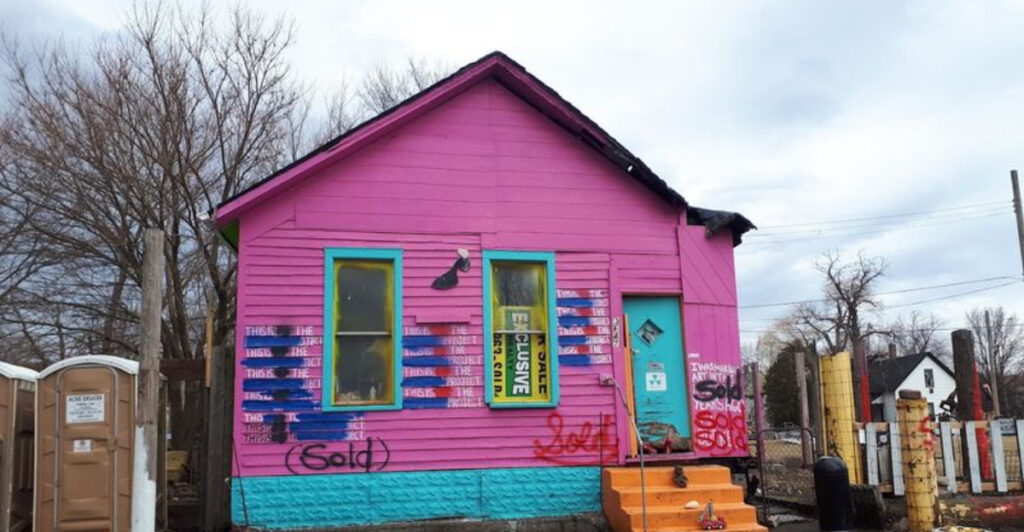
Tucked inside a quiet residential block on Detroit’s east side, the Heidelberg Project is unlike anything you’ve probably seen before. Old shoes, painted clocks, stuffed animals, and polka dots cover houses, trees, and empty lots in ways that make you stop and think.
Created by artist Tyree Guyton, this outdoor art space transforms what others threw away into something that sparks real conversation about community, neglect, and hope. Come with an open mind, and you might leave seeing the world a little differently.
The Polka Dot World That Started It All
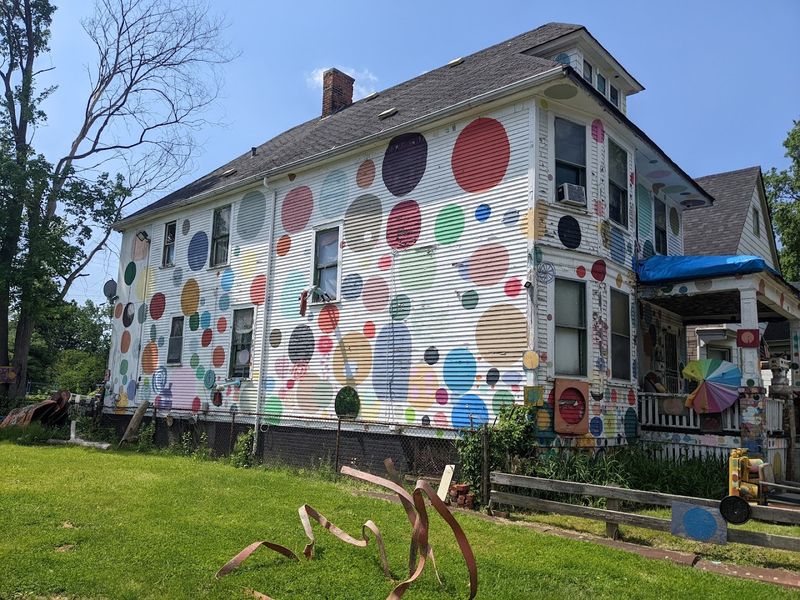
Bright circles of color cover nearly every surface on Heidelberg Street. Red, yellow, blue, and white dots appear on the road itself, on tree trunks, on old wooden fences, and across the walls of houses that have seen better decades.
It sounds chaotic on paper, but standing in the middle of it feels strangely calm.
Tyree Guyton began painting polka dots on his childhood block years ago as a way of reclaiming a neighborhood that had been left behind. The dots weren’t random decoration.
They were a statement — that beauty can exist anywhere, even in a place the rest of the city had stopped paying attention to. Over time, the dots became the visual language of the entire project.
What’s interesting is how the pattern changes depending on where you stand. From a distance, the dots read almost like abstract wallpaper.
Up close, you notice the layers — older paint showing beneath newer coats, places where rain and sun have worn things down, spots where someone clearly added a fresh circle recently.
Visitors often mention the painted street as one of the first things that catches them off guard. You’re walking on art, which shifts how you move through the space.
Kids tend to hop between dots like stepping stones. Adults slow down and start reading the surfaces more carefully.
Even on a gray Detroit morning, the dots hold color in a way that feels almost defiant. One long-time visitor described the street as feeling like someone turned the volume up on a block that the rest of the city had muted.
That’s a pretty accurate way to put it. The polka dots are simple, but they carry the whole project’s spirit.
Clocks Everywhere, Time Frozen Nowhere
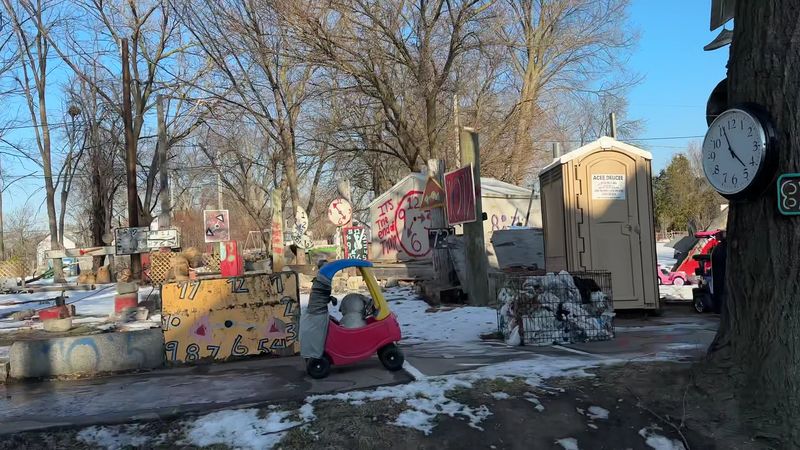
One of the most quietly unsettling parts of the Heidelberg Project is the clocks. Hundreds of them.
Old alarm clocks, wall clocks, clock faces stripped from their housings, grandfather clock parts — all gathered and arranged across surfaces, fences, and wooden frames throughout the installation. None of them are running.
Each shows a different time.
That detail alone could keep you thinking for a while. Is it about how different people experience time differently?
Is it about moments frozen in a neighborhood that the city moved on from? Guyton hasn’t always spelled out the meaning, and that ambiguity is part of what makes the clocks so effective.
You bring your own interpretation, and somehow it fits.
There’s something almost tender about the collection. These are objects people once relied on — things that woke them up for work, reminded them of appointments, hung on kitchen walls for decades.
Pulled from abandoned homes and donated piles, they now form a kind of community of their own, all pointing in different directions, all stopped at different moments.
Standing in front of a wall dense with clock faces, you get this odd feeling that you’re being watched. The round faces do resemble eyes, and several visitors have mentioned that sensation without being prompted.
It’s one of those accidental effects that makes the installation feel alive in ways the artist may or may not have intended.
Photographers tend to linger here longer than anywhere else on the block. The light plays differently across the clock faces depending on the time of day, and the textures — rust, cracked glass, faded numerals — layer in ways that reward close attention.
Bring a camera, or just bring patience. Either works fine here.
Found Objects Turned Into Portraits of a Neighborhood

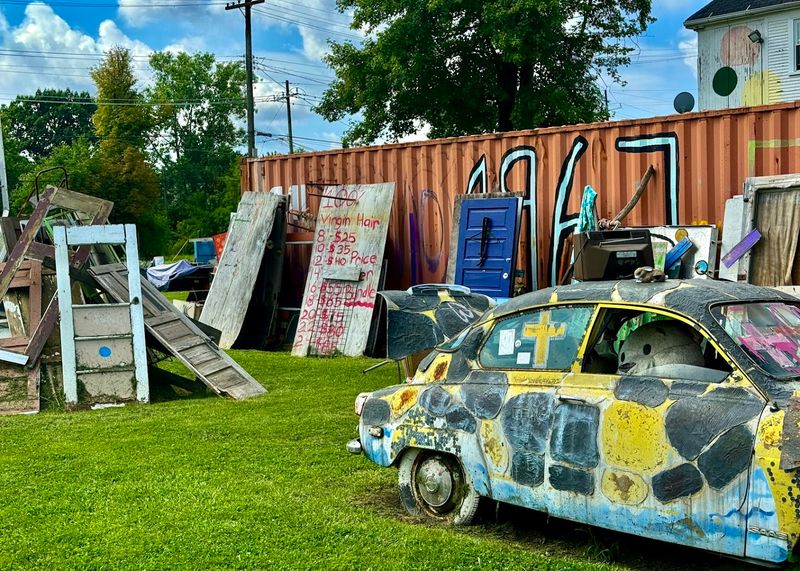
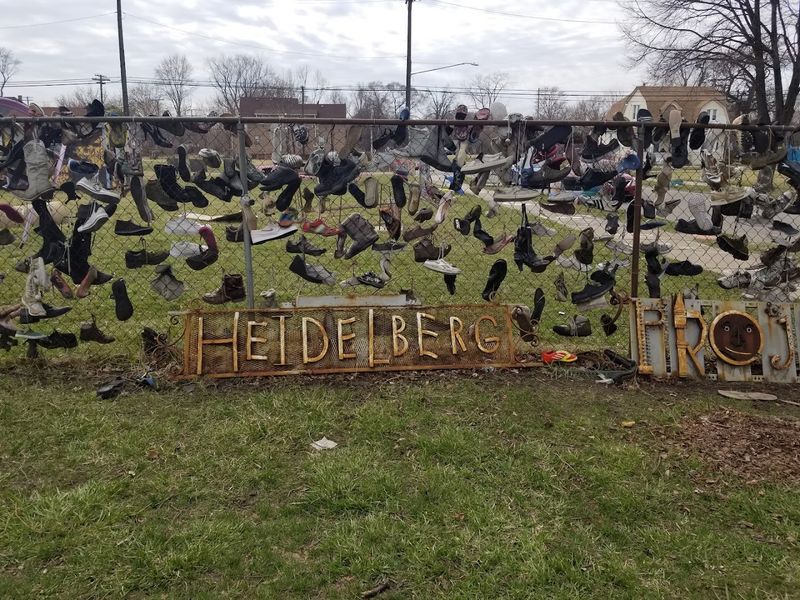
Scattered across the lots and structures of the Heidelberg Project, you’ll find objects that most people would have sent straight to the landfill. Broken televisions.
Worn-out shoes. Grocery carts.
Rusted metal parts. Old toys.
Individually, they’re just junk. Arranged the way Guyton arranges them, they start to look like a portrait of the neighborhood itself — its history, its losses, its stubborn persistence.
This is what people in the art world call found object art, and the Heidelberg Project does it on a scale that’s hard to fully absorb in a single visit. Some installations are dense and piled high, almost like archaeological digs of everyday American life.
Others are spread out more deliberately, giving individual objects room to breathe and be seen on their own terms.
A pair of old work boots nailed to a post. A row of baby dolls with their faces faded by weather.
A shopping cart filled with items that seem chosen with a kind of dark humor. None of it is accidental, even when it looks like it might be.
Guyton has spoken about the intention behind every piece, though the project also welcomes contributions from the community, which gives it an evolving, living quality.
First-time visitors sometimes feel uncertain about what they’re supposed to feel. That uncertainty is actually part of the point.
The project doesn’t hand you a neat emotional conclusion. It puts you in a space where you have to sit with some discomfort, some curiosity, and maybe some recognition of things you’ve walked past without really seeing.
One visitor described it as feeling like someone had turned a neighborhood’s memory inside out and hung it up for everyone to examine. That’s not far off at all.
The Artist Who Lives Inside His Own Work
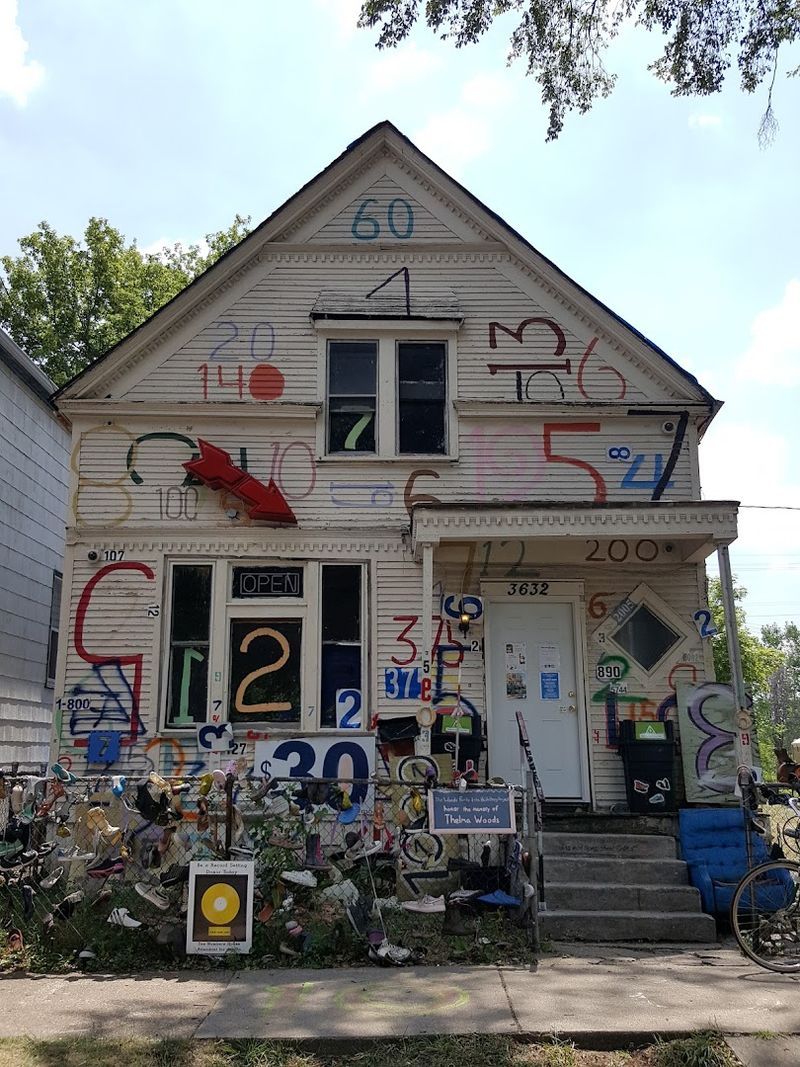
Multiple visitors to the Heidelberg Project mention the same surprise: they met Tyree Guyton himself, right there on the block, talking with people, answering questions, sometimes painting. For a project that carries this much weight in Detroit’s cultural story, there’s something disarming about how accessible its creator is.
Guyton grew up on Heidelberg Street. He watched his childhood neighborhood deteriorate, saw houses abandoned, and decided to respond not with anger or silence but with paint and collected objects.
That personal connection to the place comes through in every corner of the project. This isn’t an artist who parachuted into a struggling neighborhood for a concept piece.
He’s been here the whole time.
People who’ve had conversations with him describe someone who is warm, thoughtful, and genuinely interested in what visitors take away from the work. He’s signed books, painted polka dots with guests, posed for photos, and explained the stories behind specific pieces without making it feel like a rehearsed tour.
That kind of directness is rare.
His presence also shifts how you see the work. Knowing that the person who made all of this grew up right here, that he was responding to something real and personal, adds a layer to every object and every painted surface.
The clocks aren’t just a visual motif — they mean something specific to someone who lived through the changes on this block.
If you visit and happen to see him around, don’t hesitate to say hello. Most visitors who do walk away with something they didn’t expect — not just a better understanding of the project, but a small, genuine human moment in the middle of a very big piece of art.
Those moments tend to stick.
A Neighborhood That Became a Canvas
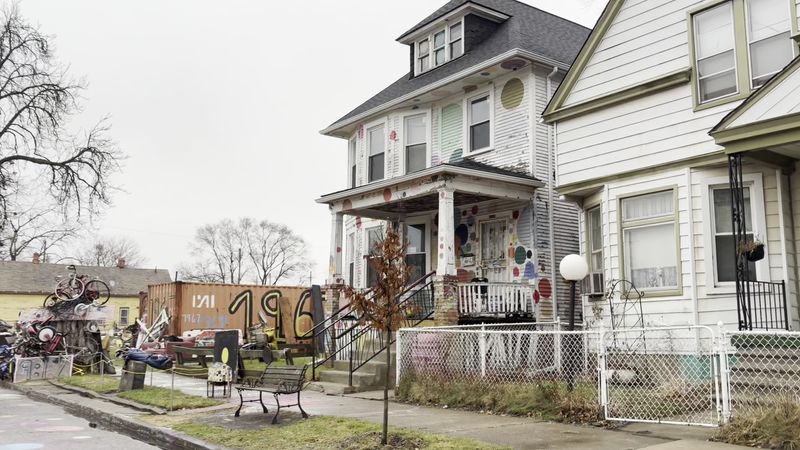
Heidelberg Street looks like a regular Detroit residential block at first glance — narrow, tree-lined, a mix of occupied and empty lots, older homes with weathered facades. Then the color starts registering.
Then the objects. Then you realize the entire block has been transformed into something that functions less like a neighborhood and more like a walk-through gallery with no walls and no ceiling.
Some of the houses on the street are lived in by actual residents. Others have become part of the installation itself, their exteriors completely covered in Guyton’s work.
That blending of the inhabited and the artistic creates an odd, layered quality. You’re never quite sure where everyday life ends and the project begins, which might be the whole point.
The surrounding area carries the weight of a neighborhood that went through serious decline. Empty lots, worn sidewalks, houses in various states of repair — all of that context doesn’t disappear when you’re standing in the middle of the Heidelberg Project.
It’s right there, part of the picture. The art doesn’t pretend the difficulty away.
It sits right alongside it.
Walking the full length of the block takes maybe fifteen minutes at a casual pace, but most people end up going back and forth several times. There’s always something missed on the first pass — a detail on a roofline, a cluster of objects tucked between two structures, a painted message half-hidden under layers of newer work.
The neighborhood itself is part of what makes this place feel different from a conventional art space. You can’t separate the work from its location.
They’re the same thing, and that inseparability gives the project a weight that a gallery setting could never replicate.
Why It’s Free and What That Actually Means
No ticket booth. No admission fee.
No timed entry or reserved slots. The Heidelberg Project is simply open, sitting on a residential street in Detroit’s east side, available to anyone who wants to walk up and look.
That openness is not incidental — it’s central to what the project is trying to do.
Art that costs money to access draws a specific kind of crowd. The Heidelberg Project draws everyone.
On any given visit, you might find retired couples from the suburbs, art students with notebooks, tourists who stumbled onto it while exploring the city, and local kids who treat the block like a playground they’ve always known. That mix of people in one space, all responding differently to the same objects and colors, adds something to the visit that no curated gallery experience replicates.
Being free also removes the pressure to feel like you got your money’s worth. You can spend five minutes or two hours.
You can walk straight through without stopping or stand in front of a single clock wall for twenty minutes trying to figure out what you’re feeling. Nobody is timing you.
Nobody is waiting for you to move along.
That said, donations are genuinely appreciated and go directly toward maintaining and expanding the installation. Weather, time, and foot traffic take a toll on outdoor work, and the project operates as a nonprofit.
Dropping something in the donation box isn’t required, but it keeps the block alive.
Visiting for free doesn’t mean taking for free. Plenty of people leave having given something — time, attention, conversation with the artist, a small financial contribution.
The project seems to operate on the idea that showing up and actually looking is already a form of participation. And honestly, that’s enough to start with.
What the Project Says About Detroit That Words Can’t
Detroit carries a complicated reputation, and the Heidelberg Project doesn’t try to smooth that over. If anything, it leans into the tension.
The abandoned lots, the worn-down houses, the objects collected from homes that no longer have families in them — all of that is present in the work, not hidden behind a cheerful coat of paint.
What Guyton built here is partly a monument to resilience and partly an indictment of neglect. Both things coexist without apology.
You can feel civic pride and civic grief in the same moment standing on that block, which is a more honest representation of what Detroit has been through than most official narratives manage.
Visitors who grew up in Detroit or who have watched the city’s story from a distance often describe a particular kind of emotion here — something between recognition and grief and something that doesn’t quite have a name. One reviewer mentioned getting emotional without fully understanding why.
That reaction makes sense. The project is doing something that good art always does: it gets to the thing underneath the thing.
For people coming from outside the city, the Heidelberg Project offers a kind of context that a downtown hotel or a riverfront restaurant can’t provide. It shows you a Detroit that has been fighting with creativity rather than waiting for rescue.
That’s a different story than the one most headlines tell.
The project has survived controversy, city attempts to demolish parts of it, fires, and years of debate about what it means for the neighborhood. It’s still here.
Still adding new pieces. Still drawing people from across the country and beyond.
Whatever it’s saying, it’s saying it loudly enough that people keep showing up to listen.