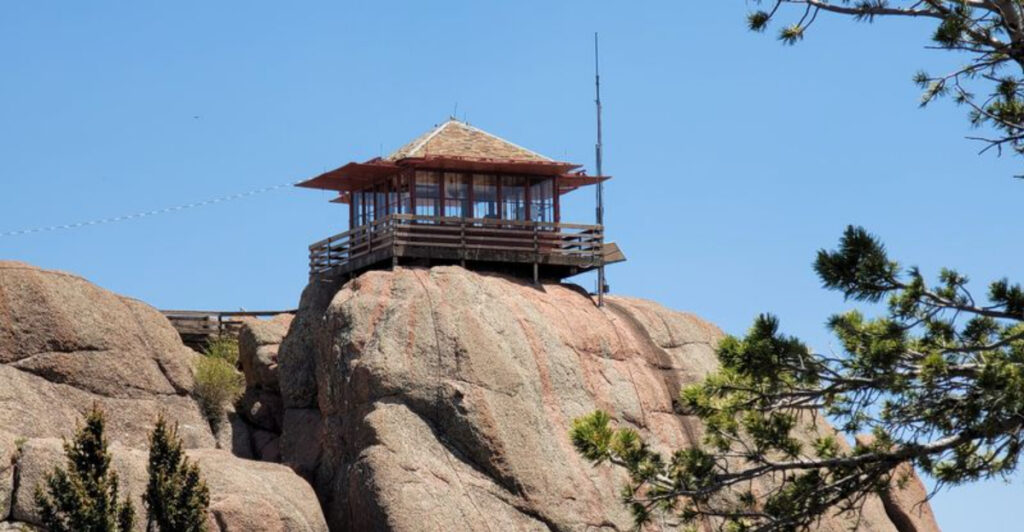
Colorado is full of unforgettable mountain adventures, but few are as unique as spending the night at Devil’s Head Lookout. Perched high above the Pike National Forest, this historic fire lookout offers breathtaking views, remarkable solitude, and an overnight experience unlike anything else in the state.
Reaching the tower requires a scenic hike, but the reward is a front-row seat to sweeping mountain landscapes and some of Colorado’s most spectacular sunsets and stargazing. For travelers seeking a memorable escape that blends history, outdoor adventure, and incredible scenery, Devil’s Head Lookout is a destination that stands in a class of its own.
Where the Trees Break and the Rock Takes Over
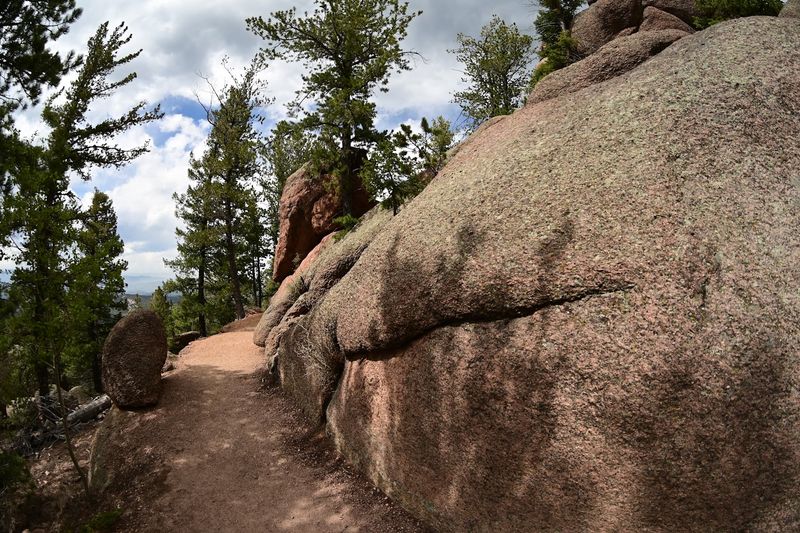
The approach to Devil’s Head plays a clever trick. It begins as a wooded walk through tall pines and filtered shade, the kind of trail that keeps its headline hidden for a while.
Then the trees loosen, the granite starts pushing through, and the whole setting shifts from forest stroll to exposed mountain drama.
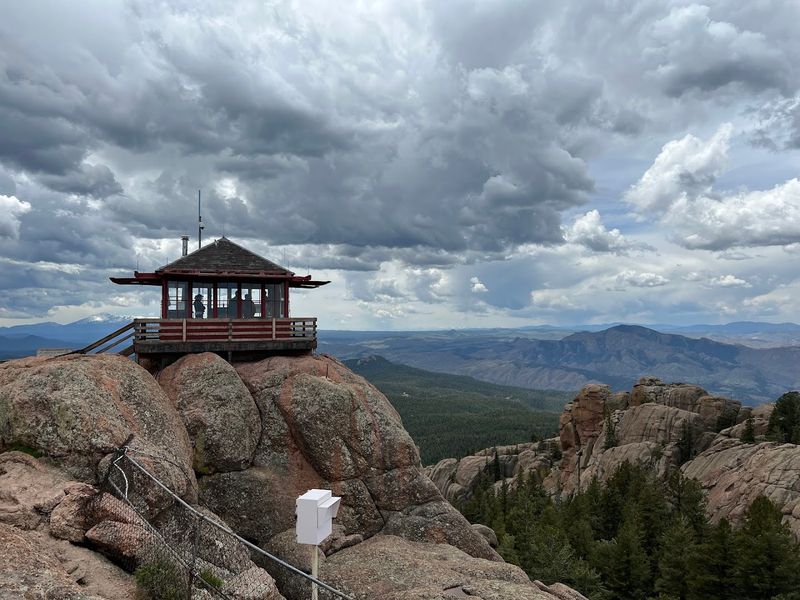
That contrast is the first big thrill here. Instead of giving away the best view too early, the trail builds anticipation with switchbacks, trunks, and glimpses of sky until the lookout finally appears where the rock spine narrows.
The tower looks improbably placed, almost pinned to the summit, with its stairway drawing a hard red line against the stone.
From below, the structure reads as both practical and theatrical. It was built to watch for smoke, yet the perch looks almost cinematic, suspended over a sea of treetops that run deep into Pike National Forest.
You are not simply reaching a viewpoint. You are approaching a working idea from another era, one that still makes immediate visual sense the second it comes into view.
Even before the final climb, the location explains its own reputation. The summit is rocky rather than sprawling, so the lookout feels concentrated and vertical instead of broad and relaxed.
Every angle tightens the focus. The stairs, the timber cabin, the slabs of granite, and the drop to the forest floor all combine into a scene that looks far more dramatic than the hike’s mileage might suggest.
That reveal is why Devil’s Head lands differently from many easy-to-moderate mountain outings. It does not rely on a distant overlook alone. It delivers a staged progression, ending with architecture balanced on bare stone high above the green canopy.
The Staircase That Turns a Hike Into a Story
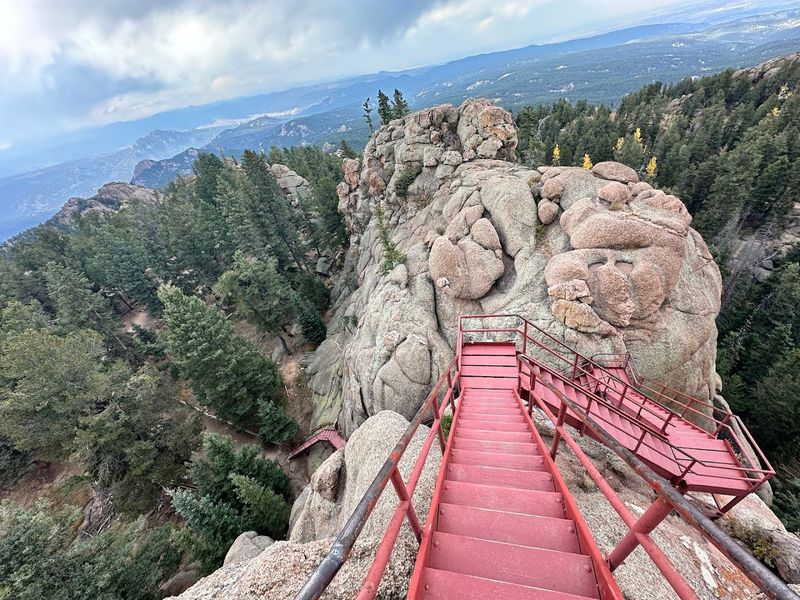
Most of the trail feels approachable, but the staircase is the part that changes the mood. After the forested climb, you arrive at those famous red steps and suddenly the outing becomes more vertical, more exposed, and much more memorable.
The stairs are not decorative. They are the final test between a pleasant hike and the summit experience everyone talks about afterward.
That shift matters because the last stretch asks for a different kind of attention. You are no longer cruising under trees or pacing yourself on dirt.
You are placing each step on an elevated run of metal and wood attached to rock, with open air where a normal trail would give you shoulder room. For anyone mildly uneasy with heights, the pulse can spike right there.
Still, the staircase is part of the genius of Devil’s Head. It is dramatic without being absurd, and its narrow, direct climb makes the lookout feel earned in a way that a broad gravel path never could.
The structure announces exactly what kind of place this is: functional, historic, and unapologetically perched. The reward begins before you even reach the top, because the scenery keeps widening with each flight.
At the summit, the sense of elevation becomes the whole point. Forest, ridges, and distant peaks unfold in a nearly continuous sweep, and the tower suddenly seems less intimidating than perfectly logical.
Of course this is where a lookout would stand. Of course the stairs had to be bold enough to reach it. That final climb is short, but it gives Devil’s Head its signature image. Many trails offer views. Very few deliver them by sending you up a staircase bolted toward the sky.
A Colorado Summit With an Unusually Human Scale
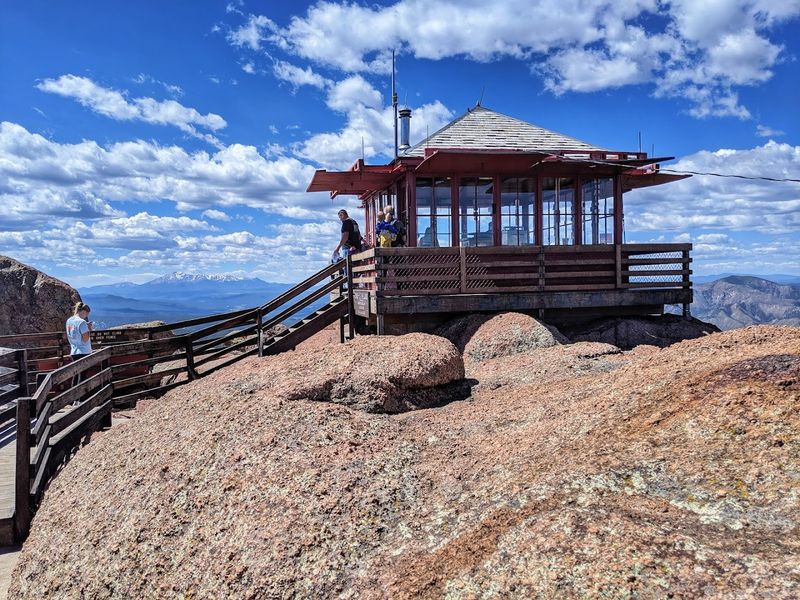
One reason Devil’s Head stands out is scale. Plenty of Colorado viewpoints feel enormous in a way that can blur into abstraction, all skyline and distance without much intimacy.
This one is different. The summit is compact, the tower is close enough to study, and the whole experience stays grounded in tangible details even while the views run for miles.
You notice the grain of the wood, the shape of the stairs, the way the lookout sits on the granite rather than dominating it. There is a practical roughness to the design that fits the setting.
Nothing about it looks ornamental. The tower belongs to a long tradition of mountain utility, when remote structures were built to do a job first and impress people second.
That human scale keeps the place engaging after the initial wow factor. Instead of taking one quick panorama and moving on, you start observing how the summit works.
Rest spots along the route matter because the climb rises steadily. The final landing matters because space gets tighter.
The lookout itself matters because it turns a scenic destination into a lived-in piece of mountain infrastructure. This is also where the overnight idea becomes so intriguing. A fire lookout is not simply a cabin with a view.
It is a tiny outpost designed around exposure, vigilance, and altitude. Even the thought of spending a night in that setting adds a new layer to the experience, because the place already feels halfway between backcountry shelter and skybox. At Devil’s Head, grandeur does not erase texture. The scene stays specific.
Rock underfoot, timber above, forest below, and a summit arrangement that makes the mountain feel inhabitable for a moment instead of just admired from a distance.
Why the Overnight Angle Changes Everything
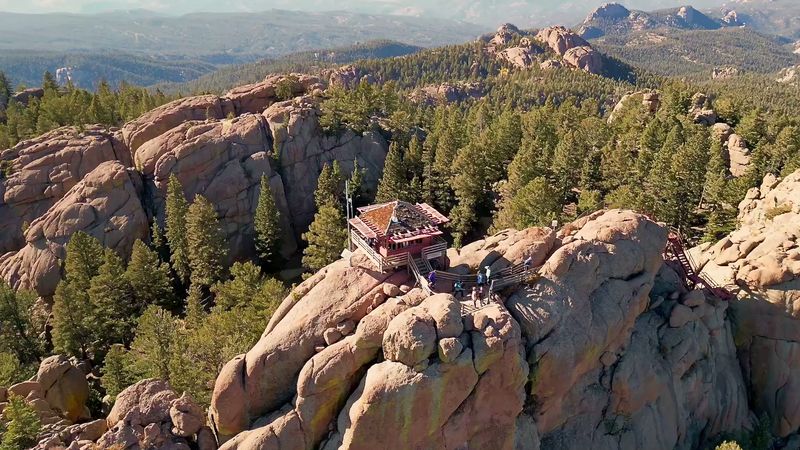
The headline appeal here is not only the hike or the staircase. It is the idea of a historic fire lookout connected to the rare possibility of staying where the watch once happened, high above the forest and close to the weather.
That overnight angle changes your reading of the entire place. During a standard day hike, the tower is dramatic. Framed as a place where a night could unfold, it becomes extraordinary.
Fire lookouts carry a built-in romance, but Devil’s Head keeps that romance tied to function. This is not luxury in the mountain-retreat sense.
It is small-space altitude, exposed horizons, changing light, and the deep quiet that arrives once day traffic fades. Even imagining sunset from this perch sharpens every daytime detail, from the narrow stairs to the way the granite summit drops into trees on all sides.
That perspective also gives the structure more narrative weight. A lookout is about vigilance, weather, distance, and isolation, all packed into a simple form.
Instead of standing at a broad overlook for ten minutes and heading back down, you start picturing dawn up here, cloud layers shifting below, and first light hitting the tower before the trail fills with hikers.
Because overnight access can depend on management and season, the exact logistics should always be confirmed before planning around them. Still, the possibility itself is powerful.
It makes Devil’s Head feel less like a scenic stop and more like a mountain outpost with a second life beyond daytime recreation.
That is the secret of the place. Even on a short visit, the summit invites a longer imagination. You do not just look outward from Devil’s Head. You picture what the mountain becomes after everyone else heads back down.
The Road In Is Part of the Filter
Devil’s Head does not hand itself over too easily, and that starts before the trail. The access road has a reputation of its own, with long unpaved stretches, washboard sections, dust, and the sort of jolting ride that makes drivers pay attention.
That approach acts like a filter. It keeps the outing from feeling casual in the polished, pull-off-and-stroll sense, even though the hike itself is manageable for many people.
The road matters because it shapes expectations. By the time you reach the trailhead, there is already a sense that you have left the smooth front-country rhythm behind.
The mountain has required a little effort before a single hiking step, which changes how the lookout registers once it appears.
A tower on a granite summit after a rough forest road feels appropriately remote. A tower reached from easy pavement would read very differently.
Parking is another practical piece of the story. Spaces can fill quickly, especially on warm weekends, so timing can be the difference between a smooth start and a frustrating turnaround.
Early arrivals gain more than convenience. They usually get cooler temperatures, softer light through the trees, and a quieter pace on the uphill stretch.
None of that makes Devil’s Head inaccessible, but it does make it less spontaneous than some Front Range favorites. Planning helps.
Good footwear helps. Water matters, because the climb gains elevation fast enough to surprise anyone who mistakes short mileage for no effort.
In a way, the road and parking situation protect the experience. They discourage half-prepared drop-ins and reward a little intention.
By the time the summit opens up, the lookout already feels like a place you traveled to, not just a spot you happened to pass.
Best Timing for Clouds, Light, and Breathing Room
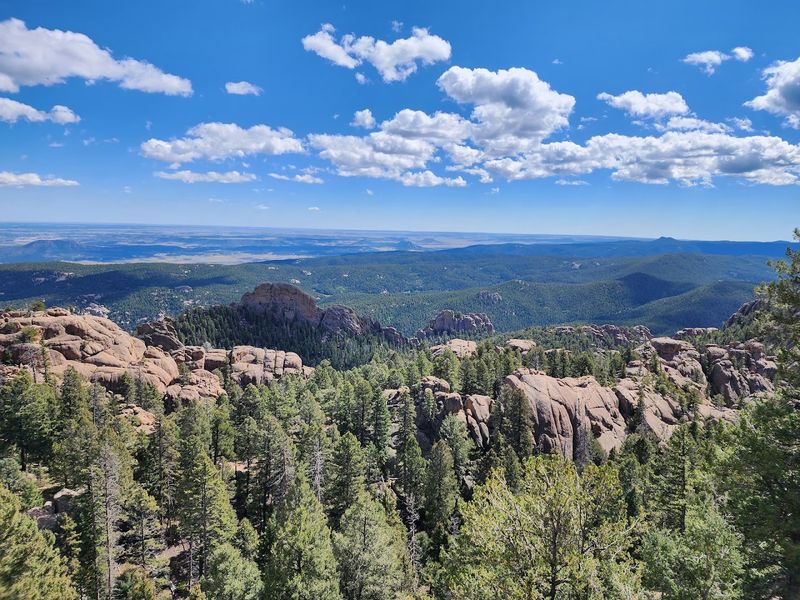
If the goal is to catch Devil’s Head at its sharpest, timing is not a side note. This is one of those places where the hour of arrival changes the entire character of the hike, from trailhead logistics to summit visibility.
Early morning is the strongest play. The air is cooler, parking odds are better, and the forest tends to feel calmer before the late-day buildup.
That cooler start matters more than it first appears. The trail climbs steadily enough to raise your breathing, and afternoon sun can turn a short ascent into a hotter, slower effort.
In the morning, the wooded sections work in your favor, and the summit often arrives with cleaner light that gives the surrounding ridges more shape. Photos also benefit.
The tower, stairs, and granite stand out better when harsh overhead glare has not flattened everything. Weather shifts deserve attention here too. Because the lookout sits high and exposed, conditions can feel different at the top than they do at the parking area.
Clouds can move in, temperatures can drop, and the wind can make the summit read cooler and rougher than expected. That is part of the drama, especially if cloud bands settle low enough to make the lookout seem suspended over them, but it is best enjoyed with an extra layer ready.
Weekdays usually offer the easiest rhythm. On busier weekends, the trail can still be enjoyable, yet the summit’s tighter spaces feel more crowded simply because the setting is so compact. Dogs, kids, seasoned hikers, and first-timers all converge on the same staircase.
Pick the timing well, and Devil’s Head gives you its best version: crisp air, manageable footing, and a tower rising above a forest that still looks half asleep.
Why Devil’s Head Still Beats a Dozen Bigger Hikes
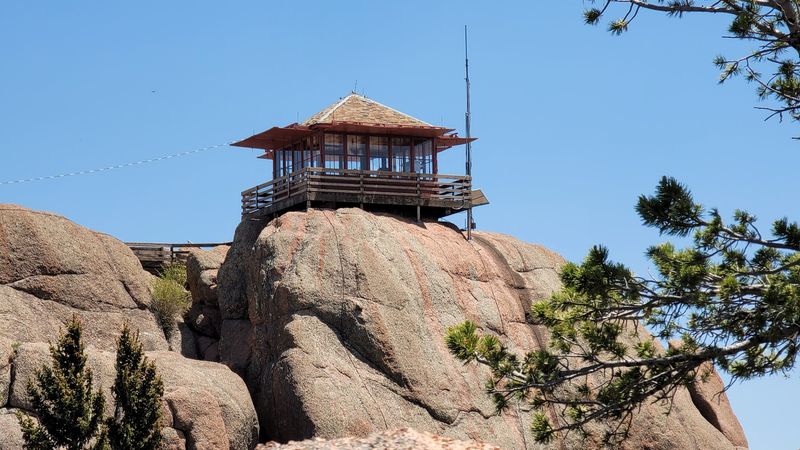
Colorado is crowded with scenic hikes, which makes Devil’s Head’s staying power more interesting. It is not the longest trail, not the wildest summit, and not the most punishing climb.
Yet it keeps pulling attention because it combines several experiences that usually live on separate outings. You get a forest walk, a granite finale, a historic structure, a staircase with actual adrenaline, and a summit perspective that feels unusually earned for the distance.
That mix gives the place a strong editorial shape. There is a beginning with shade and anticipation, a middle built around steady uphill effort, and a final act that looks almost impossible from below.
The lookout is not a random extra at the top. It is the reason the entire route has tension. Every switchback makes more sense once the tower comes into view, perched exactly where a fire watcher would need it.
There is also the rare satisfaction of seeing utility become beauty. The tower was not built as a scenic gimmick, but it now delivers one of the Front Range’s most distinctive mountain images.
That kind of place tends to last in conversation because it is instantly recognizable. Say red stairs on granite leading to a lookout above the trees, and anyone who has been here knows the scene.
For travelers looking for a mountain experience with real character, Devil’s Head has a sharper identity than many larger destinations. It does not need alpine lakes, wildflower hype, or a sprawling summit meadow to hold attention.
Its power comes from placement, structure, and a route that reveals itself in stages. That is why this lookout stands apart. It turns a relatively short Colorado hike into a full narrative, ending high above the canopy where the horizon finally takes over.
Share this story