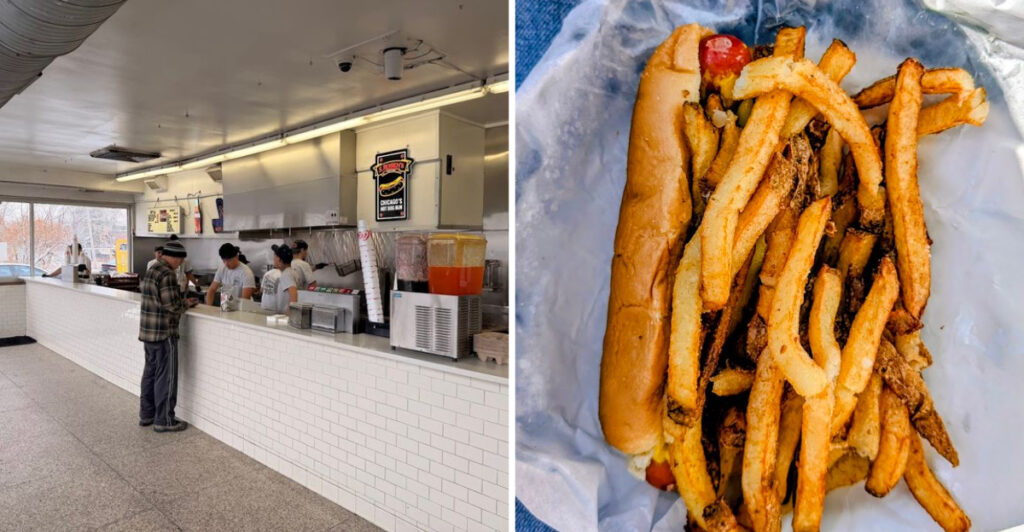
Chicago is famous for its hot dogs, but few places have achieved legendary status quite like Gene & Jude’s in River Grove. For decades, this no-frills stand has attracted loyal customers with a formula that refuses to change: perfectly cooked hot dogs, hand-cut fries piled right on top, and a streamlined menu focused on doing a few things exceptionally well.
The atmosphere is fast-paced, the lines are often long, and the experience feels refreshingly authentic in an era of endless customization. If you’re searching for one of Illinois’ most iconic food destinations, Gene & Jude’s remains a must-visit stop.
A Bright Counter on River Road
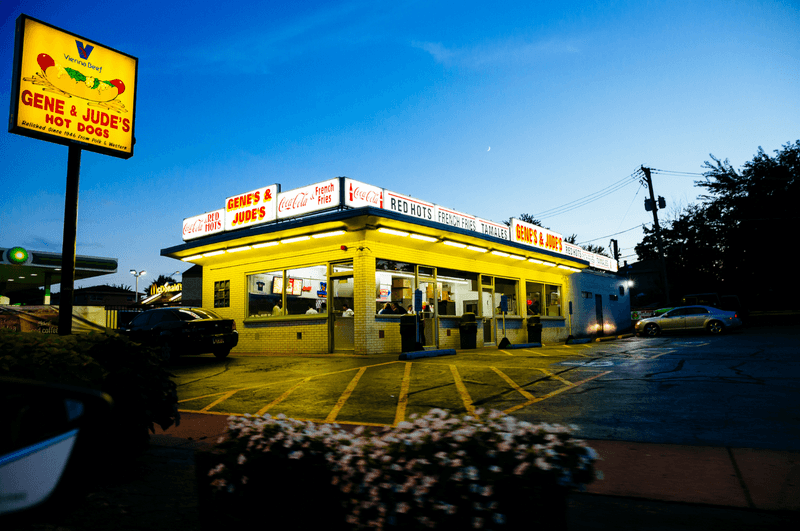
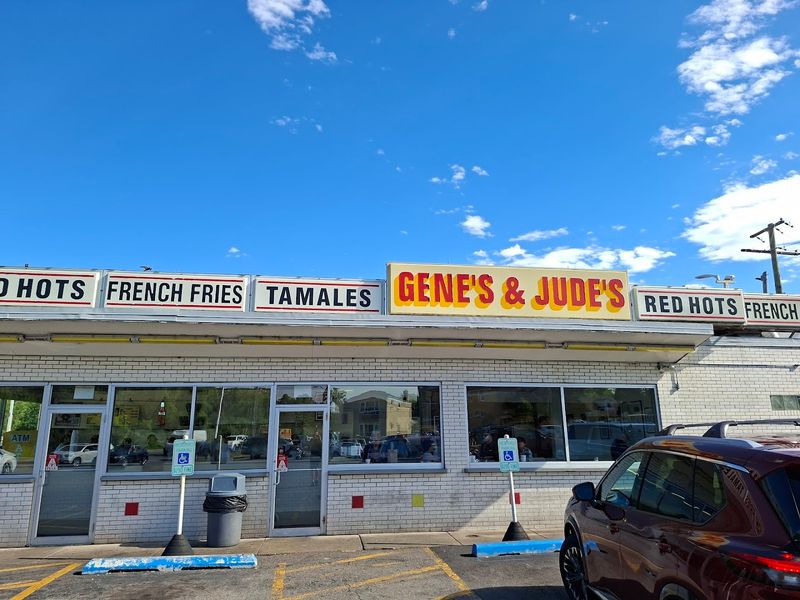
River Road is not short on traffic, but Gene & Jude’s has a way of pulling your eyes straight to it anyway. The building reads like a classic roadside stand rather than a polished destination restaurant, and that understatement is part of the draw.
Nothing about the setup tries too hard, yet the line, the pace, and the steady stream of cars make it obvious that this spot operates on reputation, not decoration.
Its visual appeal comes from function more than styling. You see people moving with purpose, food leaving the counter fast, and a rhythm that suggests the place has done this thousands of times without needing to explain itself.
There is an old Chicago area practicality to the whole scene, where the excitement comes from what is happening, not from how elaborately it is framed.
That first look also tells you what kind of meal this will be. This is not a lingering sit-down experience built around comfort, courses, or mood lighting.
It is a compact burst of heat, salt, steam, and motion, the kind of place where decisions are made quickly, orders are short, and the reward is immediate.
Even before the first bite, the crowd becomes part of the experience. Some diners head straight to the standing counter, others carry bags to the car, and plenty seem to know exactly how the routine works.
Gene & Jude’s looks unassuming at a glance, but the movement around it gives the game away. This is a landmark hiding inside a very modest shell.
The Double Dog, Built the House Way
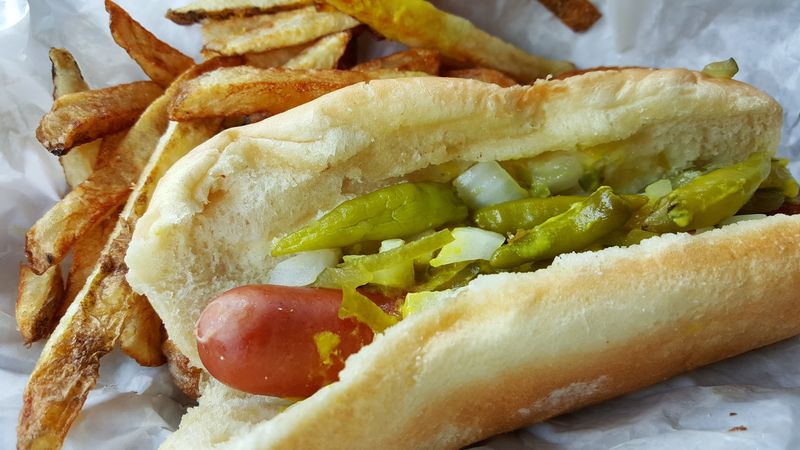
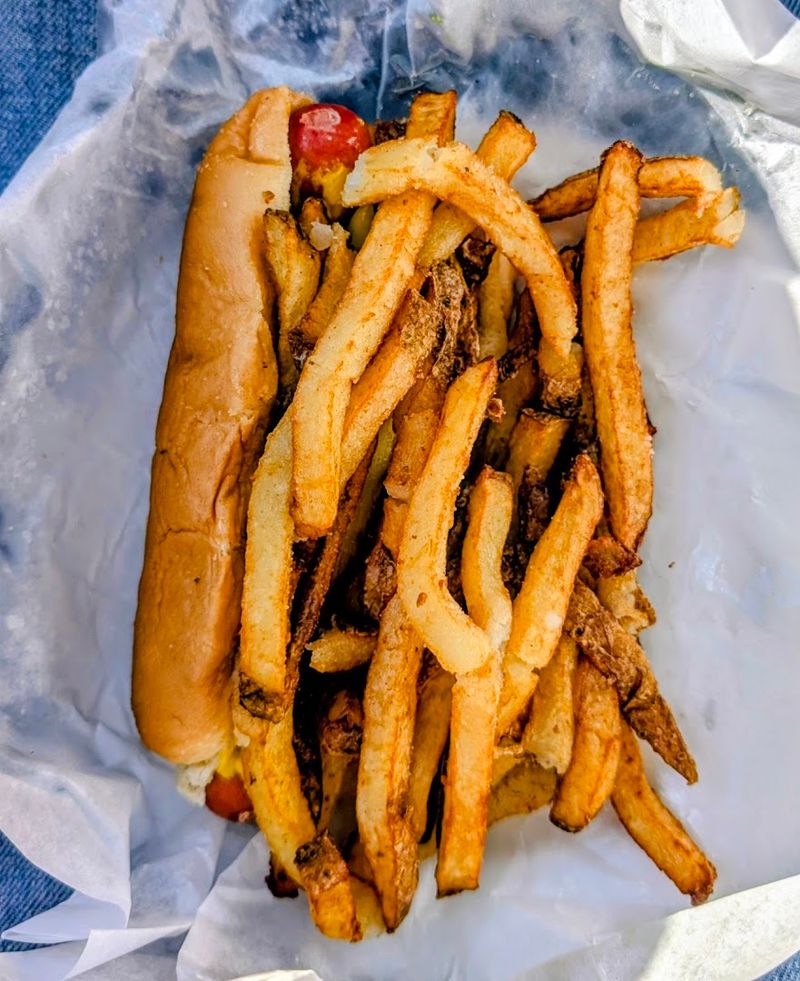
The signature order lands with zero fuss and zero confusion. A hot dog here is not dressed for spectacle or stacked for social media balance; it is assembled for momentum, with a steamed bun, a snappy dog, classic Chicago-style toppings, and a tumble of hot fries right over the top.
The presentation looks almost unruly at first, but the mess is the point. That pile of fries changes the whole structure of the bite.
Instead of sitting politely on the side, they become part of the sandwich, adding heat, salt, and a just-fried softness that presses into the bun while still keeping rough edges. Every component overlaps, so you are not eating separate elements as much as one fast, compressed idea.
The dog itself is expected to carry its share, and it does. A proper snap matters at a place like this because the toppings and fries already bring softness, moisture, and texture from every direction.
That contrast keeps the hot dog from disappearing under the extras, which helps explain why the sandwich still reads clearly even when wrapped in so much activity.
There is also something confident about how little adjustment the formula asks for. Gene & Jude’s is not trying to hand you endless customization or a giant decision tree.
It is handing over a finished argument about how this food should taste when timing, proportion, and heat are all exactly where they need to be. The first bite usually explains the line more effectively than any history lesson could.
Fresh-Cut Fries That Refuse to Be Background
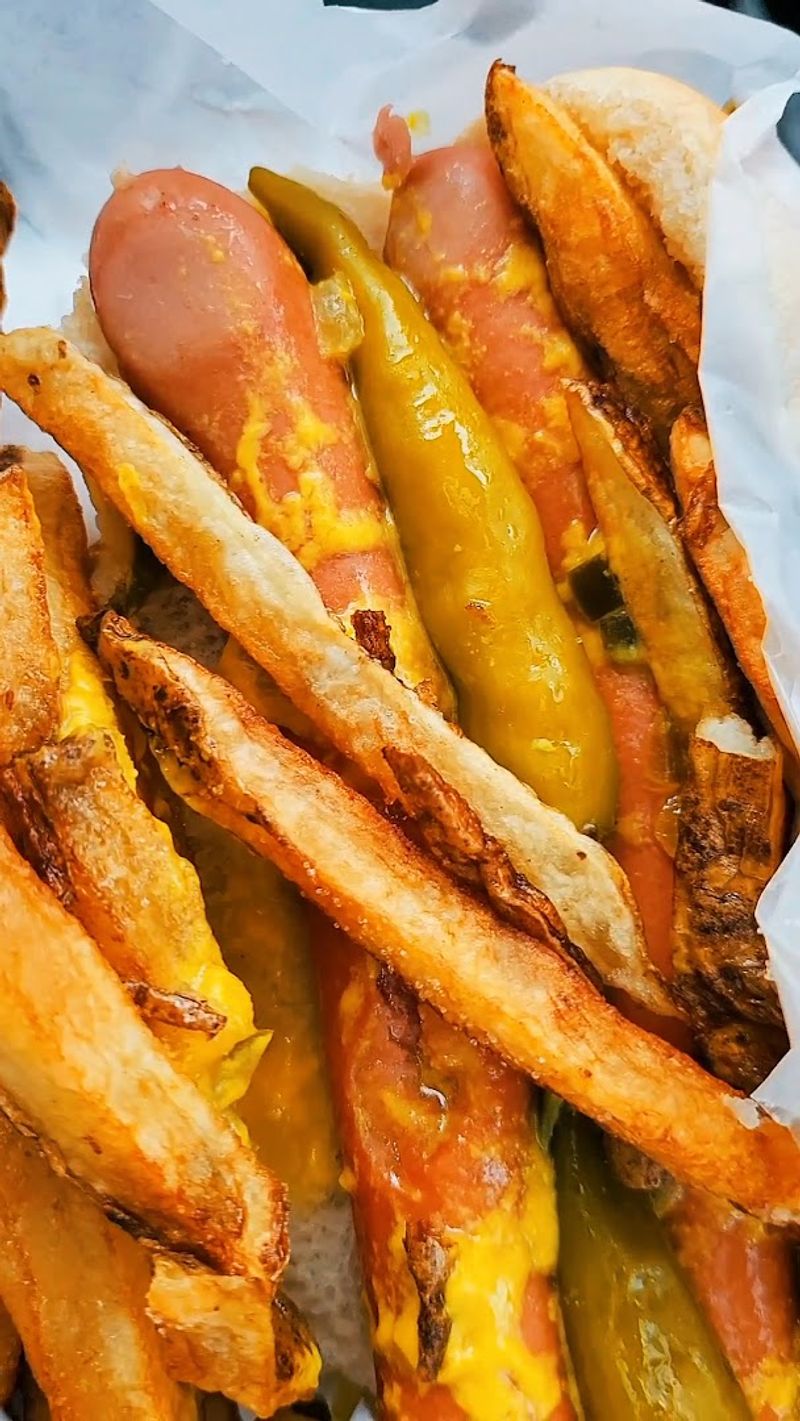
At a lot of hot dog stands, fries are the side order you notice only when they are missing. At Gene & Jude’s, they demand equal billing, and possibly a little more.
The potatoes are cut fresh, cooked hard enough to arrive piping hot, and seasoned in a way that makes the whole bag smell ready before it is fully opened.
They are not aiming for dainty uniformity. The shape is irregular, the texture runs from softer pieces to firmer edges, and that variation gives the fries personality instead of polish.
Piled onto the hot dogs or eaten straight from the wrapper, they create the kind of urgency that makes standing in a parking lot feel completely reasonable.
Temperature is a big part of the appeal. These fries often hit with the kind of heat that slows the first reach, then triggers the second one almost immediately.
That matters because fresh-cut potatoes can turn forgettable when they sit too long, and Gene & Jude’s has built its reputation around not giving them much time to cool off.
They also reshape the value of the meal. A simple order suddenly looks abundant, not through oversized portions for show, but through a generous spill that turns the package into its own little event.
This is one reason the place stands out even in a region crowded with beloved hot dog spots. The fries are not supporting actors pretending to help. They are fully written into the main role, and the meal would be a different thing without them.
A Menu So Short It Becomes a Statement
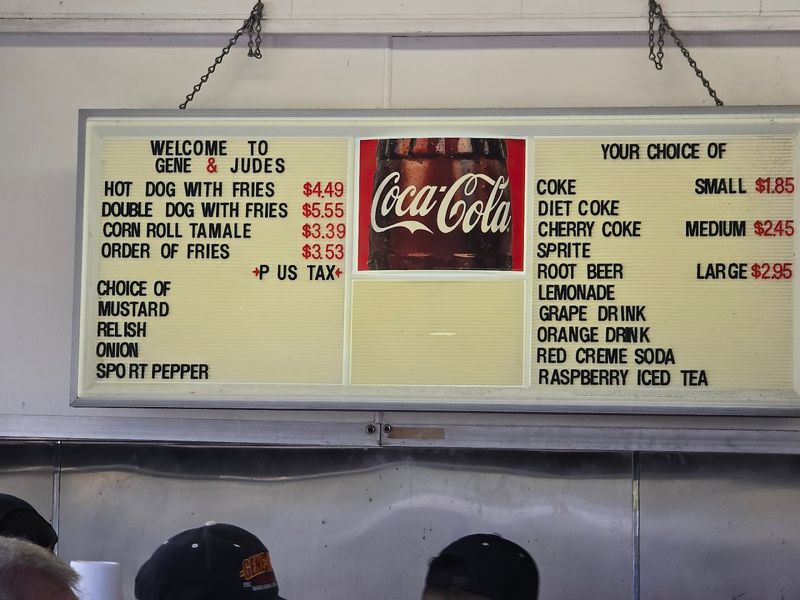
One of the sharpest things about Gene & Jude’s is how little it tries to be. The menu stays famously narrow, centered on hot dogs, fries, and a few straightforward extras, which gives the place a discipline many larger restaurants spend years trying to fake.
Instead of presenting variety as generosity, it presents focus as confidence. That decision shapes everything behind the counter. A limited menu means staff can move quickly, repeat motions precisely, and keep the line flowing even when the room is packed.
The whole operation works like a practiced sequence, where speed does not read as rush so much as familiarity sharpened over decades.
There is a deeper cultural piece here too. Chicago area hot dog history has long favored specialists, places that become known for one house style and defend it with almost stubborn consistency.
Gene & Jude’s fits squarely into that tradition, not as a museum piece, but as a working example of why simplicity can survive changing tastes, neighborhoods, and dining trends.
The short menu also protects the experience from distraction. You are not scanning endless combinations or second-guessing whether you ordered the right thing.
You arrive, commit, step into the line, and get the food this stand is known to make. That clarity helps preserve the place’s identity in a way broader concepts often lose.
Gene & Jude’s does not need to win you over with options. It wins by narrowing the field until execution is the only thing left to judge, then making sure execution arrives hot, fast, and unmistakably house-made in spirit.
Standing Room, Open Trunks, and Local Ritual
Gene & Jude’s is as much about how the food gets eaten as what lands in the wrapper. There are no plush booths to settle into and no elaborate dining room to slow the pace down.
Instead, the stand encourages quick decisions about where to eat next: at the indoor ledge, beside the car, or from an open trunk that doubles as a temporary table.
That arrangement could sound inconvenient on paper, yet it adds a kind of regional character that polished remodels would flatten. Eating here has movement built into it.
You order, receive the food, shift to a patch of standing room, and start immediately because the fries are hottest right then and the hot dog is at its best before steam has time to soften everything too much.
The scene outside can be as revealing as the counter itself. Cars pull in, bags come out, and little islands of diners form around hoods, tailgates, and sidewalks.
It gives the place a communal energy without requiring anyone to perform friendliness. The connection comes from shared timing, shared appetite, and the practical understanding that this meal is designed to be eaten now.
That style of dining also suits the menu’s directness. Nothing about Gene & Jude’s asks for ceremony, yet the routine has become ceremonial for plenty of regulars and first-timers alike.
A stand-up meal can still carry tradition when the format repeats across years, generations, and late-night stops. The lack of seating is not a missing luxury.
It is part of the structure, part of the pace, and part of the reason the whole experience stays lean, specific, and unmistakably itself.
How the Line Moves Faster Than It Looks
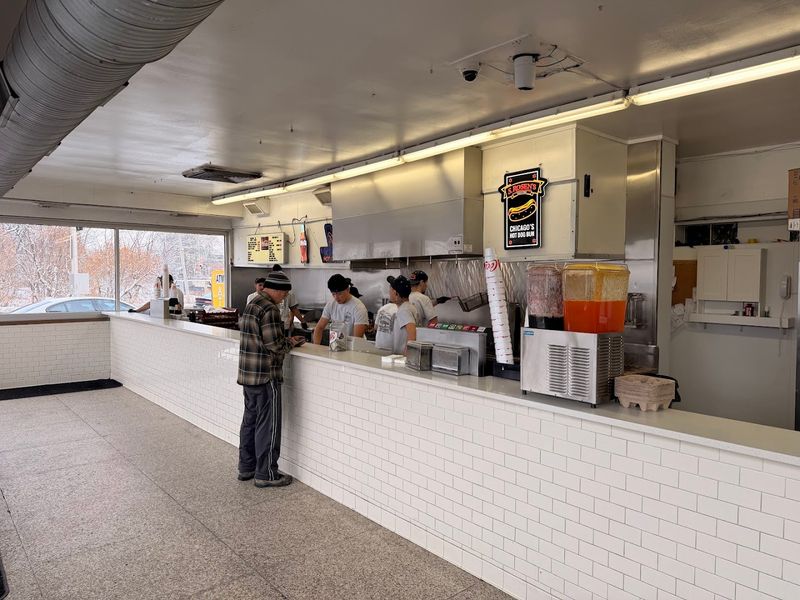
Seeing a crowd at Gene & Jude’s can trigger the usual hesitation, especially if the line pushes toward the door or the parking lot looks full. Then the system reveals itself.
This stand is built for volume, and the choreography behind the counter turns what looks like a wait into a brief pause before a very hot meal.
Speed here does not come from rushed shortcuts. It comes from repetition, a streamlined menu, and a workspace designed around constant movement.
Orders are short, assembly stays focused, and food comes out with the kind of efficiency that only works when everyone knows exactly where each item, handoff, and next step belongs.
That matters most during peak hours, when a less organized place would collapse into confusion. Gene & Jude’s instead leans into the pressure.
The line advances, wrappers stack, and fresh fries keep cycling through fast enough that even a busy night can still deliver the meal in its strongest condition. For diners, that rhythm lowers the intimidation factor of the crowd.
Timing your visit still helps. Late evenings and weekends can bring heavier traffic, while earlier windows may feel easier if standing shoulder to shoulder is not the goal.
Hours run late by suburban standards, which adds to the stand’s usefulness after events, drives, or airport-area detours. The practical advice is simple: do not let the line scare you off, and do not linger once the food arrives.
Gene & Jude’s is a place where the payoff begins the second the bag hits your hand, and the operational skill is part of why that payoff comes so quickly.
Why This Illinois Stand Still Matters
Plenty of famous food spots survive on nostalgia long after the actual meal stops carrying the weight. Gene & Jude’s avoids that trap by staying grounded in the present tense.
The history matters, the local loyalty matters, and the decades of recognition matter, but none of that would hold if the stand could not still deliver a fast, satisfying meal at a price that feels unusually approachable.
Its staying power comes from precision rather than reinvention. The building remains modest, the menu remains lean, and the service style remains direct.
In an era when many legacy places expand, rebrand, or overexplain themselves, Gene & Jude’s protects its identity by keeping the product at the center and trusting that consistency is interesting enough.
There is also an Illinois specificity here that gives the stand more than simple fame. This is Chicagoland roadside food culture distilled into a compact form: standing counter, wrapped order, fresh-cut fries, late hours, quick turnover, and a hot dog style defended with near religious certainty.
You can learn a surprising amount about regional taste just by watching how confidently this place does the basics.
That is the final reason crowds keep showing up decade after decade. Gene & Jude’s offers a meal with almost no distance between craving and payoff, and it does so without trying to modernize away the habits that made it notable in the first place.
The stand does not need grand storytelling printed on the wall. Its argument is already built into the line, the speed, the fries, and the first bite of a properly dressed dog. In a state full of serious food loyalties, that kind of clarity still has real power.
Share this story