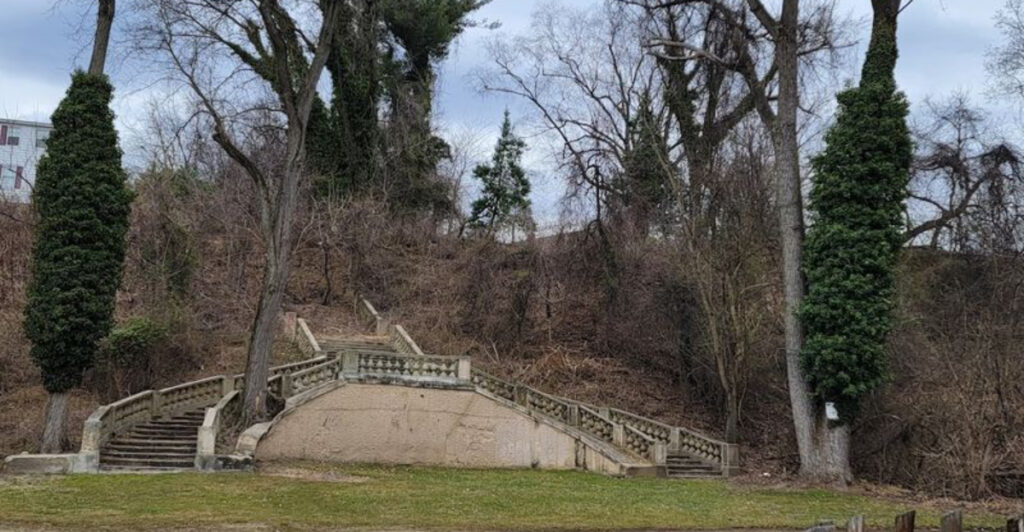
A concrete staircase rises near Spring Lake like it missed the memo that the party ended a century ago. No ticket booth waits at the top.
No music spills down from a dancehall. No kids race ahead toward a carousel.
Just weathered steps, a quiet New Jersey park, and the strange feeling that you have stumbled onto the backstage door of someone else’s summer memory. This is John A.
Roebling Memorial Park in Hamilton Township, tucked just outside Trenton and folded into the Abbott Marshlands. Today, the place belongs to turtles, beavers, red-winged blackbirds, dog walkers, and people who know that Sewell Avenue does not simply dead-end for no reason.
But those stairs are not random ruins. They are one of the last visible clues to White City, a once-busy amusement park that brought crowds to Spring Lake when trolley rides, lake promenades, and white-painted pavilions counted as a full day’s adventure.
The Stairs That Lead Nowhere In Roebling Park
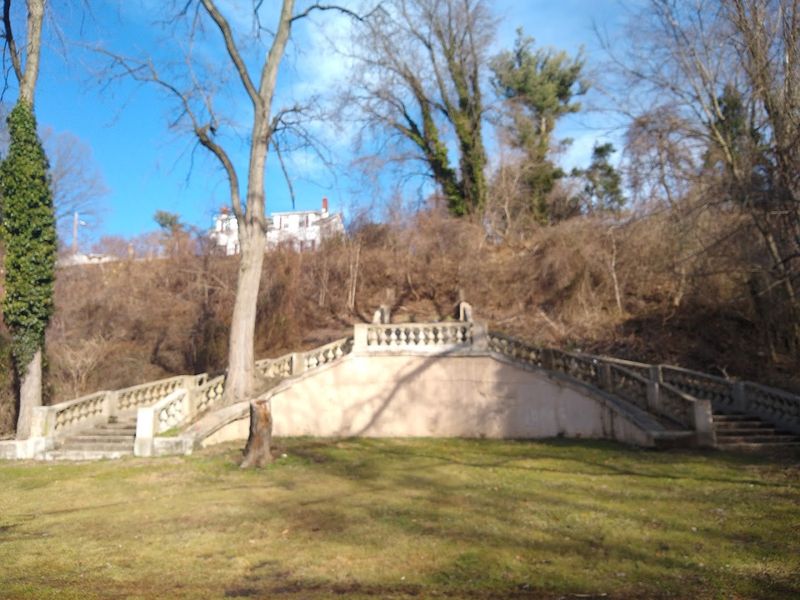
Come in from the Sewell Avenue side and the scene feels almost too quiet for its own history. The parking area sits near Spring Lake, with trees leaning over the water and marshland spreading out beyond the trail.
Then you notice the staircase. It is wide, formal, and a little dramatic, the kind of thing that looks like it should lead to a grand hotel entrance or a bandstand full of brass instruments.
Instead, it climbs into the trees and stops making sense. That is exactly what makes it so good.
The staircase once connected the amusement grounds on the bluff above to the lake below. Visitors would have used it to move between the rides, games, and crowds up top and the promenade around Spring Lake, where boats moved across the water and the whole place felt more resort than refuge.
Today, the steps are weathered and fenced in places, but their shape still gives away their former importance. They were not built as a shortcut.
They were built for arrival. Roebling Park is now part of the Abbott Marshlands, and the modern park has a completely different pace.
People come here to walk, fish, look for birds, or take the easy trails around Spring Lake. The official Spring Lake entrance is on Sewell Avenue in Hamilton, and the park is generally open from sunrise to sunset.
There is no amusement-park fanfare anymore, which is part of the charm. The best way to read the place is slowly.
Stand at the base of the stairs for a moment and look up. The old White City does not announce itself with neon or a preserved roller coaster. It lets one staircase do the talking.
Before The Marsh Was Quiet It Was White City
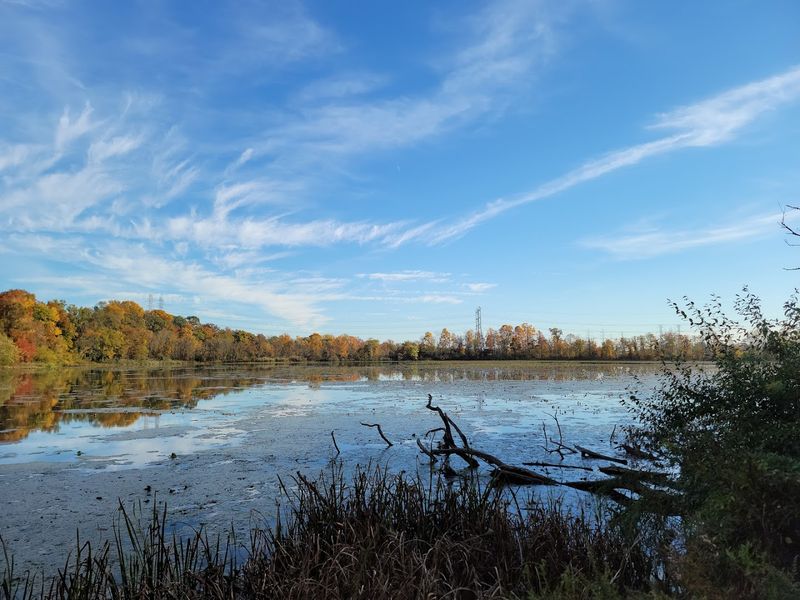
In 1907, this calm pocket of Hamilton Township became White City Amusement Park, a bright, busy escape built around Spring Lake. The name was not mysterious at the time.
White-painted amusement buildings were fashionable in the early 1900s, especially after grand fairgrounds made that gleaming look popular, and this park followed the style right down to its identity. White City sounded elegant, modern, and just a little dazzling.
The park stood in the area now known as Spring Lake within John A. Roebling Memorial Park.
Its footprint ran near the end of Harrison Avenue around McClellan Street and stretched roughly from Sewell to Buchanan Street. That is a funny thing to picture now, because the bluff above the lake is residential today, and the land below feels ruled by reeds, birds, and damp trail edges.
But at the beginning of the 20th century, this was a place where people came to be entertained. The setting helped.
Spring Lake was already a draw before White City arrived, used for picnics and passive recreation when the area was known as Spring Lake Park. A lake, a bluff, and a trolley connection were more than enough ingredients for a day-trip destination.
Add rides, music, food, and a little spectacle, and suddenly the edge of Trenton had its own answer to the amusement craze sweeping the country. White City was sometimes remembered as New Jersey’s own “Coney Island,” which tells you plenty about the ambition.
It was not a tiny roadside novelty with one ride and a popcorn wagon. It was a full entertainment district built for crowds.
The funny part is that today you can walk through the same landscape and hear mostly frogs, leaves, and the occasional splash from something in the marsh.
How A Trolley Line Helped Create A New Jersey Playground
A trolley company did not build White City because it had a soft spot for carousels. It built White City because people needed a reason to ride.
That is one of the best little pieces of local context here. By the late 1800s, trolley tracks had reached the Broad Street Park development near Spring Lake.
The area was already known as a picnic spot, and the company saw an opportunity hiding in plain sight. If there was an attraction at the end of the line, riders would fill the cars, especially on weekends and summer evenings.
In other words, White City was fun, but it was also business. That model was common in the trolley era.
Across the country, transportation companies helped create amusement parks, picnic groves, and lake resorts because leisure travel could make routes profitable. White City fit right into that pattern.
The trolley brought people out from the Trenton area, and the park gave them a reason to stay for hours once they arrived. It is easy to forget how big a deal that was before cars changed everyone’s habits.
A trolley ride could turn a regular afternoon into an outing. Families could come for the lake.
Young couples could come for the midway and music. Groups of friends could hop aboard without planning a shore trip or booking a hotel.
White City was close enough to feel easy and exciting enough to feel like a treat. The stairs were part of that movement through the park.
Guests arrived, wandered the amusements on the bluff, then made their way down toward Spring Lake. The whole landscape worked as one big loop of transportation, entertainment, and scenery.
Today, when you walk the trails, the trolley logic is gone, but the geography still tells the story. The bluff, the lake, and the steps are exactly where they need to be.
Roller Coasters, Carousels And A Water Flume Once Filled The Bluff
White City was not a park that asked visitors to use their imagination. It supplied plenty of noise on its own.
In its heyday, the bluff above Spring Lake had a roller coaster, a carousel, a scenic railway, a movie theater, a dancehall, and midway attractions with names that still sound like they belong on a hand-painted sign. Katzenjammer Castle.
Mystic Maze. The kind of names that practically come with calliope music attached. The ride list matters because it changes how you see the ruins. Those stairs were not leading to a sleepy lakeside garden.
They were part of a working amusement park, with people moving between attractions, music drifting from the dancehall, and crowds gathering around whatever ride had the longest line.
The place had the busy, slightly chaotic rhythm that amusement parks still have, only with early-1900s clothing and trolley schedules instead of parking apps.
The water flume may have been the most dramatic use of the landscape. Gondolas descended from the park above, down concrete chutes built along the cliffs, and splashed into the lake below.
Spring Lake itself was then known as White City Lake, and it served as more than pretty scenery. People boated there, fished there, and, when winter cooperated, ice-skated on the frozen surface.
That mix of rides and lake recreation gave White City its personality. It was not just mechanical thrills.
It was a summer evening by the water, a dancehall on the midway, a boat ride after the carousel, a quick breath at the lake before climbing back up to the noise. Try standing near Spring Lake now and mentally layering all of that over the quiet water.
The modern trail gives you birds and tree shade. The old park would have given you a splash, a bell, a band, and probably at least one kid begging for another ride.
Why White City Faded And Nature Took Over
Cars changed everything. That sounds too simple, but for places like White City, it was the beginning of the end.
The park had been tied to the trolley era, and the trolley era depended on people needing fixed routes to reach their fun. Once automobiles became more common, families had more options.
They could drive to bigger amusement parks, shore towns, relatives’ houses, picnic areas, or anywhere else the road would take them. A park built partly to support trolley ridership suddenly had to compete with every destination reachable by car.
White City declined through the 1920s and was eventually abandoned by the late part of that decade. That did not mean the land lost its value.
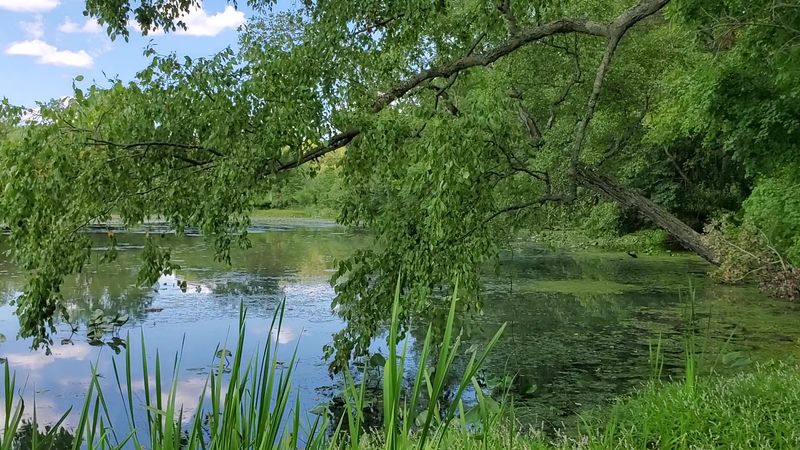
It meant its value changed. The noise faded first. Then the buildings disappeared. The rides came down or rotted away. The lake stayed. The marsh stayed. The bluff stayed. The staircase, stubborn and concrete, stayed too.
The next chapter is just as important as the amusement-park chapter. In the late 1930s, the Broad Street Civic Association formed in response to development pressure in the area.
By 1957, with major help from the Roebling family, the association had acquired 317 acres that included the former White City land. The property was transferred to Mercer County for one dollar, with the understanding that public use would be limited to passive recreation.
That one-dollar detail is the kind of local history that feels almost made up, but it says a lot about why Roebling Park feels the way it does now. It was not converted into another entertainment complex.
It became a wildlife refuge, a place where the old amusement grounds were allowed to soften back into marshland and woods. So when people say nature took over, that is only half the story.
People also chose to let it.
What Visitors Can Still Find Around Spring Lake Today
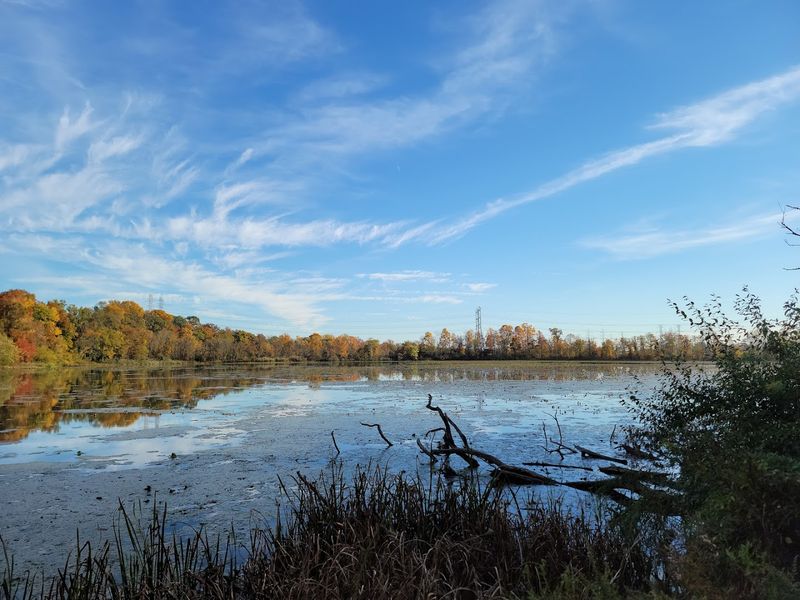
Today, Spring Lake is the easiest place to begin. From the Sewell Avenue entrance, visitors can walk near the water, look for the old staircase, and follow trails that trade amusement-park ghosts for marsh views.
It is not a polished boardwalk kind of place. Wear shoes that can handle mud after rain, especially along the lower trails, and expect a little wildness around the edges.
Roebling Park has several trail areas, including paths around Spring Lake, island trails, Watson Woods, and routes that connect toward the Abbott Brook and bluff areas. The New Jersey Trails Association lists about 4.7 miles of trail in this part of the marshlands, with mostly easy walking and some minor elevation near the bluffs.
Biking is permitted in certain areas, including around Spring Lake and between Spring Lake and Watson Woods, but this is still a slow-down park, not a race-through park. The wildlife is part of the reason to linger.
Mercer County notes beavers, turtles, and birds as regular highlights, and the marshland setting makes the place feel surprisingly alive for somewhere so close to Trenton. Depending on the season, you might see waterfowl, hear frogs, spot a beaver lodge, or watch an osprey overhead.
Fishing is allowed at Spring Lake, but swimming is not. For more context, the Tulpehaking Nature Center at 157 Westcott Avenue serves as the main interpretive hub for the Abbott Marshlands, with exhibits and programs tied to the area’s natural, cultural, and archaeological history.
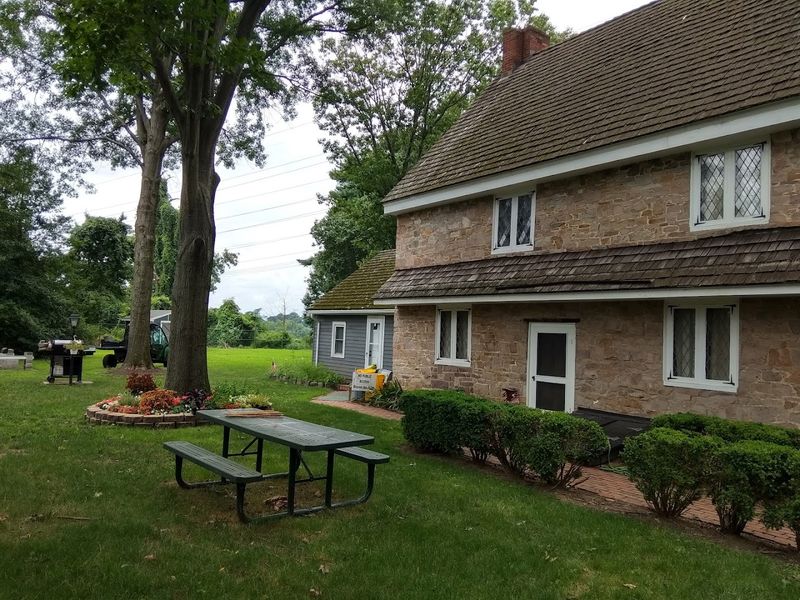
Nearby, the Isaac Watson House, built in 1708, is considered the oldest house in Mercer County and adds another layer to a park that already has more history than it first lets on. That is the real pleasure of Roebling Park.
It does not hand you one neat story. It gives you a marsh, a lake, an old house, a vanished amusement park, and a staircase that still looks ready for crowds that stopped coming generations ago.