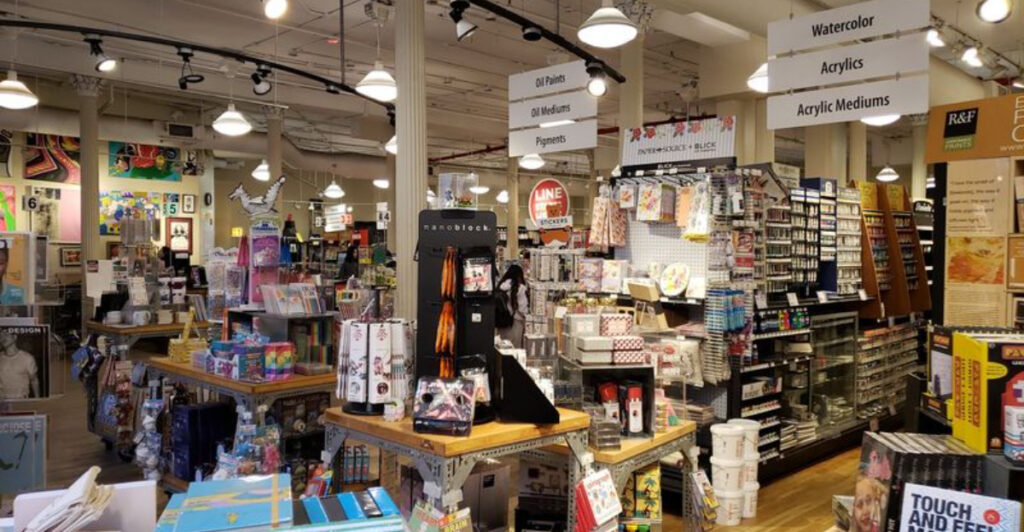
One wrong turn inside Blick Art Materials can take you from a wall of markers to armfuls of handmade paper, tubes of oil paint, sculpting tools, and an easel you definitely did not plan to buy. That is part of the fun.
Tucked into 35 Plaza along busy Route 4 in Paramus, this sprawling creative supply shop treats art materials with the seriousness most stores reserve for electronics or power tools.
Instead of a token aisle of sketchpads and basic acrylics, there are entire departments devoted to painting, drawing, printmaking, ceramics, textiles, framing, and more.
The selection is broad enough for a professional illustrator chasing a precise ink and approachable enough for a parent gathering supplies for a rainy Saturday. Behind those packed shelves is a company story stretching back to 1911, when the whole business revolved around one specialized lettering pen.
More than a century later, that tiny mail-order operation has become an art lover’s playground beside one of North Jersey’s busiest highways.
A Paramus art supply destination more than a century in the making
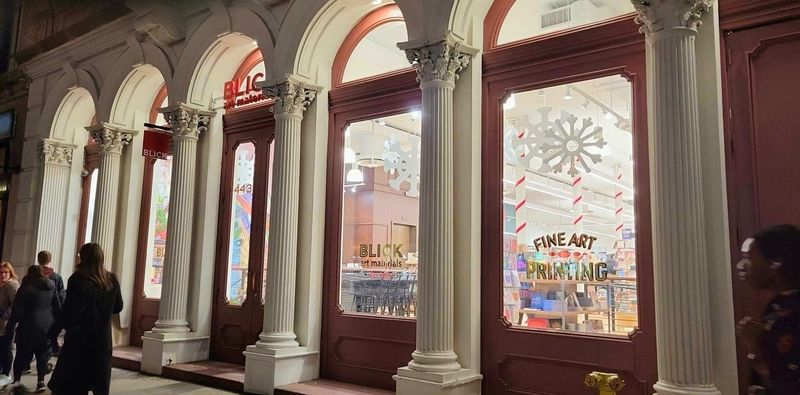
Paramus is not exactly short on places to shop, but Blick fills a niche that the town’s malls, big-box stores, and highway plazas cannot quite touch. The store sits at 65 East State Route 4 in 35 Plaza, immediately after Spring Valley Road and before the Route 17 North exit.
That puts it close to Westfield Garden State Plaza and right in the thick of Bergen County’s famously busy retail corridor. Look beyond the traffic, though, and this is a surprisingly focused destination.
Blick’s history reaches back more than 115 years, while the Paramus store itself opened on May 31, 2011. It was the company’s 32nd retail location and its first store anywhere in New Jersey.
The choice of Paramus was not random. Company representatives said at the time that online orders from the region showed a clear demand for a physical store where North Jersey customers could examine materials before buying them.
That still makes sense. Pigment, paper texture, brush spring, and canvas weight are difficult things to judge from a thumbnail on a screen.
Inside, the store serves local hobbyists as well as students, educators, and working artists connected with places such as Bergen Community College, Montclair State University, and the Montclair Art Museum. The practical details are refreshingly simple.
The store is open Monday through Saturday from 10 a.m. to 7 p.m. and closed on Sunday, in keeping with Paramus shopping restrictions. In-store shopping, pickup, and delivery are available, and the plaza has free parking.
The result is a shop with national scale but a very specific local role: it gives North Jersey’s creative crowd a place to browse, compare, ask questions, and leave with exactly the right shade of blue—or six nearby shades, just to be safe.
Blick began with a single pen and a mail-order dream
Long before the marker walls and towering stacks of canvases, there was the Payzant Pen. Dick Ernest Blick was a showcard writer, part of a once-essential trade that produced the hand-lettered signs displayed in store windows and on counters.
Before computer fonts and digital printers, those signs had to be created quickly, clearly, and with enough flair to stop shoppers in their tracks. Blick recognized the value of the Payzant, a single-stroke lettering pen designed to make complete letters in one smooth motion.
Its curved nib came in six sizes, while an adjustable gap and built-in ink reservoir helped writers control line width without constantly stopping to refill. In 1911, Blick and his wife, Grace, founded the Card Writer’s Supply Company in Galesburg, Illinois.
The entire operation fit on their kitchen table: a typewriter, a supply of pens, and the means to take mail orders. A Payzant No. 1 sold for one dollar, a wonderfully modest beginning for what would become a major art materials business.
By 1913, the company was advertising in a leading trade publication for window trimmers and showcard writers. The catalog soon expanded beyond pens to brushes, card-writing colors, inks, poster paper, paint, and cardboard.
Robert Metzenberg purchased the business in 1948 and led its next phase of growth under family ownership. Blick opened its first physical retail store in Galesburg in 1974, after more than six decades as a mail-order operation.
The annual catalog eventually grew beyond 400 pages, and the company’s present-day assortment extends to more than 90,000 items across its stores, catalog, and website. A century’s worth of expansion can sound abstract until you remember where it started: two people at a kitchen table selling one clever tool to artists who needed it.
New Jersey’s first Blick arrived with the region’s biggest art supply selection
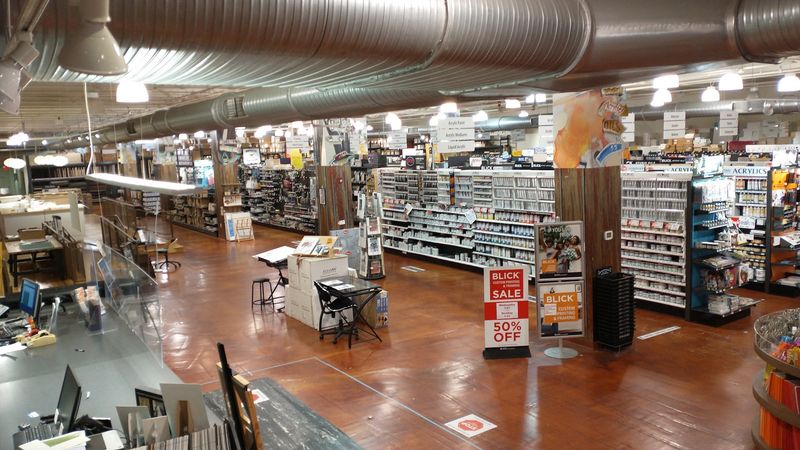
When the Paramus superstore debuted in 2011, it was billed as having the largest assortment of art products in northern New Jersey. That was a bold claim in a region with no shortage of artists, designers, art schools, and specialty shops, but the store was built to back it up.
Shoppers could browse its substantial physical inventory and use an in-store web register that, at the time, provided access to more than 70,000 additional items. In other words, walking through the front door did not limit customers to whatever happened to fit on the shelves.
The broader company selection has since grown beyond 90,000 products, while Blick’s national network now includes more than 60 stores. The Paramus opening represented something more meaningful than another chain moving into Bergen County.
Before it arrived, serious local artists could order specialty products online or cross into New York to hunt through stores in Manhattan. Blick offered a third option: a large, dedicated art retailer within driving distance of communities across northern New Jersey.
Its Route 4 address also gives it an unusually wide reach. The store is convenient for shoppers arriving from central Bergen County, but nearby connections to Routes 17, 80, and the George Washington Bridge make it accessible from Passaic County, Hudson County, Rockland County, and New York City as well.
That regional pull matters when someone needs a particular printmaking plate, an uncommon paper weight, or enough matching paint for a large project. General craft stores are useful for plenty of things, but they rarely stock the same depth within individual media.
Blick’s Paramus location was designed for people who know precisely what they need and for people who have no clue yet. Both types tend to stay longer than expected.
Paint brushes, paper and specialty tools fill aisle after aisle
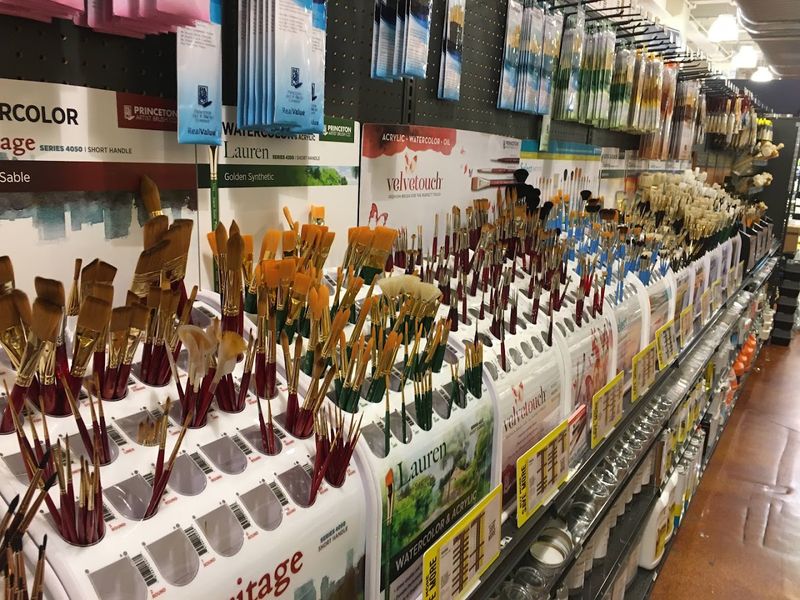
The paint department alone can turn a quick errand into a lengthy internal debate. Oils, acrylics, watercolors, gouache, inks, mediums, varnishes, and related tools occupy their own carefully divided territory, with student-grade choices sharing space with materials intended for professional studio work.
Then come the brushes: different fibers, shapes, handle lengths, and degrees of stiffness, each suited to a particular technique. A flat brush that works beautifully for blocking in an acrylic landscape may be a terrible choice for delicate watercolor details, and this is the kind of store where those differences are taken seriously.
Drawing and illustration supplies stretch from graphite pencils and charcoal to pastels, technical pens, markers, and specialty inks. Sketchbooks and pads arrive in an almost comical number of combinations—spiral or bound, smooth or toothy, pocket-sized or large enough to claim most of a table.
Paper is not treated as an afterthought either. There are surfaces intended for watercolor washes, marker work, printmaking, mixed media, calligraphy, and finished presentation.
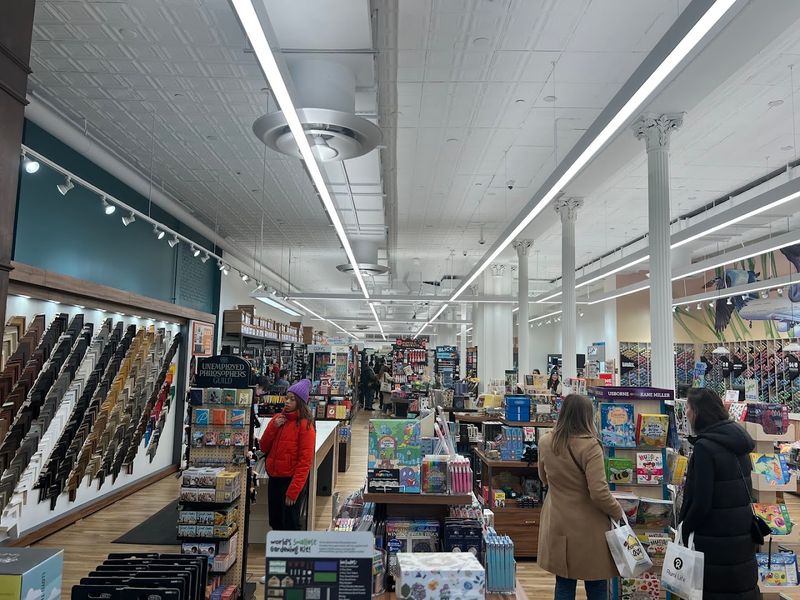
Keep moving and the departments become even more specialized. Blick carries canvas and panels, easels and studio furniture, framing materials and matboard, ceramics and sculpture supplies, craft and textile materials, printmaking equipment, books, children’s art products, and tattoo supplies.
Curious browsers may also encounter airbrush equipment, fountain pens, wax-sealing materials, modeling tools, carving accessories, and products whose purpose becomes clear only after reading the label twice. The advantage is not merely volume.
It is the ability to compare materials side by side, feel the grain of a sheet, test the balance of a brush, or see whether a marker’s color resembles the name printed on its barrel.
That tactile part of shopping remains especially useful for artists, who know that “warm gray” can describe several entirely different colors depending on who made it.
Beginners students and professional artists can all find their perfect supplies
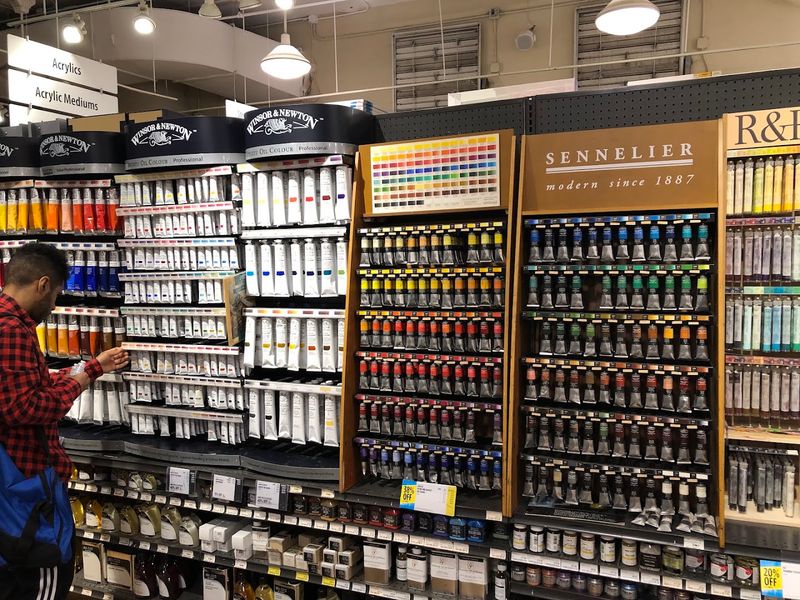
A first-time painter and a gallery-represented artist may enter with completely different lists, yet neither looks out of place here. That range is one of Blick’s strongest qualities.
Beginners can start with affordable sets, basic canvases, introductory books, and manageable packs that do not require decoding an entire semester’s worth of art-school vocabulary. Students can work from course lists and choose materials that balance quality with a realistic budget.
Professionals, meanwhile, can move toward individual colors, archival papers, specialty mediums, large-format surfaces, and tools made for repeated studio use. The differences between those tiers matter.
Student-grade paint generally contains less pigment than a professional line, while paper intended for practice may respond differently to water, ink, or repeated erasing. A cheap brush can be perfectly serviceable for experimenting, but someone painting every day may care much more about how well the tip holds its shape.
Blick’s depth lets shoppers make those decisions rather than being handed one generic option. The Paramus store’s relationship with nearby colleges and cultural institutions reinforces that broad appeal.
Bergen Community College and Montclair State University students can shop in the same aisles as art teachers, museum-connected artists, architects, designers, parents, and people rediscovering a hobby after several decades away from it.
There is also room for the person who arrives because they saw a linocut video online and now urgently needs carving blocks, brayers, ink, and an explanation of what a brayer actually does.
Nobody needs an art-school résumé to belong in the store. The shelves encourage experimentation, whether that means replacing a familiar sketchbook, upgrading to a better watercolor paper, or wandering into the textile section and leaving with the beginnings of an entirely new obsession.
Knowledgeable staff and a rotating gallery make this more than a store
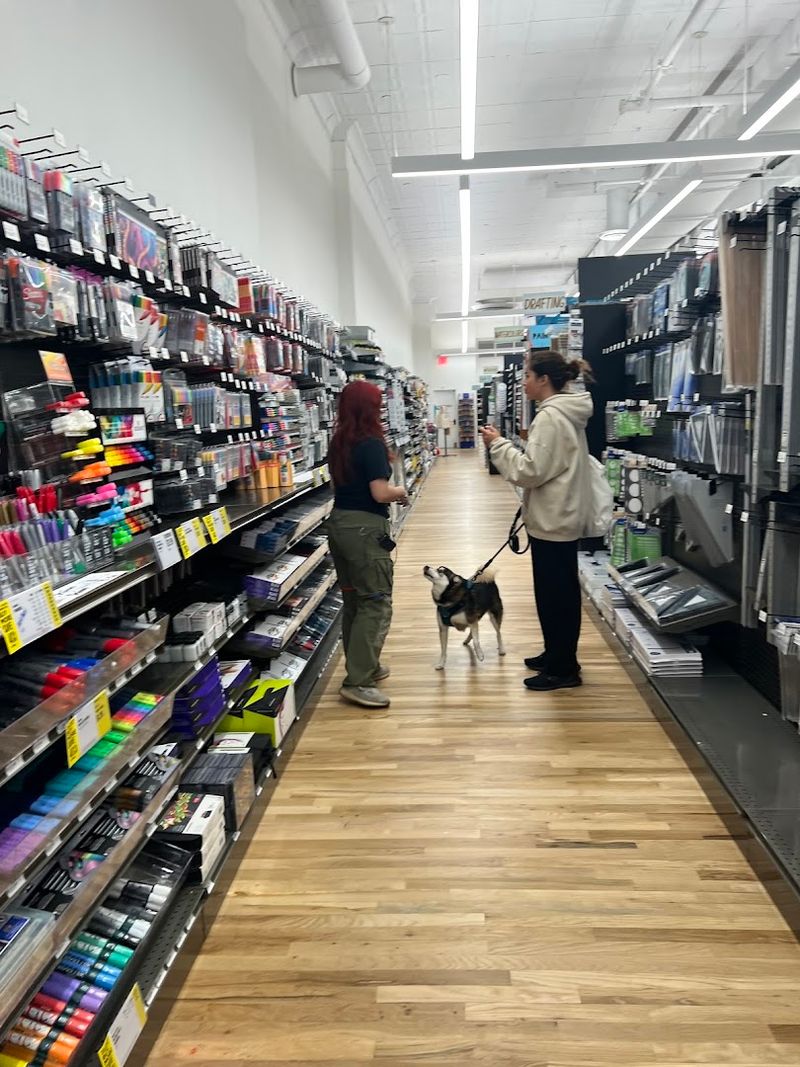
The most valuable item in the building may be the answer to a very specific question. What paper can handle alcohol markers without bleeding through?
Which medium slows acrylic paint long enough for blending? Is that brush meant for watercolor, oil, or decorating a cake?
Blick emphasizes knowledgeable service, and the Paramus team is there to help customers narrow down a store full of possibilities without making beginners feel as though they have walked into the wrong classroom.
That guidance is especially helpful when two nearly identical products have very different prices or when a project requires compatible materials.
The store also connects those supplies to the work they eventually become. Its in-store gallery features a different artist each month, giving local and regional creators a place to display finished pieces in the same building where others are choosing raw canvas, paper, and pigment.
It is a small but meaningful shift in perspective. One moment, you are comparing tubes of paint; the next, you are looking at what someone managed to create with them.
Community involvement extends beyond the gallery. The Paramus location holds an annual donation drive supporting the children’s hospital at Hackensack University Medical Center, collecting arts-and-crafts supplies and activities for young patients.
Those efforts fit naturally with a store that serves schools, educators, museums, students, and working artists rather than functioning only as a warehouse with cash registers. Route 4 may rush past outside, but the pace changes once you step through the doors.
People linger over paper, debate colors, study the monthly artwork, and ask questions that can send a project in a better direction. The store’s scale gets your attention; its human side is what keeps it from feeling overwhelming.