One of the wildest forests in Pennsylvania spent eleven years as a nuclear research site. Today, the same land is better known for elk, white birch, and miles of quiet trail.
That twist made me curious about what else the state’s fall trails are hiding. Another route here climbs more than a thousand stone steps built by quarry workers. A different one follows a creek past two dozen named waterfalls.
I love that so many of these hikes come with a backstory. October colors are the main event, but the history, the views, and the wildlife make the scenery feel even bigger. Some trails are short and steep, while others ramble for days.
There’s something special about seeing Pennsylvania at its most colorful, especially when the trails lead to places with stories of their own. From old stone stairways to hidden waterfalls and elk wandering through golden forests, these hikes offer plenty of reasons to spend a little more time outdoors this fall.
1. Turkey Path Trail
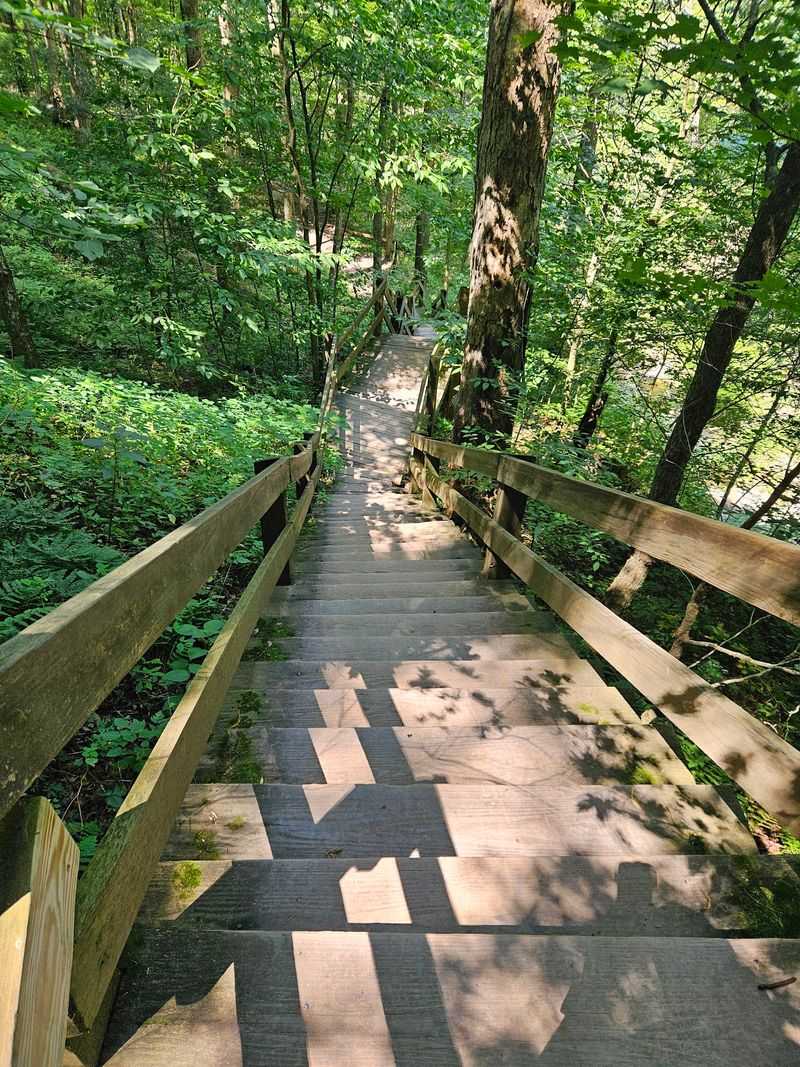
Going down takes about one mile, and coming back up feels like climbing a skyscraper made of dirt.
Welcome to the Turkey Path Trail, the famous plunge into Pine Creek Gorge.
People often call this canyon the Grand Canyon of Pennsylvania.
In fall, the nickname makes sense, because the gorge walls turn into a giant quilt of red, gold, and orange.
The trail drops roughly 750 to 800 feet from the rim to the canyon floor.
Along the way, it follows Little Fourmile Run and passes several waterfalls.
Those waterfalls are a nice excuse to stop and catch your breath.
Nobody needs to know you are resting instead of admiring the view.
At the bottom, the path meets the Pine Creek Rail Trail, which stretches about 62 miles.
You can stand by the creek, look up at the walls, and feel very small in the best way.
Then comes the climb back.
It gains around 800 feet in one mile, so good fitness and sturdy shoes are a must.
History fans will enjoy the trail’s possible origin story.
The Turkey Path is believed to have started as a mule drag for hauling lumber.
The park itself has a fun past too.
Leonard Harrison, a local businessman, turned the spot into a public picnic ground he called The Lookout.
He donated it to the commonwealth in 1922.
Later, the Civilian Conservation Corps helped develop the park even more.
Before or after your hike, spend some time at the overlooks near the rim.
Keep an eye on the sky, since bald eagles and ravens are sometimes spotted here.
The visitor center, restrooms, and gift shop make the start of your trip easy.
Grab a map, use the restroom, and maybe pick up a souvenir to prove you survived the stairs of nature.
One timing tip matters a lot.
Trails here may close from December through April because of snow and ice, so fall really is the sweet spot.
Address: 4797 PA Route 660, Wellsboro, PA 16901
2. Canyon Vista Trail
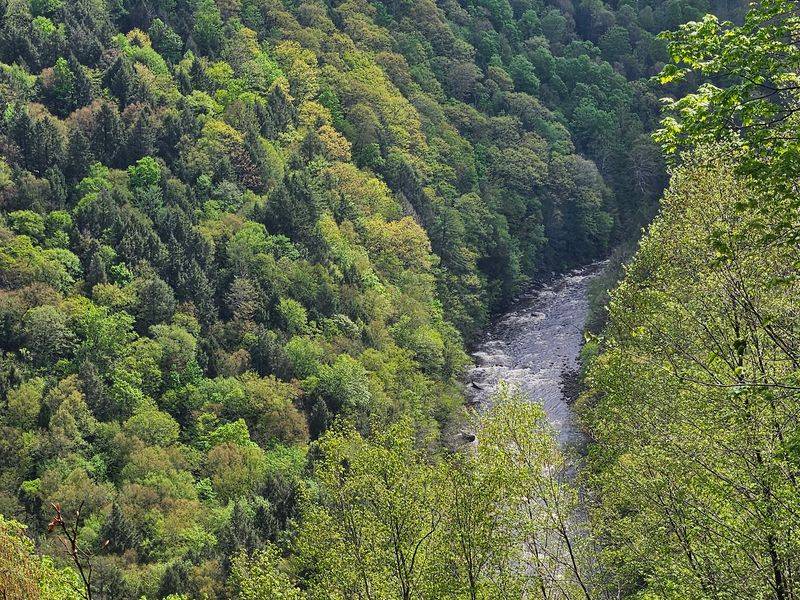
A park called Worlds End sounds a little dramatic.
Once you reach the top of the Canyon Vista Trail, though, the name starts to feel like a compliment.
The big prize is a sweeping view of the Loyalsock Creek Gorge.
Behind it, the Endless Mountains roll away in waves of fall color.
Getting there takes real effort.
The trail runs about four miles and climbs more than 900 feet over rocky, challenging ground.
Pick shoes with good grip and leave the flimsy sneakers at home.
Your ankles will send you a thank-you note later.
Worlds End State Park covers 780 acres in a narrow, S-shaped valley.
Loyalsock Creek curls through the middle, and Loyalsock State Forest borders the park.
That twisty valley shape is what makes the overlook so striking.
From above, you can trace the creek’s path through the trees like a line on a map.
Not up for a tough climb?
You still have options for seeing the gorge without the sweat.
An ADA-accessible spot called Loyalsock Canyon Vista sits off Mineral Spring and Cold Run roads.
It gives more people a chance to enjoy the scenery during peak season.
High Knob Vista is another nearby lookout worth adding to your day.
If you love views, you can easily turn this into a little overlook tour.
Planning a longer stay is easy here as well.
The park is open year-round, with camping from April to December and cabins available through the whole year.
A cabin weekend in October could be a dreamy plan.
Hike the vista trail one morning, then spend the next day exploring the other lookouts at a slower pace.
Start early so you have plenty of daylight on the rocky sections.
Bring water, snacks, and a jacket, because ridge tops can feel chillier than the valley floor.
Address: Route 154, 82 Cabin Bridge Rd., Forksville, PA 18616
3. Falls Trail
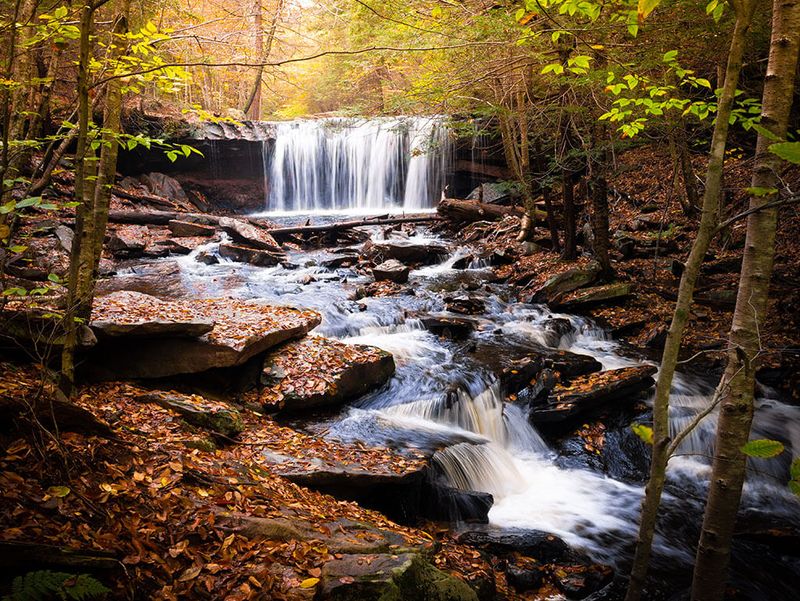
Twenty-two named waterfalls in Ricketts Glen State Park sounds like someone got a little carried away.
At Ricketts Glen State Park, it is simply the truth.
The Falls Trail follows Kitchen Creek through deep gorges and old-growth forest.
Giant pines, hemlocks, and oaks tower overhead, and fall color lights up the gaps between them.
The star of the show is Ganoga Falls, which drops 94 feet.
It is the kind of sight that makes you forget your legs are tired, at least for a minute.
Speaking of legs, this hike is rated difficult.
Expect lots of stone steps and surfaces that can get slippery from water spray and wet leaves.
Good boots with strong tread are a smart choice.
Take your time on the steps and let faster hikers pass when you need a breather.
The area is a National Natural Landmark, which tells you how special it is.
Old trees and rushing water make it feel like a storybook forest.
Its history adds another layer.
Colonel R. Bruce Ricketts bought the land in 1868 for timber and later built trails to the falls.
He named many of the waterfalls after Native American tribes, friends, and family members.
As you hike, the signs become little clues to his life and connections.
Ricketts was also a Civil War veteran.
He led Battery F at the Battle of Gettysburg.
The Falls and Glens area became a state park in 1942.
Recreation facilities opened two years later, in 1944.
Today the park covers 13,050 acres.
It also includes Lake Jean, a 245-acre lake popular for swimming and boating in warmer months.
In fall, the lake makes a pretty stop before or after your hike.
Pack lunch, find a spot near the shore, and plan which waterfall you want to see first.
Address: 695 State Route 487, Benton, PA 17814
4. Mount Minsi Trail
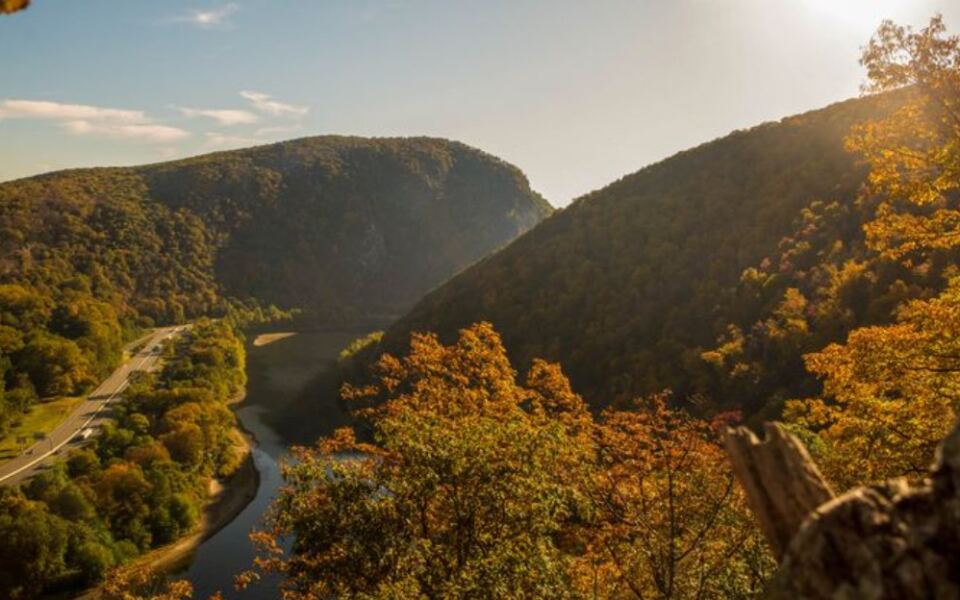
Rivers usually go around mountains, but the Delaware River decided to go straight through.
The Mount Minsi Trail lets you look down on that bold move from above.
This hike sits in the Delaware Water Gap National Recreation Area.
The gap formed where the river passes through the Blue Mountains and Kittatinny Ridge.
From the vistas, you can see the river winding between steep, forested slopes.
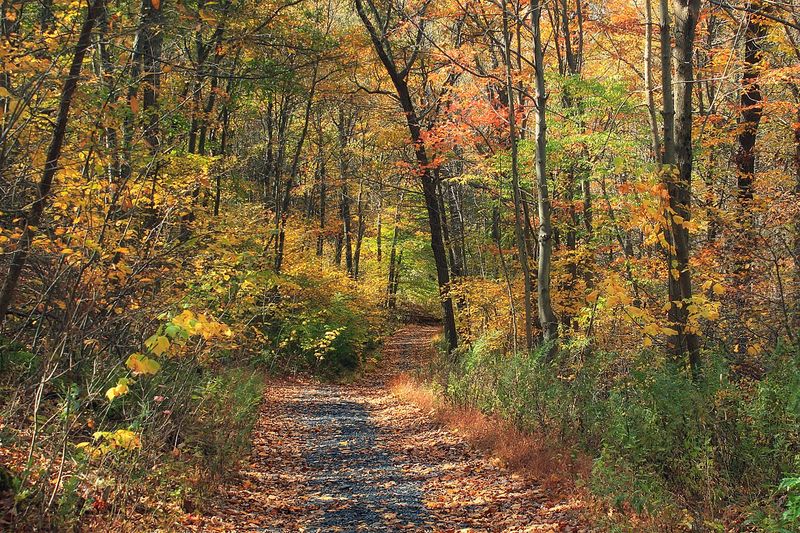
In autumn, those slopes look like someone spilled a giant box of crayons.
Plan on roughly five miles up and back.
The trail is challenging, so give yourself plenty of time and keep a steady pace.
Part of the route follows the Appalachian Trail.
That means you get to say you hiked a piece of one of the most famous footpaths in the country.
The recreation area has over 100 miles of trails.
About 27 of those miles belong to the Appalachian Trail.
Watch for leftover pieces of an old fire tower along the way.
It is a fun reminder that people once kept watch over these woods from up high.
The forest itself deserves attention too.
Near the trailhead, old-growth forests dominated by oaks cover the ridge tops.
Down in the ravines, large hemlocks grow in shady pockets.
The mix of trees gives the hike a changing look as you climb.
Got a four-legged hiking buddy?
Leashed pets are welcome, so your dog can join the fall fun.
Bring extra water for both of you.
Rocky climbs can make even energetic pups slow down.
Multiple viewpoints make this trail easy to enjoy at your own pace.
You can stop at the first great view or push on for more river scenes.
Either way, the Delaware Water Gap shows off one of the best fall views in Pennsylvania.
Address: Mountain Road Trailhead, Delaware Water Gap, PA 18327
5. Lookout Trail
Leaf peeping is great, but what if the sky puts on a show too?
On the Lookout Trail at Hawk Mountain Sanctuary, you may get both at once.
Hawk Mountain was founded in 1934 as the first refuge in the world for birds of prey.
That alone makes it a pretty cool place to spend a fall afternoon.
The sanctuary sits on the Kittatinny Ridge, also known as Blue Mountain.
This ridge is an important flyway for migrating raptors.
Peak raptor migration runs from August through December.
Birdwatchers travel from around the globe to see hawks, eagles, and other raptors glide past.
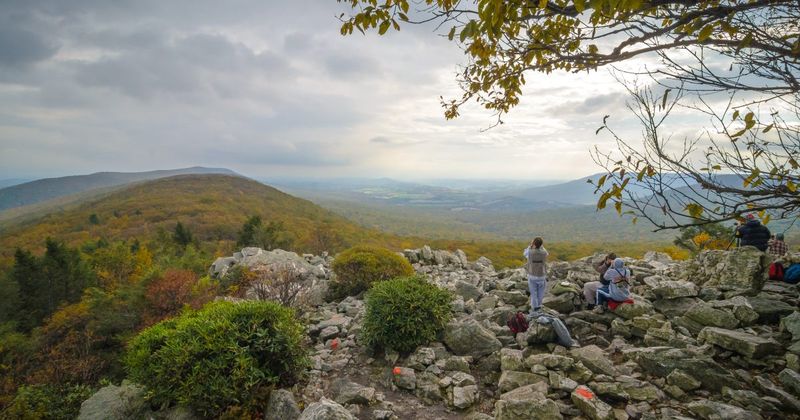
The Lookout Trail leads to rocky outcrops with views of about 200 degrees.
Below you, the valley spreads out in fall color while birds ride the wind overhead.
Bring binoculars if you have them.
Even if you cannot tell a hawk from a hat, spotting one is still exciting.
The trails are rocky, so watch your step.
The sanctuary notes they may not suit young children.
Good news for wider access, though.
An accessible trail leads to the South Lookout, so more visitors can enjoy the scenery.
The sanctuary covers more than 2,600 acres with a large trail system.
You could easily spend a full day here.
Leave pets at home for this one.
No pets are allowed anywhere in the sanctuary.
The visitor center is a handy first stop.
There is also a Native Plant Garden and a range of educational programs.
Planning a late-season trip?
Some trails close on certain November and December dates for deer hunting season.
The main Lookout Trail is not part of those closures.
Still, check the schedule before you go so you know which paths are open.
Address: 1700 Hawk Mountain Rd, Kempton, PA 19529
6. Pulpit Rock And The Pinnacle
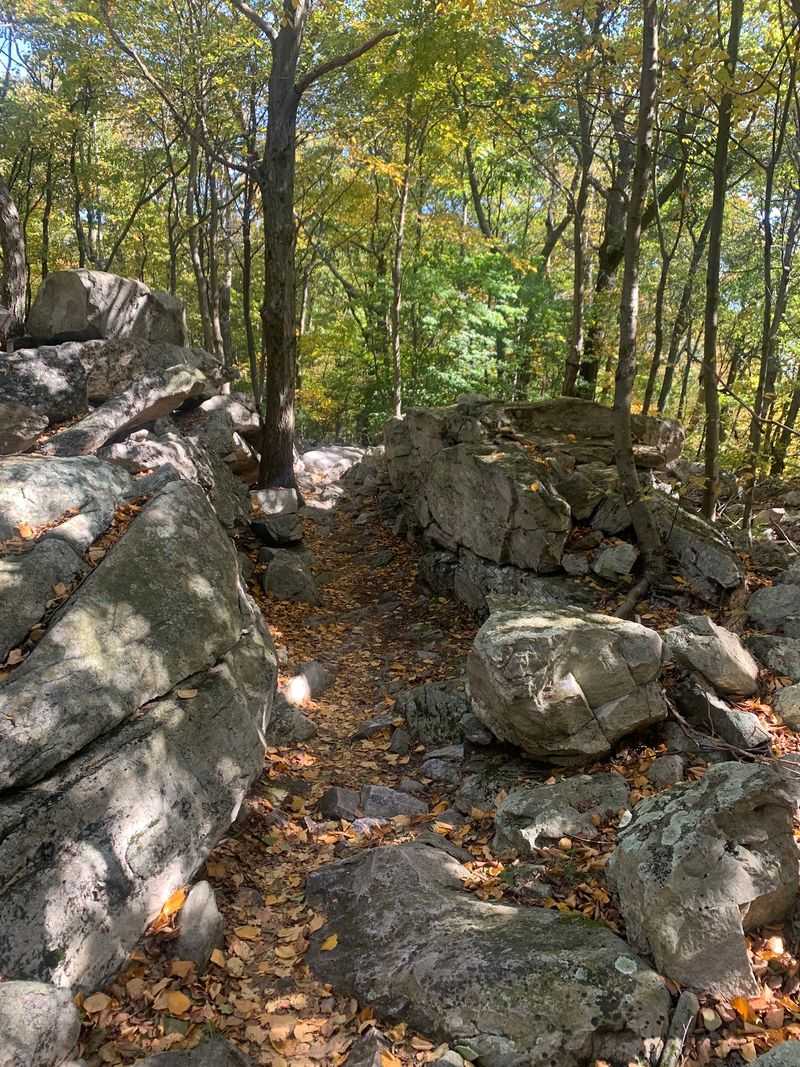
Hikers have a nickname for the rocky trails here: Rocksylvania.
On the Pulpit Rock and Pinnacle loop, you will quickly understand why.
This roughly nine-mile loop follows part of the Appalachian Trail.
It is often called one of the most scenic hikes in Pennsylvania.
The loop is rated moderately difficult.
You will face real elevation gain and boulder fields that ask for careful footwork.
Think of the rocks as nature’s balance test.
Slow and steady wins here, especially when fallen leaves hide the gaps.
Pulpit Rock comes with wide views into the valley below.
It makes a great first reward and a smart snack stop.
Then comes The Pinnacle, the headline view.
From 1,635 feet, you get a 270-degree panorama over the Lehigh Valley and the Blue Mountain ridge.
In peak fall, the farmland and forests below look like a giant patchwork blanket.
It is easy to stay longer than you planned.
Fun fact: The Pinnacle is the second highest point in Berks County.
That is solid bragging material for the ride home.
Keep your eyes open for a natural mountain spring and a small hidden cave along the route.
Part of the descent also follows Furnace Creek.
Dogs can come along if they stay leashed.
Rocky ground can be rough on paws, so watch how your pup is doing.
Parking hours matter at Hamburg Reservoir.
From May through September, the lot is open 6 a.m. to 8 p.m.
From October through April, hours shrink to 7 a.m. to 5 p.m.
Since peak foliage falls in that window, start early so you are not racing the gate.
Overnight parking needs advance permission.
Plan ahead if you want to camp or hike longer.
Address: Hamburg Reservoir parking lot, Reservoir Road, Hamburg, PA 19526
7. Thousand Steps
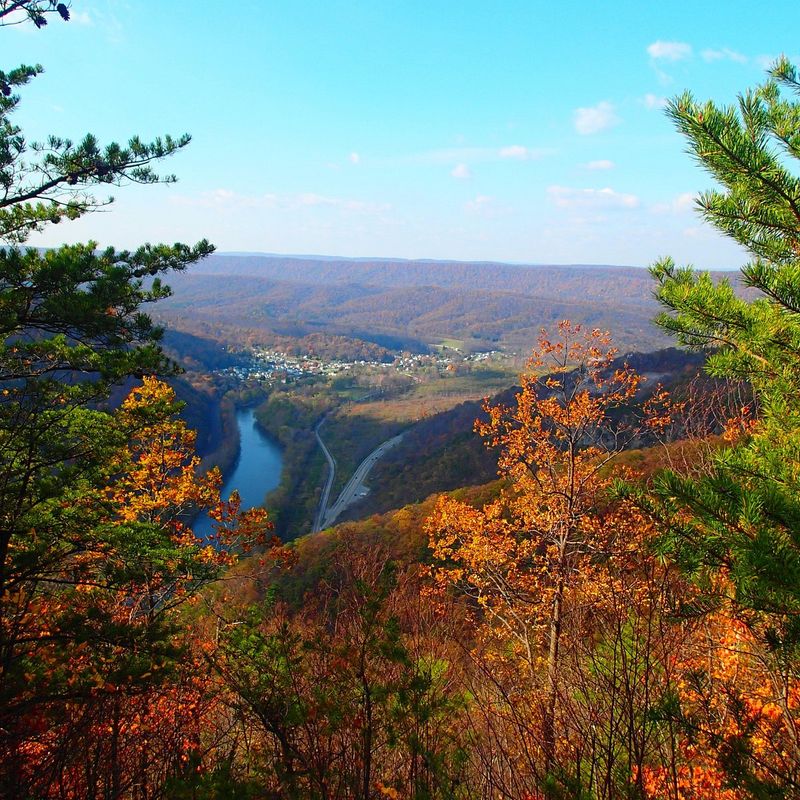
The name is actually an undersell.
The Thousand Steps include 1,037 stone steps, so you get a bonus 37 at no extra charge.
These steps climb the side of Jacks Mountain on the Standing Stone Trail.
They gain about 850 feet in roughly half a mile.
That is a lot of up in a short space.
Your legs will feel it, and your heart rate will definitely notice.
The steps are not neat or even.
They are irregular stones set into the mountain, so watch your footing as you go.
Quarry workers built them around 1936 to reach the Ledge Quarry.
Some sources place the work in the 1930s or 1950s.
Workers climbed these steps to get to their jobs.
Suddenly your gym’s stair machine does not sound so tough.
The quarry produced ganister stone.
It was used to make heat-resistant silica bricks.
In the early 1920s, Mount Union earned a reputation as the Silica Brick Capital of the World.
The steps are a hands-on link to that story.
At the top, you can explore the old stone quarry and remains of a train shed.
It feels like a little outdoor history museum.
Then there are the views.
Overlooks like Mapleton and Mount Union show off the Juniata River Valley in full fall color.
The area was also where two major American Indian paths crossed.
People have traveled through this valley for a very long time.
The steps belong to the 80-mile Standing Stone Trail.
That trail is part of the larger Great Eastern Trail network.
The route is open year-round.
Rain, ice, and snow can make the stones slippery, so a dry fall day is ideal.
Address: Parking on westbound side of Route 22, between Huntingdon and Mount Union, PA (GPS: 40.39169, -77.91420)
8. Flat Rock Trail
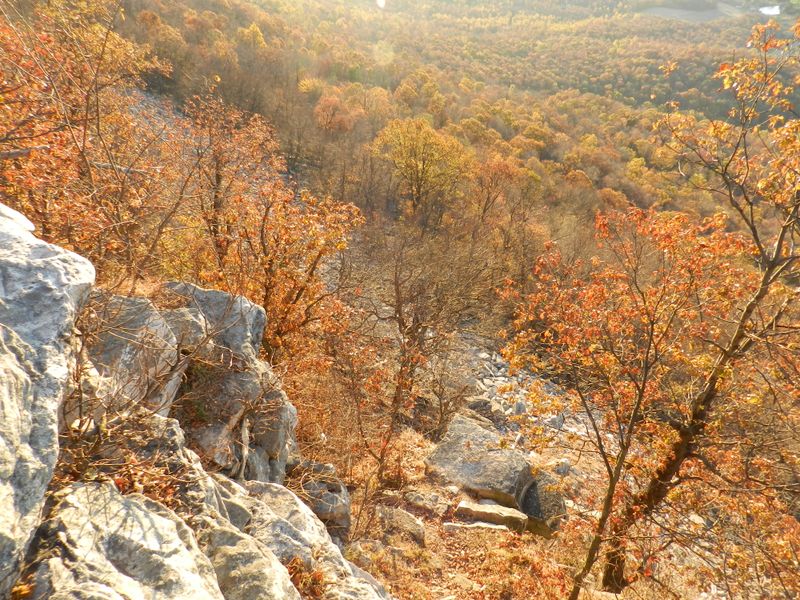
Sometimes the best seat in the house is a big, flat rock.
At Colonel Denning State Park, that rock comes with a view of the Cumberland Valley.
The Flat Rock Trail is a five-mile out-and-back hike.
Some sections are strenuous, so expect your legs to work for that payoff.
Once you arrive, the valley spreads out below in a patchwork of farms and woods.
In autumn, the colors make it look like a painted postcard.
The park sits in Doubling Gap in the Blue Mountain range.
It is small at 273 acres, but it packs in plenty of scenery.
A 3.5-acre lake adds a peaceful touch near the start of your day.
It is a lovely spot to slow down after the hike.
Hungry hikers will like the picnic setup here.
The park offers lots of picnic tables and charcoal grills.
Picture a post-hike cookout as your reward, minus the cliché.
Hot dogs simply taste better after a mountain climb.
The park is also a major trailhead for the Tuscarora Trail.
Long-distance hikers and curious day hikers both pass through.
Its name honors William Denning, who lived from 1737 to 1830.
He was a sergeant in the Revolutionary War.
That history gives the park a little extra character.
You are hiking through a place named for someone from the earliest days of the country.
Hours are simple to remember.
The park is open year-round from dawn to dusk.
Fall days get shorter fast, so start early.
That gives you time to hike, rest on the rock, and get back before dark.
Pack water, a layer, and a snack for the overlook.
A flat rock is perfect for a mini picnic with a big view.
Address: 1599 Doubling Gap Road, Newville, PA 17241-9756
9. Minister Creek Trail
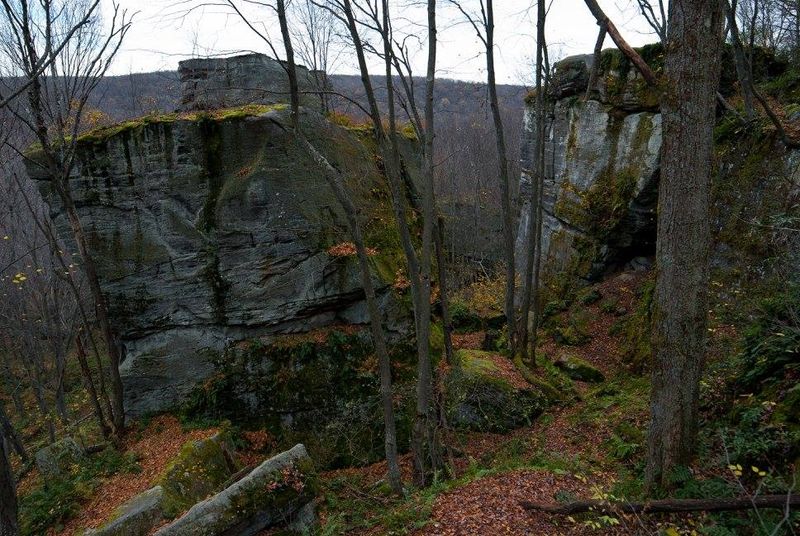
Giant boulders, a trout stream, and a valley overlook walk into a forest.
That is no joke, just the Minister Creek Trail.
This loop sits in the Allegheny National Forest, the only national forest in Pennsylvania.
That makes it a pretty special place to chase fall colors.
The loop runs about 6.6 to 7.3 miles, depending on the source.
It is rated moderately difficult.
Along the way, you will weave past huge boulders scattered through the woods.
Some look big enough to have their own zip codes.
In fall, the forest around those rocks bursts with color.
The contrast between gray stone and bright leaves is a photographer’s dream.
Do not miss the Minister Valley Overlook.
It gives you a wide look across the colorful landscape below.
The trail also follows Minister Creek itself.
Anglers can fish there for small native brook trout.
Older trees and decaying vegetation help support wildlife in the area.
Move quietly, and you may spot some forest residents.
History hides under your feet here.
Sections of the trail follow old railroad grades from early logging days.
Those flat stretches are a nice break between rocky parts.
They also remind you how much these woods have changed over time.
Part of the trail connects with the North Country National Scenic Trail.
It is a long-distance route, so you might share the path with serious backpackers.
The trailhead is near Minister Creek Campground.
Camping nearby can make an early start much easier.
Fall is a great time to visit for another reason.
In winter, access can be limited because parking areas are not plowed.
Address: 10353 Route 666, Tionesta, PA 16353
10. Quehanna Trail
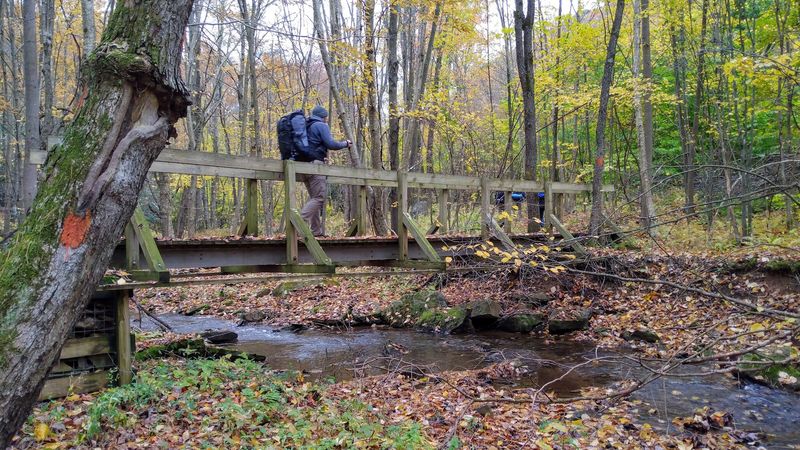
Few trails can say they used to share space with nuclear research.
The Quehanna Trail can, and today it is all about elk and wild forest.
The Curtiss-Wright Corporation began using this area for jet-engine and nuclear research in 1955, and the property was returned to the Commonwealth in 1966.
Now the Quehanna Wild Area covers nearly 50,000 acres.
It stretches through Moshannon and Elk State Forests.
The main trail runs 73 miles, so most people will not finish it in an afternoon.
Blue-blazed connectors and side trails add about 30 more miles.
Those extra paths make shorter loop hikes possible.
You can sample the wild area without signing up for a week of trail mix.
The main route is blazed orange.
Its western end begins in Parker Dam State Park.
Expect rugged ground and elevations up to 2,200 feet.
Forests shift between mixed oak, deciduous, and evergreen trees.
That mix makes fall especially colorful.
Dark evergreens frame the reds and golds like a picture frame.
Elk are the big celebrities here.
The area is known for its large herd, so keep your camera handy.
You may also see white-tailed deer, bears, turkeys, or even bobcats.
Give wildlife plenty of space and enjoy the show from a distance.
Inside the wild area sits the Marion Brooks Natural Area.
It contains one of the largest stands of white birch in the eastern United States.
Pale birch trunks against golden leaves make a striking scene.
It is one of the most unusual fall views in the state.
One safety note matters here.
Timber rattlesnakes live in the area, so watch where you step and where you sit.
Address: Parker Dam State Park, 28 Spitzer Rd, Penfield, PA 15849
Share this story