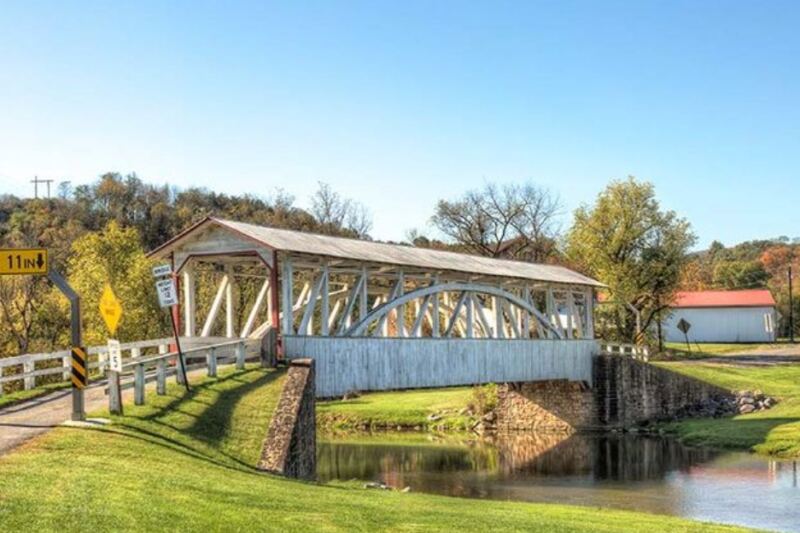
In July 1863, Union soldiers marched across a wooden bridge with a roof on their way to one of the most famous battles in American history. A few days later, retreating Confederate troops crossed those very same planks. That bridge is still standing, and you can walk across it today.
I love that a structure made of timber can hold that much story. Pennsylvania has plenty more like it, too. One sits right above a natural waterfall. Another perches 30 feet over a creek, and one more stretches 278 feet from end to end.
Fall makes these old spans even better. Red siding against golden leaves is the kind of scene I could stare at for hours. Add a quiet back road and a thermos of cider, and the day plans itself. So grab a jacket, charge your phone, and fill the tank. These old bridges are even prettier in person, especially when the fall colors show up.
1. Sachs Covered Bridge
Two armies crossed this bridge in the same week, and that is not a line you hear about many structures.
Union troops marched over it on July 1, 1863, while heading toward Gettysburg.
Three days later, retreating Confederate forces used the same span.
That history is why many people call it the most historic covered bridge in Pennsylvania.
The bridge dates to around 1854.
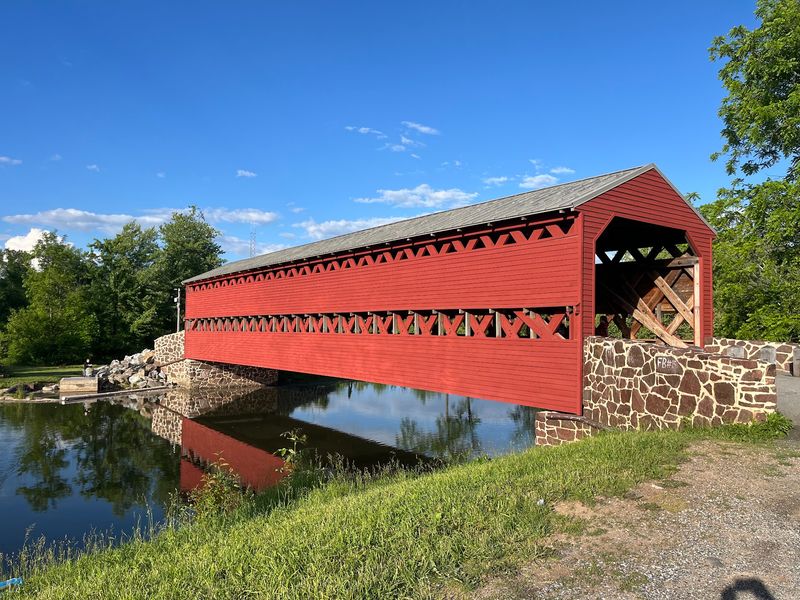
Builders used a Town lattice truss, which looks like a giant crisscross of wooden boards along the sides.
Stand inside and look at the walls.
That diamond pattern is doing the heavy lifting, spreading weight across the whole frame.
At about 100 feet long, the span is easy to explore at a slow pace.
You can walk from one end to the other in a minute, but you probably won’t.
Most visitors stop in the middle to peek out at the creek below.
It’s a natural spot to pause and think about the soldiers who once hurried through.
Autumn is the headline season here.
The bridge is well known for its fall foliage, and the trees around it put on a big show.
Plan to bring a good camera or a fully charged phone.
The red siding pops against orange and yellow leaves in a way that almost feels unfair to other bridges.
A smart move is to pair this stop with a day around Gettysburg.
The battlefield and town make the bridge feel like part of a bigger story instead of a quick photo stop.
Morning light works well if you like softer photos.
Late afternoon gives the wood a richer glow, so try both if you have the time.
Wear comfortable shoes, since you will want to wander the banks for different angles.
The view from beside the creek shows off the full shape of the roof and trusses.
History lovers and leaf peepers can agree on this one.
It’s a rare place where a quick walk feels like a short trip back to 1863.
Address: 222 Sachs Rd, Gettysburg, PA 17325
2. Pack Saddle Covered Bridge
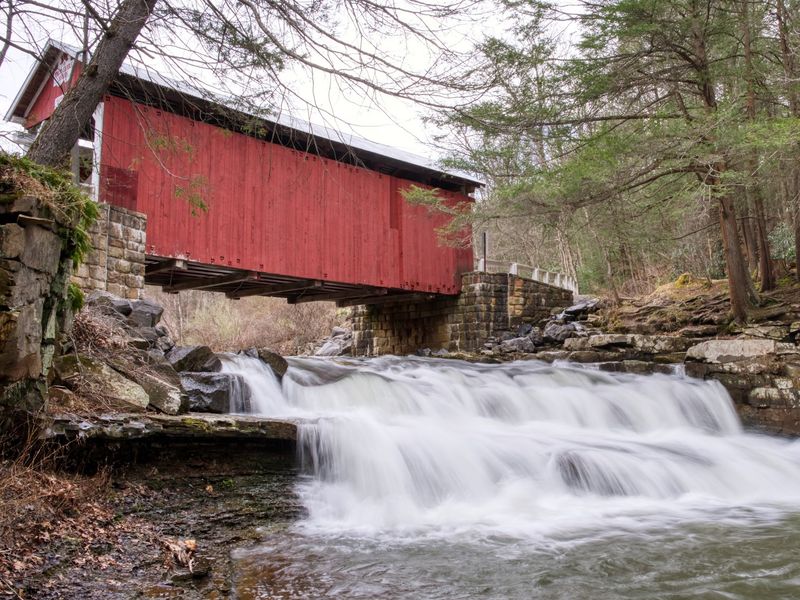
Most covered bridges cross a lazy creek and call it a day.
Pack Saddle decided that wasn’t dramatic enough and sat itself right over a natural waterfall.
It is the only covered bridge in Pennsylvania built over a natural waterfall.
That one detail makes it a favorite in Somerset County and beyond.
Don’t expect a giant structure, though.
The bridge is just 48 feet long, which makes it small, charming, and very easy to photograph from below.
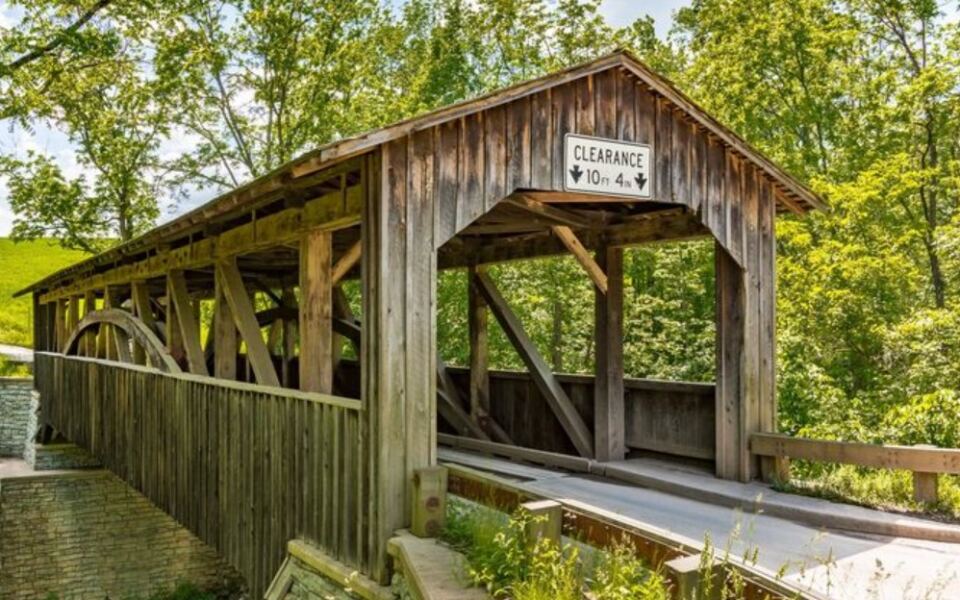
Built in 1870, it uses a King Post truss.
That design is one of the simplest, with a center post holding things together like the middle pole of a tent.
Nobody knows who built it.
The builder’s name has been lost, which adds a little mystery to your visit.
Good news for its future came in the spring of 2020.
The bridge went through an extensive rehabilitation project to keep it safe and stable.
Thanks to that work, you can keep enjoying it for years to come.
It’s now one of the most photographed spots in the Laurel Highlands.
So how do you get the best shot?
Many photographers head down near the stream so the falls and the bridge share the frame.
Watch your footing if you try that angle.
Wet rocks near moving water can be slippery, especially when fallen leaves cover them.
Fall turns this little scene into a postcard.
The sound of rushing water plus colorful trees overhead makes a short stop feel bigger than it is.
Because the bridge sits on a rural road, a slow and careful drive is part of the experience.
Give yourself time to enjoy the countryside on the way in.
Pack a snack and linger a bit.
This is the kind of spot where ten minutes easily turns into an hour of listening to the falls.
Address: 1024 Covered Bridge Rd, Fairhope, PA 15538
3. Knapp’s Covered Bridge
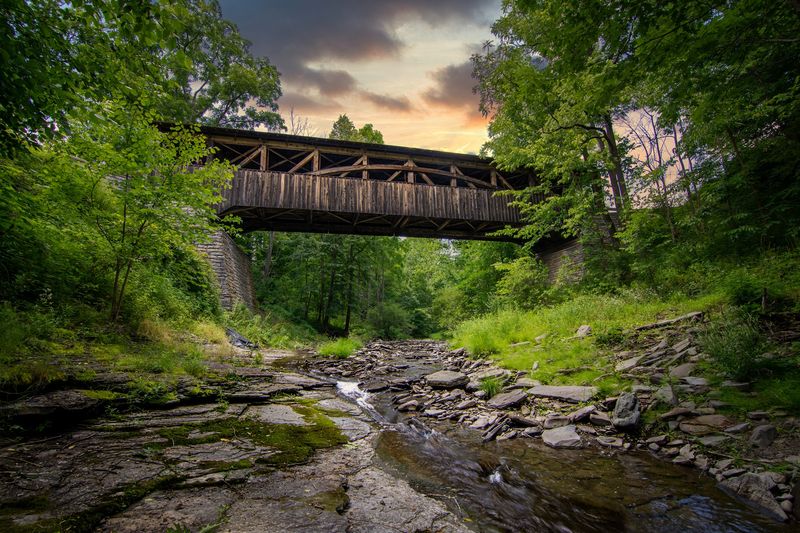
Afraid of heights?
You might want to hold someone’s hand here, because this bridge sits about 30 feet above Brown’s Creek.
That makes Knapp’s the highest covered bridge in Pennsylvania, according to records.
It’s a fun twist, since most covered bridges hug the water pretty closely.
Up in Bradford County, this span has another claim to fame.
It’s the only covered bridge still standing in the county.
Builders finished it in 1853, so it has been around for more than 170 years.
Think about how many seasons of falling leaves it has watched drift into the creek.
The bridge stretches 95 feet.
Its design uses a Burr arch truss, which pairs a big curved arch with a wooden frame for extra strength.
When you look at the sides, try to spot the arch.
It’s a clever trick from the 1800s that helped bridges carry heavy loads over longer distances.
A major renovation took place in 2000 to help preserve it.
That care is a big reason the bridge still looks so good today.
The height changes how you see the scenery.
Instead of looking across the water, you get to look down into the creek valley.
In autumn, that view is a real treat.
Treetops in red, orange, and yellow spread out below and around the bridge like a giant quilt.
Bring a camera with a wide setting if you have one.
The tall setting is hard to capture in a single tight shot.
The drive out to the Troy area is part of the fun, too.
Northern Pennsylvania back roads are known for rolling hills that shine in fall.
Take your time and enjoy the quiet.
A bridge that has lasted this long deserves a visitor who isn’t in a rush.
Address: 341 Covered Bridge Rd, Troy, PA 16947
4. McConnell’s Mill Covered Bridge
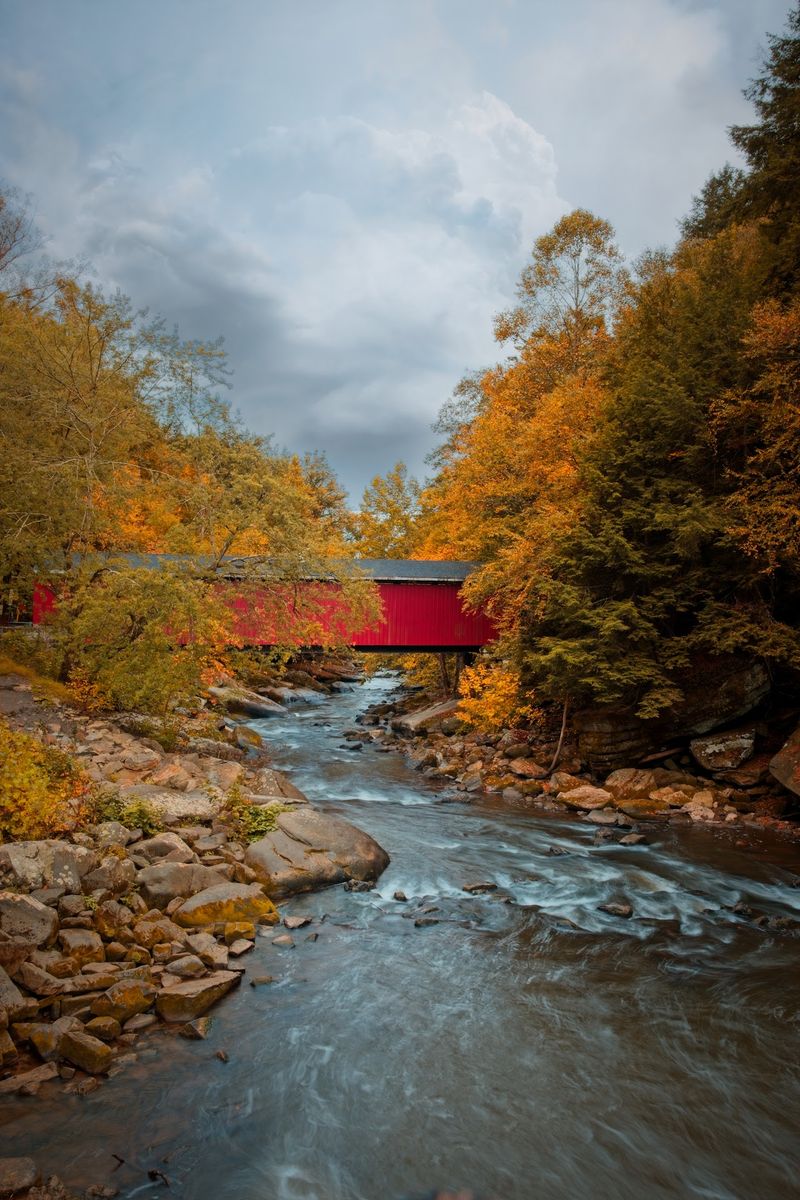
Why settle for one attraction when you can get a bridge, a waterfall, a mill, and a rocky gorge in one stop?
McConnell’s Mill State Park packs them close together.
The covered bridge dates to 1874.
Its bright red exterior stands out against the forest, especially when the leaves change.
In autumn, the hardwoods around the gorge turn shades of red and gold.
That color matched with the red bridge has made this a favorite for photographers.
Right nearby sits a historic grist mill.
Mills like this once ground grain for local farms, and seeing it next to the bridge helps the past click into place.
Then there’s the waterfall.
Moving water, old timber, and stone all in one view is a pretty great deal for a single parking spot.
Speaking of parking, it’s free.
The park is also open around the clock, which gives you flexibility for sunrise or golden hour photos.
Lace up real shoes for this visit.
The park offers hiking trails that wind through the gorge and past glaciated rock formations.
Those rocks tell a story much older than the bridge.
Ancient glaciers helped shape this rugged landscape long before anyone built anything here.
Trails in a gorge can be rocky and uneven.
Go slow, watch your step, and stay back from the edge of the water.
If you have kids along, this stop is a winner.
There’s enough to see that nobody gets bored after one quick photo.
Plan for at least a couple of hours.
Between the bridge, the mill, and a short hike, the time goes faster than you expect.
Western Pennsylvania doesn’t always get as much covered bridge love as Lancaster County.
This park makes a strong case that it should.
Address: McConnells Mill Rd, Portersville, PA 16051
5. Pomeroy Academia Covered Bridge
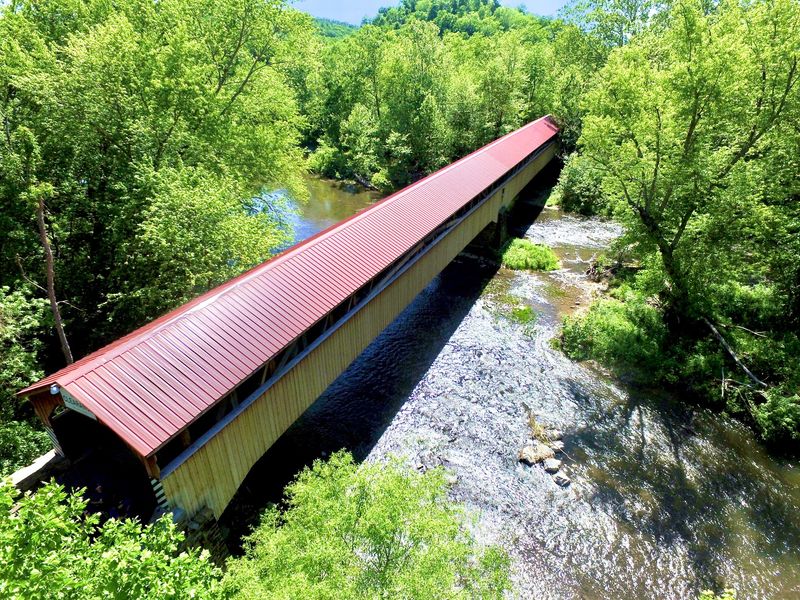
Bring your walking legs, because this one goes on for a while.
At 278 feet, the Pomeroy Academia Covered Bridge is the longest covered bridge in Pennsylvania.
That’s a lot of timber.
Standing at one end and looking toward the other is a little like peering down a long wooden tunnel.
You’ll find it in Juniata County, in the small community of Academia.
The area is rural, so the drive takes you past open fields and quiet roads.
Length is the big story here.
In a state packed with covered bridges, holding the top spot for size is a pretty big deal.
The bridge stands as a landmark of old craftsmanship.
Builders back then worked without modern machines, which makes a structure this size even more impressive.
Try counting your steps as you cross.
It’s a silly little game, but it helps you feel just how long the span really is.
Fall is an easy choice for a visit.
Trees along the creek add color that frames the bridge from both sides.
For photos, step back and go wide.
A long bridge looks best when you can fit the whole thing in one shot.
Side views often work better than straight-on shots here.
They show off the full stretch of the roofline against the sky.
Since the setting is quiet and out of the way, plan ahead.
Pack water, snacks, and a map in case your phone signal gets spotty.
Juniata County makes a nice escape from busier tourist spots.
You can enjoy the bridge at a slower pace and soak in the countryside.
If you’re making a full covered bridge road trip, this stop is a must.
Saying you crossed the longest one in the state is a fun bragging right.
Address: 6474 Academia Rd, Academia, PA 17044
6. Colemanville Covered Bridge
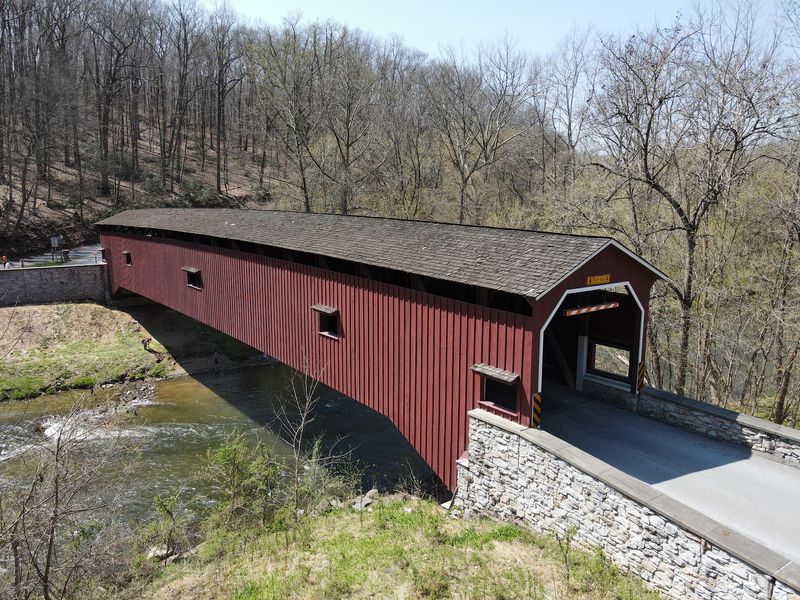
Talk about a comeback story.
Floods kept knocking this bridge around, so Lancaster County finally lifted it six feet higher and scooted it west.
That big move happened in 1992, when the county completely rebuilt it.
The goal was simple: keep Pequea Creek from causing more trouble.
Don’t be surprised if you hear different names for it.
The Colemanville Covered Bridge is also called Martic Forge Covered Bridge or Pequea #12 Bridge.
James C.
Carpenter first built it in 1856.
Over the years, floods damaged it enough that parts were rebuilt in 1938 and again in 1973.
So the bridge you see today is a survivor with a lot of patch jobs in its past.
That stubborn streak is part of its charm.
It uses a single Burr arch truss.
Look along the inside walls to spot the curved arch that helps it span the creek in one stretch.
Here’s a fun fact for your next trivia night.
It’s Lancaster County’s second-longest single-span covered bridge still in operation.
And yes, it’s still in use.
Cars cross it, so be alert and give traffic plenty of room when you stop for photos.
The paint job is classic Lancaster County.
Red siding with white trim makes it look like it jumped right off a holiday card.
Fall gives that red and white combo a colorful backdrop.
Leaves along Pequea Creek make the scene feel extra peaceful.
Lancaster County is full of covered bridges, so this one fits nicely into a loop.
You can see several in a single afternoon.
Drive slowly on the back roads around here.
Horse-drawn buggies are common in the county, and sharing the road is part of the experience.
Address: 41 Fox Hollow Rd, Pequea, PA 17565
7. Pine Grove Covered Bridge
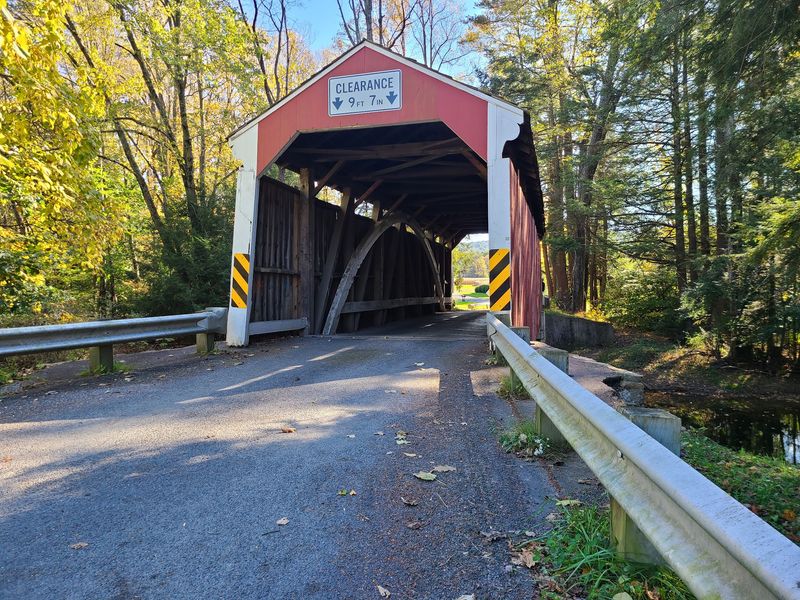
One bridge, two counties, and two spans.
Pine Grove Covered Bridge sits right on the border of Lancaster and Chester Counties.
It crosses the East Branch of Octoraro Creek.
That means you can technically start your stroll in one county and finish in another.
Elias McMellen built it in 1884.
His name pops up a lot in Lancaster County bridge history, so remember it for later.
Size is a big deal here.
It’s the longest covered bridge in Lancaster County, which is saying something in a county loaded with them.
It’s also the only two-span covered bridge in the county still in use.
Most bridges cross in one stretch, but this one takes a breather in the middle.
The design is a wooden double Burr arch truss.
Steel hanger rods were added later to give it extra support.
Look down as you go, too.
The deck is made of oak planks, a sturdy wood that has long been a favorite for bridges.
Outside, it wears the traditional red paint.
The white approaches at each end make a crisp contrast that photographers love.
Fall adds a third color to the mix.
Gold and orange leaves around the creek make the red and white stand out even more.
For the best shot, try catching both spans in one frame.
Standing back along the creek bank can help you show off its full length.
Remember that cars still use the bridge.
Pull off safely before taking photos, and keep an eye out for traffic.
This stop pairs well with other Lancaster County bridges.
It’s a nice way to wrap up a long day of leaf peeping in the southern part of the county.
Address: 8 Ashville Rd, Nottingham, PA 19362
8. Kauffman’s Distillery Covered Bridge
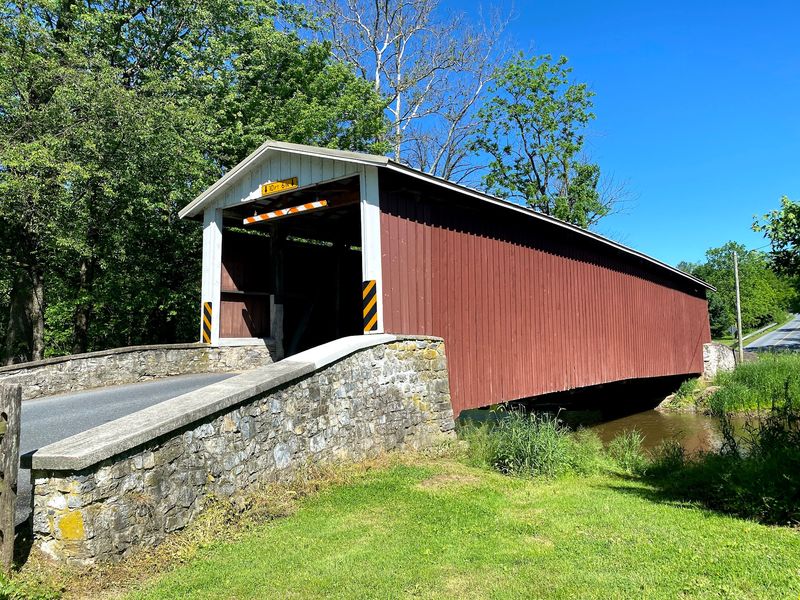
Plenty of covered bridges are named after mills, but this one took a more unusual route.
It was named for the nearby Kauffman’s Distillery Mill, which operated in the late 1800s.
That detail gives it a fun bit of history.
It stands apart from the many bridges named after grain mills or local families.
Like a few others on this list, it goes by more than one name.
You might see it called Sporting Hill Bridge or Big Chiques #1 Bridge.
The bridge crosses Chiques Creek in Lancaster County.
It sits near Manheim, a nice area for a slow countryside drive.
James C. Carpenter first built it in 1857.
Then Elias McMellen rebuilt it in 1874, so two big names in local bridge history had a hand here.
Remember McMellen from Pine Grove?
Spotting the same builder on different bridges is a fun way to connect the dots on your road trip.
The design is a single-span double Burr arch truss.
That means paired arches help carry the load across the creek in one long stretch.
Outside, it’s painted red with white approaches.
That combination is a traditional look for Lancaster County covered bridges.
It still carries cars today.
Be careful when you stop, and choose a safe pull-off spot before grabbing photos.
Autumn is a lovely time to visit.
Trees along Chiques Creek add color that makes the red siding look even brighter.
Try shooting from a little distance to show the bridge and the creek together.
The setting tells the story just as much as the boards do.
Ending your Pennsylvania bridge tour here feels fitting.
After all, a bridge with two builders, three names, and over 150 years of service deserves a grand finale.
Address: 1100 Sun Hill Rd, Manheim, PA 17545
Share this story