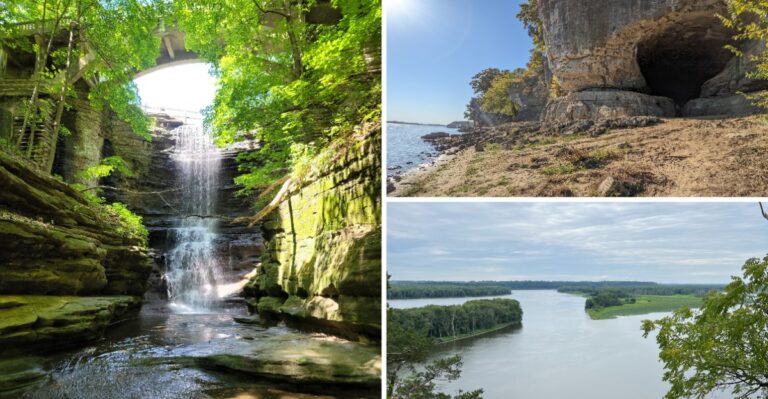
Illinois may not be famous for caves, but some of the state’s most spectacular hiking trails reveal a surprisingly rugged landscape filled with sandstone formations, rock shelters, narrow passages, and hidden geological wonders. From the dramatic bluffs of southern Illinois to secluded canyon systems and ancient river-carved formations, these trails offer scenery that feels far removed from the state’s flatter reputation.
Every bend brings something new, whether it’s a towering overhang, a hidden cave-like recess, or a striking rock formation shaped over thousands of years. If you’re looking for hikes that combine adventure, natural beauty, and unforgettable geology, these 9 Illinois trails deserve a place on your list.
1. Cave-in-Rock Trail (Cave-in-Rock State Park)
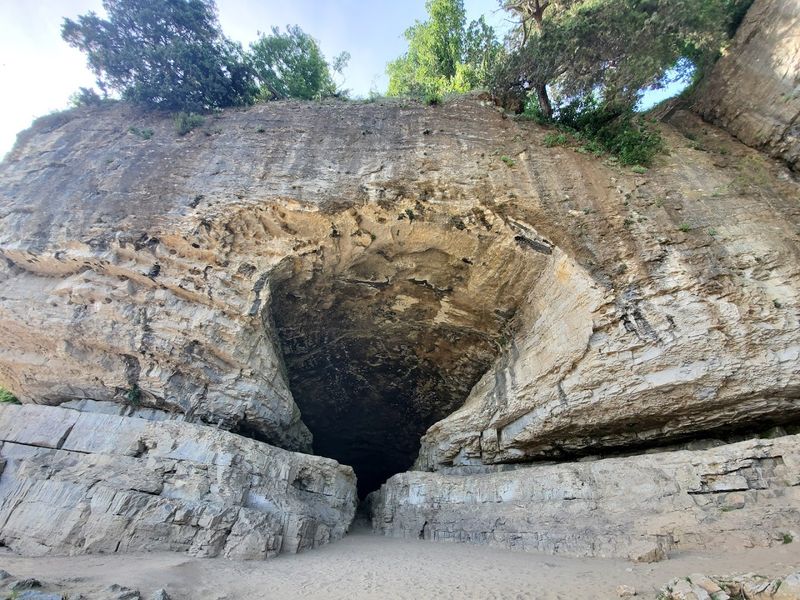
Start with the headliner. Cave-in-Rock Trail leads you toward one of the most striking natural openings in Illinois, where a huge cave cuts into limestone above the Ohio River and instantly changes the scale of the landscape around you.
The approach builds anticipation in a satisfying way, with bluff scenery, shifting light, and glimpses of water that make the cave’s arrival land even harder.
Once you are near the opening, the rock walls do most of the talking. The cave is broad, shadowy, and powerful without needing any extra drama, and the contrast between the dark interior and the bright river beyond gives the whole place a bold, stage-like look.
You get texture everywhere – weathered stone, uneven surfaces, and layers shaped over time into a space that looks both raw and strangely grand.
This is the kind of trail where you will probably stop more than planned, partly for photos and partly because the setting keeps pulling your eyes in different directions.
One moment you are focused on the massive curve of the cave ceiling, and the next you are staring out at the wide Ohio River framed by rock. Even if the walk itself is manageable, the visual payoff is oversized and memorable.
If you are building a Southern Illinois hiking day around scenery that looks immediately iconic, this one belongs near the top of the list. It gives you a famous cave, serious bluff presence, and river views strong enough to hold their own against the stone.
Few places combine those elements so cleanly, which is exactly why this trail remains such an easy recommendation.
2. Ox-Lot Cave Trail (Rim Rock National Recreation Trail)

Ox-Lot Cave Trail has that classic Shawnee ability to keep changing shape on you. A wooded path gives way to cliffs, then to tighter rocky sections, then to a cave tucked beneath high sandstone bluffs that make the whole route feel more intricate than its mileage suggests.
You are not just walking through the forest here – you are moving through a layered stone landscape with a strong sense of enclosure.
The sandstone steals the show early and often. In some stretches, the trail threads past narrow passages and bluff faces that rise abruptly beside you, creating the kind of close-up geology that makes every turn feel active rather than repetitive.
Ox-Lot Cave itself adds another visual shift, sitting under protective rock in a way that highlights the overhangs, textures, and sculpted lines that define this corner of the recreation area.
This hike works especially well for anyone who likes variety without needing a huge expedition. The forest softens the route, but the rock features keep it from ever blending into a standard woodland walk, and the cave gives the trail a clear destination with real presence.
Light filtering through the trees can make the stone glow warmer in places, which adds even more contrast between the sheltered rock and the open trail.
There is also a nice rhythm to how this route reveals itself. You get short, scenic transitions between the biggest features, so the trail never dumps everything on you at once.
By the time you finish, the memory that sticks is not only the cave, but the full sequence of bluff walls, passageways, and forested bends that led you there.
3. Hawk’s Cave Trail (Ferne Clyffe State Park)
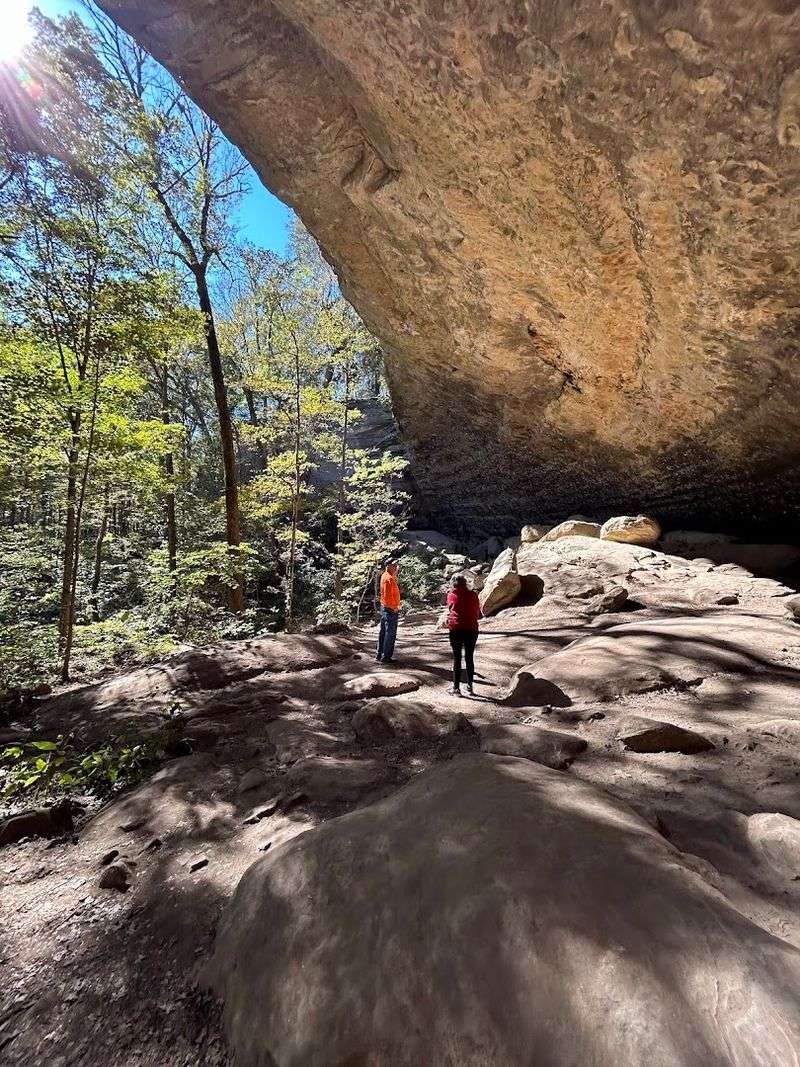
Hawk’s Cave Trail is one of those hikes that manages to be approachable without looking tame. The route heads through rich woodland toward a huge sandstone rock shelter, and the payoff is immediate once the bluff line comes into view.
For families, casual hikers, or anyone chasing big scenery on a shorter outing, this trail delivers scale fast. The rock shelter is the star, but it is not working alone.
Rugged bluffs frame the area with a rough, muscular look, and when water is flowing nearby, the surrounding scenery gets an extra lift from small seasonal falls and damp, mossy surfaces.
That mix of stone, shade, and greenery creates strong visual contrast, especially where the broad overhang meets the softer woods around it.
One of the best parts of Hawk’s Cave is how easy it is to appreciate from different distances. Standing back lets you take in the size of the shelter and the bluff formation above it, while moving closer draws attention to the curved ceiling, weathered textures, and the sheltered feel beneath the rock.
You can keep the visit simple, or linger and notice how the landscape shifts with light, moisture, and the season. This trail has a relaxed confidence that makes it easy to recommend. It offers a cave-like feature with real presence, but the path to it stays welcoming enough that the outing can fit into almost any Southern Illinois itinerary.
When you want a hike that balances comfort, scenery, and a strong sandstone payoff, Hawk’s Cave is an easy pick.
4. Sentry Bluff & Natural Bridge Area (Bell Smith Springs Recreation Area)
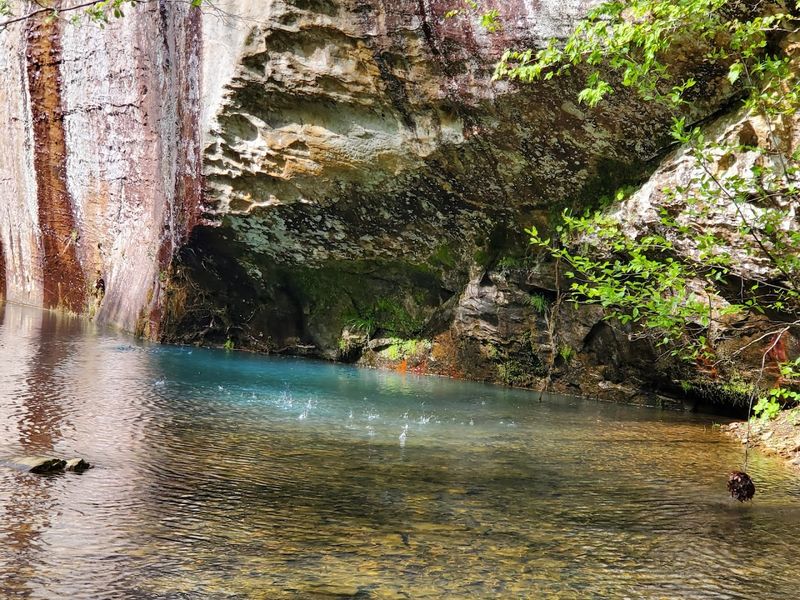
Sentry Bluff and the Natural Bridge area pack a lot into one outing, and that is exactly the appeal. On this hike, cave-like rock shelters, tall sandstone forms, and one of Southern Illinois’ most eye-catching natural bridges all share the same stretch of wild terrain.
Instead of building toward a single reveal, the route keeps stacking feature after feature in a way that makes the entire walk feel eventful.
The sandstone here has a bold, sculpted look that changes from ledge to ledge. Some sections feel open and elevated, while others tuck you beneath overhangs and into spaces where the bluffs create shelter and shadow.
Then the natural bridge arrives with a strong architectural presence, spanning rock with the kind of shape that looks almost designed, even though the surrounding textures keep it firmly grounded in the landscape.
This area is especially satisfying for hikers who like scenery with range. You can move from narrow, enclosed moments near rock walls to broader views where the bluff country opens up, and that change in scale keeps your eyes busy the whole time.
The shelters and bridge also photograph differently depending on angle and light, so there is plenty to notice beyond the first glance.
If you are choosing one trail system because you want several kinds of rock formations in a single trip, this area makes a strong case for itself. It combines structure, texture, and variety without feeling scattered, and every section supports the next.
The result is a hike that stays visually sharp from beginning to end, with sandstone doing something interesting at nearly every turn.
5. Giant City Nature Trail (Giant City State Park)
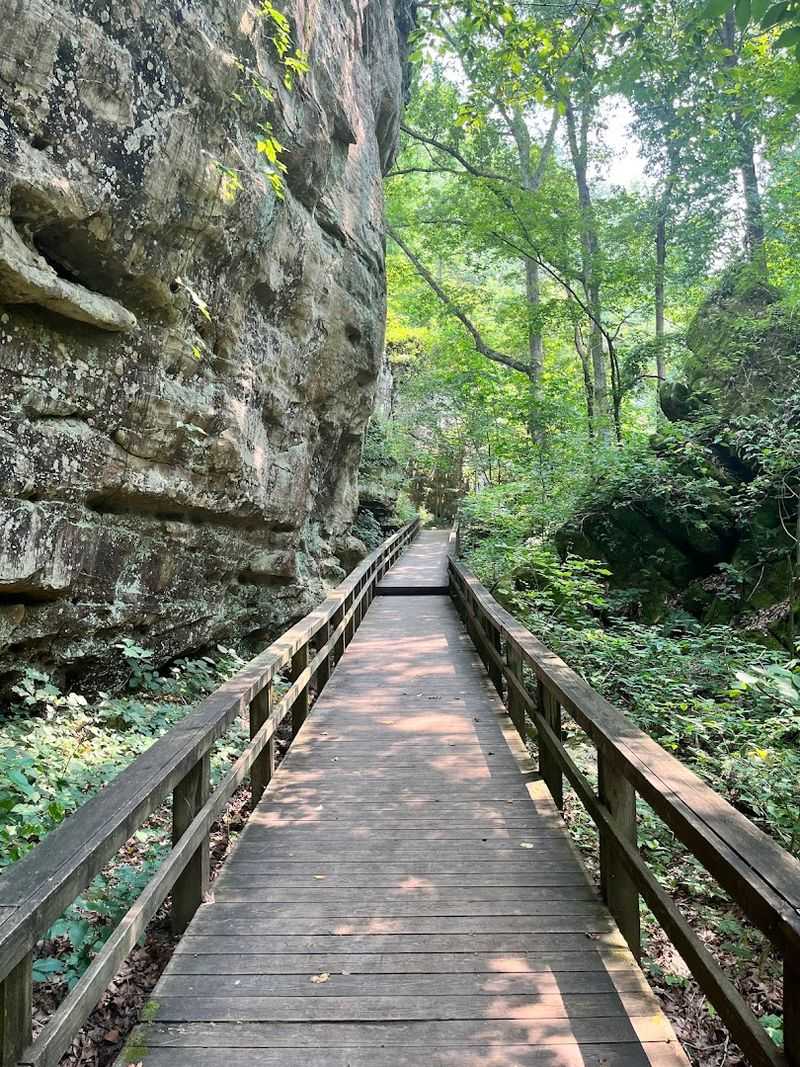
Giant City Nature Trail does not ease you in. Very quickly, you are moving through the park’s famous Giant City Streets, where towering sandstone walls rise on both sides and create corridors that look oversized, theatrical, and completely unlike a typical Midwestern walk.
The trail turns geology into architecture, with stone shaping the route in ways that feel immersive from the first enclosed section onward.
The appeal here is all about scale and closeness. Huge blocks and bluff faces form narrow passageways, shaded recesses, and overhangs that brush right up against the path, so you are rarely just looking at rock from a distance.
Instead, the sandstone surrounds you, revealing ledges, cracks, color shifts, and cave-like spaces that keep the landscape dynamic even when the trail itself is not especially long.
Because the walls are so prominent, light becomes part of the experience. Bright patches filter down from above, shadows deepen in the tighter corridors, and each bend changes how the stone reads, from warm and layered to cool and imposing.
It is a great route for fast scanners who still want texture, because the major features appear quickly and stay concentrated throughout the walk. There is a reason this trail remains one of the best introductions to Southern Illinois sandstone country.
It gives you canyon energy, overhangs, giant walls, and enough cave-like character to satisfy anyone hunting dramatic rock formations without committing to a rugged all-day route. When you want a hike that looks bold almost the entire time, Giant City Nature Trail is hard to beat.
6. Panther Den Loop (Panther Den Wilderness)
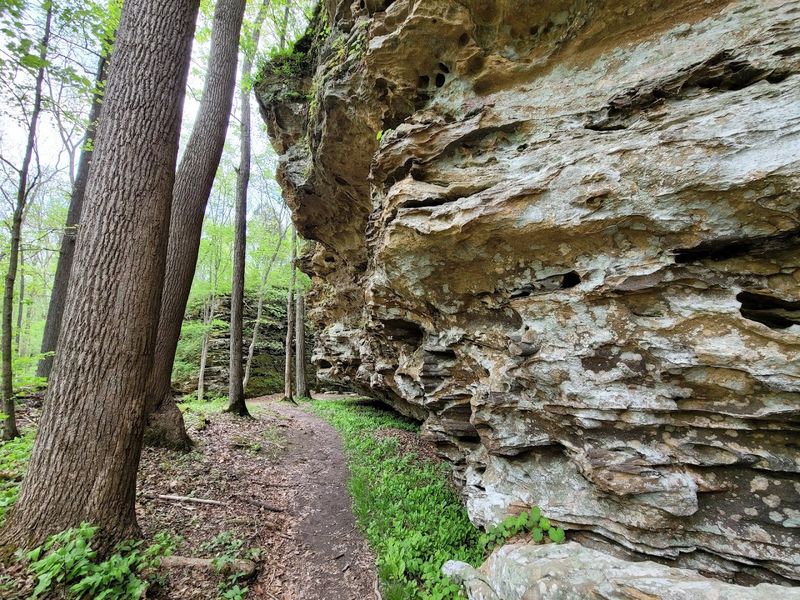
Panther Den Loop brings a rougher edge than some of the more polished park trails on this list. The route moves through wilderness terrain dotted with hidden rock shelters, narrow crevices, giant boulders, and oddly shaped sandstone features that appear almost casually among the trees.
It has a more exploratory personality, the kind that rewards hikers who enjoy scanning the woods for shapes, openings, and stone tucked just off the obvious line.
The rock formations here feel scattered in the best possible way. Instead of one central landmark dominating the hike, Panther Den offers a sequence of bluff fragments, sheltering overhangs, and tight passage-like sections that give the loop a constant sense of discovery.
Massive boulders amplify that effect, breaking up the forest floor with sudden chunks of stone that make the landscape look jumbled, rugged, and a little secretive.
This is a strong pick when you want cave-adjacent scenery without a single formal cave destination carrying the whole trip. The shelters, crevices, and rock piles create enough variety that your attention keeps shifting, and the wilder setting makes each formation stand out more sharply.
You are less likely to experience this trail as a straightforward march and more likely to treat it like a slow-moving search through a sandstone maze.
That sense of untidiness is part of its charm. Panther Den Loop feels less curated, more raw, and especially good for hikers who enjoy terrain with a bit of texture underfoot and a stronger backcountry mood.
If giant walls and obvious overlooks are not the priority, but weird formations and hidden stone spaces are, this loop earns its place easily.
7. Jackson Falls Trail (Jackson Falls Recreation Area)
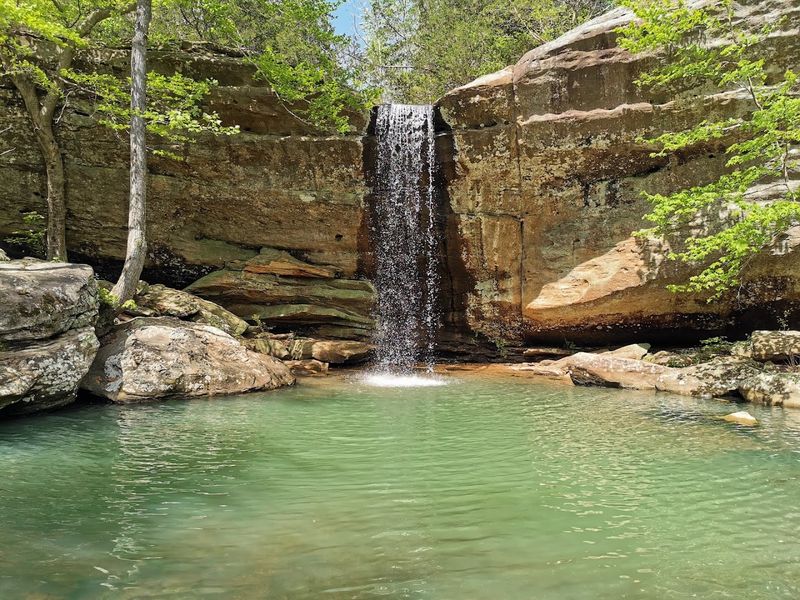
Jackson Falls Trail adds water to the sandstone equation, and that changes the whole mood. The route follows a stream through a canyon where waterfalls, bluff overhangs, rock shelters, and towering cliffs all crowd into the same scene, creating a hike that feels active and textured at every step.
Even before you focus on the individual rock features, the canyon itself sets up a dramatic stage. The overhangs and shelters give the trail plenty of cave-like interest, but the vertical sandstone walls are just as memorable.
They rise above the watercourse with a strong, clean presence, and their scale becomes even more noticeable when paired with smaller cascades and darker recesses beneath the bluffs.
It is easy to understand why climbers are drawn to this area, since the cliffs look imposing even from the valley floor.
For hikers, the appeal is in the layering. Moving water, uneven canyon walls, sheltered pockets, and dense greenery all overlap, so the landscape rarely sits still visually.
One stretch highlights a waterfall spilling near rock, another draws your eye to a broad overhang, and another frames the stream against sandstone walls that seem to tighten around the path.
Jackson Falls works best when you want your cave-trail scenery to come with extra motion and depth. Instead of a single destination, the route offers a continuous sequence of canyon details that keep the walk engaging from start to finish.
Add in the rugged cliff setting and those sheltering rock forms, and you get one of Southern Illinois’ most visually layered trail experiences.
8. Sand Cave Trail (Shawnee National Forest near Eddyville)
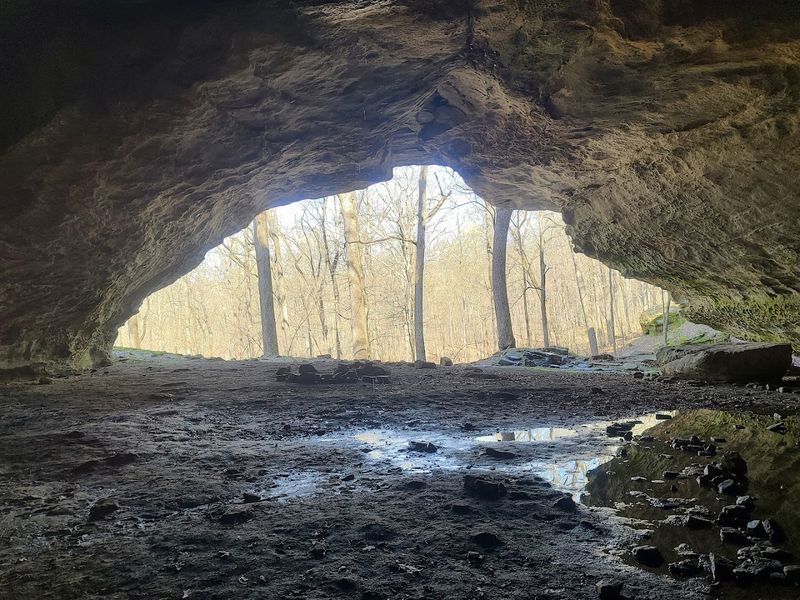
Sand Cave Trail is short, but it does not waste any time getting to the point. The walk leads to a massive sandstone alcove hidden beneath tall bluffs, and the reveal lands with real force because the scale feels far larger than the approach suggests.
If you like quick hikes with an oversized finish, this one knows exactly how to make an entrance. The alcove is the kind of feature that changes the temperature of the scene the moment you step into it.
Its sandy floor softens the setting, while the high curved walls and layered sandstone create a huge sheltered chamber with strong color and texture.
Depending on the light, the rock can show warm bands and subtle shifts in tone that make the whole space look even deeper and more sculpted.
There is a clean simplicity to this trail that works in its favor. You are not juggling a long route or waiting for scattered highlights to add up; the hike is about reaching one spectacular geological feature and then taking it in from every angle.
Stand near the edge of the alcove and the bluff overhead feels immense, move deeper inside and the outside forest starts to frame the opening like a stage set. That focus is why Sand Cave Trail earns such a strong spot on a cave-themed list.
It offers a true wow moment, cave-like scale, and sandstone detail packed into a manageable outing that still feels bold. For hikers chasing one of Southern Illinois’ most dramatic alcove views, this trail gets straight to the good part.
9. Devil’s Standtable Nature Trail (Giant City State Park)
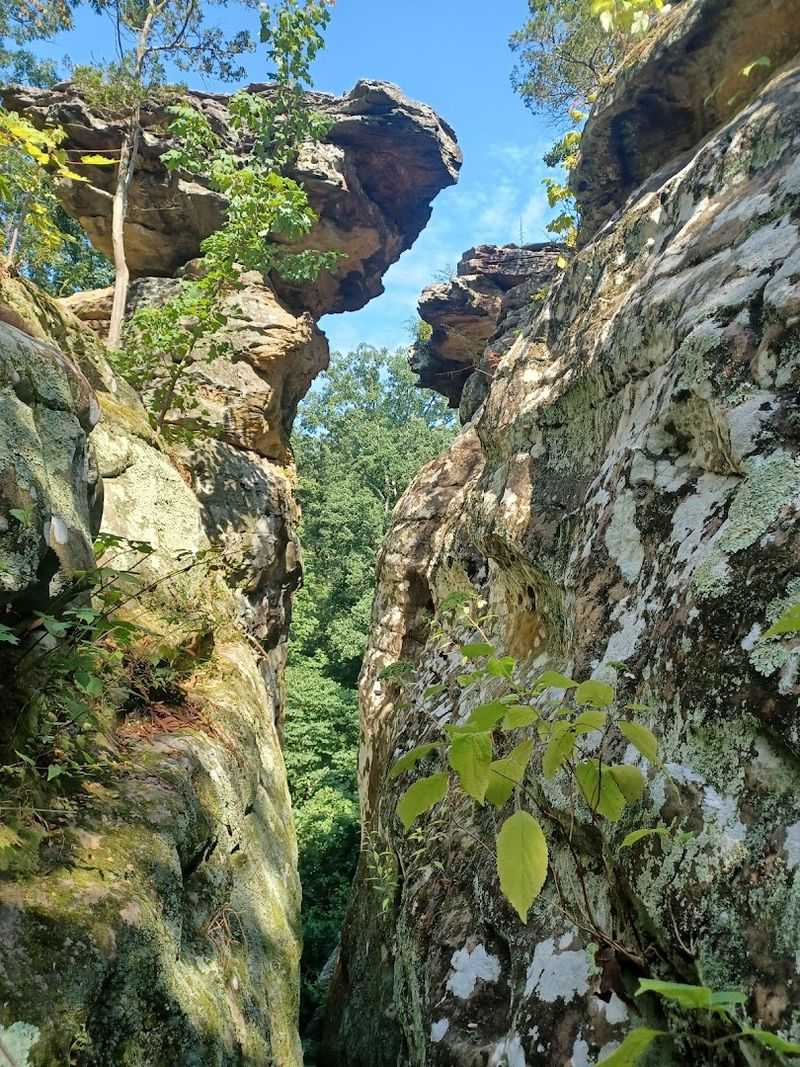
Devil’s Standtable Nature Trail proves that a short hike can still pack in a lot of rock drama. The path threads through sandstone overhangs, small shelter-like spaces, and oddly weathered formations before finishing at the famous mushroom-shaped pillar that gives the trail its name.
It is compact, photogenic, and loaded with enough geological personality to keep the route interesting from beginning to end.
Along the way, the stone does more than sit beside the trail. Overhangs dip low, bluff fragments create shallow cave-like pockets, and the weathering patterns on the sandstone give many surfaces a sculpted, almost stacked appearance.
Because the route is shorter, those details feel concentrated, which is great when you want a hike that stays visually busy without stretching into a major time commitment.
Then comes Devil’s Standtable itself, an unusual formation with a broad top balanced on a narrower base. Its shape stands out immediately against the forest setting, and the feature works so well because it looks improbable without seeming out of place.
You still get the rough texture and earthy color of the surrounding sandstone, but arranged into a form that feels playful and slightly surreal.
This trail is an easy add when your day already includes other Giant City stops, but it also stands on its own because the route gives you more than one memorable rock scene.
The overhangs and shelters set the tone, and the final pillar delivers a distinct finish that is hard to confuse with anything else in the region. For variety packed into a shorter walk, this one hits nicely.
Share this story