A narrow path slips beneath the trees, curls around a moss-covered boulder, and suddenly drops into a rocky valley where water trickles between ferns. It feels less like entering a public garden and more like discovering a place that was deliberately left off the map.
Leonard J. Buck Garden in Far Hills has that effect almost immediately.
There are no grand fountains demanding attention or rigid flower beds arranged with ruler-straight precision. Instead, ancient basalt ledges rise from the forest floor, delicate plants fill their crevices, and small bridges carry visitors over streams that helped shape the land thousands of years ago.
Spread across 33 acres in Somerset County, this remarkable rock garden blends horticulture, geology, and woodland scenery without making any one of them feel staged. Every turn reveals another tucked-away pond, steep stone staircase, or pocket of wildflowers.
It is carefully cultivated, certainly, but it still carries the thrilling sense that nature is running the show.
Leonard J. Buck Garden Hides 33 Acres of Natural Beauty in Far Hills
Far Hills may be best known for rolling estates, horse country, and the annual steeplechase at Moorland Farm, but one of its finest landscapes is tucked quietly along Layton Road. Leonard J.
Buck Garden occupies a wooded stream valley where rocky slopes, mature trees, and carefully placed plantings create one of the most distinctive public gardens in New Jersey.
The Somerset County Park Commission manages the property, yet its understated entrance gives little indication of how much lies beyond the visitor center.
Once inside, paths descend toward Moggy Hollow and branch through a series of alpine and woodland gardens. The terrain makes the 33 acres feel much larger than a conventional garden of the same size.
Trails climb, dip, turn sharply, and disappear behind boulders, allowing the landscape to unfold gradually instead of revealing itself all at once. A walk here is not particularly long, but it rewards a slower pace.
Tiny blossoms hide beside stones, moss forms miniature landscapes on shaded ledges, and water appears where the valley reaches its lowest points. The garden is open from 10 a.m. to 4 p.m. on weekdays throughout the year.
Weekend hours generally run from April through November, with the grounds open from 10 a.m. to 5 p.m. on Saturdays and noon to 5 p.m. on Sundays. Rather than charging a fixed admission fee, the garden accepts donations, with suggested amounts of $6 for adults and $3 for seniors and children.
That modest entrance makes it easy to drop in for an hour, although the maze-like paths have a habit of stretching a short visit into an entire afternoon.
A Geologist and Landscape Architect Transformed a Glacial Valley Into a Living Work of Art
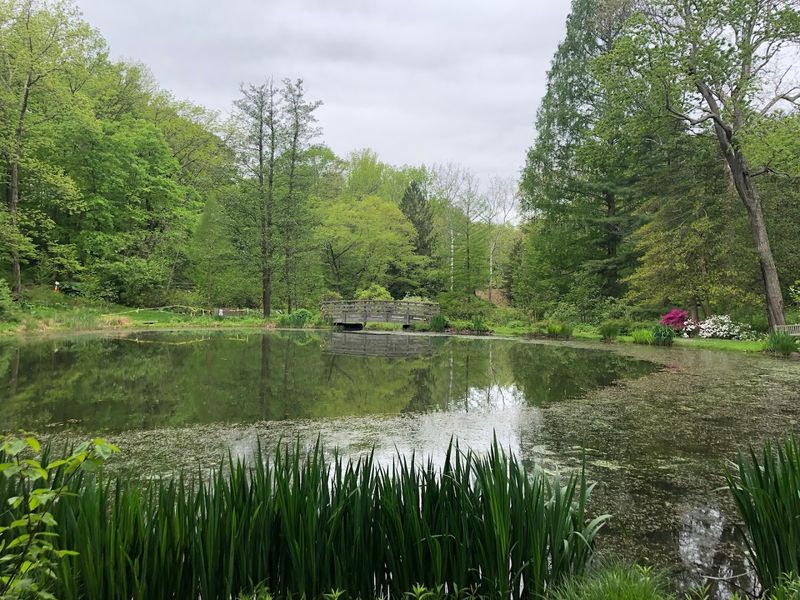
The garden began during the 1930s as a collaboration between Leonard J. Buck and landscape architect Zenon Schreiber.
Buck was a geologist and a trustee of the New York Botanical Garden, which helps explain why the property treats stone as something far more interesting than background scenery.
He and Schreiber worked with the valley’s existing contours, studying its ledges, slopes, exposures, and pockets of moisture before introducing plants suited to each setting.
The result was not a garden imposed upon the land but one coaxed from what was already there. Its foundation had been formed long before either man arrived.
During the last Ice Age, the Wisconsin Glacier reshaped this part of New Jersey, while water from Glacial Lake Passaic eventually rushed through a gap near present-day Moggy Hollow. Those forces exposed and sculpted the basalt outcroppings that now anchor the garden.
Some of the rock itself dates back hundreds of millions of years to ancient volcanic activity. Against that geological timeline, the garden’s human history feels surprisingly recent.
Buck developed the property as part of his estate, and after his death, his wife, Helen R. Buck, preserved the couple’s legacy by donating it to the Somerset County Park Commission in 1976.
It subsequently opened as a public garden, allowing a private passion project to mature into one of the premier rock gardens in the eastern United States. The design still carries the fingerprints of its creators.
A sunny shelf supports plants that need excellent drainage, while a shaded hollow shelters species that prefer cooler, damper conditions. Schreiber’s landscape work guides the eye, but Buck’s geological instincts remain the garden’s defining force.
Here, the rocks are not decorations placed among the flowers. They determine what grows, where visitors walk, and how the entire landscape reveals itself.
Towering Rock Outcroppings Create Remarkable Habitats for Native and Exotic Plants
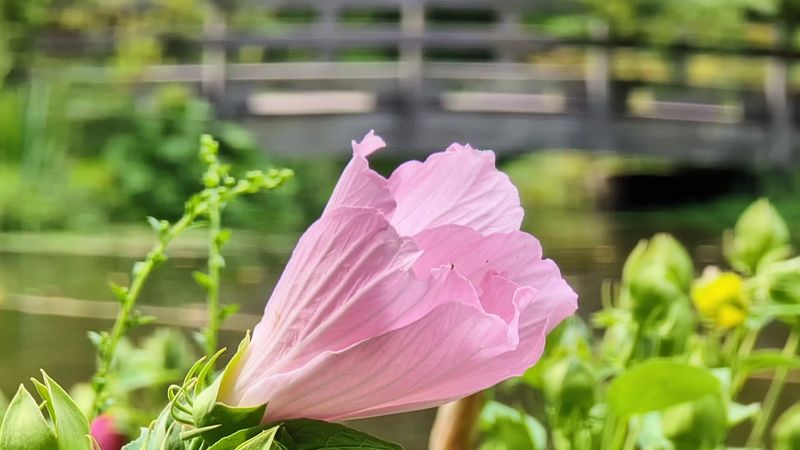
Look closely at a single outcropping and it begins to resemble a garden within the garden. One face may be warm, dry, and exposed to full sun, while a crevice only a few feet away remains shaded and damp.
Leonard J. Buck Garden uses those abrupt changes to support an unusually diverse collection of native and exotic plants.
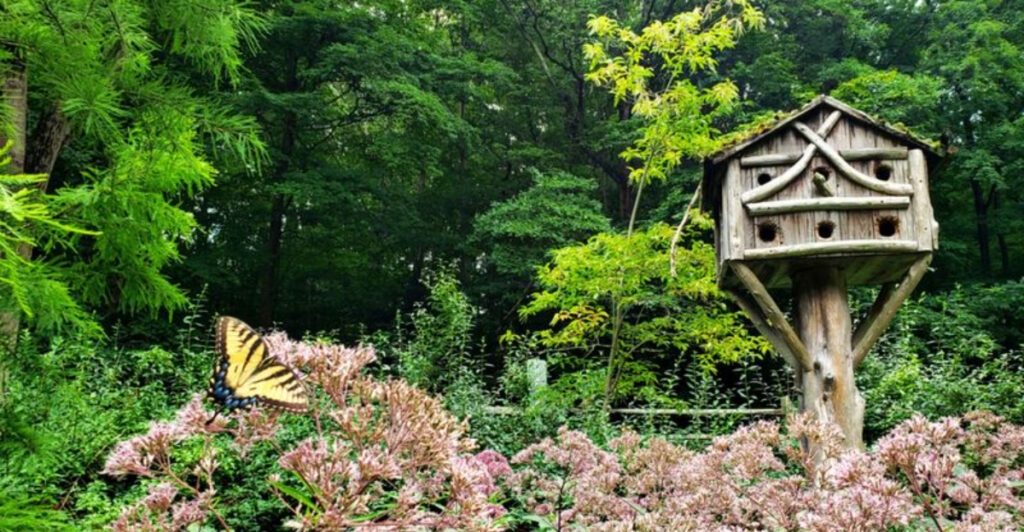
Diminutive alpine species cling to cracks where water drains quickly, woodland perennials settle beneath the tree canopy, and mosses soften stone surfaces that might otherwise appear severe.
Rather than separating plants by country or arranging them in formal blocks, the designers grouped them according to the conditions each rocky pocket provides.
The effect is naturalistic, but hardly accidental. Years of careful selection allow plants from different regions to coexist in microclimates that resemble their original habitats.
Some specimens sit at eye level along a ledge, while others require visitors to crouch and peer into a shaded opening. That element of discovery is part of the fun.
The F. Gordon Foster Fern Collection, located below the visitor center, shows how much variety can exist within one seemingly simple category.
Hardy ferns and shade-loving perennials fill the slope with contrasting shapes, from finely divided fronds to broad, architectural leaves. Elsewhere, flowering shrubs rise behind smaller rock-garden plants, building layers without hiding the formations beneath them.
Even visitors who cannot identify a single species can appreciate the logic of the planting. Sun lovers occupy bright ledges.
Moisture-loving plants gather near the stream. Ferns and woodland flowers settle into cool hollows.
The ancient basalt creates boundaries, shelter, drainage, and temperature shifts, turning every formation into its own miniature neighborhood. That relationship between rock and plant life is what separates Buck Garden from a pretty woodland walk.
It is a living demonstration of how dramatically a few feet of elevation, sunlight, or moisture can change what thrives.
Winding Woodland Trails Lead Past Quiet Ponds, Streams, and Storybook Bridges
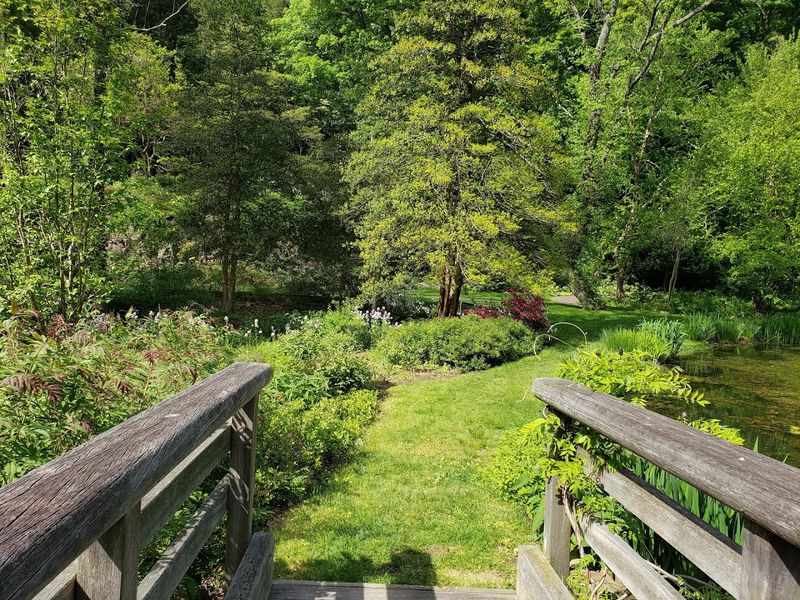
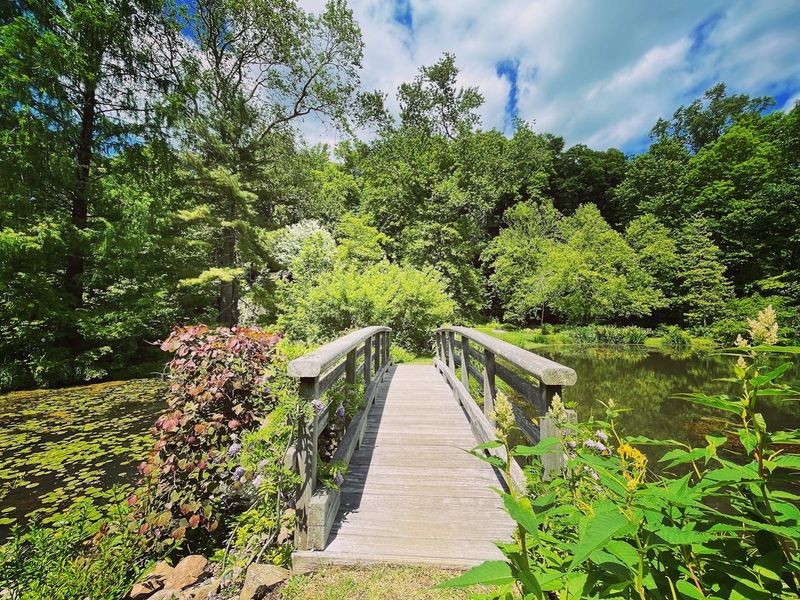
Water provides the soundtrack along much of the route. Moggy Hollow Brook threads through the valley, feeding ponds and slipping beneath modest wooden crossings that blend into the surrounding woods.
At times, the stream is visible beside the trail; elsewhere, it disappears behind vegetation but continues to announce itself through the sound of moving water. The paths follow its course loosely rather than tracing a single direct loop.
Gravel walkways give way to stone steps, narrow turns, and short climbs around the larger outcroppings. None of this feels like a backcountry hike, but sturdy footwear is more useful than sandals, particularly after rain.
The uneven terrain is also part of the garden’s appeal. A pond may appear only after the trail drops around a bend, framed by low branches and water-loving plants.
A bridge that looks purely functional from one direction becomes a perfect overlook once you step onto it and notice the ferns leaning toward the brook below. These little transitions keep the walk from becoming predictable.
There is always a choice between looking ahead to see where the trail goes and stopping to inspect what is growing at your feet. Visitors should remain on the marked paths, both for their own safety and to protect the delicate beds tucked among the rocks.
Climbing on the outcroppings is prohibited, as are swimming, fishing, bicycling, smoking, and picking plants. Pets are not permitted apart from service animals, which helps preserve the quiet atmosphere and protect the collections.
Picnicking is limited to designated spaces near the visitor center, its adjacent deck, and the shelter above the perennial border. Those rules are sensible once the terrain comes into view.
Many of the smallest plants would be easy to miss and even easier to damage. Staying on the trail still leaves plenty to explore, including enough bends, bridges, stairways, and waterside pauses to make the compact route feel like a genuine woodland adventure.
Spring Wildflowers, Azaleas, and Ferns Keep the Landscape Changing With the Seasons
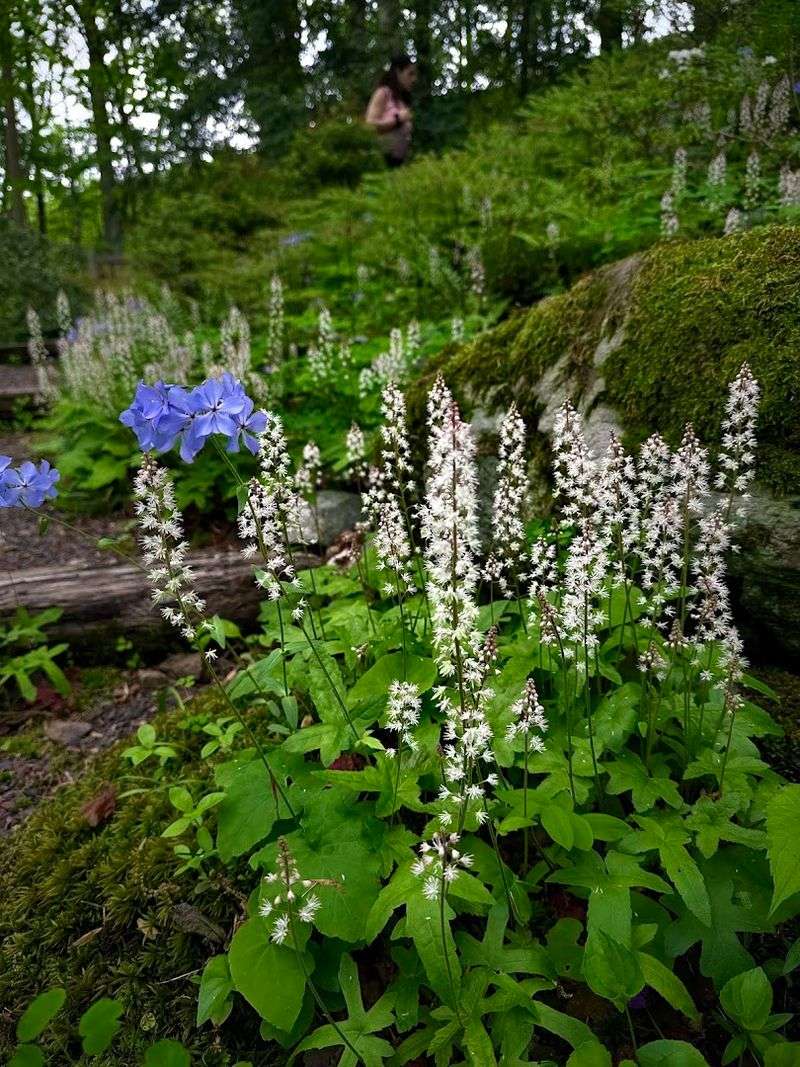
Spring arrives here in layers rather than all at once. The earliest woodland flowers push through leaf litter while the branches overhead are still bare, taking advantage of the sunlight before the canopy fills in.
Soon, tiny alpine blooms begin coloring the rock crevices, wildflowers spread across the slopes, and azaleas brighten the valley with far bolder splashes of pink, red, and white. This is widely considered the garden’s peak season, and for good reason.
The contrast between delicate flowers and dark basalt gives the landscape a drama that a flat flower bed could never reproduce. Yet spring is not the only time the garden earns a visit.
By early summer, the valley becomes greener and more enclosed. Ferns reach their full size, hostas and other shade plants fill gaps beside the trails, and the dense canopy changes the light from minute to minute.
The ponds also feel livelier in warm weather, with aquatic plants spreading across the surface and frogs, birds, and insects adding movement to otherwise still scenes. Autumn shifts attention away from individual flowers and toward the structure of the whole property.
Gold, copper, and crimson foliage hangs above gray rock faces, while fallen leaves collect along the streams and stairways. Once much of the canopy drops, formations that remained partly hidden during summer become easier to appreciate.
Winter strips the garden back further, emphasizing the bones of the landscape and the sharp relationship between the valley and its stone ledges. Regular weekday hours continue throughout the year, though weekend access pauses from December through March.
Because the plantings are distributed across sunny ledges, moist banks, open slopes, and deep shade, the garden never changes everywhere at the same speed. One area may be fading just as another reaches its best moment, giving repeat visitors something different to notice on nearly every walk.
This Peaceful Somerset County Escape Feels Far Removed From Everyday New Jersey
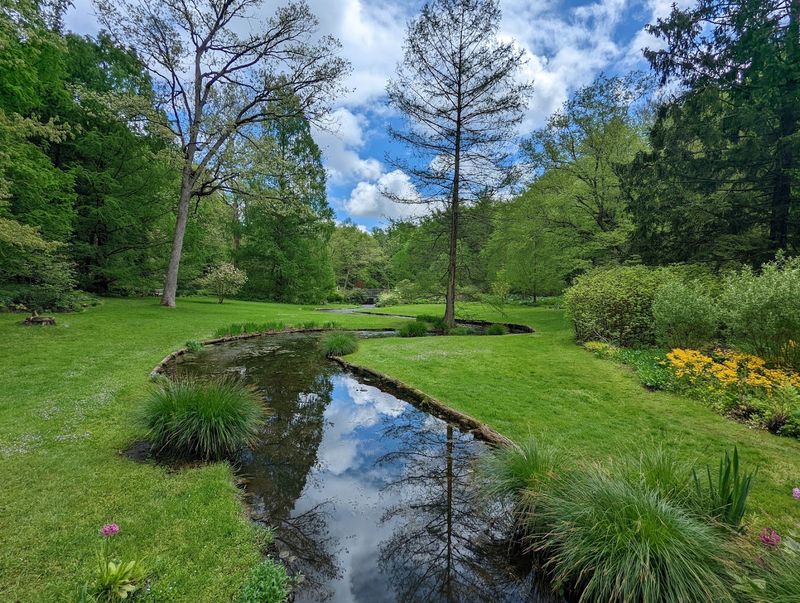
Route 287 runs only a few miles away, yet it might as well belong to another state once the trail descends into Moggy Hollow. The valley walls, tree canopy, and constant movement of water absorb the familiar noise of suburban New Jersey.
What remains is the crunch of gravel, the splash of a stream, and the occasional conversation drifting from another path. That sense of separation does not require a long drive into the mountains or an ambitious hike.
The garden sits at 11 Layton Road in Far Hills, within reach of some of Somerset County’s busiest communities, but its terrain creates a convincing pocket of seclusion. Practical details remain refreshingly simple.
A visitor center provides maps, background on the property, and public restrooms. Comfortable shoes are important, insect repellent is useful during warmer months, and a refillable water bottle is worth bringing when temperatures climb.
Parking is limited enough that an early arrival can make weekend visits easier, especially during the height of the spring bloom. Formal, posed, engagement, and family photography requires a permit, while casual snapshots taken from the paths are welcome.
Those restrictions help keep the garden from feeling like an event venue disguised as a natural retreat. Its focus stays on the plants, rocks, and people quietly enjoying them.
There are no thrill rides, oversized sculptures, or packed schedule of attractions competing for attention. The most memorable moments are smaller than that—a fern uncurling beside a boulder, sunlight touching one corner of a pond, or a wooden bridge appearing through the leaves.
Leonard J. Buck Garden offers the rare pleasure of a place that has been meticulously shaped without losing its wildness.
The trails eventually climb back toward the visitor center, but the valley below still feels like a secret world, patiently continuing without an audience.
Share this story