Tennessee holds some of the most surprising and memorable public art in the South. From towering bronze tributes to quirky folk-art installations, the state offers sculpture destinations that range from deeply moving to wonderfully weird.
Whether you’re a road-tripper hunting hidden gems or simply curious about the creative side of Tennessee, these ten stops will show you a side of the state most visitors miss.
1. Musica – Nashville
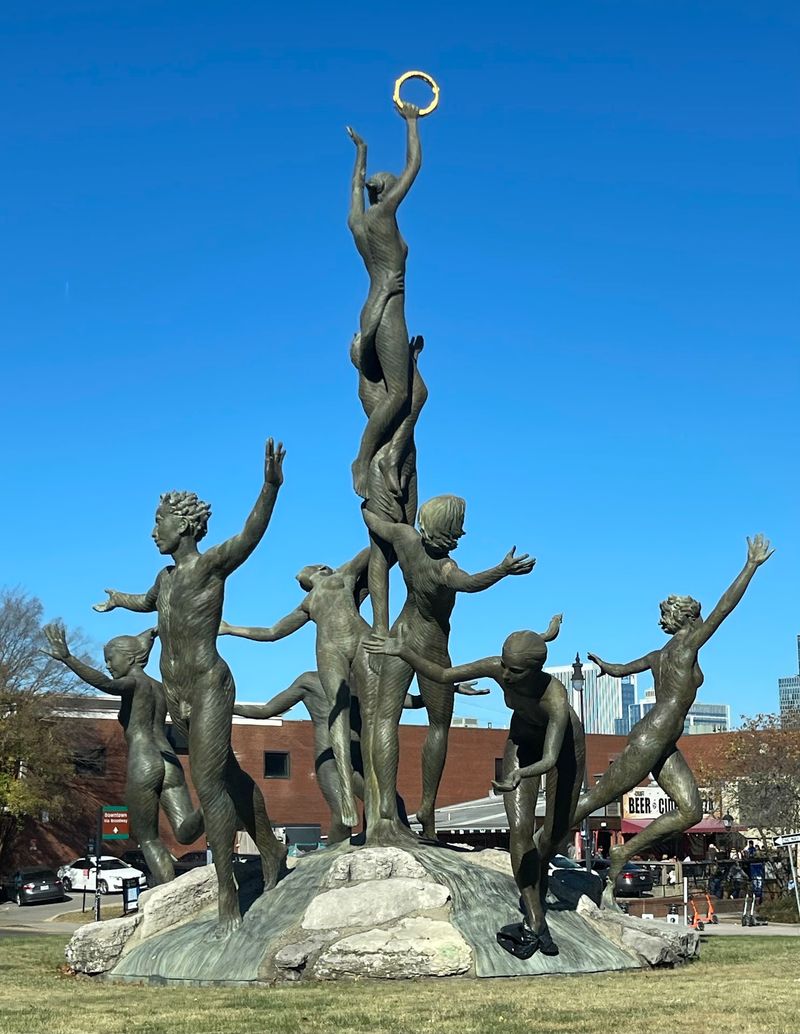
Right in the heart of Music Row, nine larger-than-life bronze dancers form a circle so striking that drivers slow down just to take it in. Sculptor Alan LeQuire spent years bringing this commission to life, and the result is reportedly the largest sculpture group in the entire United States.
Each figure stands tall and graceful, frozen mid-movement in a celebration of rhythm and connection.
The piece sits on a roundabout, so you can walk right up and experience the scale. From street level, the dancers tower over you, and the detail in every muscle and gesture becomes clear.
LeQuire designed the work to honor Nashville’s musical heritage, but the figures themselves are timeless, not tied to any single genre or era.
Visiting at different times of day changes the experience entirely. Morning light casts long shadows across the bronze, while evening glow softens the forms and makes the circle feel almost alive.
Because it’s located on a busy traffic circle, parking can be tricky, but there are spots along the surrounding streets where you can pull over safely.
Musica has become one of Nashville’s most photographed landmarks, yet it still surprises first-time visitors with its sheer size and energy. The composition feels joyful and unguarded, which is rare for public monuments.
If you’re exploring Music Row’s studios and historic sites, this sculpture offers a powerful visual anchor.
The roundabout itself is small, so plan to spend just a few minutes walking the perimeter. Bring a camera, because the angles shift dramatically as you move around the circle.
Whether you’re an art lover or just passing through, Musica delivers a memorable encounter with one of Tennessee’s boldest artistic statements.
2. Dolly Parton Statue – Sevierville
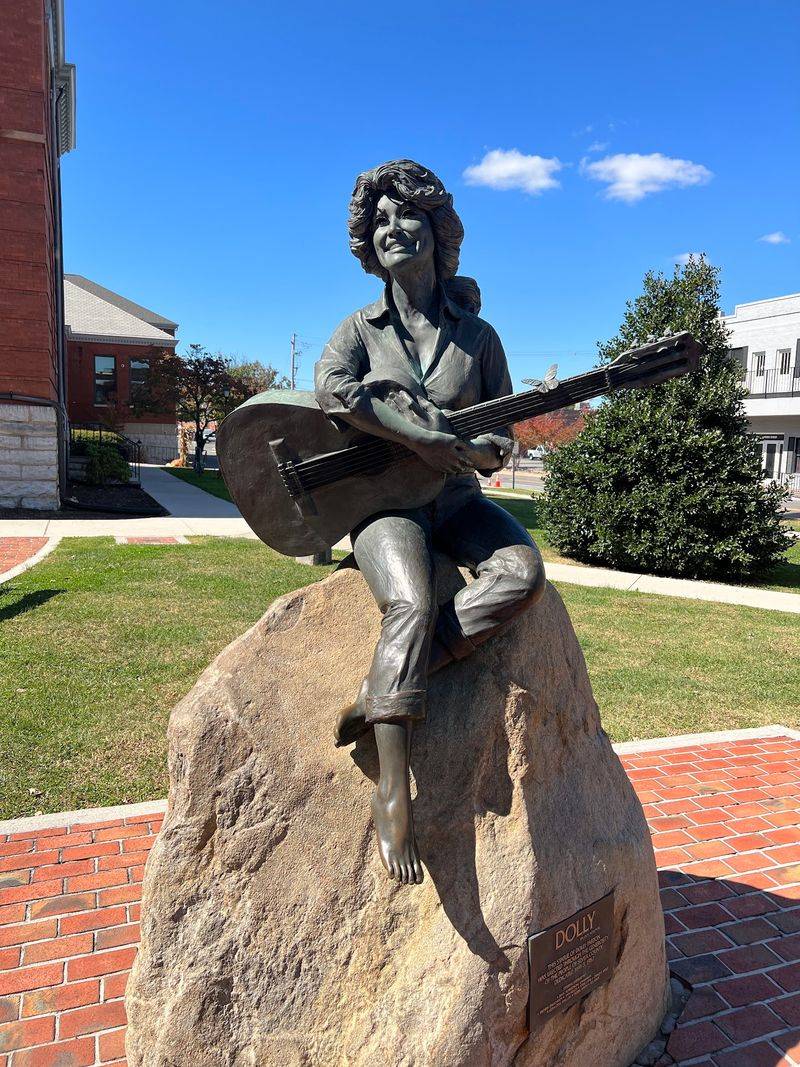
Outside the Sevier County Courthouse, a young Dolly Parton sits cross-legged with her guitar, forever frozen in bronze at the age she left these mountains to chase her dreams. Local artist Jim Gray created the piece, and it was unveiled back in 1987 when Dolly’s star was already shining bright.
The statue captures her at a turning point, before the wigs and rhinestones, back when she was just a girl with a voice and a plan.
Sevierville takes pride in being Dolly’s hometown, and this statue anchors that connection. The courthouse square feels like small-town Tennessee, with brick storefronts and a slower pace that contrasts sharply with nearby Pigeon Forge.
Visitors stop by year-round to snap photos, and the statue has become a pilgrimage site for fans who want to stand where Dolly’s story began.
The bronze has weathered beautifully over the decades, developing a warm patina that makes the figure feel even more grounded in place. Dolly herself has spoken fondly of the tribute, and the town treats it with genuine affection.
You’ll often see fresh flowers or small tokens left at the base, a quiet testament to how much she means to this community.
The courthouse grounds are easy to navigate, with benches nearby if you want to sit and take in the scene. Parking is free and plentiful, and the statue is accessible from the sidewalk, so you can get close without any barriers.
It’s a quick stop, but one that feels personal and unhurried.
If you’re heading to the Smokies or Dollywood, plan a detour through downtown Sevierville. The statue offers a chance to connect with Dolly’s roots in a way that theme parks and concert halls can’t replicate.
It’s a simple, honest tribute to a woman who never forgot where she came from.
3. Big Kids Sculptures – Memphis
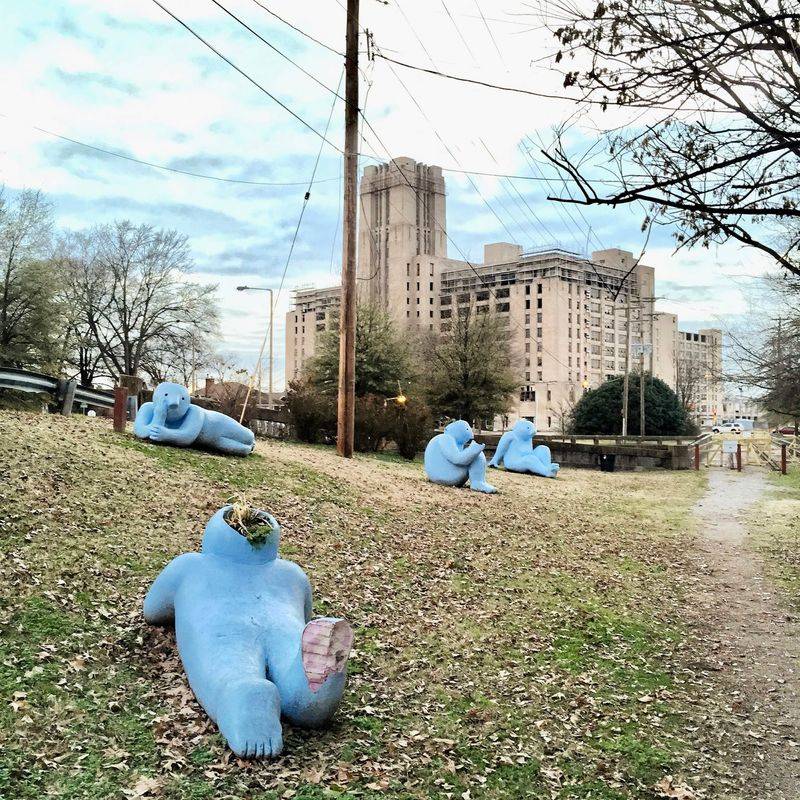
Along the V&E Greenline, several enormous human figures lie sprawled across the landscape, looking like giants who decided to take a nap mid-journey. Rhodes College students created these playful installations back in 2011, and each one measures several feet long, dwarfing anyone who walks by.
The real twist? Some of the figures have planters built into their heads, so flowers and greenery literally sprout from their scalps as living hair.
The sculptures feel whimsical and approachable, inviting interaction rather than reverence. Kids love climbing on them, and photographers appreciate the surreal contrast between the oversized forms and the natural greenway setting.
Each figure has its own personality, from relaxed poses to more dynamic positions, and the weathered surfaces add character over time.
The V&E Greenline itself is a converted rail corridor, now a popular spot for walking, jogging, and biking. The Big Kids sculptures are spread along the trail, so you can visit them all in a single outing or stumble upon them one at a time during a longer walk.
The greenway is flat and accessible, making it easy for families and casual visitors to explore without much effort.
Because the sculptures are outdoors and unsupervised, they’ve picked up moss, dings, and the occasional graffiti tag. Rather than diminishing their charm, these imperfections make them feel more integrated into the community.
They’re not precious museum pieces; they’re public art that people actually use and enjoy.
Visiting during spring or summer means the planters will be in full bloom, turning the figures into living art that changes with the seasons. Fall and winter offer a different mood, with bare branches and muted colors that make the sculptures feel more contemplative.
Either way, the Big Kids add an unexpected dose of creativity to a Memphis greenway that might otherwise feel purely functional.
4. Alex Haley Statue – Knoxville
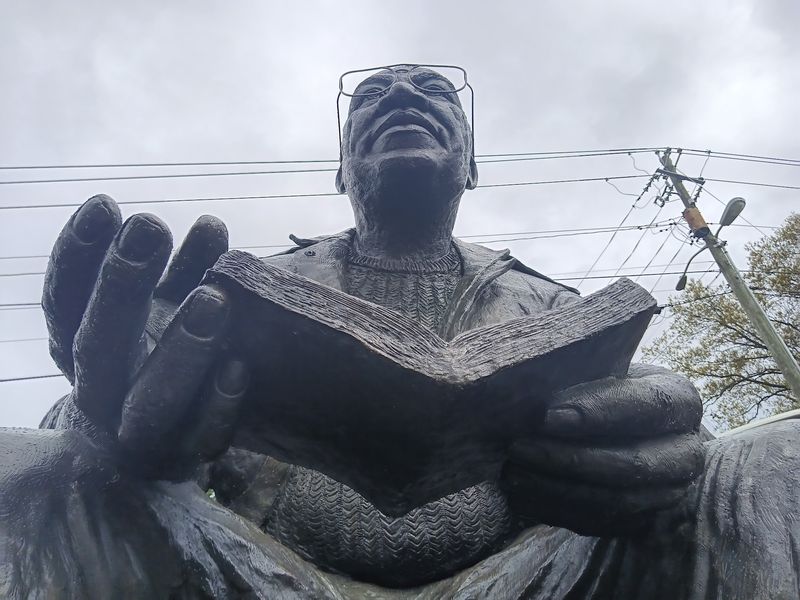
In Haley Heritage Square at Morningside Park, a seated Alex Haley looms 13 feet tall and weighs a staggering 6,500 pounds. The sheer scale catches first-time visitors off guard, because photos rarely convey just how imposing this tribute to the Roots author truly is.
Sculptor Tina Allen designed the piece to reflect Haley’s towering influence on American literature and genealogy, and the result is a monument that demands attention.
Haley sits in a relaxed pose, notebook in hand, as if he’s pausing mid-thought to jot down an idea. The bronze captures fine details like the folds in his clothing and the texture of his hands, giving the statue a sense of warmth despite its monumental size.
Visitors often stand beside the figure for photos, and the comparison makes it clear just how oversized the sculpture really is.
The park setting adds context, with interpretive panels explaining Haley’s life and legacy. Morningside Park itself is a community gathering space, so the statue isn’t isolated or treated as untouchable.
Families picnic nearby, kids play on the grass, and the statue becomes part of the everyday fabric of the neighborhood.
Haley’s connection to Tennessee runs deep, even though he was born in New York and spent much of his life elsewhere. His family roots trace back to the state, and Knoxville embraced him as a literary giant worth honoring.
The statue was unveiled in 1998, and it has since become a landmark for locals and a discovery for travelers exploring East Tennessee.
The bronze has aged gracefully, developing a rich patina that contrasts beautifully with the surrounding greenery. Visiting during late afternoon offers the best light for photography, as the low sun highlights the statue’s texture and shadows.
Whether you’re familiar with Haley’s work or just curious about the figure towering over the park, this stop offers a powerful reminder of storytelling’s lasting impact.
5. E.T. Wickham Sculpture Trail – Palmyra
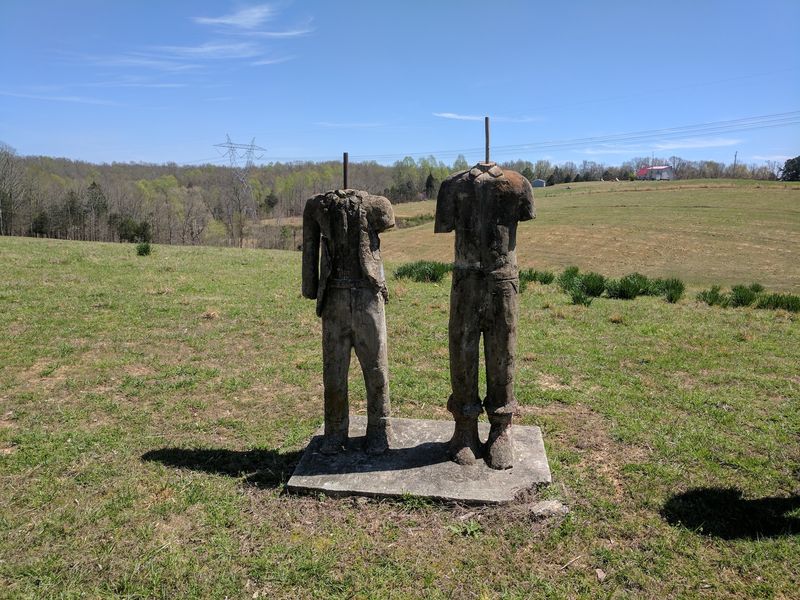
Starting in the 1950s, farmer Enoch Tanner Wickham began pouring cement into massive homemade molds, creating larger-than-life figures of historical heroes like Tecumseh, Andrew Jackson, Sitting Bull, Daniel Boone, and the Kennedy brothers. He worked alone, using whatever materials he could scrounge, and eventually scattered more than 30 sculptures along the rural roads near Palmyra.
Decades later, many of these figures stand as weathered ruins, slowly crumbling back into the landscape in a way that feels both haunting and strangely beautiful.
Wickham had no formal training, and his sculptures show it. Proportions are awkward, faces are rough, and the cement has cracked and chipped over the years. Yet that’s exactly what makes the trail so compelling.
These aren’t polished monuments; they’re raw folk art created by a man driven by vision rather than technique.
The trail isn’t marked or maintained, so finding the sculptures requires some detective work. Locals can point you in the right direction, and a few online guides map out approximate locations.
Some figures stand in overgrown fields, others lean against trees, and a few have toppled entirely, leaving only fragments behind.
Visiting feels like stumbling onto a forgotten chapter of Tennessee history. The rural setting amplifies the eerie atmosphere, especially when you encounter a towering, weather-beaten figure emerging from tall grass.
Wickham’s original intent was to honor American heroes, but time has transformed his work into something more ambiguous and melancholic.
The sculptures are on private property, so respect boundaries and stick to public roads when searching. Bring a camera, because the decay and rural backdrop create striking contrasts.
Plan for mud if it’s been raining, and don’t expect amenities or signage. This is outsider art in its most unfiltered form, and part of the experience is the challenge of finding it.
If you’re drawn to roadside oddities and forgotten landmarks, the E.T. Wickham trail offers one of Tennessee’s strangest and most rewarding detours.
6. Clinton 12 Statues – Clinton
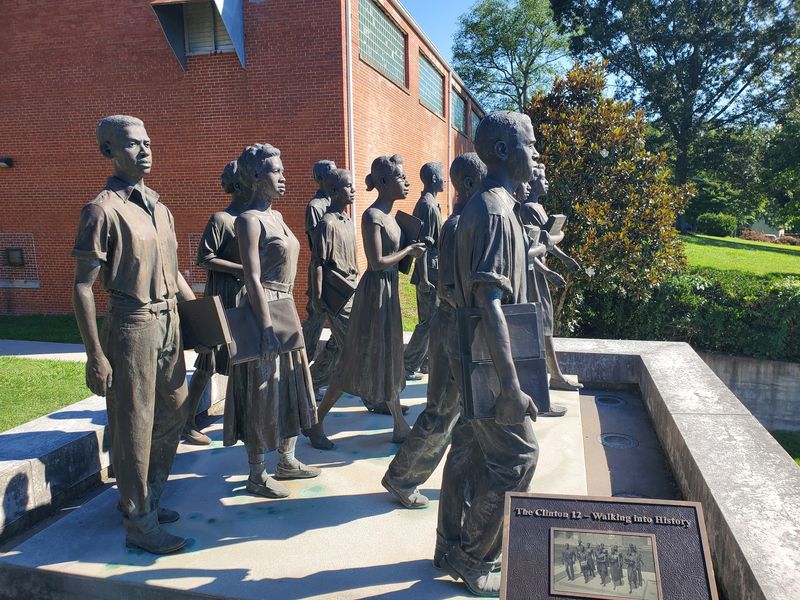
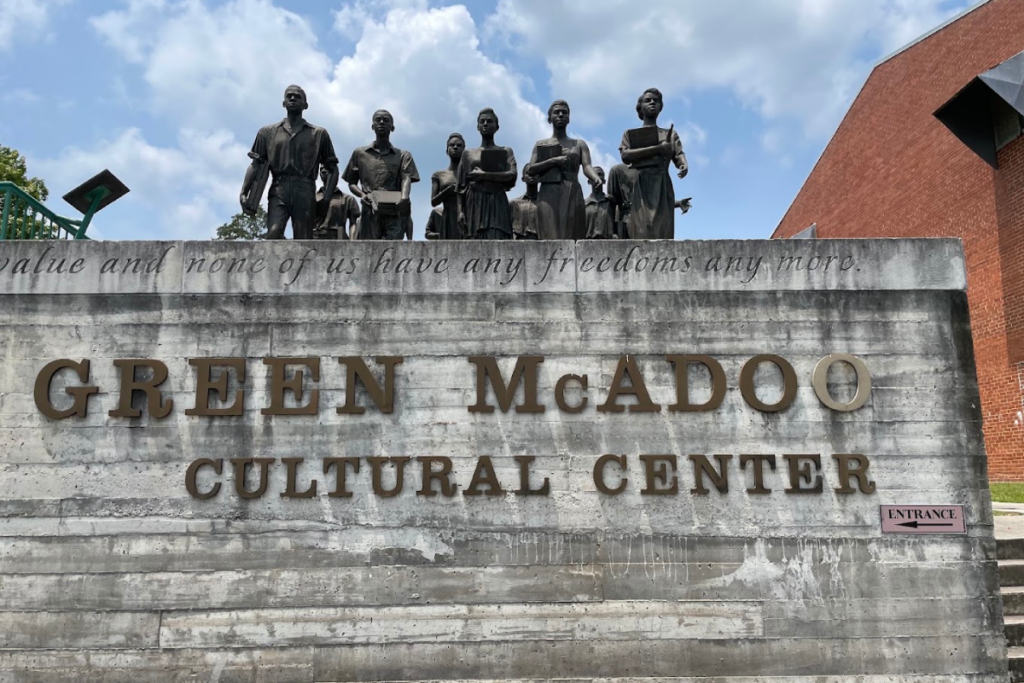
Outside the Green McAdoo Cultural Center, twelve life-size bronze figures stand arranged not on pedestals but at ground level, positioned as if they’re beginning their walk toward Clinton High School. The Clinton 12 were the Black students who integrated the school in 1956, and this memorial captures them mid-stride, forever moving forward despite the hostility they faced.
The composition feels immediate and personal, as if you’re joining them on that historic journey.
Each figure is individually sculpted, with distinct clothing, postures, and expressions. Some walk with confidence, others appear more tentative, and the variety reflects the reality that these were real kids with different personalities and fears.
The ground-level placement invites visitors to stand among the figures rather than looking up at them, creating a sense of shared experience.
The Green McAdoo Cultural Center itself tells the full story of the Clinton 12 and the violent resistance they encountered. The statues serve as an outdoor extension of that narrative, making the history visible to anyone passing by.
Interpretive plaques provide context, but the sculptures speak powerfully even without explanation.
Clinton High School was one of the first public schools in the South to integrate following the Brown v. Board of Education decision, and the Clinton 12 paid a steep price for that distinction.
The memorial honors their courage without sanitizing the brutality they endured. The setting is quiet and residential, which makes the statues’ presence even more striking.
Visiting feels less like sightseeing and more like paying respects. The figures are close enough to touch, and many visitors do, running their hands over the bronze as if offering encouragement across the decades.
Families use the site as a teaching moment, and school groups visit regularly to learn about this chapter of Tennessee history.
The statues are accessible year-round, with free parking nearby. Plan to spend time reading the plaques and walking around the figures to see each student’s unique details.
This isn’t a quick photo stop; it’s a memorial that asks for reflection and recognition.
7. Minnie Pearl Sculpture – Centerville
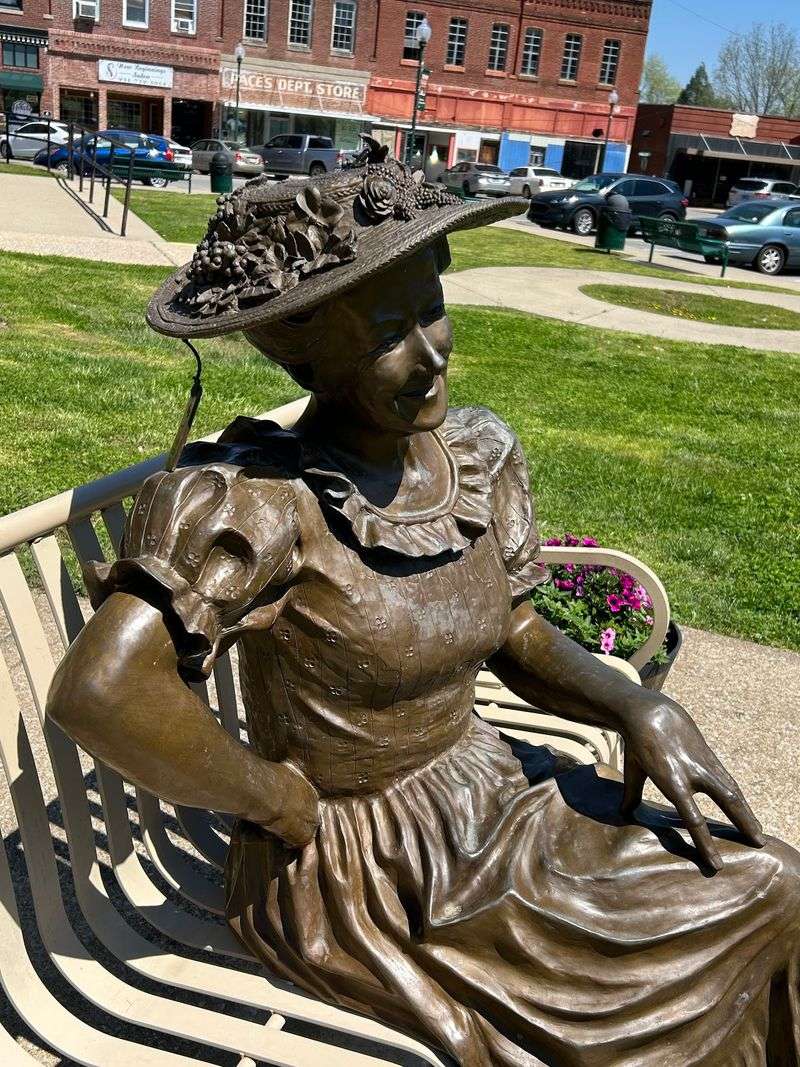
In Centerville, artist Ricky Pittman took a spool of chicken wire and turned it into an eight-foot-tall likeness of Grand Ole Opry comedian Minnie Pearl, complete with her trademark hat and that dangling price tag everyone remembers. The sculpture is exactly as odd and charming as it sounds, standing proudly in a town that claims Minnie Pearl as one of its own.
The sculpture sits in a public spot where locals and visitors can see it easily, and it’s become a beloved oddity in a town that doesn’t have many tourist attractions. Minnie Pearl, born Sarah Ophelia Colley, grew up in Centerville before becoming a country music icon known for her homespun humor and self-deprecating stage persona.
The chicken-wire tribute feels entirely appropriate for someone who built a career on folksy authenticity.
Up close, the sculpture reveals Pittman’s skill in manipulating wire to suggest form and texture. The hat brim curves convincingly, and the price tag dangles just as it did in Minnie’s performances.
Centerville itself is a small town, so the sculpture doesn’t draw massive crowds, but it’s a fun stop for anyone exploring the backroads of Middle Tennessee. The piece has held up well over time, with the wire developing a weathered patina that adds character.
Local residents enjoy pointing it out to visitors, and it’s become a point of pride for a community that values its quirky landmarks.
Photographing the sculpture works best in daylight, when the wire’s texture and shadows are most visible. The surrounding area is quiet and safe, making it easy to park and spend a few minutes appreciating Pittman’s handiwork.
If you’re a fan of offbeat roadside art or Grand Ole Opry history, this chicken-wire Minnie Pearl delivers a dose of both.
8. Little Debbie Statue and Giant Snack Sculptures – Collegedale
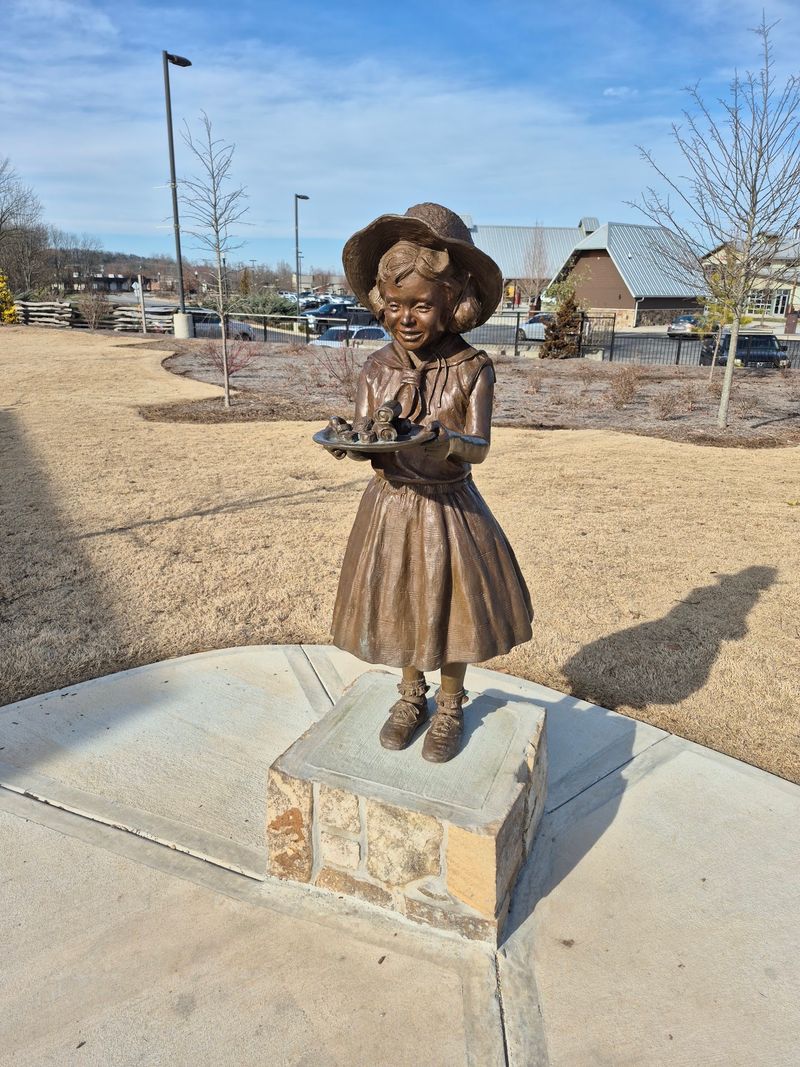
Little Debbie Park opened in 2023 and immediately became one of the most colorful and playful sculpture destinations in Tennessee. The centerpiece is a life-size bronze Little Debbie herself, but the real crowd-pleasers are the oversized sculptures inspired by iconic snack cakes: a towering Oatmeal Creme Pie, a gleaming Cosmic Brownie, a supersized Nutty Buddy, and even a giant Christmas Tree Cake.
Each sculpture is painted in bright, candy-like colors that pop against the park’s green lawns and blue skies.
The park sits in Collegedale, home to the McKee Foods headquarters, so the Little Debbie connection runs deep. The sculptures celebrate the brand’s history and its place in American snack culture, but they also function as legitimate public art that people of all ages enjoy.
Kids love running between the giant snacks, and adults appreciate the nostalgic nod to treats they grew up eating.
The bronze Little Debbie statue shows the brand’s mascot in her familiar pose, and the detail is impressive, from her braids to the folds in her dress. She’s positioned near the entrance, welcoming visitors with the same friendly face that’s appeared on snack boxes for decades.
The oversized snack sculptures are scattered throughout the park, creating a scavenger-hunt vibe as you explore the grounds.
Each sculpture is built to withstand weather and heavy interaction, so they’re designed for touching, climbing, and posing with. The Cosmic Brownie’s candy-coated chocolate chips are individually sculpted, and the Oatmeal Creme Pie’s ridged texture mimics the real thing.
These aren’t abstract art pieces; they’re literal, larger-than-life versions of beloved snacks.
The park is free to visit and offers plenty of parking, making it an easy stop for families or anyone curious about Tennessee’s quirkier attractions. Benches and walking paths make it comfortable to spend more than a few minutes, and the sculptures photograph beautifully thanks to their bold colors and playful scale.
Whether you’re a Little Debbie fan or just appreciate art that doesn’t take itself too seriously, this park delivers a sweet, surprising experience.
9. There They Go at the National Bird Dog Museum – Grand Junction
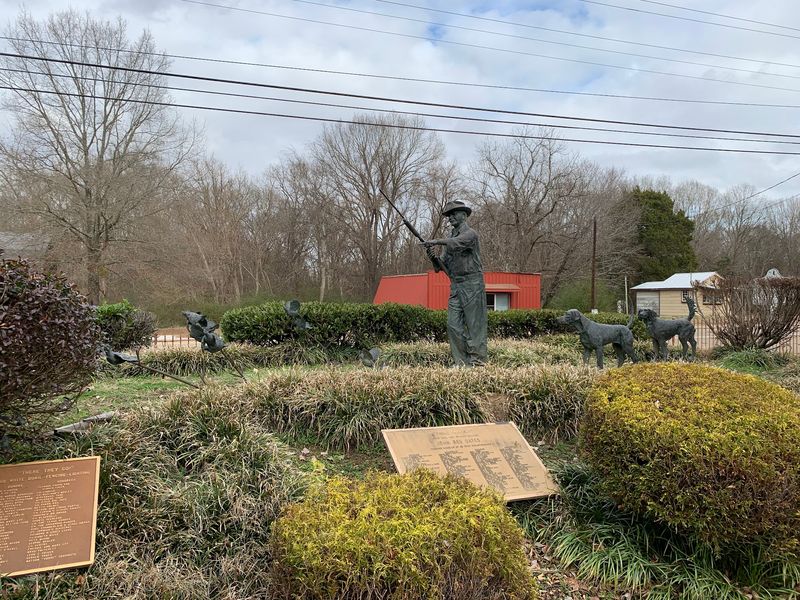
Outside the National Bird Dog Museum in Grand Junction, Sandra Van Zandt’s bronze composition captures a split-second moment: a hunter, an English pointer, and a setter frozen mid-hunt as a covey of 22 quail explodes into the air. The sculpture is titled “There They Go,” and it delivers exactly that sense of sudden motion and instinct.
Each quail is individually cast, wings spread in different positions, creating a dynamic burst of bronze birds that seems to defy gravity.
The museum itself is dedicated to celebrating bird dogs and the hunting traditions they represent, so the sculpture serves as a perfect introduction to what’s inside. Additional life-size bronze dogs line the entrance, each representing a different breed known for its hunting prowess.
The combination of sculptures turns the museum grounds into an outdoor gallery that honors both the animals and the sport.
Van Zandt’s attention to detail is remarkable. The dogs’ muscles are taut, their focus absolute, and the hunter’s posture suggests someone who’s spent a lifetime in the field.
The quail, despite being cast in metal, look weightless and panicked, their wings catching air in a way that feels utterly convincing. The composition works from every angle, rewarding viewers who take the time to walk around it.
Grand Junction isn’t a major tourist destination, so the museum and its sculptures remain a hidden gem for most Tennesseans. Bird dog enthusiasts make pilgrimages here, but the sculpture’s quality and drama appeal to anyone who appreciates skilled bronze work.
The rural West Tennessee setting adds authenticity, placing the art in the same landscape where these hunting scenes have played out for generations.
The museum charges a small admission fee, but the outdoor sculptures are visible from the parking area and accessible to anyone who stops by. Visiting during cooler months means you can explore the grounds comfortably, and the bronze patina looks particularly rich under overcast skies.
If you’re traveling through West Tennessee and want to see something unexpected, “There They Go” offers a masterclass in capturing movement and tradition in metal.
10. Sculpture Fields at Montague Park – Chattanooga
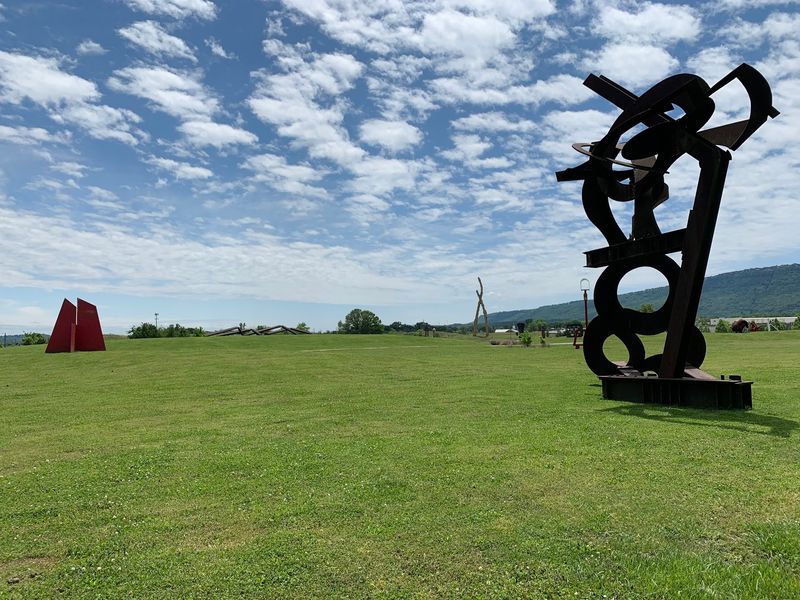
Rather than a single statue, Sculpture Fields at Montague Park offers 33 acres filled with dozens of monumental contemporary works. The outdoor sculpture destination sits on a reclaimed brownfield site, transforming industrial land into a sprawling art park where visitors can wander among towering abstract pieces.
Each sculpture is large enough to interact with the landscape, and the variety of styles and materials keeps the experience visually unpredictable.
The collection includes works by regional and national artists, with pieces ranging from sleek metal constructions to organic forms that seem to grow out of the earth. Some sculptures invite climbing and touching, while others maintain a more formal distance.
The park’s open layout means you can see multiple works at once, creating interesting visual relationships as you move through the space.
Montague Park’s history as an industrial site adds depth to the experience. The sculptures stand where factories once operated, and the juxtaposition of contemporary art and post-industrial landscape creates a narrative about transformation and renewal.
Walking paths wind through the fields, making it easy to explore at your own pace, and benches provide spots to sit and take in the view.
The park is free and open year-round, which makes it accessible to everyone. Families use it as a playground, photographers hunt for dramatic compositions, and art lovers return repeatedly to see how the sculptures change with the seasons.
Snow, rain, and sunlight all affect how the works appear, so no two visits feel identical.
Chattanooga has invested heavily in public art, and Sculpture Fields represents one of the city’s most ambitious projects. The scale and quality rival dedicated sculpture parks in much larger cities, yet it remains relatively uncrowded.
Visiting during golden hour offers the best light, but overcast days create moody, dramatic conditions that suit the contemporary aesthetic.
Plan to spend at least an hour if you want to see everything. The fields are large, and the sculptures reward close inspection.
Whether you’re an abstract art enthusiast or just curious about what’s possible when art meets landscape, Sculpture Fields delivers a world-class experience in an unexpected Tennessee setting.