The first thing that gets you is the contrast. One minute you are in Fort Lee, with traffic curling around the George Washington Bridge and buses moving people in and out of the city.
A few steps later, you are standing on a cliff edge made of dark diabase that began forming roughly 200 million years ago, looking straight across the Hudson at Upper Manhattan. Down below, the river moves with its usual confidence.
Behind you, there is a reconstructed Revolutionary War encampment. In front of you, there is one of the most recognizable skylines on earth.
It is hard to think of another New Jersey spot that pulls off that kind of double life so effortlessly. The Palisades feel ancient and oddly intimate at the same time.
They are dramatic without being far-flung, historic without feeling dusty, and close enough to the city that you can be here in less time than it takes to argue about dinner plans.
The New Jersey cliffs that feel worlds away from the city
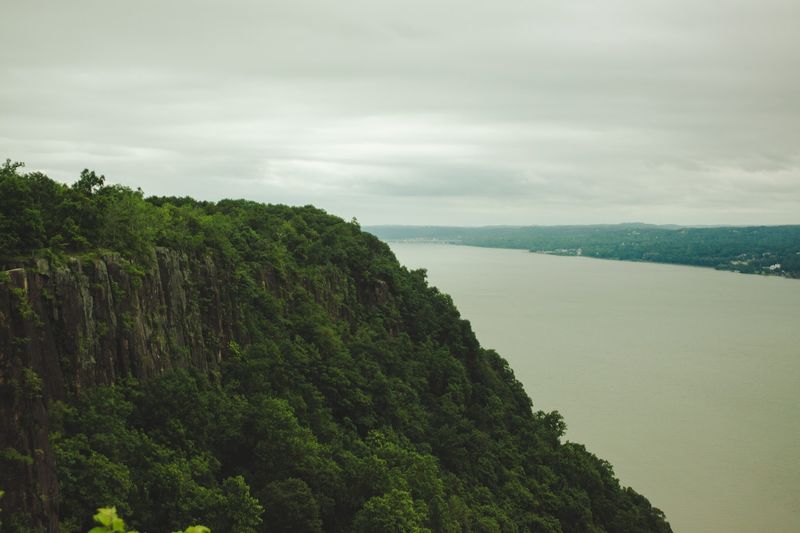
Standing at Fort Lee Historic Park, you are technically just south of the George Washington Bridge, but it rarely feels that way. The park sits on the cliff tops along Hudson Terrace, and once you angle yourself toward the overlooks, the noise softens and the landscape takes over.
The river widens beneath you. Manhattan rises across the water.
And the cliffs themselves do the heavy lifting, creating a sense of separation that feels much bigger than the actual distance from Midtown.
The Palisades Interstate Park in New Jersey stretches about 12 miles and covers roughly 2,500 acres of shorefront, uplands, and cliff tops, so even though you are never truly far from the metro area, the setting has room to breathe.
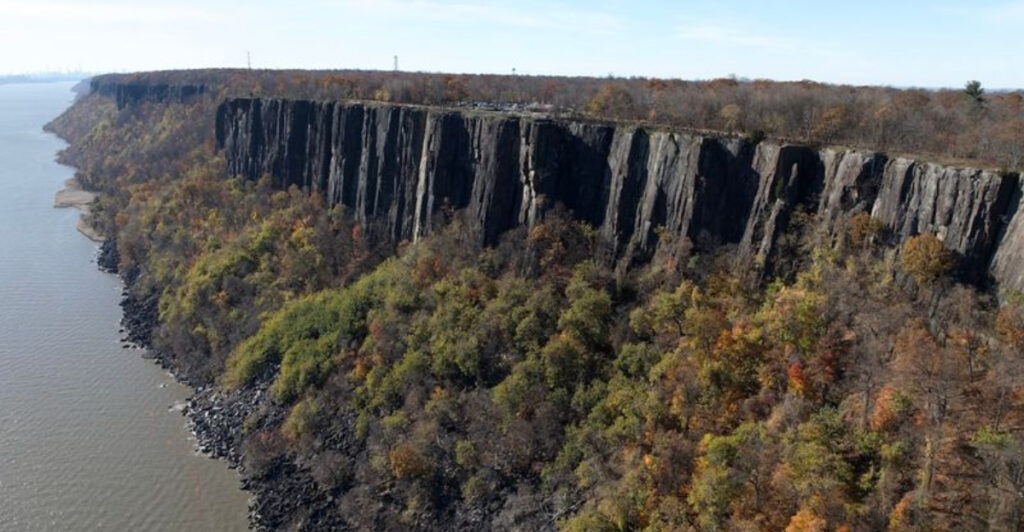
That difference starts with the rock. The Palisades are made of diabase, an igneous rock that cooled from magma as Pangaea was breaking apart around 200 million years ago.
Up close, the stone has a salt-and-pepper look from light feldspar and dark augite. From a distance, it reads as sheer wall.
The vertical columns are what give the cliffs their name, since they resemble a line of wooden palisades. This is not just pretty scenery.
It is a major geologic feature running for more than 40 miles along the west side of the Hudson, with the New Jersey section occupying a particularly dramatic middle stretch. Part of what makes this place feel so improbably intact is that it was nearly damaged beyond recognition.
In the late 19th century, quarry operations blasted the cliffs for crushed stone and paving material. The Palisades Interstate Park Commission was formed in 1900 in part to stop that destruction, and the New Jersey park was dedicated in 1909.
That means the view you get today is not some happy accident of survival. People fought for it.
You can still see the cliffs as a natural spectacle, but they are also a preservation story, one that feels especially satisfying in a region where open space usually has to be defended inch by inch.
Why the Palisades still stop people in their tracks
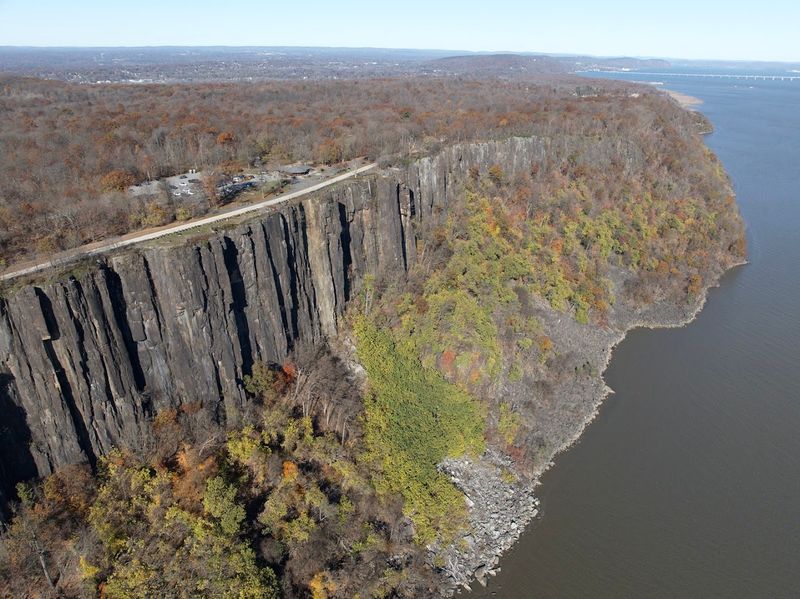
There is a reason locals keep bringing out-of-towners here. The cliffs have scale, and scale still works.
Even if you know the skyline by heart, the combination of vertical rock, moving water, and bridge steel has enough punch to make people go quiet for a second.
Fort Lee Historic Park’s northern overlooks serve up a clean view of the Hudson, Upper Manhattan, and the George Washington Bridge, and the combination does not need any dramatic exaggeration to impress.
This is one of those rare lookouts where the famous thing and the less-famous thing make each other better. Manhattan looks sharper because the Palisades frame it.
The Palisades look wilder because Manhattan is right there reminding you how close civilization actually is. The cliffs also keep their edge because they are not overly polished.
Yes, there are overlooks and formal access points, but this is still a landscape with real texture. Rockfalls happen.
Talus slopes pile up below the cliffs. Glacial markings can still be found on exposed rock farther north in the park, and the forested slopes beneath the cliff face are built from debris that has broken off over thousands of years.
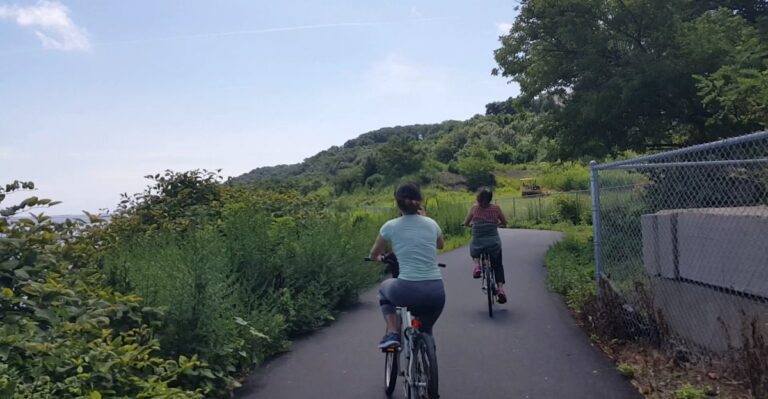
Even the trails do not pretend everything is gentle. The Shore Trail, which runs 12 miles along the riverfront, ranges from easy to difficult, with rocky sections and the famously tough Giant Stairs stretch.
That kind of honesty is refreshing. It is a beautiful place, but it is still a real one.
Then there is the local pride factor. Fort Lee is often called New York City’s sixth borough, yet this cliff line gives the town its own personality.
Fort Lee gets the proximity and the energy of being right next to Manhattan, but the Palisades keep it from feeling like a satellite. They make the place feel distinct, and locals treat them accordingly.
People do not just admire these cliffs. They defend them, talk about them, and use them as one of the clearest reminders that North Jersey has a landscape all its own.
The best Manhattan views are hiding along this dramatic ridgeline
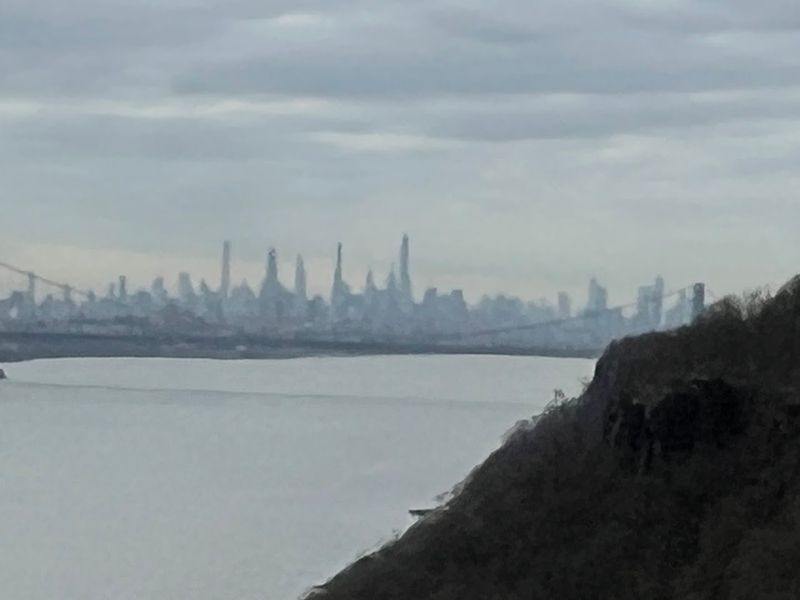
The funny part is that one of the easiest skyline payoffs in North Jersey is hiding in a place many people speed past on their way somewhere else. Fort Lee Historic Park is just off Hudson Terrace, south of the bridge, and its overlooks give you a clean sweep of the river, bridge, and Upper Manhattan.
The grounds are open year-round, and the Visitor Center is typically open Wednesday through Sunday from 10:00 a.m. to 4:45 p.m., which makes this one of those rare scenic spots that works as both a spontaneous stop and an actual half-day outing.
If you want to turn the view into a walk instead of a quick look, the cliff-top Long Path is the move.
In the park’s New Jersey section, it runs 11 miles and is generally considered easy to moderate, though there are steeper stone-step sections farther north. One of the nicest things about it is how accessible it is from the southern end of the park.
The trail can be picked up right from Fort Lee Historic Park, and Fort Lee Bridge Plaza is nearby for anyone arriving by bus. That makes this more than just a car-person scenic route.
It is surprisingly doable for people who want a real view without a full logistics production. For something more loop-shaped, Carpenter’s Loop is a strong choice.
It covers about 5.5 miles round trip and usually takes around two and a half hours, with a shorter option if you do not feel like earning every inch of it. The route links cliff-top and riverfront terrain, which is really the best way to understand the Palisades in one outing.
Up top, you get the grand reveal. Down below, you feel the scale of the cliffs from river level, where they look less like scenery and more like a wall somebody forgot to explain.
Practical note, because useful information matters here: metered parking is in effect at Fort Lee Historic Park year-round. Rates are typically $1.50 per hour Monday through Friday and $2.50 per hour on weekends, paid by card or through Park Mobile or Flowbird.
No cash, which is exactly the kind of small modern annoyance you would rather know before arriving feeling smugly prepared.
A walk through the Revolutionary War history of Fort Lee
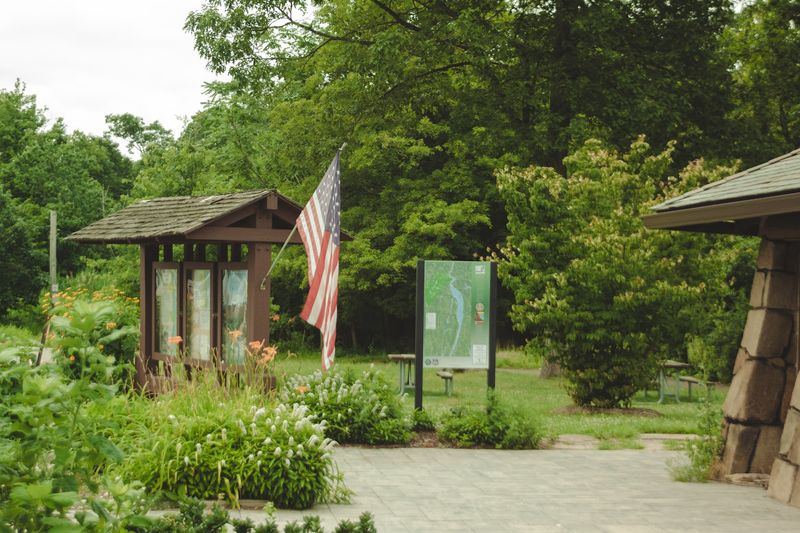
Before Fort Lee was a scenic overlook with show-off views, it was a military position in a very bad moment for the American cause. In July 1776, the Americans began fortifying the site, originally calling it Fort Constitution.
Across the river on the high ground of northern Manhattan, work was already underway on Fort Washington. Together, the two positions were meant to help defend the Hudson River, which both sides understood was strategically critical.
The British wanted control of the river because it could split the colonies in half. Washington wanted to stop that from happening.
That larger-stakes story is part of what gives the place its charge. This was not background scenery to the Revolution.
It was part of the board the whole game was being played on. The name Fort Lee came later, honoring General Charles Lee after his success in Charleston, South Carolina.
But the most important chapter came in November 1776, after the fall of Fort Washington. British and Hessian forces under Cornwallis moved against Fort Lee, and the Americans were forced to abandon the position.
The retreat from here became the start of the Continental Army’s long, brutal withdrawal across New Jersey. It was one of the lowest points of the war, yet it also marked the beginning of the retreat that eventually led to the victories at Trenton and Princeton.
That is what makes Fort Lee so compelling. The story here is not about easy triumph.
It is about surviving the stretch when everything looked like it was falling apart. Today, the historic park makes that history easy to read without turning it into costume-drama fluff.
The encampment area includes a reconstructed officers’ hut, and the Visitor Center helps visitors connect the landscape to the events that happened on it.
Each year, the park also marks the anniversary of the November 20, 1776 invasion with Retreat Weekend, featuring music, cooking, artillery demonstrations, and other living-history elements tied to Washington’s Retreat to Victory.
It is a smart way of honoring the site because Fort Lee’s place in New Jersey history has always been less about a single glorious moment and more about endurance under pressure.
How ancient stone and American history meet in one unforgettable park
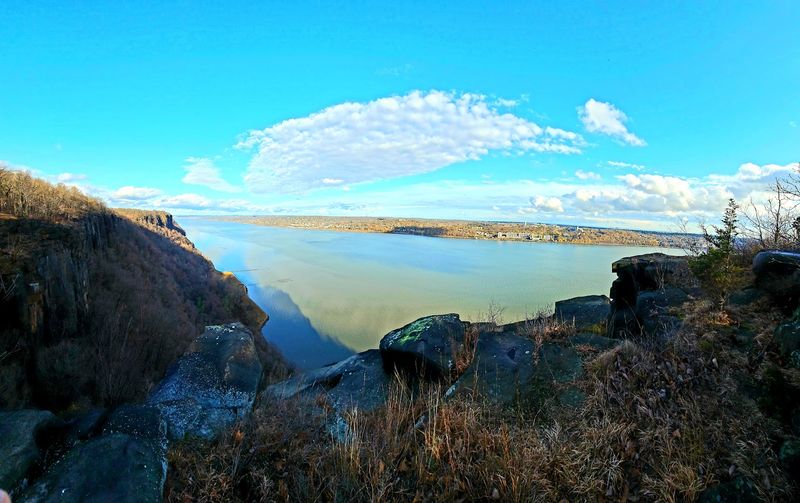
Some places have great scenery. Some places have a good story. The Palisades, annoyingly for the competition, have both. At Fort Lee Historic Park, the overlap is literal.
You are standing on Early Jurassic rock while looking at a Revolutionary War site that later became part of one of the region’s most important preservation efforts. That is a lot of timeline in one small area, and yet it never feels crowded.
It feels layered, which is much more interesting. The geology gives the history its stage.
These cliffs were formed when molten diabase pushed into older layers of sedimentary rock and later hardened. Over millions of years, erosion stripped away the surrounding material and left the sill exposed.
Later, glaciers scratched and shaped the rock, and the river kept reshaping the land. Long before European settlement, this was Lenapehoking, homeland of the Munsee Lenape.
One Indigenous name connected with the area, Wee-Awk-En, is often translated as Rocks that look like trees, a reference to the upright rock columns. It is a useful reminder that the cliffs had meaning long before they became postcard material or military real estate.
The historic layers keep going. The Kearney House, near Alpine Picnic Area, was built in the 1760s and has lived several lives over the centuries, including family home, dockside tavern, park police station, and historic site.
It is listed on the National and New Jersey State Historic Registers and was once known as Cornwallis Headquarters because it was thought the British general stayed there in 1776. Today, it is generally open on many weekend and holiday afternoons from May through October, depending on weather and staffing.
That house feels like a perfect Palisades detail because it narrows the distance between grand history and ordinary river life. Not everything here was a battlefield maneuver.
Some of it was roads, freight, meals, taverns, and families trying to make a life along the Hudson.
Why this Hudson River landmark deserves a spot on your New Jersey list
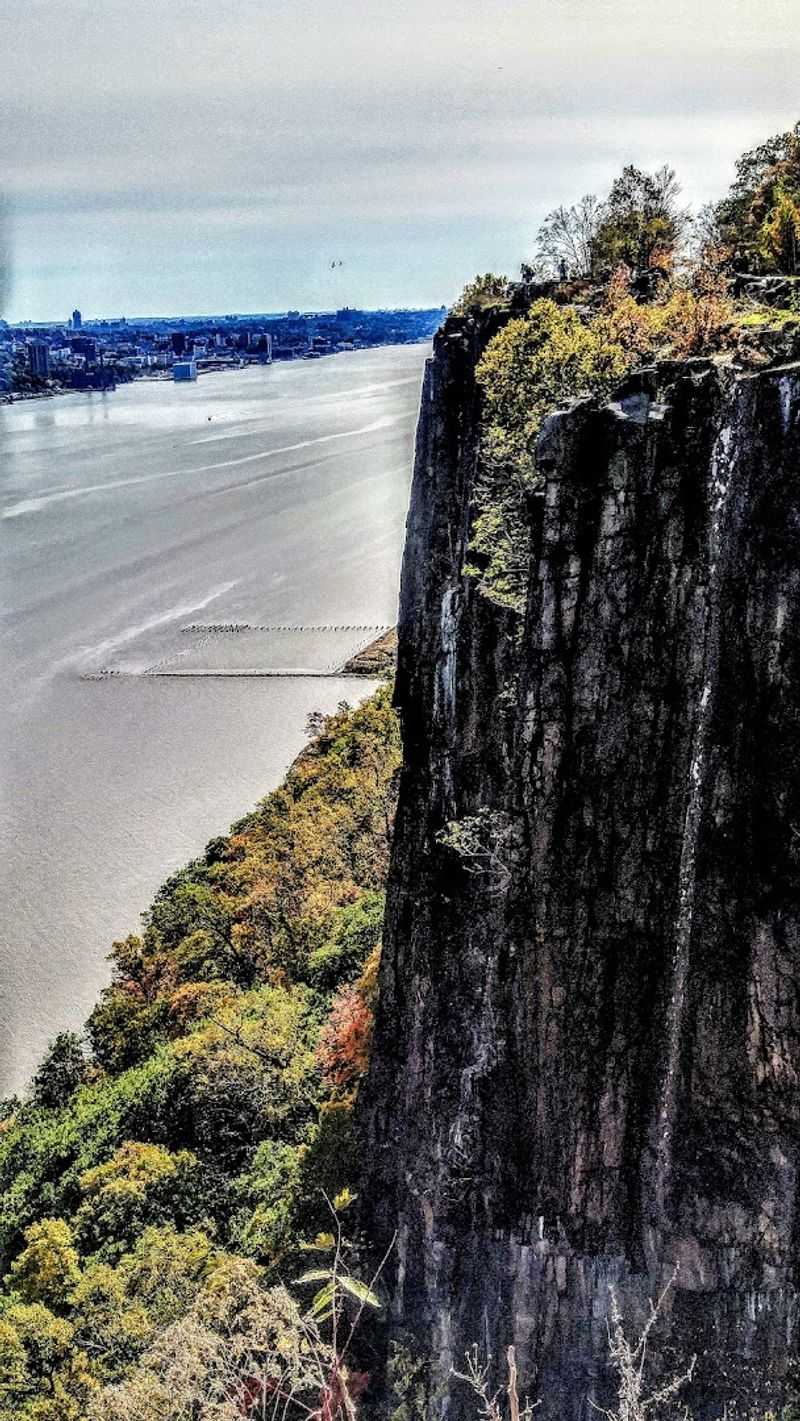
There are plenty of New Jersey places that are easier to explain in one sentence. The Palisades are not one of them, which is exactly why they stay with people.
They are a geologic landmark, a Revolutionary War site, a preserved green corridor, a transit-accessible hike, and one of the sharpest Manhattan viewpoints in the state. The park’s New Jersey section is minutes from Midtown, but it does not feel borrowed from New York.
It feels firmly, stubbornly local. That matters.
The best North Jersey destinations usually have a little grit under the polish, and this one has literal cliff rock to spare. It also rewards different kinds of visits.
You can come for 20 minutes, stand at the overlook, and leave satisfied. You can spend a couple of hours in the Visitor Center and encampment area at Fort Lee Historic Park.
You can commit to the Long Path or build a loop that drops you to the river and back. You can come in late fall for Retreat Weekend and watch the place lean into its 1776 identity.
Or you can drive farther north and start collecting other vantage points, trailheads, and angles on the same cliff line. The Palisades are generous like that.
They do not require a grand itinerary to make sense. There is also something satisfying about a place that still manages to surprise people in a state this densely mapped and thoroughly discussed.
New Jersey gets underestimated in oddly repetitive ways, and the Palisades quietly blow up most of them. They are older than almost anything around them, more dramatic than first-timers expect, and threaded with enough real history to keep them from being just another nice view.
Once you have seen Upper Manhattan from that cliff edge and thought about the centuries stacked beneath your feet, the whole place becomes hard to reduce to a quick label.
It is a park, yes, but it is also one of the clearest reminders that New Jersey’s most memorable landscapes do not always announce themselves with much warning. They just wait for you to step to the edge and notice.
Share this story