A Pennsylvania town once renamed itself after an Olympic champion who never set foot there. That odd bit of history is real, and it’s only one of the surprises waiting in the state’s smaller corners each fall.
Another town on this list claims the first run of a commercial steam locomotive on rails in America, back in 1829. A third has a toboggan slide that rockets riders onto a frozen lake. I love that these places carry stories this strange alongside their scenery.
Then October shows up and paints the hillsides red, orange, and gold. Gorges, river bends, waterfalls, and Victorian main streets suddenly look like calendar pages. I can’t imagine a better excuse to load up the car and wander.
So which one gets your first free weekend? I have a feeling your answer might change a few times before you reach the end.
1. Jim Thorpe
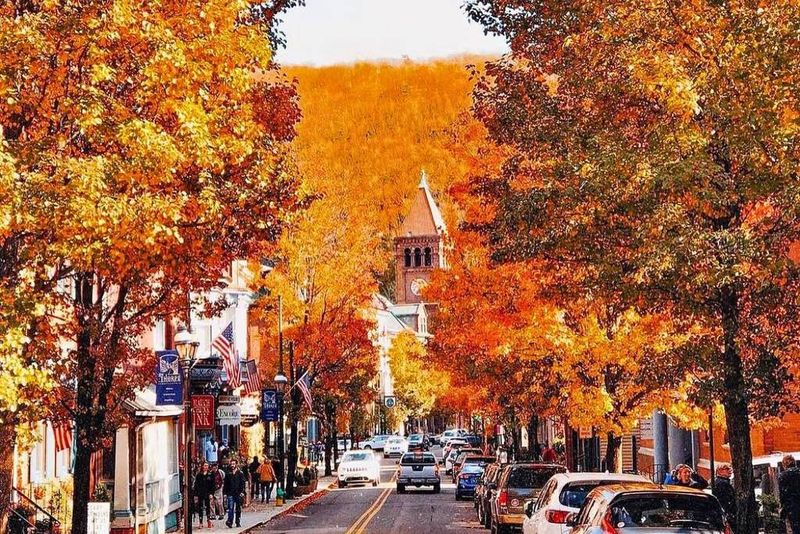
Few towns can say they swapped their name for a famous athlete who never even visited.
Mauch Chunk did exactly that in 1954, becoming Jim Thorpe to honor the Olympic legend.
Today the borough sits in a deep valley in Carbon County, with steep ridges rising on nearly every side.
Its nickname, the Switzerland of America, starts making sense once the leaves turn.
For the easiest leaf-peeping, hop aboard the Lehigh Gorge Scenic Railway.
Its vintage coaches roll out of town and follow the Lehigh River through Lehigh Gorge State Park.
You sit back while the gorge does the showing off.
No hiking boots required, though you may want a jacket for those open windows.
Back in town, the Asa Packer Mansion tells the story of a railroad tycoon who founded Lehigh University.
It is a National Historic Landmark, and the hillside setting makes it a fall photo favorite.
Right next door stands the Harry Packer Mansion, now an inn.
Its exterior is often credited as an inspiration for Disney’s Haunted Mansion, which feels fitting in October.
History fans should also stop at the Old Jail Museum.
It holds original cellblocks and shares the story of the Molly Maguires and the region’s coal-mining past.
Want water with your color?
Mauch Chunk Lake Park, just outside town, wraps a lake in trees that reflect beautifully on calm days.
The town’s Fall Foliage Festival usually lands on October weekends.
Expect crafts, food, and music, plus plenty of company on the sidewalks.
One more fun fact: the old Mauch Chunk Switchback Railway started hauling coal in 1827.
It later carried thrill-seekers and is often linked to the roots of the American roller coaster.
Plan to arrive early on festival days, since parking in a narrow valley fills quickly.
A morning start also gives you softer light on those famous hillsides.
2. Honesdale
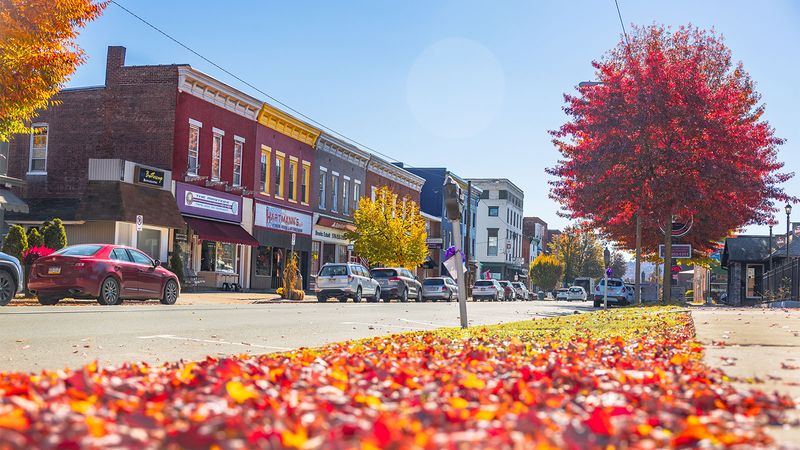
Railroad history in America got a big early push in this Wayne County town.
On August 8, 1829, the Stourbridge Lion made its trial run here, earning Honesdale the title Birthplace of the American Railroad.
You can see a full-scale replica of that locomotive at the Wayne County Historical Society museum on Main Street.
It is a fun way to start a fall day before heading outside.
Next, look up.
Irving Cliff towers over downtown, and it is part of public parkland that gives you a bird’s-eye view of the town and hills.
In autumn, that view turns into a patchwork of rooftops and bright trees.
Bring a camera and maybe a snack for the top.
Prefer to ride instead of climb?
The Stourbridge Line runs scenic excursions along the Lackawaxen River Valley, including special fall foliage trips.
Tickets are handled at the Wayne County Visitors Center on Main Street.
That makes it easy to pair a train ride with a downtown stroll.
Speaking of downtown, Honesdale’s Victorian-era buildings hold independent shops and restaurants.
Central Park sits across from the historic Wayne County Courthouse, a classic small-town scene.
The Wayne County Farmers Market runs Saturdays through October.
It is a handy stop for local produce and baked goods to take home.
The town’s name comes from Philip Hone, a former New York City mayor tied to the Delaware and Hudson Canal Company.
Before that, the spot was called Dyberry Forks.
Honesdale became a borough in 1831.
Nearly two centuries later, it still feels built for slow walks and long looks.
Want more trees?
Prompton State Park sits close by with trails and a lake for extra fall wandering.
3. Galeton
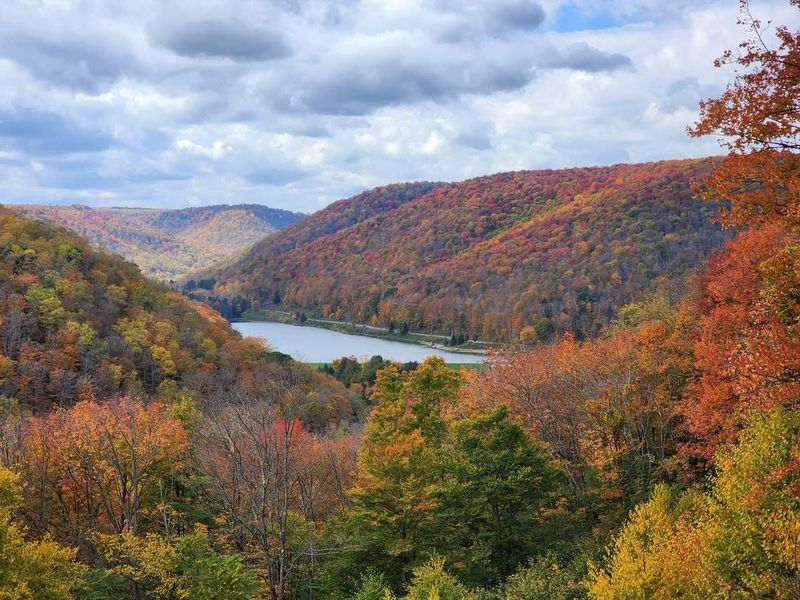
Need a place where the trees outnumber the people by a wide margin?
Galeton, in Potter County, fits that description nicely.
This small borough grew up as a booming lumber town in the early 1900s.
It was incorporated in 1897 and named for William McClure Gale.
Those old logging days explain the forests that surround it now.
In fall, they turn the hills into layers of red, orange, and yellow.
Lyman Run State Park sits just outside town and centers on Lyman Run Lake.
Maples and cherries in its northern hardwood forest make the shoreline glow when the season peaks.
The park offers hiking, fishing, and boating, with camping available into late fall.
A quiet lake morning here is about as peaceful as Pennsylvania gets.
Getting to Galeton is part of the fun.
US Route 6 runs right through town, and the highway is famous for long stretches of forests and mountains.
Galeton also hosts a Fall Festival in September at John J.
Collins Memorial Park.
Look for local produce, maple products, crafts, and entertainment.
Curious about the region’s logging roots?
The Pennsylvania Lumber Museum sits a short drive away and explains how the woods shaped local life.
When the sun goes down, head toward Cherry Springs State Park.
It is a Dark Sky Park, so your leaf-peeping day can end with serious stargazing.
Pack layers, because northern Pennsylvania nights can get chilly fast.
Also fill your gas tank before exploring, since services spread out in this part of the state.
Galeton will not overwhelm you with attractions.
Instead, it hands you trees, water, sky, and a quiet you might not find at home.
4. Marienville
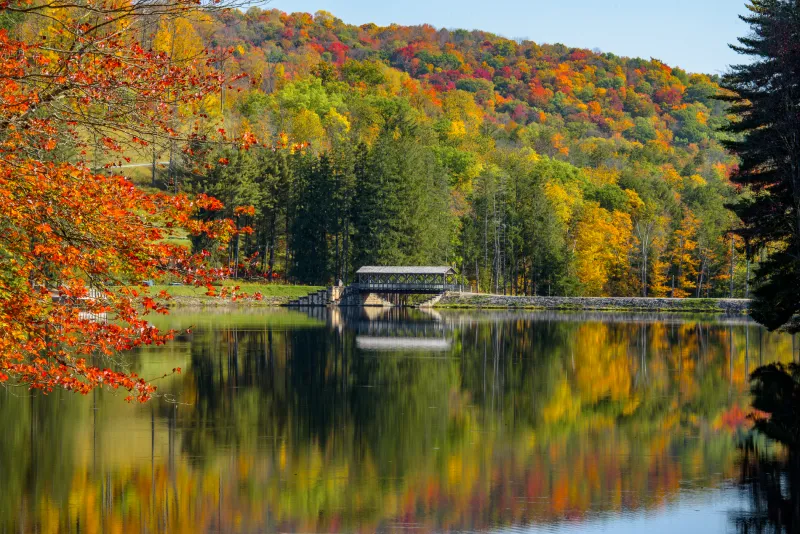
Here is a town whose first name was Blood’s Settlement.
Thankfully for postcards, it later became Marienville, after Marien Blood Hunt, daughter of Forest County founder Cyrus Blood.
Marienville calls itself a gateway to the Allegheny National Forest.
That forest spreads across more than half a million acres, so fall color is never far off.
Trails wind through the woods for hikers, horseback riders, and off-road fans.
Some trail types follow seasonal schedules, so check dates before you pack.
Each fall, the Tour-De-Forest ATV ride brings a crowd of riders to the area.
It is a lively side of a town that is usually pretty quiet.
Want calmer company?
Buzzard Swamp Wildlife Management Area offers easy trails around ponds and wetlands near town.
Birders watch for bald eagles and ospreys there.
Add fall leaves on the water, and you have a scene worth a slow walk.
Cook Forest State Park is a reasonable drive away.
Its Forest Cathedral area protects towering old white pines and hemlocks, which make a nice contrast to bright maples.
Marienville served as the Forest County seat from 1851 until 1866.
Lumber and glassmaking once powered its economy.
The town also shows its playful side with a Bigfoot Festival in summer.
You probably won’t spot the big guy in October, but the woods sure look like his kind of place.
Stop by the Marienville Ranger District Office for maps and forest information.
Rangers can point you toward roads and trails that fit your plans.
Bring snacks and water for longer drives, since the forest is huge.
A full tank and a paper map are smart moves out here.
5. Tunkhannock
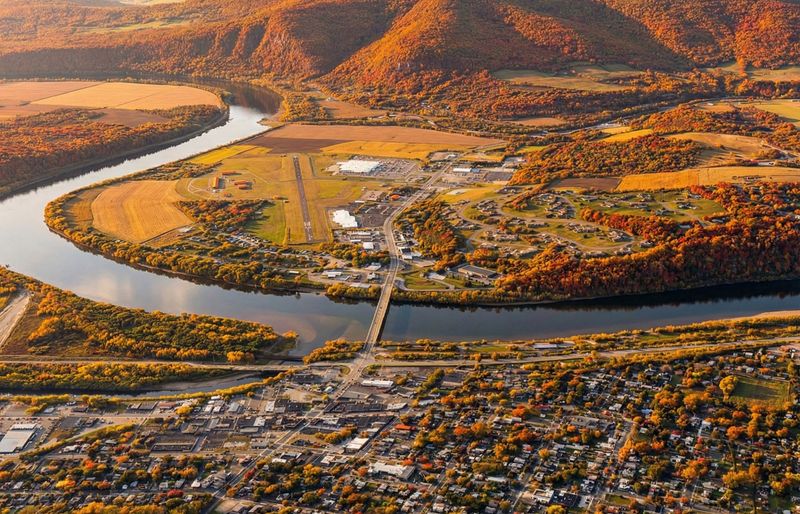
The name sounds like a riddle, but the meaning is simple.
Tunkhannock is often translated as small river or meeting of the waters, pointing to where Tunkhannock Creek joins the Susquehanna.
That river bend shapes the whole town.
In fall, the hills along the water light up and frame the Wyoming County seat beautifully.
Downtown is a great place to begin.
Much of it was rebuilt after a big fire in 1870, so many storefronts carry that late 1800s look.
A self-guided historic walking tour helps you spot the stories behind the buildings.
It is an easy way to stretch your legs between scenic drives.
Riverside Park sits right on the Susquehanna.
You’ll find a boat launch, picnic spots, and even disc golf with river views.
For a bigger outdoor fix, head to Vosburg Neck State Park, a few miles west.
It opened as a state park in 2022 and sits inside a loop of the river.
Trails there are great for hiking and wildlife watching.
Paddlers can use non-motorized boats to see the color from the water.
Fall also brings farm fun to the area.
Brown Hill Farms offers seasonal activities like pumpkin picking and a corn maze.
Tunkhannock became a borough in 1841 and the county seat in 1842.
It also serves as a doorway to the Endless Mountains region.
Stop by the Endless Mountains Visitors Bureau on Route 6 for maps and ideas.
They can help you plan loops through nearby countryside.
Pick a clear afternoon if you can.
The low sun on the Susquehanna makes the trees look even brighter.
6. Forksville
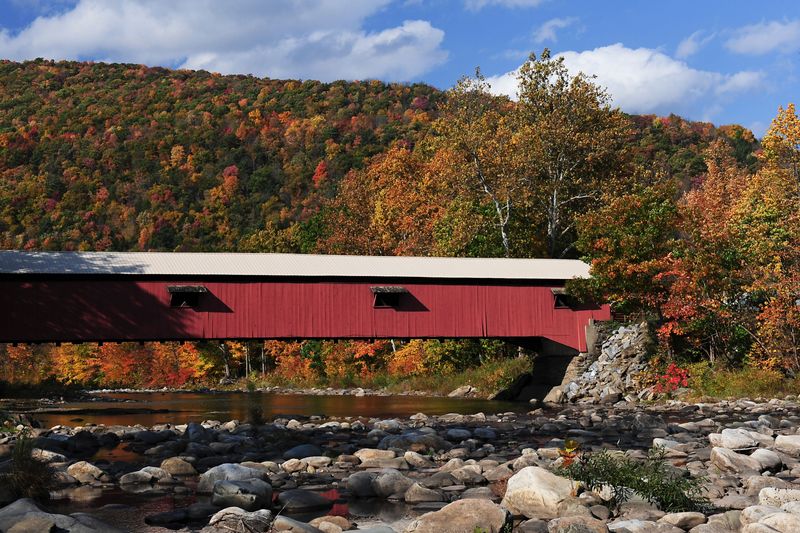
A covered bridge from 1850 still carries cars over Loyalsock Creek in Forksville.
If that doesn’t make you want to slow down and grab a photo, nothing will.
The Forksville Covered Bridge was built by Sadler Rogers.
It joined the National Register of Historic Places in 1980.
Fall gives the bridge its best backdrop.
Bright trees crowd the creek banks, and the wooden structure looks like it belongs in a storybook.
Forksville gets its name from its spot where Little Loyalsock Creek meets Loyalsock Creek.
Water and woods define this tiny Sullivan County borough.
Just south of town is Worlds End State Park.
Its S-shaped valley along Loyalsock Creek is a fall favorite for good reason.
Overlooks like Canyon Vista and High Knob give wide views of rolling, colorful ridges.
Bring sturdy shoes if you want to tackle the Loyalsock Trail.
The Sullivan County Fairgrounds sit in Forksville too.
The fair brings agricultural exhibits and competitions each year near the start of September.
Back in town, the Forksville General Store is a well-known stop.
It makes a handy break before or after a park visit.
Early settlers built a sawmill here around 1810.
The village was laid out in 1854 and became a borough in 1880.
Fall weekends can get busy near Worlds End, so arrive early for overlook parking.
Weekdays are calmer if your schedule allows.
Leave time to just stand by the creek.
The sound of water under that old bridge is half the reason people come back.
7. Eagles Mere
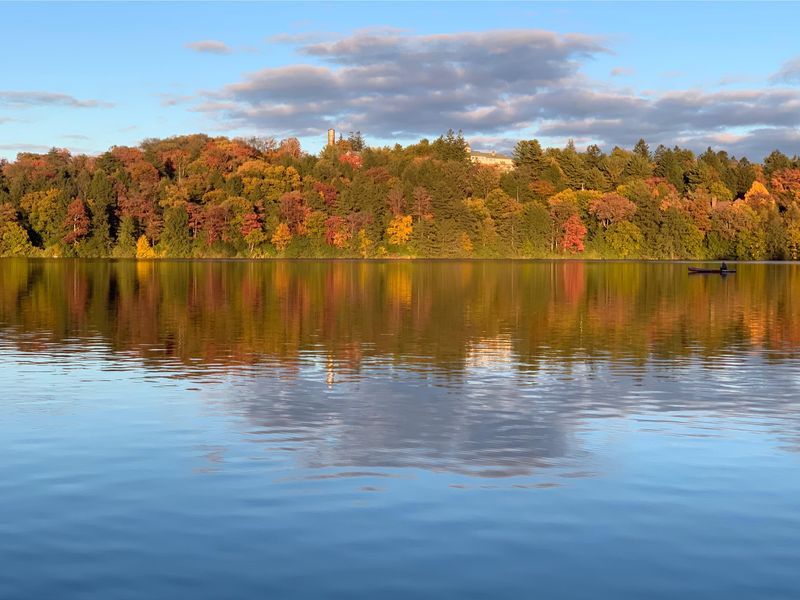
People call Eagles Mere the town that time forgot, and honestly, it seems happy about that.
Its historic resort look dates back to visitors who came for cool mountain air in the late 1800s.
The heart of town is Eagles Mere Lake, a spring-fed lake ringed by trees.
In autumn, the shoreline turns into a mirror of red and gold.
The Laurel Path circles the lake for about two miles.
It is lined with old rhododendrons and makes for a relaxed fall walk.
Wondering about the name?
The lake was once called Lewis Lake after George Lewis, who bought the land in 1794 and started a glass factory.
Later it became Eagles Mere.
The resort era took off from the 1860s onward, drawing families from big eastern cities.
The Eagles Mere Inn, built in 1887, is the last original hotel still standing.
It belongs to Historic Hotels of America.
Downtown, the village shops add charm to a leaf-peeping day.
Car fans can visit the Eagles Mere Auto Museum, and the Eagles Mere Air Museum covers early aviation.
Nature lovers should check out the Eagles Mere Conservancy.
Its trails connect toward Loyalsock State Forest for longer woodland wandering.
Here’s a winter bonus to plan for later.
When the lake freezes, the Eagles Mere Toboggan Slide sends riders zooming onto the ice.
Worlds End State Park is also close by for bigger views.
Pair a lake loop with an overlook drive for a full day.
Fall is quieter than summer here.
That means you might get stretches of the Laurel Path almost to yourself.
8. Ohiopyle
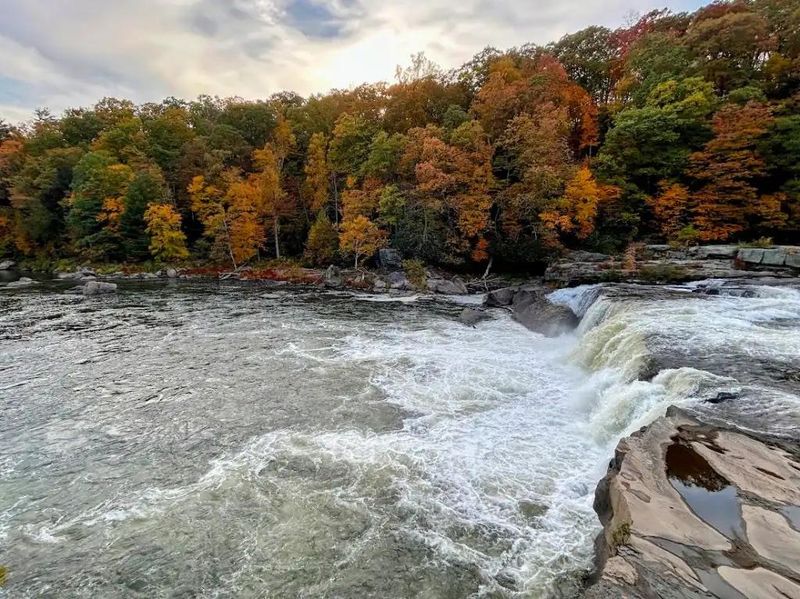
White frothy water is a pretty good description of this place.
The name Ohiopyle comes from a Lenape phrase often translated that way, a nod to the foamy falls.
Those falls sit right in town on the Youghiogheny River.
Viewing areas let you watch the water tumble while fall trees glow on the banks.
Ohiopyle is a tiny Fayette County borough surrounded by Ohiopyle State Park.
The park covers about 20,000 acres in the Laurel Highlands.
Trails head off in many directions.
The Ferncliff Peninsula loop is a popular short hike with river views.
For something extra pretty, drive to Cucumber Falls.
It spills over a rock ledge into a small gorge framed by changing leaves.
Baughman Rock Overlook gives a big view across the Youghiogheny River Gorge.
On a clear October day, the color seems to roll forever.
Cyclists know Ohiopyle as a stop on the Great Allegheny Passage.
That rail-trail links Pittsburgh with Cumberland, Maryland.
You don’t need to ride the whole thing, of course.
A short out-and-back on the flat trail still delivers river and foliage views.
George Washington passed through this area in the 1750s.
He hoped to use the river for travel, but the falls changed his plans.
Frank Lloyd Wright fans are in luck too.
Fallingwater and Kentuck Knob are both a short drive from town.
Arrive early on fall weekends, because this is a popular spot.
The morning mist over the river is worth the alarm clock.
9. Wellsboro
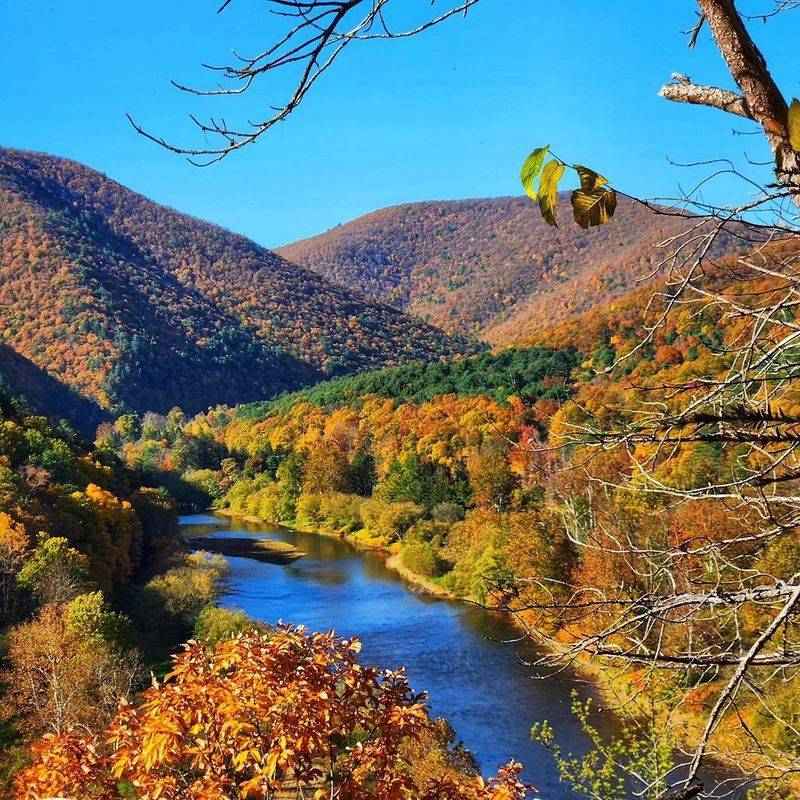
Gas street lamps on Main Street give Wellsboro an old-time glow before you even reach the canyon.
Then the Pennsylvania Grand Canyon steals the show.
That canyon is officially Pine Creek Gorge.
It stretches about 47 miles and drops to around 1,450 feet deep in places.
Leonard Harrison State Park on the east rim offers overlooks near Wellsboro.
Colton Point State Park on the west rim feels more rustic.
In fall, the gorge walls fill with color from top to bottom.
It is one of the most famous foliage views in the state.
Down at the bottom, the Pine Creek Rail Trail follows the creek.
It’s great for biking or walking, since the grade stays gentle.
Back in town, The Green is a park on Main Street.
Look for the Wynken, Blynken, and Nod fountain sculpture there.
The Dietrich Theater adds a classic touch to downtown.
It has hosted movies and film events for decades.
Wellsboro was founded in 1806 by Benjamin Wistar Morris.
He named it for his wife, Mary Wells Morris.
Lumber once drove the local economy.
Today, visitors coming for canyon views help keep shops and restaurants busy.
Plan a sunset at an overlook if you can.
The low light makes the canyon walls look like they are on fire, in the best way.
Fall weekends draw big crowds, so book lodging early.
Weekday trips usually give you more room at the railings.
10. Delaware Water Gap
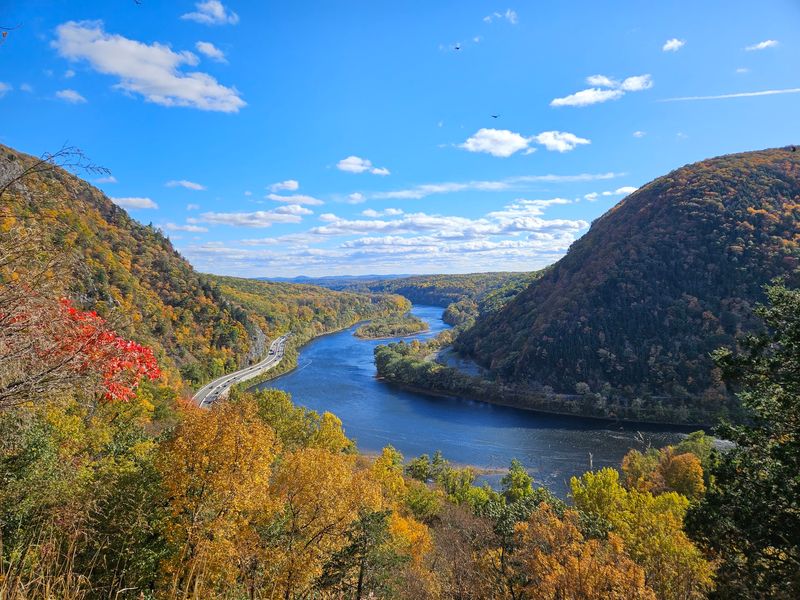
A river slicing straight through a mountain ridge is not something you see daily.
At Delaware Water Gap, the Delaware River did exactly that, carving a dramatic pass through the Kittatinny Ridge.
The small Monroe County borough sits right at the edge of this gap.
In fall, the steep slopes turn bright and rise above the water.
Around it spreads the Delaware Water Gap National Recreation Area.
It covers about 70,000 acres along the river in Pennsylvania and New Jersey.
Hikers love Mount Tammany on the New Jersey side for its view back across the gap.
The Appalachian Trail also passes right through the borough.
Waterfalls add more reasons to visit.
Raymondskill Falls and Dingmans Falls sit within the recreation area farther north.
Peak color here often shows up in October.
That makes it a great month for a riverside drive.
The town also loves music.
The COTA Jazz and Arts Festival, usually in September, brings performances and art to the community.
The village grew into an early resort spot in the 1800s.
Railroads helped bring visitors from nearby cities.
Today, small shops and cafes line the main road.
They make easy stops between overlooks and trailheads.
Paddling is another way to see the season.
Canoes and kayaks give you a low, close view of the trees.
Bring layers, since the river can feel chilly.
A thermos of hot cocoa doesn’t hurt either.
11. Hawley
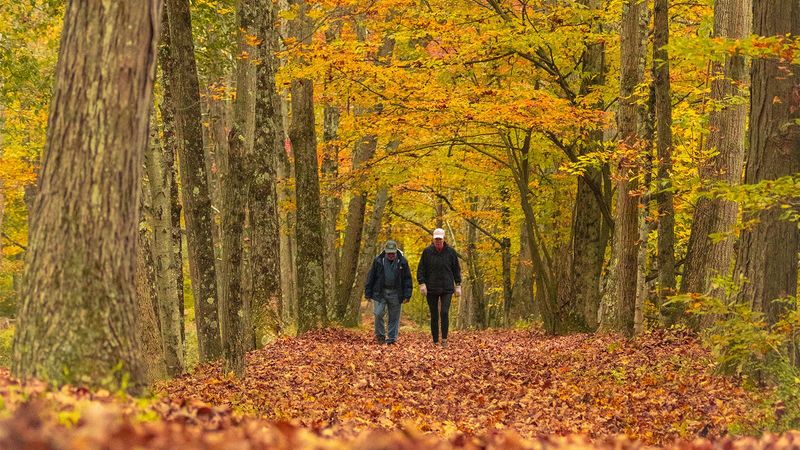
A huge lake built for hydroelectric power ended up turning Hawley into a vacation spot.
Lake Wallenpaupack was created in the 1920s, and fall shows off its shoreline beautifully.
The lake has about 52 miles of shoreline.
Trees crowd much of it, so autumn reflections can look almost unreal.
Boat tours on the lake are a relaxing way to see the color.
You can also paddle or fish if you prefer doing the work yourself.
Hawley’s roots go back to coal and canals.
The Delaware and Hudson Canal helped make it a transport hub in the 1800s.
The historic Hawley Silk Mill still stands in town.
Today it holds businesses, including Cocoon Coffee House.
The Settlers Inn on Main Avenue is another landmark.
This Arts and Crafts style inn first opened in 1927.
Bingham Park sits along the Lackawaxen River near downtown.
It’s a pleasant spot for a short walk under changing leaves.
Want something quirky?
Pennsylvania Rail Bike lets you pedal along old rail lines starting near Hawley.
Route 507 along the lake makes a great fall drive.
Pull-offs give you chances to snap photos of the water.
Downtown shops and galleries add color of their own.
Strolling Main Avenue fits nicely between lake views.
Fall weekends can be busy, especially on sunny days.
Book any tours ahead if you can.
12. Dushore
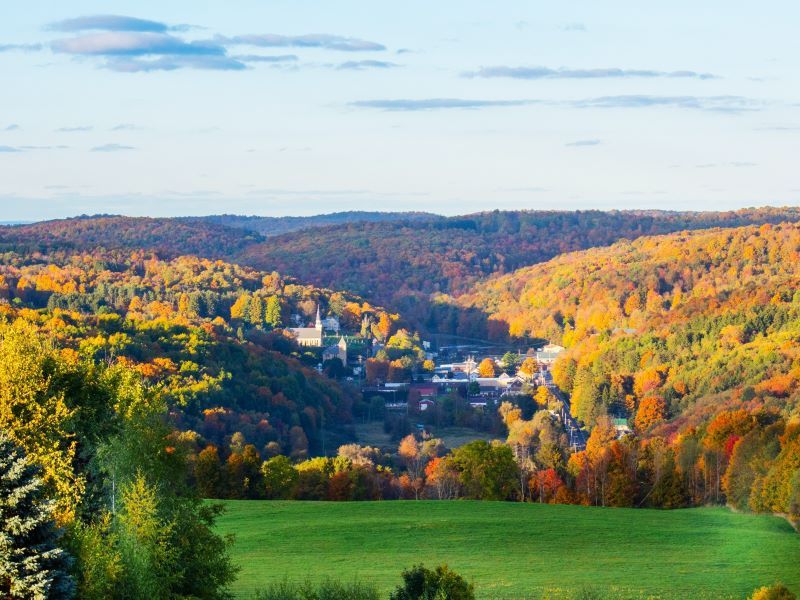
Sullivan County is so rural that Dushore is known for hosting the county’s only traffic light.
That one fact tells you plenty about the peace waiting here.
Dushore is the largest town in Sullivan County, which isn’t saying much.
Still, it serves as a handy base for Endless Mountains exploring.
The town’s name honors Aristide du Petit Thouars, a French naval officer.
He settled in the area in the 1790s.
Fall paints the surrounding farmland and forests in rich color.
Country roads here practically beg for slow driving.
Worlds End State Park sits a short drive away.
Its overlooks show off Loyalsock Creek valley views.
Ricketts Glen State Park is also within reach.
It’s famous for its trail of waterfalls through old forest.
Back in town, local shops and restaurants line the main streets.
The Dushore Fall Festival usually brings vendors and music in October.
St. Basil’s Church sits on a hill above town.
Its spire looks lovely against autumn trees.
Kast Pond offers a quiet spot for a picnic.
It’s a nice break from driving.
The Sullivan County Fair takes place nearby in Forksville.
Visit in early September for fair fun before peak color.
Pack a picnic and wander.
Dushore rewards people who aren’t in a hurry.
Share this story