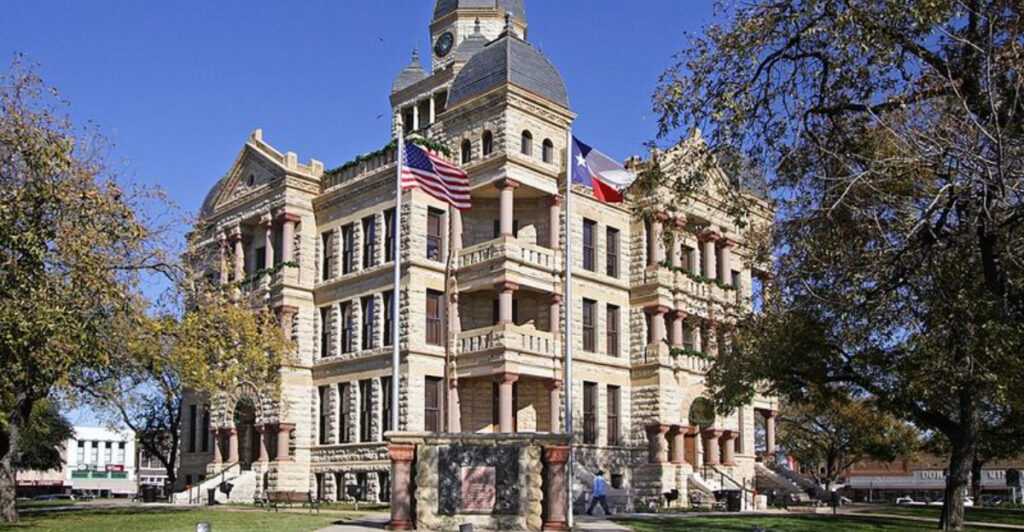
Texas courthouses aren’t just buildings where legal business happens—they’re the beating hearts of small towns across the state. Many of these grand structures have stood for over a century, watching generations of Texans gather, celebrate, and debate on the squares surrounding them. From ornate stone towers to elegant domes that pierce the sky, these architectural treasures tell stories of frontier justice, community pride, and the determination to build something beautiful even in the most remote corners of the Lone Star State.
1. Ellis County Courthouse (Waxahachie)
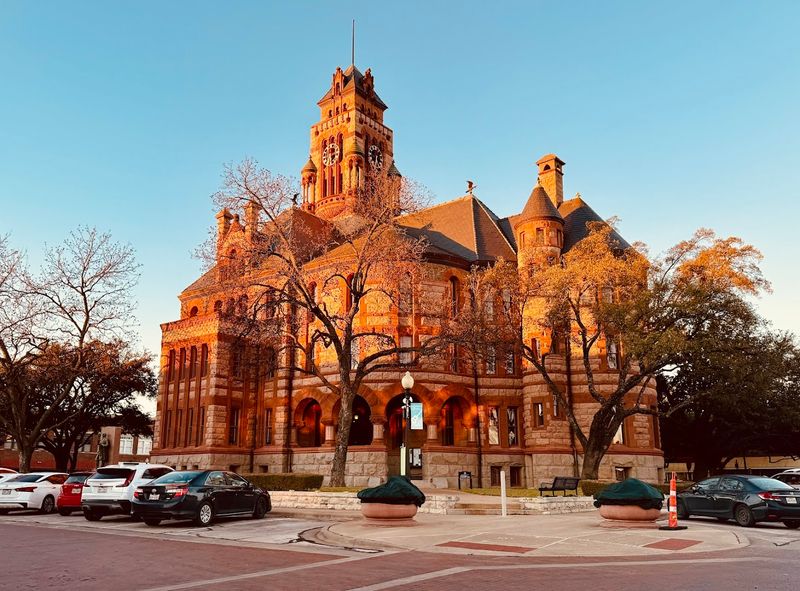
Standing nine stories tall with red sandstone walls that glow at sunset, this 1895 masterpiece looks more like a European castle than a Texas courthouse. The building cost $150,000 back then—a fortune that sparked heated debates among taxpayers who wondered if their county had lost its mind. Turns out, they built something that would become one of the most photographed courthouses in America.
Six faces carved into the stonework have sparked legends for generations. Local lore says the Italian stonecutter fell for a local woman who rejected him, so he carved her face with increasingly ugly expressions as his heartbreak deepened. Whether that’s true or romantic fiction, visitors still crane their necks searching for those mysterious faces hidden among the ornate details.
The building dominates the downtown square with an presence that’s impossible to ignore. Four clock faces keep time from the central tower, visible from blocks away in every direction. Intricate carvings cover nearly every surface—gargoyles, flowers, faces, and geometric patterns that would take days to fully appreciate.
Inside, the attention to detail continues with original woodwork, tile floors, and a courtroom that feels transported from another era. The county still conducts business here, though the building now shares duties with a modern facility. Tours reveal hidden staircases, former jail cells, and stories of famous trials that once captivated the state.
Waxahachie’s square bustles with antique shops and restaurants that benefit from the constant stream of architecture enthusiasts. The courthouse anchors it all, a reminder that Texans have always believed in making bold statements. That controversial price tag from 1895 now seems like the bargain of the century for a building that defines an entire community.
2. Williamson County Courthouse (Georgetown)
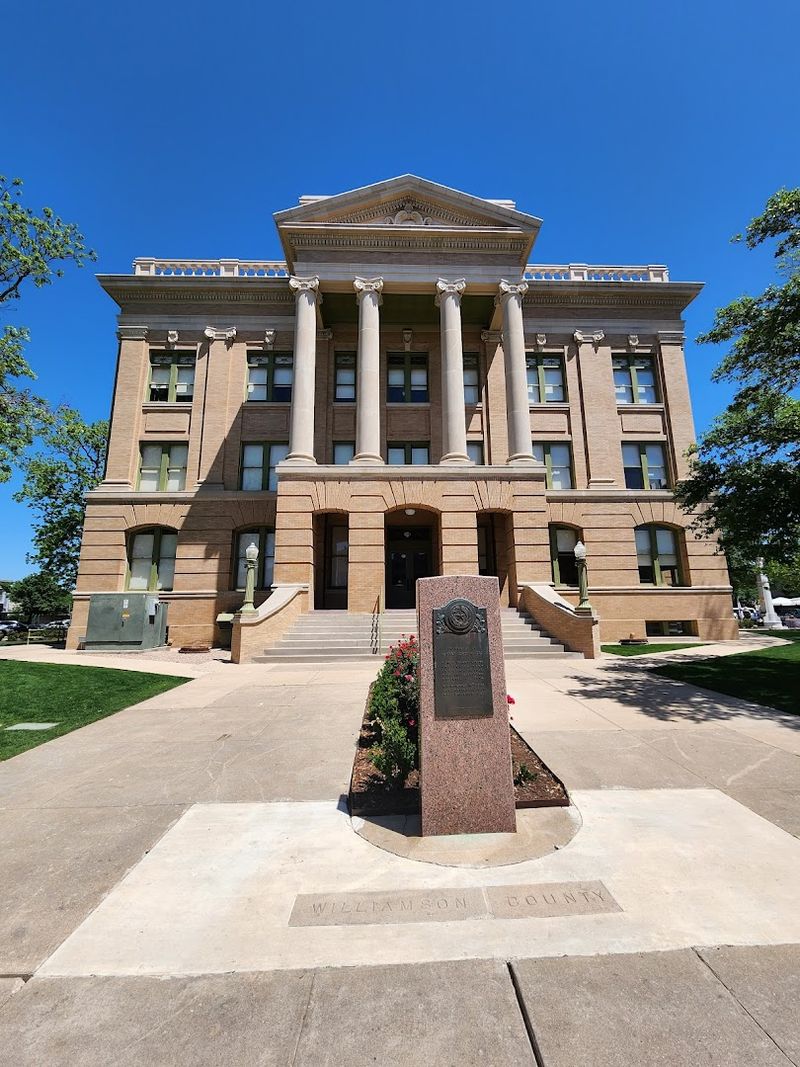
Constructed in 1911, this beauty replaced an earlier courthouse that burned down—a fate that claimed many Texas courthouses in the late 1800s. The county wasn’t taking chances the second time around, investing in fireproof construction and materials that could withstand whatever Texas threw at it.
The Classical Revival design features a central dome crowned with Lady Justice holding her scales. She’s watched Georgetown transform from a quiet agricultural town into one of the fastest-growing cities in America. That rapid growth has tested the building’s capacity, but the county has carefully preserved the historic structure while adding modern facilities nearby.
Local limestone gives the exterior a warm, creamy color that changes with the light throughout the day. The material came from quarries right here in Williamson County, making this quite literally a courthouse built from the land it serves. Massive columns support the entrance portico, creating a shaded gathering spot that stays cooler even during brutal summer heat.
Inside, the original courtroom maintains its period details, including wooden benches worn smooth by generations of residents. The building houses a museum on the third floor where visitors can explore Georgetown’s history through photographs, documents, and artifacts. Don’t miss the view from the upper windows—you’ll see the courthouse square laid out below just as town planners envisioned over a century ago.
The square itself thrives with locally-owned businesses, weekend farmers markets, and festivals that draw crowds year-round. Georgetown has mastered the balance between honoring its heritage and embracing growth. The courthouse stands at the center of that equation, proving that old buildings can remain relevant and vital in modern Texas communities.
3. Hood County Courthouse (Granbury)
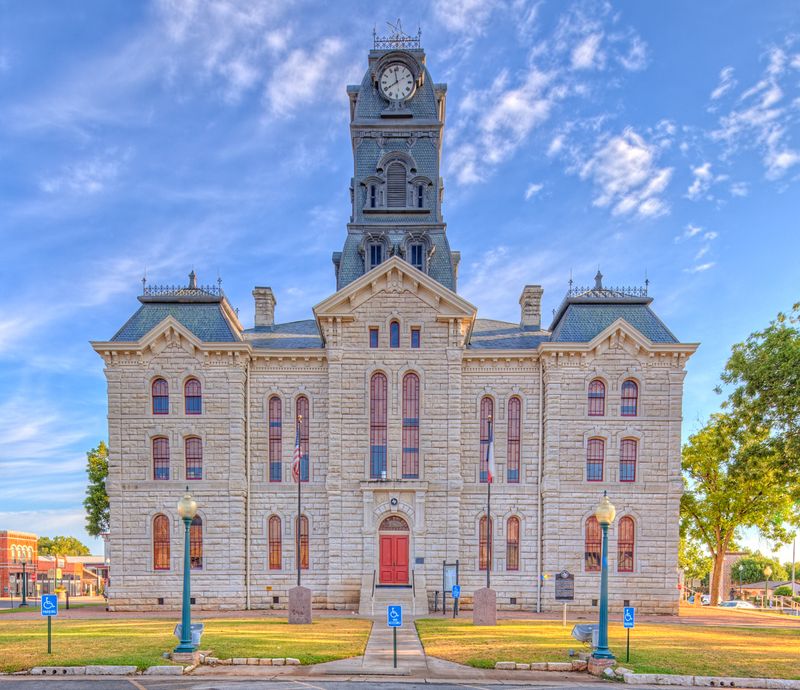
Granbury’s square feels like stepping onto a movie set, and the 1891 courthouse provides the perfect backdrop. That’s not coincidental—the entire square has been carefully preserved, earning it a spot on the National Register of Historic Places. The courthouse tower rises above two-story buildings that house antique shops, restaurants, and galleries, creating a scene that filmmakers and photographers can’t resist.
Built from native limestone in the Second Empire style, the building features a mansard roof and a clock tower that’s become Granbury’s most recognizable landmark. The architectural details reward close inspection—decorative stonework, arched windows, and a corner entrance that faces the square diagonally rather than straight-on. This unusual orientation was intentional, designed to welcome visitors approaching from any direction.
The building served Hood County until 2003 when operations moved to a modern justice center. Rather than letting this treasure deteriorate, the county converted it into a museum and visitor center. Now everyone can explore the restored courtroom, vintage jail cells, and exhibits about Hood County’s colorful past without worrying about interrupting actual court proceedings.
Granbury’s town square comes alive on weekends when visitors flock to shop, dine, and soak up small-town atmosphere. The courthouse anchors the scene, its tower visible from every corner of the square. Evening brings a special magic when lights illuminate the building, casting dramatic shadows across the limestone walls.
Local legends claim outlaw Jesse James didn’t die in Missouri but instead lived out his days in Granbury under an assumed name. True or not, the story fits perfectly with the old-west ambiance that permeates this square. The courthouse has witnessed plenty of real drama over the decades—trials, celebrations, protests, and community gatherings that shaped Hood County’s identity.
4. Harrison County Courthouse (Marshall)
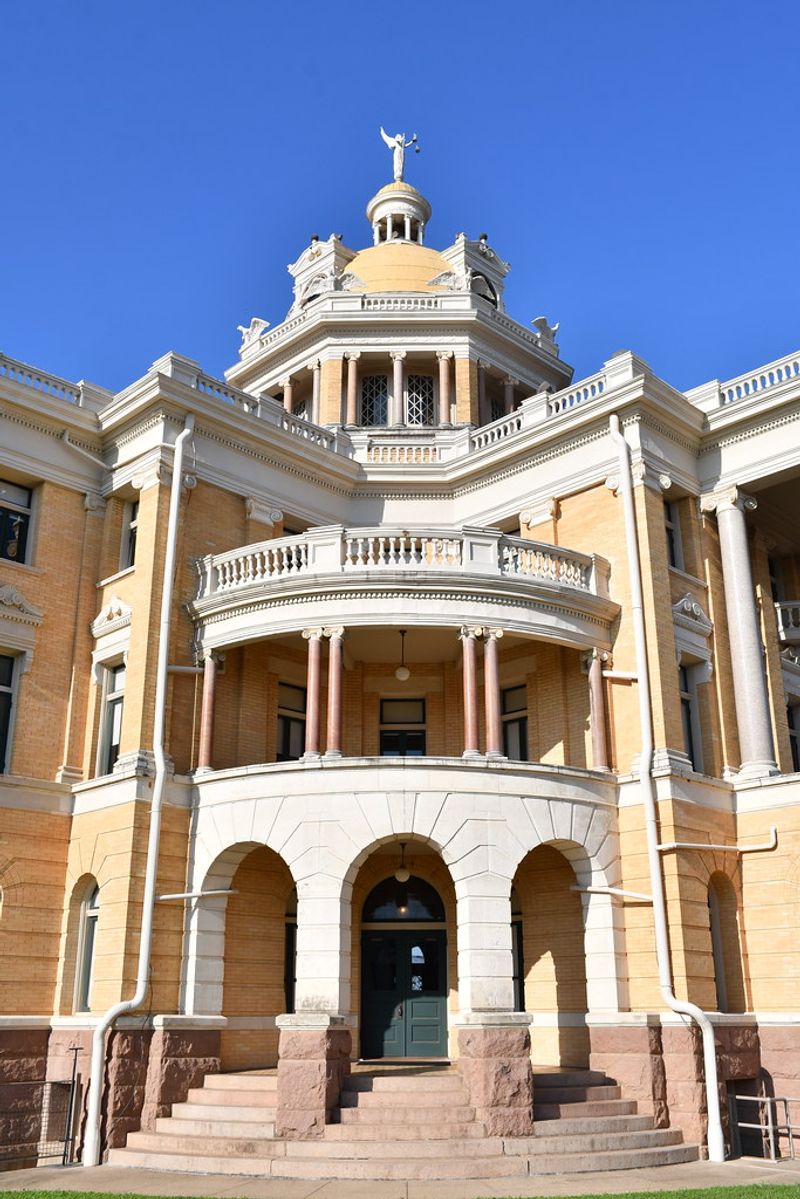
Rising above downtown Marshall, the courthouse immediately grabs attention with its imposing design and unmistakable sense of importance.The 1964 structure replaced a spectacular 1900 courthouse that burned—a tragedy that devastated the community and destroyed a masterpiece of Victorian architecture. What rose in its place took a completely different approach, embracing mid-century modern classicism with clean lines and imposing scale.
Six massive columns support the entrance portico, each one thick enough that three people couldn’t wrap their arms around it. The building stretches wide rather than tall, prioritizing horizontal lines that create a sense of stability and permanence. Marble and granite cladding give the exterior a formal, serious character appropriate for the seat of county government.
Harrison County’s history runs deep, and Marshall played a significant role in Texas’s Confederate past and subsequent reconstruction. The courthouse grounds feature monuments and markers that acknowledge this complex history. Inside, modern courtrooms handle the business of justice while administrative offices keep county operations running smoothly.
Marshall’s downtown has experienced the same struggles many small Texas towns face—competition from big-box stores, changing economies, and younger generations leaving for cities. But the courthouse square maintains activity, anchored by restaurants, a historic hotel, and shops that cater to both locals and visitors exploring East Texas.
The building might lack the ornate Victorian charm of its predecessor, but it represents its own era with integrity. Mid-century architecture deserves appreciation too, and this courthouse demonstrates that civic buildings can be dignified without relying on historical revival styles. Marshall got a courthouse that reflected 1960s optimism and progress, a building that looked forward rather than backward.
Visiting today, you’ll find a functioning county government hub surrounded by a square that’s working to revitalize itself. The courthouse remains the center of it all, just as it has been for generations.
5. Fayette County Courthouse (La Grange)
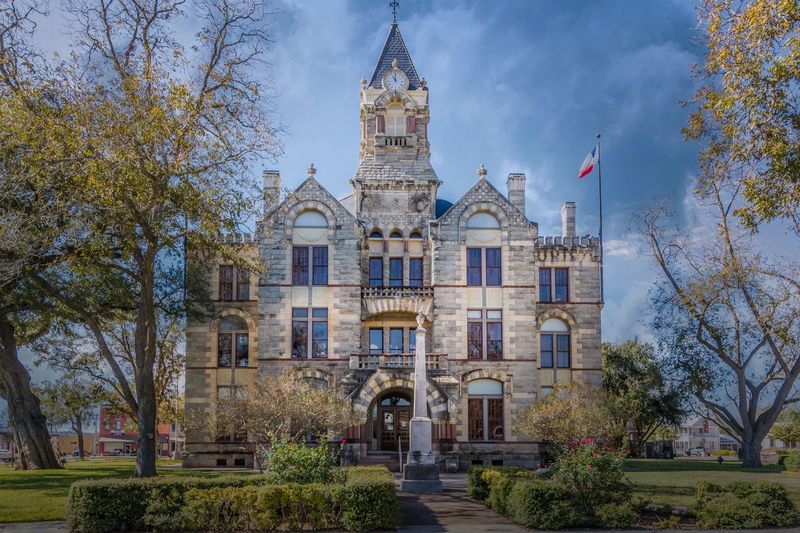
La Grange’s courthouse tells its story in red brick and stone, a Romanesque Revival beauty that’s anchored the town square since 1891. The tower rises asymmetrically from one corner—an architectural choice that gives the building a distinctive silhouette you’ll recognize from blocks away. This wasn’t the county’s first courthouse, but it’s certainly been the most enduring, surviving fires, storms, and the passage of time that claimed so many others.
Architect J. Riely Gordon designed this masterpiece, and his reputation for creating stunning Texas courthouses was well-deserved. The attention to detail shows in every archway, window arrangement, and decorative element.
Contrasting stone trim breaks up the brick walls, creating visual interest that prevents the large structure from feeling monotonous or heavy.
Fayette County’s Czech and German heritage influences everything from local cuisine to annual festivals, and the courthouse square reflects that cultural mix. The building has witnessed generations of these communities gathering for celebrations, markets, and the everyday business of rural Texas life. Inside, county offices maintain original architectural features while serving modern administrative needs.
The square surrounding the courthouse maintains its small-town character with local businesses, a few antique stores, and restaurants where regulars know each other by name. La Grange sits in the heart of what Texans call “the other Hill Country”—rolling farmland and historic towns that don’t see the tourist crowds flooding Fredericksburg and Wimberley.
That relative obscurity works in La Grange’s favor. The courthouse and square feel authentic rather than preserved for visitors, still functioning as the genuine center of community life. County business happens here, locals shop and eat here, and the building serves its original purpose rather than existing primarily as a museum or tourist attraction.
The tower’s clock faces keep time for a town that hasn’t rushed into the future, preferring to honor its past while adapting at its own pace.
6. Denton County Courthouse on the Square Museum (Denton)
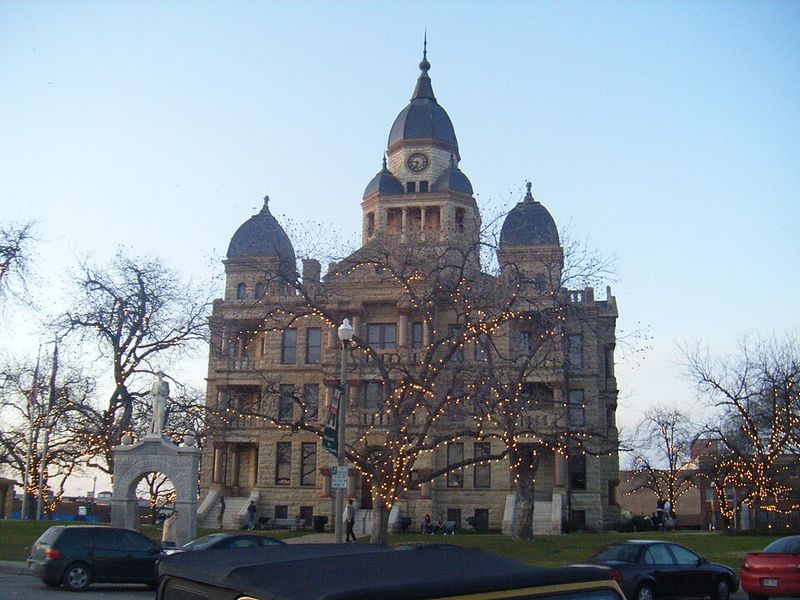
When evening falls in Denton, the 1896 courthouse shines beautifully as lights highlight its striking pink granite and limestone exterior. The building retired from courthouse duties in 1987, transforming into a museum that lets visitors explore both the architecture and Denton County’s history without the constraints of active government operations. This career change probably saved the building, giving it new purpose and ensuring funds for proper maintenance and restoration.
The Romanesque Revival design by W.C. Dodson features a dramatic clock tower that soars above the square, visible from the nearby University of North Texas campus. That tower houses a Seth Thomas clock that’s kept time for over a century, its four faces ensuring nobody in downtown Denton has an excuse for being late.
The building’s pink granite came from Burnet County, hauled by wagon and rail to construct what would become one of North Texas’s most photographed landmarks.
Inside, exhibits rotate but always include displays about county history, vintage photographs, and artifacts that bring the past to life. The restored courtroom lets you sit where defendants once sat, imagining trials from an era when justice moved slower and formality mattered more. Original woodwork, tin ceilings, and period details transport visitors backward in time.
Denton’s square thrives with local businesses, music venues, and restaurants that benefit from the college-town energy. The courthouse-turned-museum anchors it all, providing a tangible connection to history that students and longtime residents alike appreciate. Weekend events often spill onto the courthouse lawn, from farmers markets to festivals celebrating Denton’s vibrant arts scene.
The building’s second act as a museum proves that historic structures don’t have to perform their original function to remain relevant. Sometimes letting go of courthouse duties means a building can better serve as a community gathering place and educational resource. Denton figured that out before many Texas counties, preserving this treasure by giving it new life.
7. Llano County Courthouse (Llano)
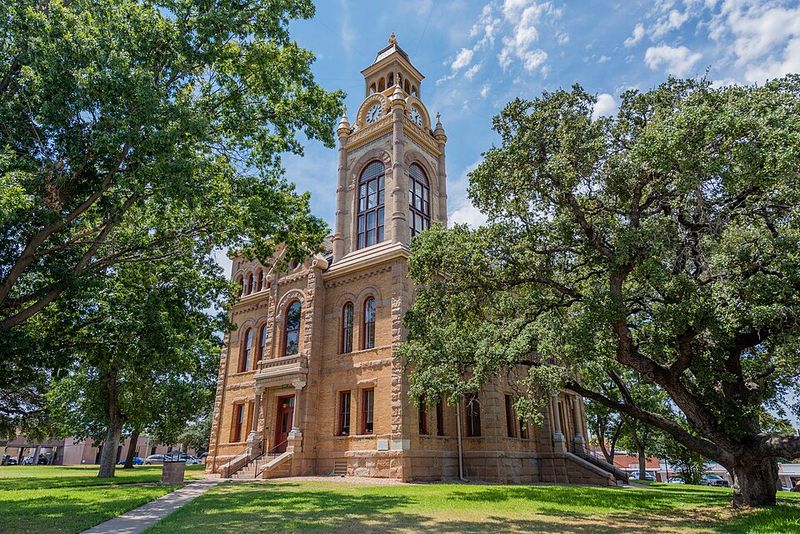
Built entirely from locally-quarried pink granite in 1893, Llano’s courthouse literally rose from the ground beneath it. The Hill Country town sits atop some of the finest granite deposits in Texas, a geological gift that shaped the local economy and gave the county a courthouse unlike any other. That distinctive pink stone glows warm in afternoon light, making the building especially photogenic during golden hour.
The Second Empire design features a central tower topped with a clock and bell that once summoned residents to important gatherings. Four identical facades face the cardinal directions, each with an entrance that welcomes visitors to the square. This symmetrical design creates a sense of balance and order, reflecting Victorian ideals about how government buildings should present themselves.
Llano remains a small town where everybody knows everybody, and the courthouse square still functions as the community’s living room. Local businesses ring the square, including a legendary barbecue joint and shops selling Hill Country antiques and crafts. The Llano River flows nearby, bringing fishermen and kayakers to a town that’s maintained its unhurried pace despite growing tourism in surrounding areas.
Inside the courthouse, county business continues in spaces that honor original architectural details while meeting modern needs. The building underwent careful restoration that preserved its historic character without turning it into a museum piece. Llano County residents still conduct their business here, from paying taxes to filing documents to serving on juries.
The pink granite that built this courthouse launched an industry that once employed hundreds of workers. Llano granite was shipped across Texas and beyond, used in other courthouses, state buildings, and monuments. Walking around the building, running your hand along the stone walls, connects you to that industrial heritage and to the quarry workers who cut and shaped these massive blocks.
The courthouse dominates the small square without overwhelming it, sized perfectly for a town that’s never tried to be something it’s not.
8. Lavaca County Courthouse (Hallettsville)
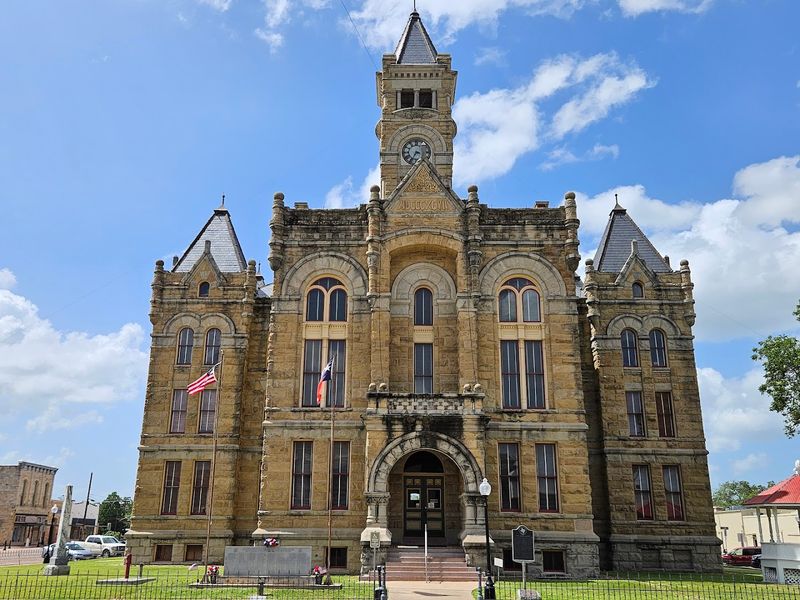
Hallettsville’s courthouse makes a statement with rusticated stone walls that look like they could withstand a siege. Built in 1897, this Romanesque Revival structure replaced an earlier courthouse that—you guessed it—burned down. The county invested in a fireproof building with thick stone walls, metal roof, and construction techniques designed to prevent the tragedy from repeating itself.
The corner tower rises asymmetrically, a design choice that creates visual interest and gives the building a castle-like appearance. Arched windows and doorways repeat throughout the facade, a hallmark of Romanesque architecture that architects loved during this era. The rough-cut stone exterior contrasts with smooth limestone trim around openings, creating texture and depth that flat walls could never achieve.
Lavaca County’s Czech heritage shows everywhere in Hallettsville, from kolache bakeries to polka music at local festivals. The courthouse has hosted generations of these families, witnessing their weddings, trials, property transactions, and the everyday interactions that bind a community together. Inside, original features mix with modern updates that keep the building functional for contemporary county operations.
The square surrounding the courthouse maintains its small-town atmosphere with local businesses that have served the community for decades. Hallettsville doesn’t chase tourists or try to become the next trendy Hill Country destination. It remains authentically itself—a working agricultural town where the courthouse serves its original purpose rather than existing primarily as a historic attraction.
That authenticity makes visiting more interesting than touring a preserved museum piece. You’ll see actual county business happening, locals stopping to chat on the courthouse lawn, and a building that’s genuinely central to community life. The architecture impresses, but the living, breathing function of this courthouse and its square tells a better story than any restoration project could.
Hallettsville proves that historic preservation works best when buildings continue serving their communities rather than becoming frozen relics of the past.
9. Caldwell County District Court — Lockhart
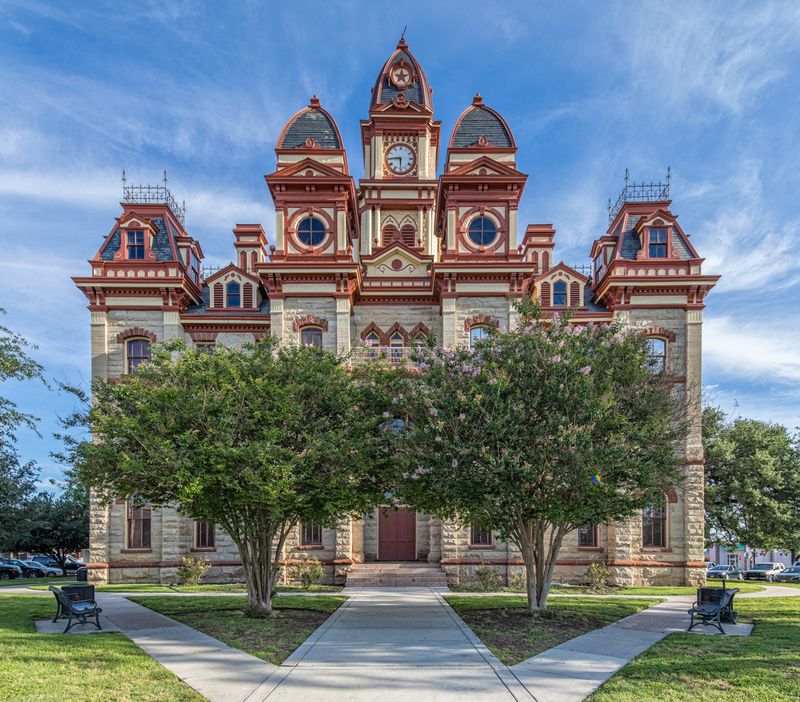
Known as the “Barbecue Capital of Texas,” Lockhart proudly embraces a title that carries serious weight in a state famous for smoked meat traditions. But before you dismiss it as small-town boasting, know that the courthouse square sits within blocks of multiple legendary barbecue joints that attract pilgrims from across the country. The 1894 courthouse has witnessed this culinary tradition evolve from local secret to international fame.
The building itself combines Romanesque and Classical Revival elements, creating a unique hybrid that reflects the transition between architectural styles happening during the 1890s. A central tower with clock faces dominates the composition, while arched openings and rusticated stonework add texture and visual interest. The county built this courthouse to last, using quality materials and craftsmanship that’s allowed it to serve for over a century.
Inside, the district courtroom maintains much of its original character, with wooden benches, high ceilings, and details that remind you justice has been dispensed here for generations. Caldwell County continues using the building for court proceedings, though some county offices have relocated to more modern facilities. This mixed use keeps the historic structure active and relevant rather than relegating it to museum status.
Lockhart’s square buzzes with activity, especially during lunch when barbecue pilgrims descend on the town. The courthouse provides an architectural anchor for a downtown that’s benefited from food tourism without losing its authentic small-town character. Local shops, the historic Caldwell County Jail Museum, and tree-shaded sidewalks create an environment that invites lingering after you’ve demolished a plate of brisket.
The building has appeared in several films, its period appearance and well-preserved square making it perfect for productions needing authentic Texas settings. That Hollywood attention hasn’t gone to Lockhart’s head—the town remains focused on barbecue, county business, and maintaining the community character that made it special in the first place.
Visit for the barbecue, but take time to appreciate the courthouse that’s anchored this square through boom times and struggles alike.
10. Atascosa County Courthouse (Jourdanton)
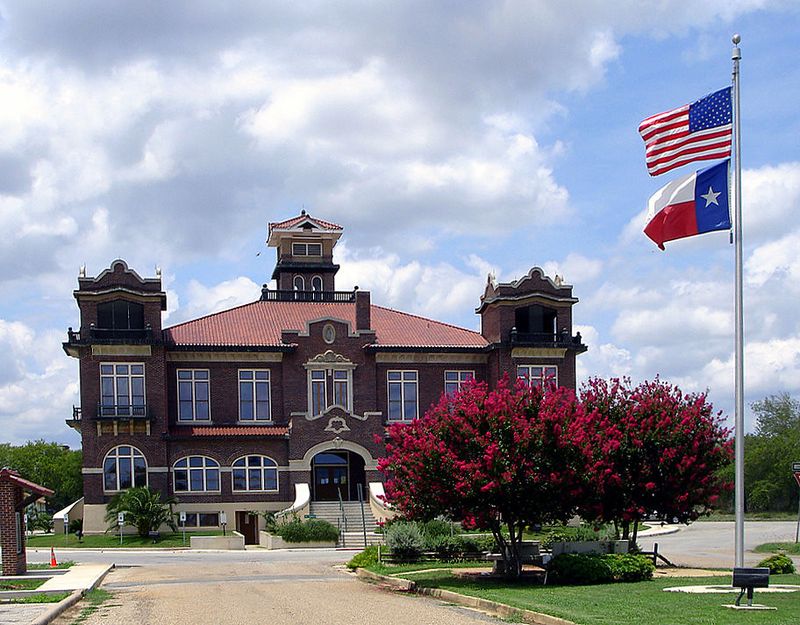
Built in 1912, Jourdanton’s courthouse stands apart from earlier Texas designs with its understated Classical Revival architecture, favoring balance and elegance over elaborate Victorian ornamentation. The building sits on the town square with a quiet dignity, its clean lines and symmetrical design reflecting early twentieth-century ideas about how modern government buildings should look.
Atascosa County remains deeply rural, its economy still tied to ranching and agriculture that have sustained this region for generations. The courthouse serves as a hub for a far-flung population spread across thousands of square miles of South Texas ranch country. Inside, county offices handle the business of a community where everybody might not know everybody, but connections run deep through family ties and shared history.
The building’s exterior features light-colored brick and minimal ornamentation, a practical choice for a county that couldn’t afford the elaborate stonework of wealthier regions. What it lacks in decorative flourishes, it makes up for in honest, straightforward design that’s aged well. The central entrance creates a focal point, while windows arranged in regular patterns maintain visual rhythm across the facades.
Jourdanton’s square serves a working town rather than a tourist destination. You won’t find boutique shops or trendy restaurants here—just essential businesses serving local residents and the ranchers who come to town for supplies and county business. That utilitarian character feels authentic in a state where many small-town squares have been gentrified beyond recognition.
The courthouse grounds feature monuments and memorials honoring veterans and local history, creating a civic space that acknowledges the sacrifices and achievements of previous generations. Old oak trees provide shade across the lawn, their spreading branches creating natural gathering spots during South Texas’s brutal summer heat.
This courthouse won’t make architectural magazine covers or attract crowds of tourists, but it perfectly serves the community it was built for, which might be the highest compliment any public building can earn.
11. Cass County Courthouse (Linden)
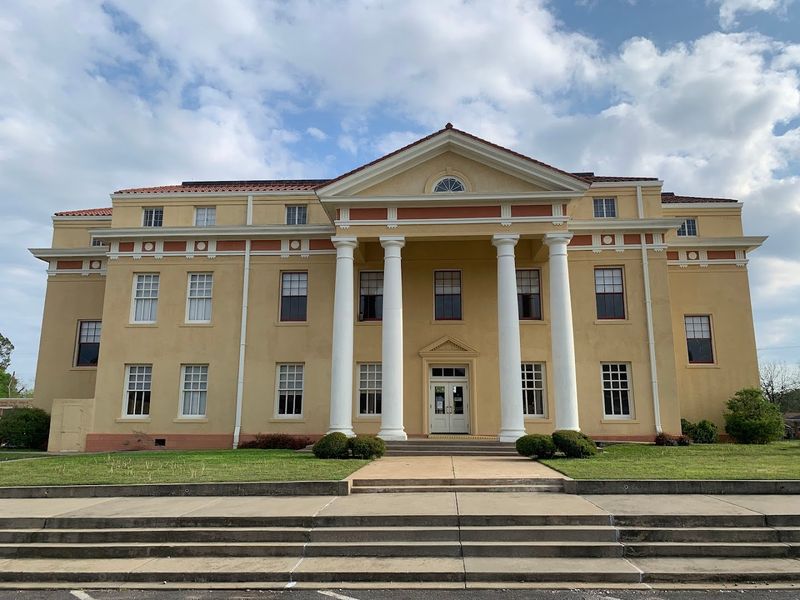
Way up in the Piney Woods where Texas starts feeling more like Louisiana, Linden’s courthouse presides over a square shaded by towering trees. The 1861 building—yes, it survived the Civil War—makes it one of the oldest continuously operating courthouses in Texas. That longevity alone makes it remarkable, but the building’s Greek Revival design and remarkable preservation make it truly special.
Massive white columns support the entrance portico, creating the kind of Southern courthouse look that appears in novels and films about small-town justice. The building’s brick walls have been painted white, enhancing the classical appearance and reflecting heat during East Texas summers that feel more oppressive than anywhere else in the state. The understated elegance speaks to a different era’s ideas about proportion, symmetry, and civic architecture.
Cass County’s location in the far northeastern corner of Texas gives it a distinct character from the rest of the state. The landscape here is all pine forests, red clay soil, and humidity that makes you understand why Southerners move slowly. Linden reflects that environment—a quiet town where the courthouse has witnessed over 160 years of county history, from Reconstruction through the civil rights era to today’s challenges.
Inside, the building has been carefully updated to meet modern needs while preserving historic character. The courtroom maintains its period appearance, and county offices occupy spaces that have served similar functions since before most Texas counties even existed. Walking these halls connects you to generations of Cass County residents who conducted their business in these same rooms.
The square around the courthouse stays quiet most days, with local businesses serving residents rather than tourists. Linden doesn’t see the visitor traffic that other historic courthouse towns attract, partly because of its remote location far from major highways. That isolation has helped preserve both the building and the town’s authentic character, untouched by the commercial pressures that have transformed more accessible communities.