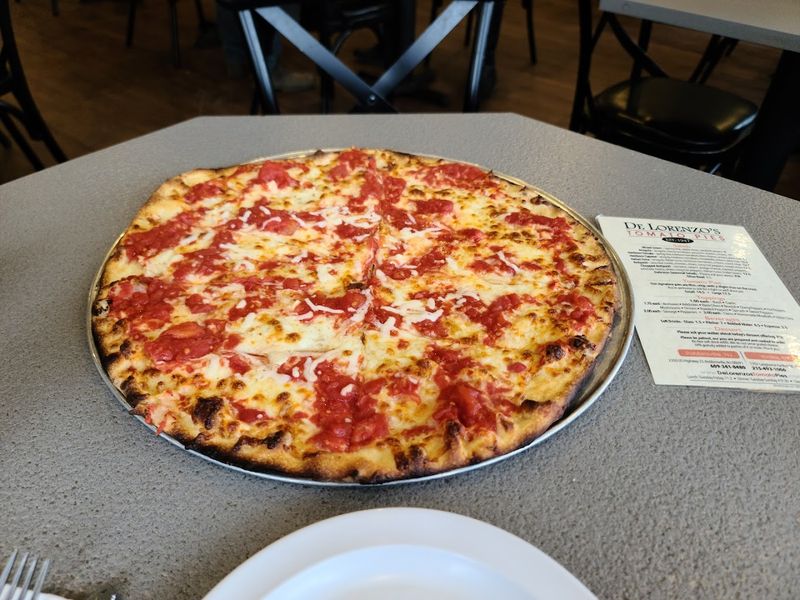
The pie hits the table looking a little backward, at least if you grew up on regular pizza. The tomatoes are right there on top, bright and bossy, instead of hiding under a blanket of cheese.
The crust is thin enough to crackle, dark enough around the edges to make you pause, and sturdy enough to remind you that this is not some floppy afterthought. That is the De Lorenzo’s Tomato Pies experience in Robbinsville, where a Route 33 dining room carries a story that started in Trenton’s Chambersburg neighborhood back in 1947.
Alexander “Chick” De Lorenzo opened the original shop on Hudson Street after his family had already helped shape the local tomato pie tradition, and the restaurant’s reputation has been traveling farther than its address ever since. It is old-school without trying too hard, which is exactly why it still works.
How De Lorenzo’s Became a New Jersey Tomato Pie Legend
A lot of famous food places talk about tradition, but De Lorenzo’s can actually put names, addresses, and decades behind the word. Alexander “Chick” De Lorenzo was one of twelve children born to Pasquale and Maria De Lorenzo, who came to the United States from Southern Italy in the early 1900s.
By 1936, the De Lorenzo family had opened one of the early tomato pie restaurants in Trenton’s Chambersburg section, a neighborhood that became famous for this very particular Central Jersey style. Chick later went out on his own, opening De Lorenzo’s Tomato Pies at 530 Hudson Street in 1947 with his wife, Sophie, working beside him.
That detail matters because the place never felt like a concept. It felt like a family business because it was one.
Chick and Sophie worked side by side for nearly 40 years, building the kind of reputation that does not need clever branding to survive. The pies did the talking.
The original Hudson Street location became a destination for people who understood that Trenton tomato pie was not just another word for pizza. It had its own rhythm, its own rules, and its own loyal crowd.
Later generations kept that reputation alive, including Chick’s daughter Eileen Amico, her husband Gary Amico, and grandson Sam Amico. The Robbinsville location opened in late 2007, giving the business a roomier home while the original Trenton restaurant continued for a few more years.
When the Hudson Street shop closed in early 2012, it marked the end of a beloved chapter, not the end of the story. De Lorenzo’s moved forward, but it did not wander away from what made people care in the first place.
Why Pizza Lovers Still Make the Trip to Robbinsville
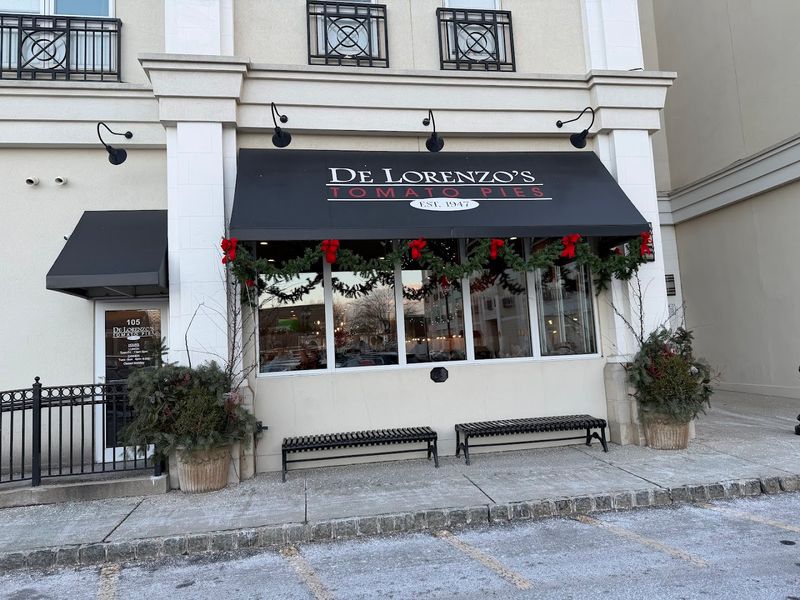
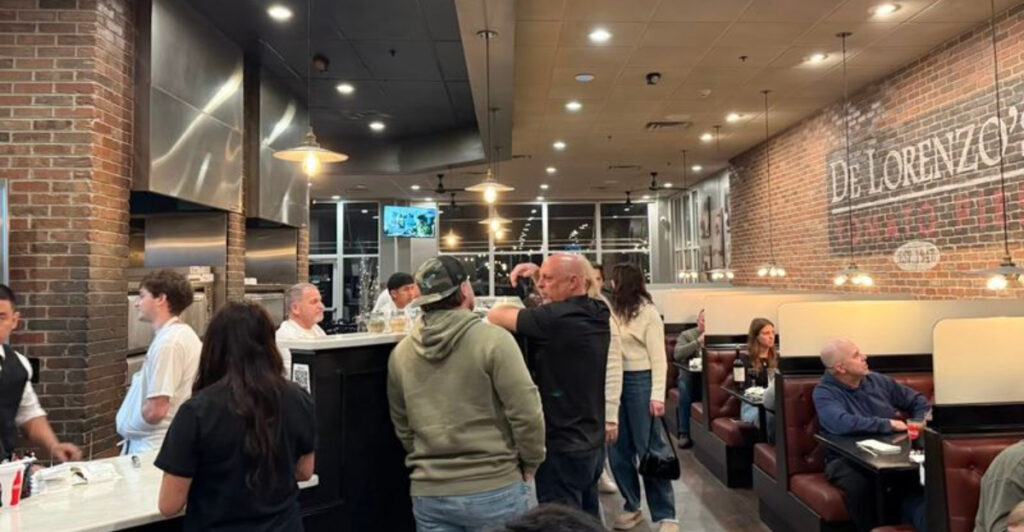
Robbinsville is not the kind of place where you accidentally stumble into a legendary tomato pie after turning down a cobblestone alley. De Lorenzo’s sits at 2350 NJ-33, in a practical Central Jersey location with a parking lot, a modern dining room, and the unmistakable feeling that half the room has been here before.
That is part of the charm. People do not go because the setting is dramatic.
They go because the pie has a reputation strong enough to pull them off their normal route. The official hours are lunch Tuesday through Friday from 11 a.m. to 2 p.m., dinner Tuesday through Sunday from 4 p.m. to 9 p.m., and closed Monday, which immediately tells you this is not an all-day slice counter where you grab whatever has been sitting under a heat lamp.
This is a sit-down, order-a-whole-pie, plan-your-evening-around-it kind of place. It also helps that Robbinsville has become serious tomato pie territory, with Papa’s Tomato Pies nearby and plenty of Central Jersey locals ready to debate their favorites with the intensity other people reserve for playoff sports.
De Lorenzo’s does not need to shout in that conversation. It has enough history to sit back and let the crust make its case.
From Trenton, it is only a short drive. From Princeton or Hamilton, it is an easy dinner run.
From farther out, it becomes something closer to a pizza pilgrimage, though locals would probably roll their eyes at that word and just call it a good decision. The trip feels worth it because the restaurant has managed the rare trick of becoming more convenient without becoming watered down.
The room is newer than Hudson Street ever was, but the tomato pie still tastes like it came from a place with memory.
What Makes a Trenton Tomato Pie Different From a Regular Slice
The easiest way to understand a Trenton tomato pie is to stop expecting it to behave like a standard pizza. In a typical pizza setup, sauce usually goes down first, then cheese, then toppings.
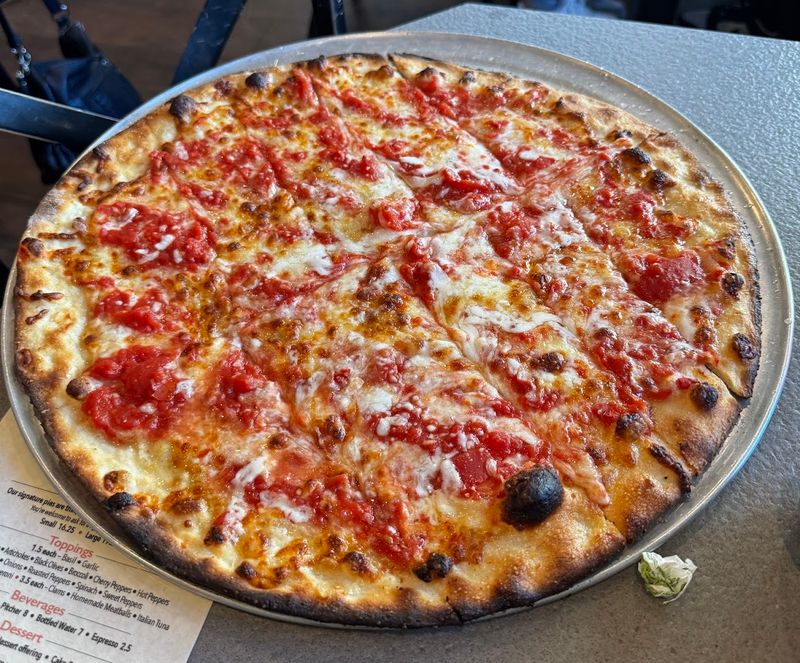
With Trenton tomato pie, that order gets flipped around. Cheese and toppings often go directly on the dough, and the tomatoes are added on top, giving the finished pie a brighter, more tomato-forward bite.
It sounds like a small adjustment until the first slice proves otherwise. At De Lorenzo’s, the tomatoes are not buried or blended into the background.
They sit right where you can see them, adding little bursts of sweetness and acidity that cut through the cheese instead of disappearing under it. The pie looks more rustic than a standard slice, with red patches across the surface rather than one smooth layer hidden beneath melted mozzarella.
That unevenness is part of the pleasure. One bite might lean more tomato, the next might give you more cheese, and the next might be all crisp edge and char.
People who grew up on big boardwalk slices or foldable North Jersey pizza sometimes need a minute to adjust, but that is exactly what makes the style memorable. It is thinner, sharper, and less heavy than many classic pizzas, but it is not delicate in a fussy way.
A good tomato pie still feels like proper comfort food. It just has better balance.
The style also carries a strong sense of place. New Jersey has plenty of excellent pizza towns, but Trenton tomato pie has its own accent, and De Lorenzo’s speaks it fluently. That is why calling it “just pizza” feels a little lazy. It is pizza, sure, but with local grammar.
The Thin Charred Crust That Keeps People Coming Back
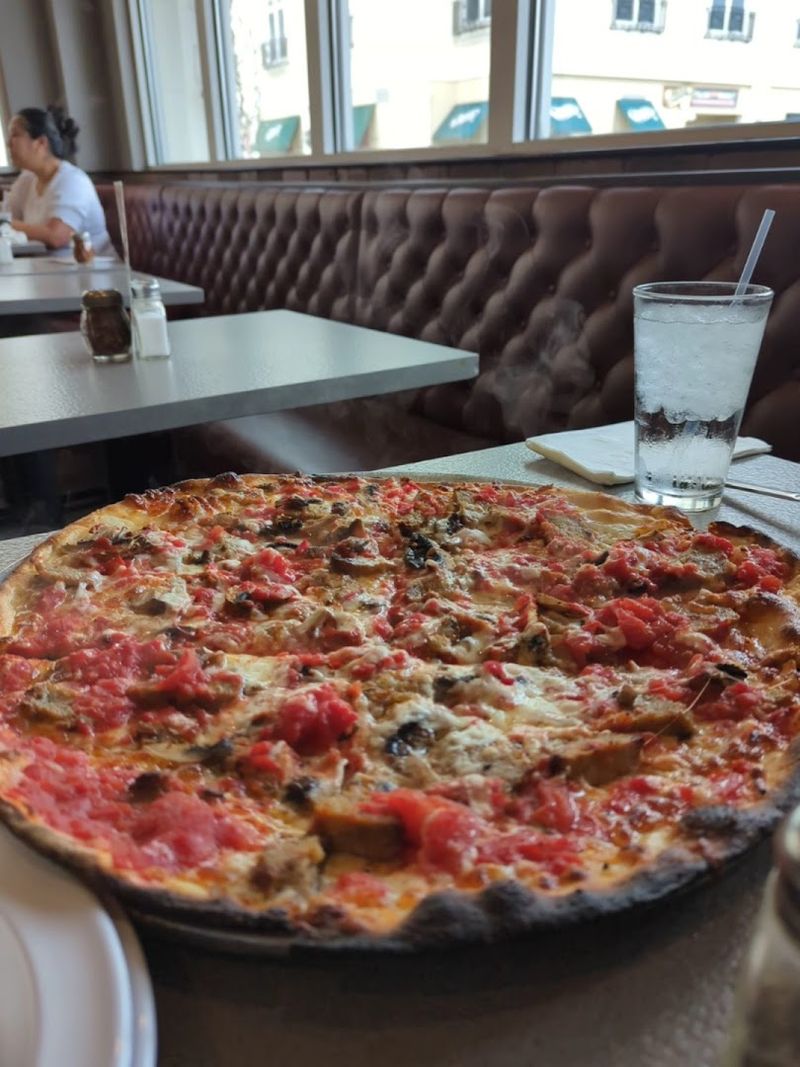
Before anyone argues toppings, sauce, or cheese, they should talk about the crust. De Lorenzo’s is known for a thin crust that comes out crisp, blistered, and dark in the right places, the kind of crust that makes a soft, doughy pizza feel like it forgot to finish the job.
The char is not there by accident, and it is not something to politely ignore. It is one of the reasons the pie has personality.
Those darker spots bring a slightly bitter, toasted edge that plays against the brightness of the tomatoes and the richness of the cheese. Without that contrast, the whole thing would be flatter and less interesting.
The structure matters, too. A tomato pie this simple cannot hide behind towers of toppings or novelty sauces.
If the crust is weak, you know immediately. De Lorenzo’s crust gives the pie backbone while still staying thin enough to feel nimble.
The best slices have a little crackle when you bite in, followed by just enough chew to remind you this is still handmade food, not a cracker with sauce on it. The center is more delicate, especially where the tomatoes settle in, but the outer edge brings the payoff.
That is usually the part people save for last without admitting they are saving it. Add pepperoni and the pie gets saltier and richer.
Add sausage and it becomes more filling. Go with basil and the tomato flavor feels even brighter.
But the plain pie may be the most honest test, because there is nowhere for the fundamentals to hide. At De Lorenzo’s, plain does not mean basic.
It means dough, tomatoes, cheese, heat, and timing all have to show up at once. That is harder than it looks, which is why so many places do not pull it off.
A Simple Menu That Knows Exactly What It Does Best
There is a quiet confidence in a restaurant that does not try to be everything. De Lorenzo’s is not the place handing you a menu packed with barbecue chicken pizza, loaded fries, truffle oil experiments, and a burger that seems to have wandered in from another business.
The focus stays where it belongs: tomato pies, supported by a handful of salads, antipasti, and classic toppings that actually make sense with the style.
The restaurant’s offerings include familiar pie options such as plain, basil, spinach and garlic, peppers and onions, meatball, sausage, clam, mushroom, and pepperoni, which is exactly the kind of lineup you want from a place that has been doing this since 1947.
The restraint is refreshing because it keeps dinner from turning into homework. You are not sorting through twelve categories and wondering whether the kitchen is better at pizza or marketing.
You are deciding what kind of tomato pie mood you are in. The salads are not just filler either.
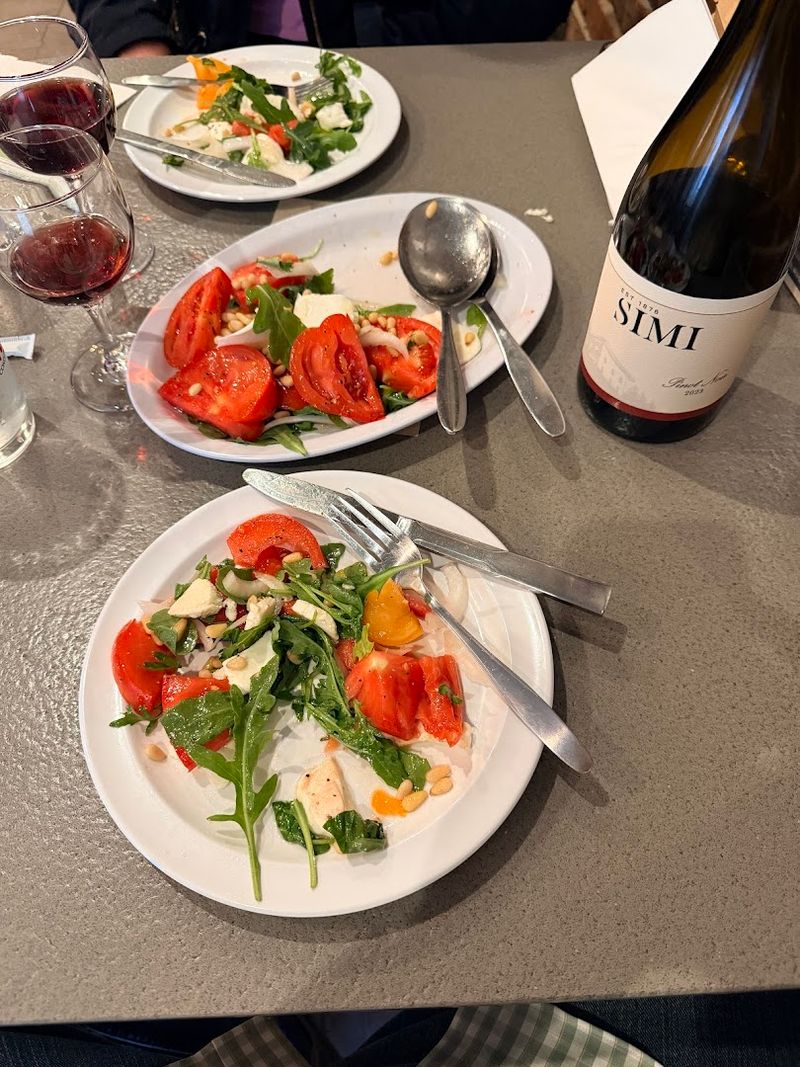
Options like arugula with cherry tomatoes, Pecorino, and onions, or a tomato salad with heirloom tomatoes, bleu cheese, onions, and pine nuts, make sense next to a thin, charred pie because they bring freshness, salt, and crunch without trying to steal attention.
The chopped antipasto goes bigger, with ingredients like salami, Asiago, roasted peppers, artichoke hearts, olives, long hot peppers, Italian tuna, and butter beans, which feels very much in tune with the Central Jersey Italian-American table.
The best order is usually the simplest: one salad, a couple of pies, and enough people at the table to justify trying more than one topping. A plain pie lets you understand the house style.
A sausage or pepperoni pie gives you something richer. A basil or garlic pie keeps things sharp and fragrant.
The menu knows its lane, and that is a beautiful thing.
Why the Wait Is Part of the De Lorenzo’s Experience
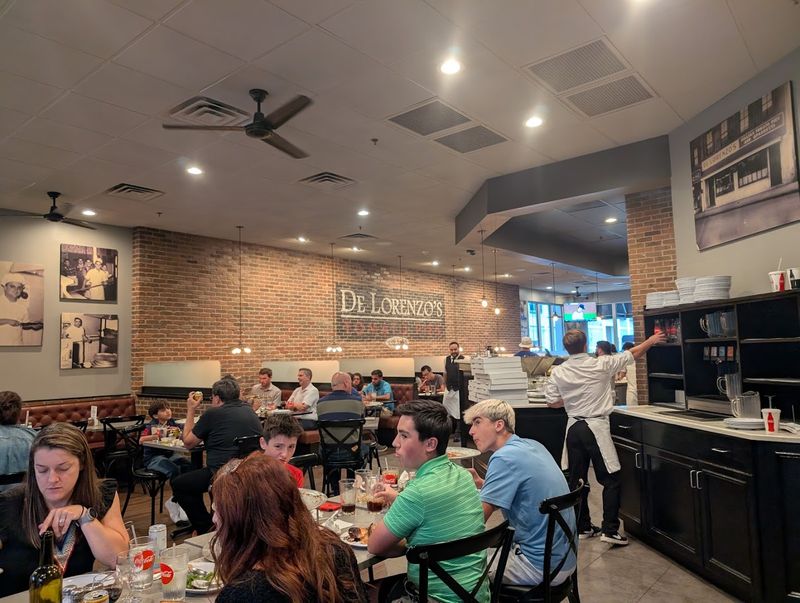
On a busy night, De Lorenzo’s does not move with the frantic speed of a chain built to get you in and out before you remember where you are. It has its own tempo.
Dinner begins at 4 p.m., the dining room fills, and the whole place starts to feel like a small Central Jersey ritual: people settling in, menus barely needed, conversations pausing whenever a fresh pie passes too close to the table. The wait is not some manufactured exclusivity trick.
It comes from the simple fact that a well-known restaurant with a loyal following can only make so many tomato pies at once. That said, the waiting often improves the meal in a strange way.
You get time to smell the crust coming out of the oven. You see someone else’s pie land and immediately start second-guessing your order.
You overhear a table debating clam pie or garlic. You watch a server carry a tomato-bright pie across the room and suddenly understand why regulars do not treat this like ordinary pizza night.
The Robbinsville location is more comfortable and convenient than the old Hudson Street shop, and the restaurant has modern touches like online ordering, but the essential experience still feels pleasantly analog. You sit down.
You order. You wait. Then the pie arrives, thin and charred, with tomatoes on top and history underneath. That is the part no newer dining room can fake.
De Lorenzo’s has lasted because it is not just old, and it is not just famous. Plenty of restaurants have a long story and not much else.
This one keeps giving people a reason to care, one crisp-edged tomato pie at a time.