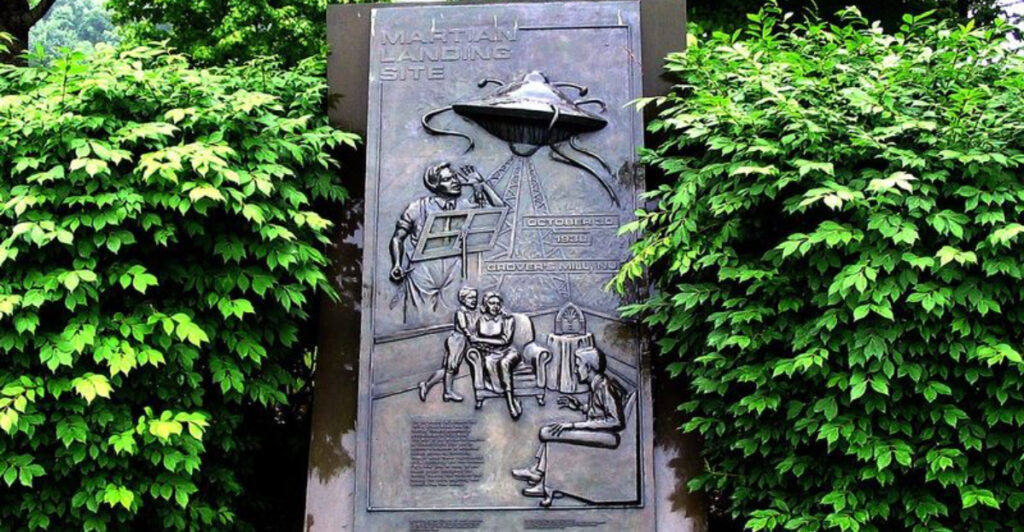
A bronze monument sits near a quiet pond in West Windsor, honoring an invasion that never happened. No crater. No scorch marks. No little green footprints in the mud.
Just Grovers Mill Pond, some trees, a playground nearby, and one of the strangest claims to fame in all of New Jersey: this is the place where radio listeners once believed Martians had landed.
The story begins on Mischief Night in 1938, when Orson Welles and his Mercury Theatre on the Air turned H. G. Wells’ The War of the Worlds into a fake breaking-news broadcast.
The “meteor” came down in Grovers Mill, a real hamlet in Mercer County, and suddenly a sleepy farming community was cast as ground zero for an alien attack. Today, the panic is part fact, part myth, and part proudly preserved Jersey weirdness.
The best part is that you can still visit the pond, the memorial, and the tiny place that accidentally scared a nation.
How a quiet Grovers Mill pond became America’s most famous fake alien landing site
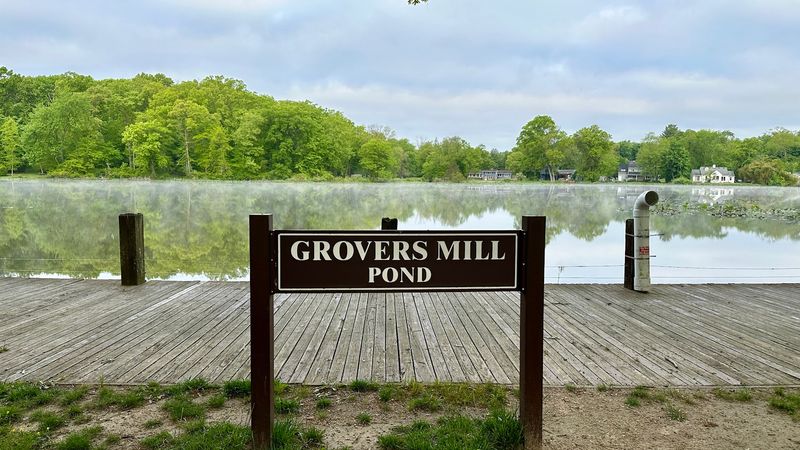
Stand beside Grovers Mill Pond today and the whole thing feels wonderfully unlikely. Ducks move across the water.
Kids climb on the playground at Van Nest Park. Cars pass along Cranbury Road without any particular urgency.
Nothing about the scene screams “interplanetary crisis,” which is exactly what makes it so good. Grovers Mill is not a city, and it was even less of one in 1938.
It is an unincorporated community in West Windsor Township, centered around Cranbury Road and Clarksville Road, about four miles southeast of Princeton. Before it became tied forever to Martians, it was tied to a mill.
The community grew around a saw and grist mill that stood by Bear Brook, and the pond itself traces back to the old damming of that waterway. In other words, this was practical New Jersey countryside before it became legendary New Jersey oddity.
That quiet mattered. When the radio drama needed an American landing site, Grovers Mill sounded believable because it was ordinary.
It had farms, roads, fields, and a name that felt specific enough to be real but unfamiliar enough to feel alarming. The fictional broadcast described the action at “Wilmuth farm,” placing the first Martian cylinder in this corner of Mercer County.
The pond became the landmark people could actually find afterward. The “landing” was fictional, but the place was not.
That is why Grovers Mill has the rare distinction of being both completely innocent and strangely famous. It did nothing except sit there on a New Jersey map, and for that, it became America’s most memorable fake alien landing site.
The radio broadcast that made New Jersey believe Martians were on the move
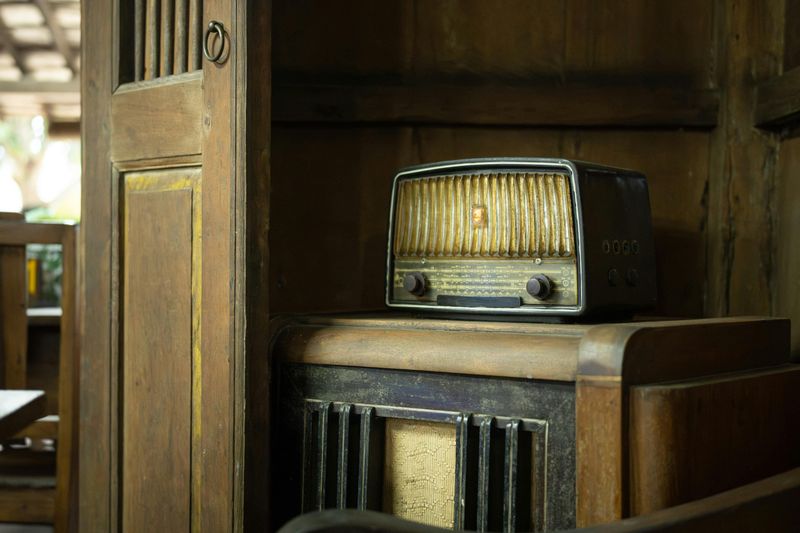
At 8 p.m. on Sunday, October 30, 1938, CBS aired a one-hour Halloween-season episode of The Mercury Theatre on the Air. Orson Welles was only 23 years old, but he already knew how to make drama feel dangerously immediate.
Instead of presenting The War of the Worlds like a standard play, the production disguised much of it as live radio coverage. That was the hook.
Listeners heard music from the fictional Ramón Raquello and his Orchestra, then sudden interruptions. A bulletin reported strange explosions on Mars.
A supposed Princeton astronomer was interviewed. More dance music returned, then more news broke in.
Soon the story moved to Grovers Mill, where a “meteor” had landed. Then it was not a meteor at all. It was a cylinder. Then the cylinder opened.
The broadcast used the language of radio news at a time when radio news carried real weight. Families were used to hearing major updates break into entertainment programming.
Europe was tense. The Great Depression was still in living memory.
Franklin D. Roosevelt’s fireside chats had made radio feel personal and authoritative.
So when a polished voice described emergency scenes in New Jersey, some listeners treated it less like theater and more like a national warning. The production also had timing on its side.
Some people missed the opening announcement that identified the show as fiction. Others may have tuned in late after listening to more popular Sunday-night programming.
Dropping into the middle of the broadcast was like walking into a movie theater during the disaster scene and not realizing there had been a title card. No Martians were moving through Mercer County that night.
But for a little while, radio made it sound as if New Jersey had become the front line of Earth’s worst evening.
Why Orson Welles chose a tiny Mercer County community for the invasion
Here’s the funny part: Grovers Mill did not win this role through fame, strategy, or any obvious dramatic value. The place was chosen because writer Howard Koch needed a landing site and, according to local history, dropped a pencil point onto a New Jersey road map.
It landed on Grovers Mill. Koch liked the sound of the name and its closeness to Princeton, which helped the script build in references to astronomers and scientific authority.
That tiny bit of chance changed the town’s afterlife. Had the pencil landed a few inches away on the map, maybe another Mercer County community would be answering Martian questions every October.
Instead, Grovers Mill got the bronze monument, the oddball fame, and the permanent association with one of broadcasting’s wildest nights. The choice worked because Grovers Mill was believable.
In 1938, West Windsor Township was still largely agricultural, with a population of around 2,000. Farmland stretched through the area, and the local rhythm was much more rural than suburban.
A meteor crashing into a farm field there sounded just plausible enough for a radio play. It was close enough to Princeton to connect to the observatory angle, yet quiet enough to feel exposed and eerie.
Welles gets most of the public credit because his voice and showmanship drove the production, but the map-point detail belongs to the mechanics of writing. Koch took an English science-fiction invasion and made it feel American, local, and immediate.
The original H. G. Wells novel had its own geography. The 1938 version needed roads, towns, farms, and institutions that listeners could picture.
Grovers Mill gave the story a pin on the map. Once a fake news bulletin has a real place attached to it, the imagination does the rest.
The panic was real but the legend may be bigger than the truth
Yes, some people were scared. That part is not just local bragging. Police stations and newspapers received calls. CBS had explaining to do.
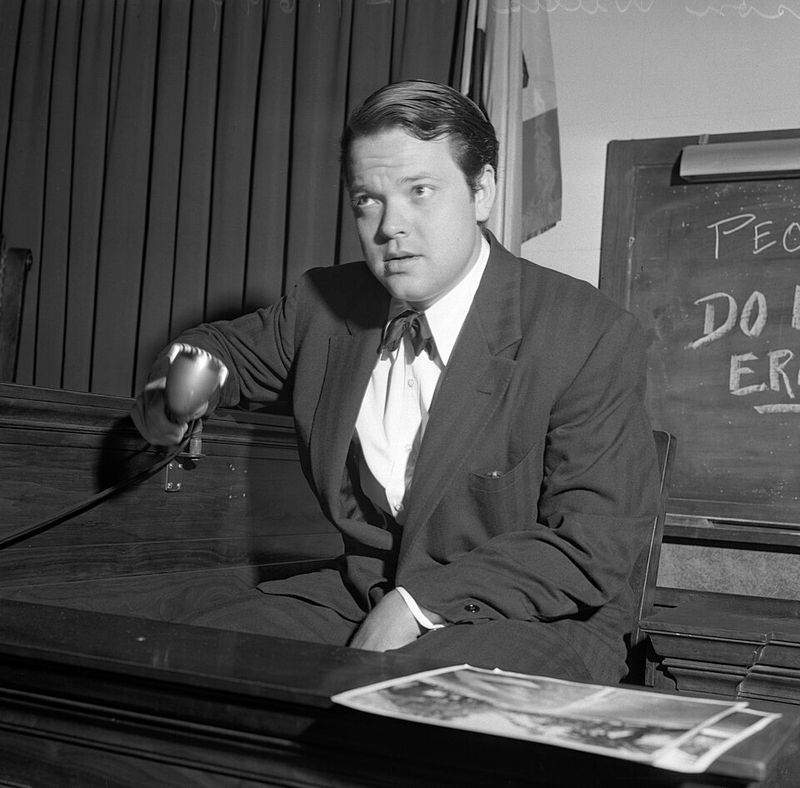
Welles faced reporters afterward. The broadcast became a national story almost immediately, and the phrase “War of the Worlds panic” never really left American culture.
But the version many of us inherited, with half the country running into the streets and preparing for death rays, is probably too large. The panic happened, but the legend grew faster than the Martians.
Newspapers had every reason to make radio look reckless and powerful. Radio was becoming a serious competitor for attention and advertising, and here was a perfect chance to frame it as dangerous. “People were confused and frightened” became, over time, “the nation went completely out of its mind.”
The truth sits somewhere more interesting. Some listeners absolutely believed they were hearing real reports. Others were unsettled but not convinced.
Many never heard the broadcast at all. Some knew it was a play and enjoyed the trick.
Later studies tried to measure the fear, but even those numbers have been debated because fear, confusion, embarrassment, and newspaper retellings all got mixed together after the fact. That is what makes the Grovers Mill story feel so modern.
It is not only about aliens. It is about media, trust, timing, and how quickly a dramatic story can harden into accepted memory.
A fake invasion became a real headline. Then the headline became folklore. Then the folklore became a monument. Grovers Mill did not need actual Martians to become famous. It only needed enough people to wonder, for one chilly October night, whether the impossible had chosen New Jersey first.
The strange local stories that kept the Martian myth alive
Every good New Jersey legend picks up a few barnacles, and Grovers Mill has one of the best: the water tower. Local lore says that during the panic, someone mistook a nearby water tower for a Martian war machine and fired at it.
The usual version involves a nervous local with a shotgun, a dark night, and a silhouette that looked just alien enough if you had been listening to terrifying radio bulletins. It is a perfect story, which is also a warning sign.
The water tower tale has been repeated for decades, but it is not exactly nailed down as fact. One real local, William Dock, was photographed with a shotgun after the broadcast, which certainly helped the image stick.
Whether anyone actually blasted away at the tower is murkier. Still, the legend survives because it fits the mood so neatly.
If a fake Martian invasion was going to produce one unforgettable New Jersey detail, of course it would involve someone eyeing a water tower suspiciously. The tower itself has become part of the scavenger-hunt side of Grovers Mill.
It is near the old mill area around Cranbury and Clarksville roads, though it is not something visitors should treat like a public attraction. Much of what people try to glimpse is on or near private property, and trees can make it hard to see anyway.
The smarter move is to appreciate the story without wandering where you should not. That is the charm of Grovers Mill’s Martian mythology.
Some pieces are documented. Some are exaggerated. Some are probably just too fun to surrender. The town has managed to hold all of it at once without taking itself too seriously.
The result is not a polished roadside spectacle. It is quieter and weirder than that. A pond, a marker, an old farming crossroads, and a story that still sounds half-impossible even when you know exactly how it happened.
Where to find the Grovers Mill memorial today
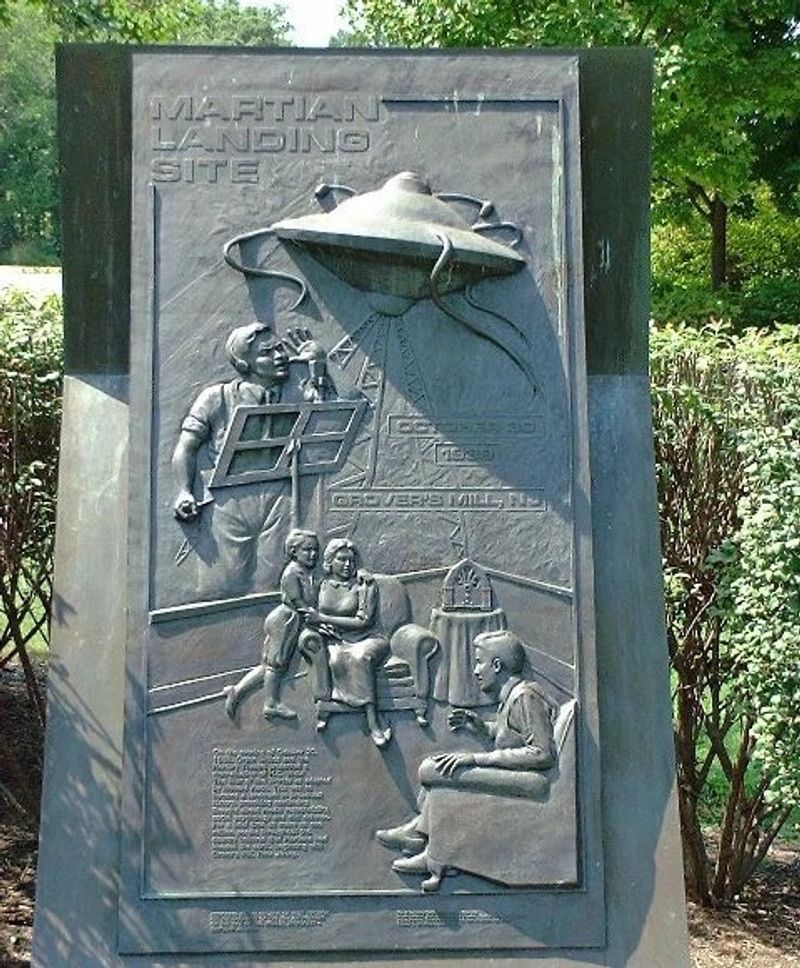
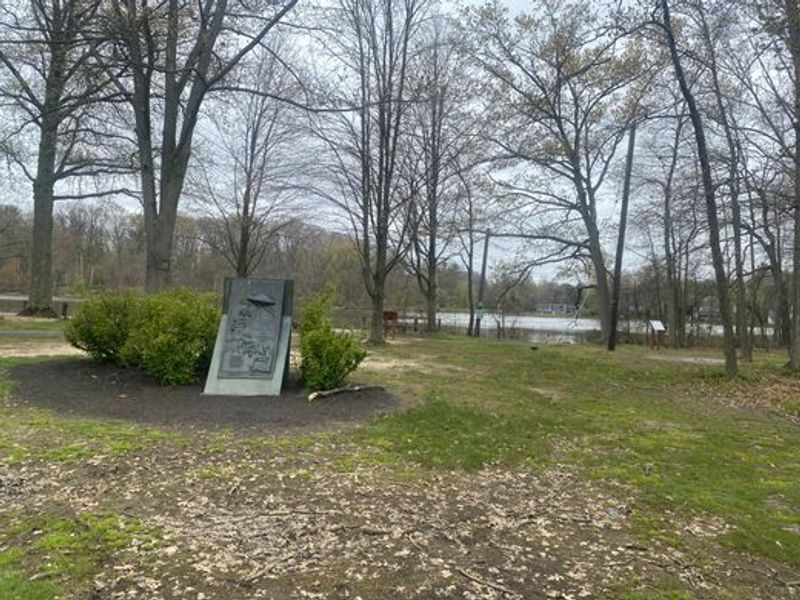
The monument sits in Van Nest Park at 218 Cranbury Road in West Windsor Township, near Grovers Mill Pond and just east of Clarksville Road. It is easy to miss if you are expecting something enormous.
This is not a neon alien museum or a giant saucer on a pole. It is a thoughtful bronze memorial in a local park, which somehow feels more appropriate for a fake invasion that landed in a real farming hamlet.
West Windsor commissioned the memorial for the 50th anniversary of the 1938 broadcast. The bronze monument includes imagery tied to the fictional invasion and stands near interpretive signs that explain why this quiet spot has such an outsized place in radio history.
You can visit without buying a ticket, and the surrounding park is the kind of place where people are just as likely to be fishing, pushing a stroller, or sitting at a picnic table as they are hunting for Martian trivia. Van Nest Park has practical features too: picnic areas, grills, bike racks, playground equipment, open space, a dock, and a boat launch.
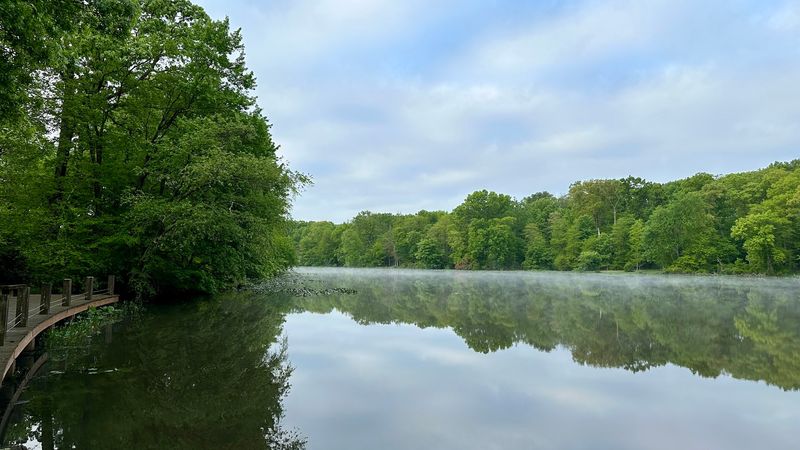
The township also restored Grovers Mill Pond in 2009, removing decades of built-up silt, improving the depth to about six or seven feet, adding artificial habitat structures, and stocking fish. That gives the place a life beyond the legend, which is nice.
The pond is not frozen in 1938. It is still a neighborhood park pond, doing ordinary pond things.
The visit works best if you slow down. Read the marker.
Look over the water. Picture a 1930s family huddled around a radio, hearing urgent reports from a place most of America had never heard of five minutes earlier.
Then look around again at the calm little park in front of you. That contrast is the whole story: one quiet New Jersey pond, one unforgettable broadcast, and a Martian landing that never happened but never quite went away.