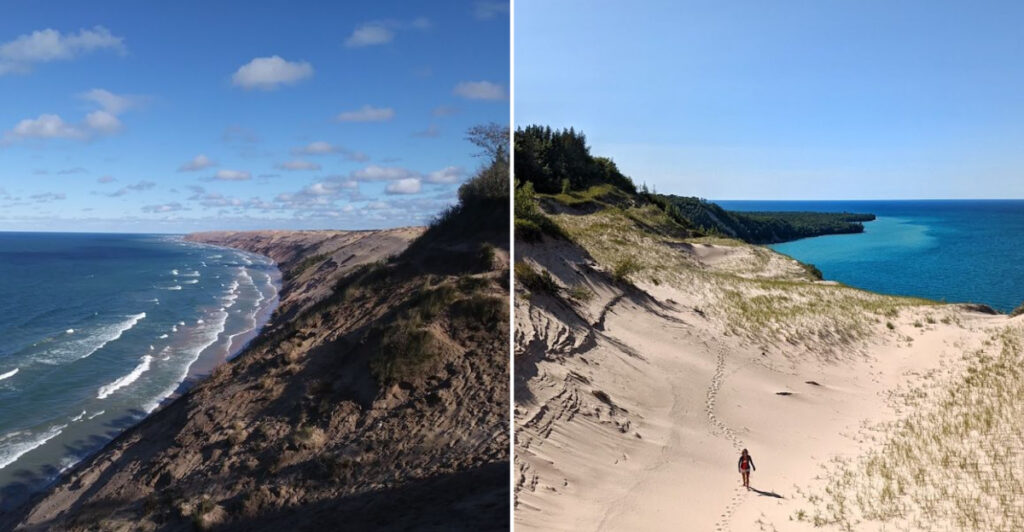
Lake Superior has plenty of dramatic viewpoints, but Log Slide Overlook adds a little adrenaline to the scenery. Along Highway 58 near Grand Marais inside Pictured Rocks National Lakeshore, this Upper Peninsula stop looks out from the top of a massive sand dune that drops nearly 300 feet toward the cold blue sweep of the lake.
The name comes from the site’s logging past, when timber was sent sliding down a wooden chute toward the water below. Today, the old industry has given way to pure awe, with wide-open views, wind-carved sand, and a downhill slope that tempts daring visitors before reminding them the climb back up is no joke.
If you want a Michigan ov
The View That Stops You Cold
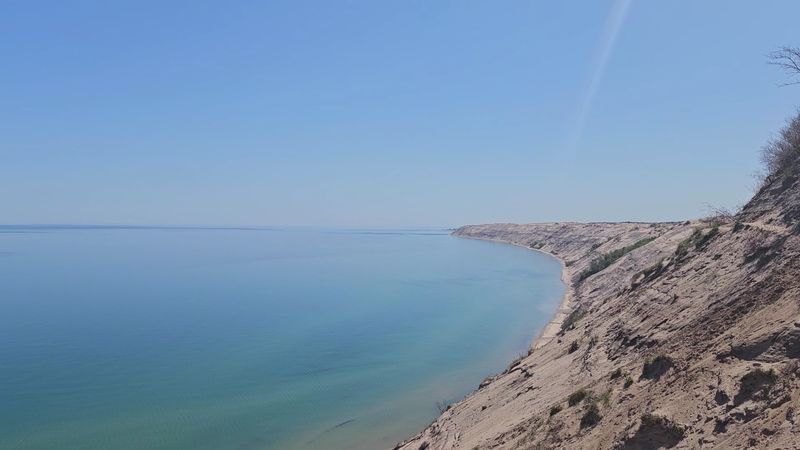
Nothing quite prepares you for the moment the tree line breaks open and Lake Superior fills your entire field of vision. The dune falls away so sharply beneath your feet that the first instinct is to take a step back.
From this height, the water stretches out in shades of deep navy and aquamarine, almost too blue to look real against the pale sand below.
On a clear day, the Au Sable Light Station is visible in the distance, a small white tower perched along the shoreline several miles to the west. The lighthouse doesn’t dominate the scene — it just punctuates it, reminding you how vast and remote this stretch of Lake Superior coastline truly is.
Scan further along the shore and the beach curves away until it disappears, framed by dense forest on one side and open water on the other.
The overlook itself sits at the top of the Grand Sable Dunes, one of the largest perched dune systems in the world. Perched dunes form when sand accumulates on top of glacial bluffs rather than at sea level, which is why the drop here feels so extreme.
The elevation creates a natural wind tunnel effect, and even on warm summer days, a steady breeze rolls in off the lake. Bring a light jacket regardless of the forecast.
The viewing area offers multiple vantage points — a short spur trail to the right of the main overlook provides a slightly different angle and a cleaner sightline toward the lighthouse. Early morning light hits the dune face at a low angle, casting long shadows across the sand and turning the whole scene into something that looks almost sculpted.
Plan to spend more time here than you think you will.
A Short Walk With a Surprisingly Rich Story
The trail from the parking lot to the overlook covers just about 350 feet — a distance most people can cover in a few minutes without breaking a sweat. But the path is lined with interpretive signs and displays of old logging equipment that make it worth slowing down.
Cast iron machinery, rusted pulleys, and heavy iron hardware sit along the walkway like an open-air museum, each piece a relic from the late 1800s when this dune was an industrial workhorse.
Back then, logging crews used a long wooden chute — the log slide — to send freshly cut timber down the steep dune face and into Lake Superior. From there, the logs were bundled into rafts and floated to sawmills.
It was fast, efficient, and brutally dangerous work. The chute stretched hundreds of feet down the dune, and logs picked up enough speed that they reportedly skipped across the water’s surface before finally sinking.
Workers had to time their movements carefully to avoid being crushed.
The interpretive panels along the trail explain this history with enough detail to make the landscape feel layered with meaning. Standing at the top of the dune with that context in mind changes the experience entirely.
You stop seeing just a dramatic sand hill and start seeing the shape of an industry that once defined this corner of Michigan’s Upper Peninsula. A few benches are placed along the trail for anyone who wants to pause and read without rushing.
The final stretch to the overlook climbs through loose sand, so sturdy footwear makes a real difference. Flip-flops work going down — they do not work coming back up.
That last sandy push to the top is short but steep, and arriving breathless only adds to the payoff waiting at the edge.
Sliding Down Is the Easy Part
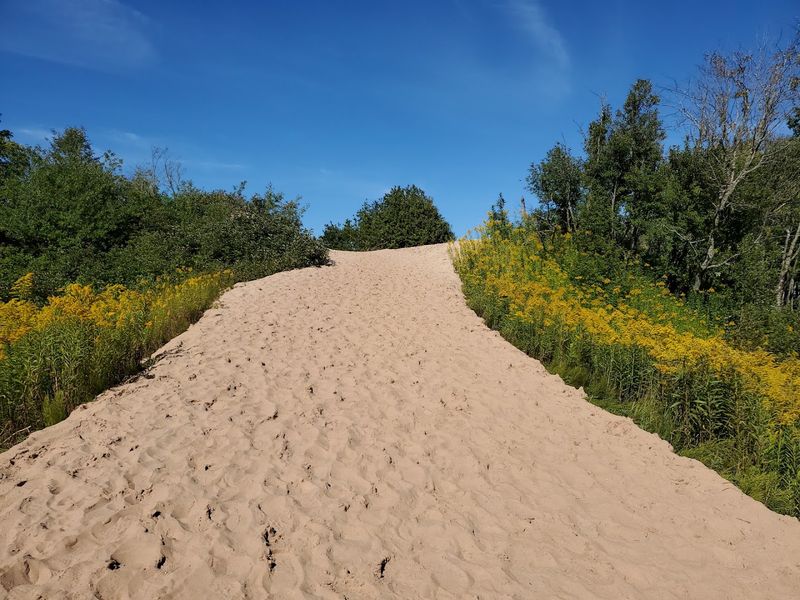
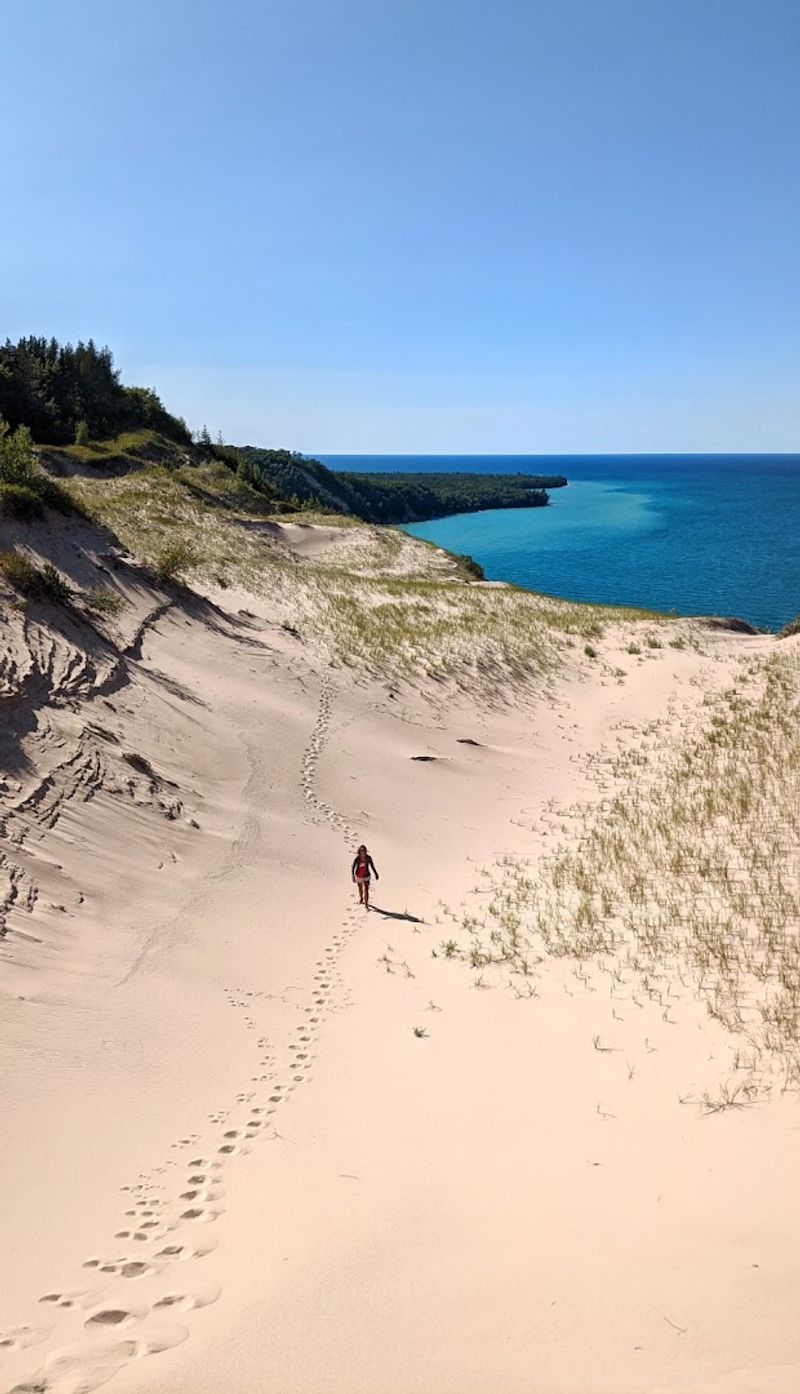
Dropping down the dune face is one of those experiences that feels like a dare you talk yourself into. The slope is steep enough that once you commit to it, gravity does most of the work.
Sand gives way underfoot with every step, and within seconds the overlook platform is already far above. The descent to the waterline covers close to 300 vertical feet and the angle rarely lets up.
Reaching the bottom rewards you with direct access to Lake Superior’s shoreline — a stretch of beach that most visitors never touch because getting there requires coming down the dune. The water is bracingly cold even in August, and the beach feels genuinely remote.
Looking back up at the dune from the bottom is a completely different kind of awe. The sand wall towers above, and the people standing at the overlook look impossibly small.
The climb back up is the reality check. Every step forward slides you back a half-step, and the loose sand offers almost nothing solid to push against.
Legs burn quickly. Breathing gets heavy fast.
Hikers who make the round trip describe it as a serious workout packed into a short distance. A posted sign at the top warns visitors plainly about the difficulty of the return climb, and that warning is genuine — not a formality.
Bring water, and plan for the ascent to take two to three times longer than the descent. Some visitors make it halfway down, reassess, and turn back.
That is a perfectly reasonable call. The view from the top is spectacular on its own, and no one has to earn it by sliding down.
For those who do make the full trip, the beach at the bottom offers a quiet reward before the hard work begins.
Michigan’s Upper Peninsula Sets the Stage
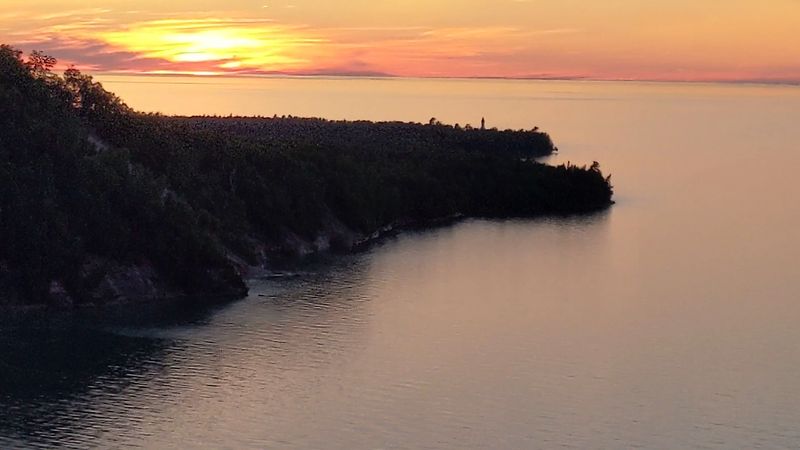
Log Slide Overlook sits near the eastern edge of Pictured Rocks National Lakeshore, roughly 12 miles west of Grand Marais along Highway 58. The drive in from Grand Marais already sets expectations — the road narrows, the forest thickens, and the landscape starts to feel increasingly wild.
By the time you reach the parking lot, the sense of being somewhere genuinely remote is already working on you.
The Upper Peninsula of Michigan is a different world from the rest of the state. Cell service fades in and out.
Towns are small and far apart. The scale of the natural features — the dunes, the lake, the forest — dwarfs everything man-made in the region.
Grand Sable Dunes, which form the backdrop of the overlook, stretch for nearly five miles along the lakeshore and rise up to 300 feet above the water. They are among the largest freshwater coastal dunes on the planet, shaped by glacial deposits left behind roughly 10,000 years ago.
Lake Superior itself is the largest of the Great Lakes by surface area, and from the overlook its size is not just visible — it is felt. There is no opposite shoreline to anchor your gaze.
The water simply continues until it meets the horizon, and on overcast days the line between lake and sky blurs completely. The combination of the dunes, the forest, the lake, and the remoteness makes this corner of Michigan feel like somewhere much farther away than it actually is.
Pictured Rocks draws visitors primarily for its painted cliffs and sea caves, but Log Slide Overlook offers a completely different perspective — high, open, and exposed in a way that the boat tours and kayak routes simply cannot replicate.
Timing Your Visit for Maximum Payoff
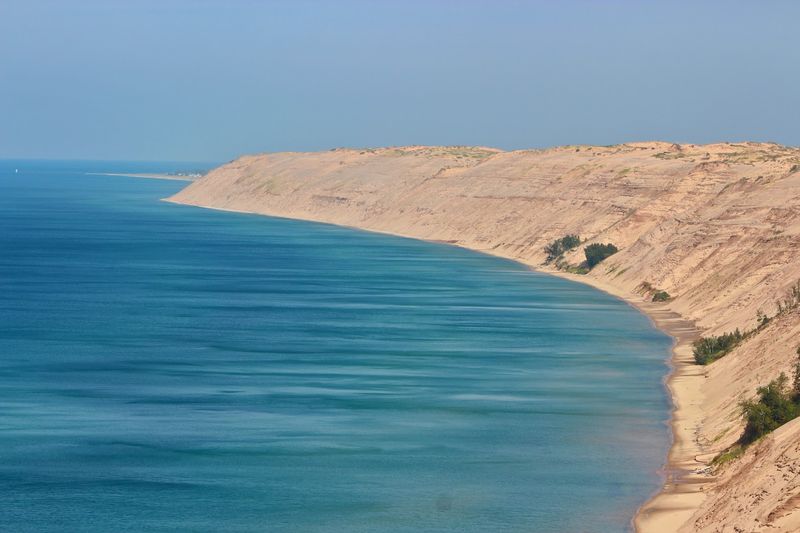
Log Slide Overlook opens at 6 AM every day of the week, and that opening hour is worth taking seriously. Early morning visits offer something the midday crowd rarely gets — stillness.
The parking lot is nearly empty, the trail is quiet, and the light on the dune face shifts from deep orange to pale gold as the sun climbs. Lake Superior holds onto early morning mist longer than you’d expect, and watching it burn off the water from 300 feet above is a genuinely rare sight.
Weekday mornings in late spring or early fall tend to be the least crowded windows. Summer weekends bring a steady flow of visitors, and while the parking lot is reasonably sized, it can fill up during peak afternoon hours.
Wednesday is the one day with extended hours — the overlook stays open until 8 PM rather than the standard 6 PM closing — which creates an opportunity for a late evening visit when the crowds have thinned and the light is warm again.
A National Park pass or Pictured Rocks entry fee is required for access, so having that sorted before arriving saves time at the gate. Weekly passes can be purchased in advance and printed at home.
Fall is arguably the most visually dramatic season here — the forest surrounding the dunes shifts to deep reds and oranges, the lake turns a darker, more intense blue, and the angle of the sun creates longer shadows across the sand. Snow visits in winter are technically possible but require checking road conditions on Highway 58 carefully, as the route is not always reliably plowed.
For most visitors, the sweet spot runs from mid-May through early October, with late August and September offering the best balance of warmth, color, and manageable crowds.
Practical Details That Actually Matter
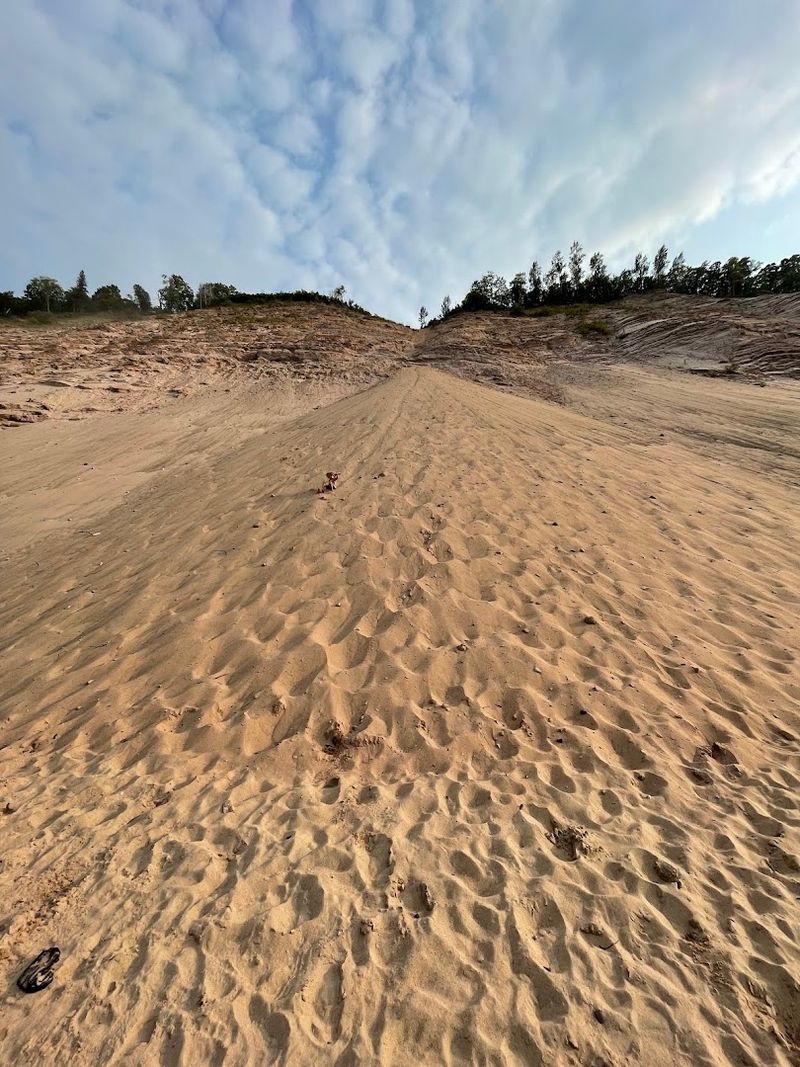
The parking area at Log Slide Overlook is paved and large enough to handle a reasonable number of vehicles without feeling chaotic. A restroom facility is available on-site during operating hours, though access after the 6 PM closing time is restricted — the overlook itself remains accessible after hours, but facilities are locked.
Portable water is not available at the trailhead, so bringing your own is essential, especially if the dune descent is part of the plan.
Dogs are not permitted on the dune or the overlook area, which is worth knowing before loading up the car. The trail from the parking lot to the overlook is short but ends with a loose-sand climb that catches people off guard.
Closed-toe shoes with some grip are strongly recommended. Sandals and open footwear make the final sandy stretch genuinely frustrating, and they become a real problem on the climb back up if you’ve gone down the dune.
Light layers are smart packing even in summer — the elevation and lake wind create conditions that feel cooler than the temperature suggests.
Log Slide Overlook is part of the North Country Trail, which runs through the Pictured Rocks area and connects to longer hiking routes including the trail to Au Sable Light Station. Hikers and backpackers use the area regularly, and the parking lot occasionally sees overnight campers staged for multi-day trips.
A small picnic area near the trailhead makes it a reasonable lunch stop between other park destinations. The nearest services — gas, food, lodging — are back in Grand Marais, roughly 12 miles east on Highway 58.
That drive is scenic but takes longer than the mileage suggests due to the road conditions and speed limits in the national lakeshore corridor. Budget extra time on both ends of the visit.
Why This Overlook Earns Its Reputation
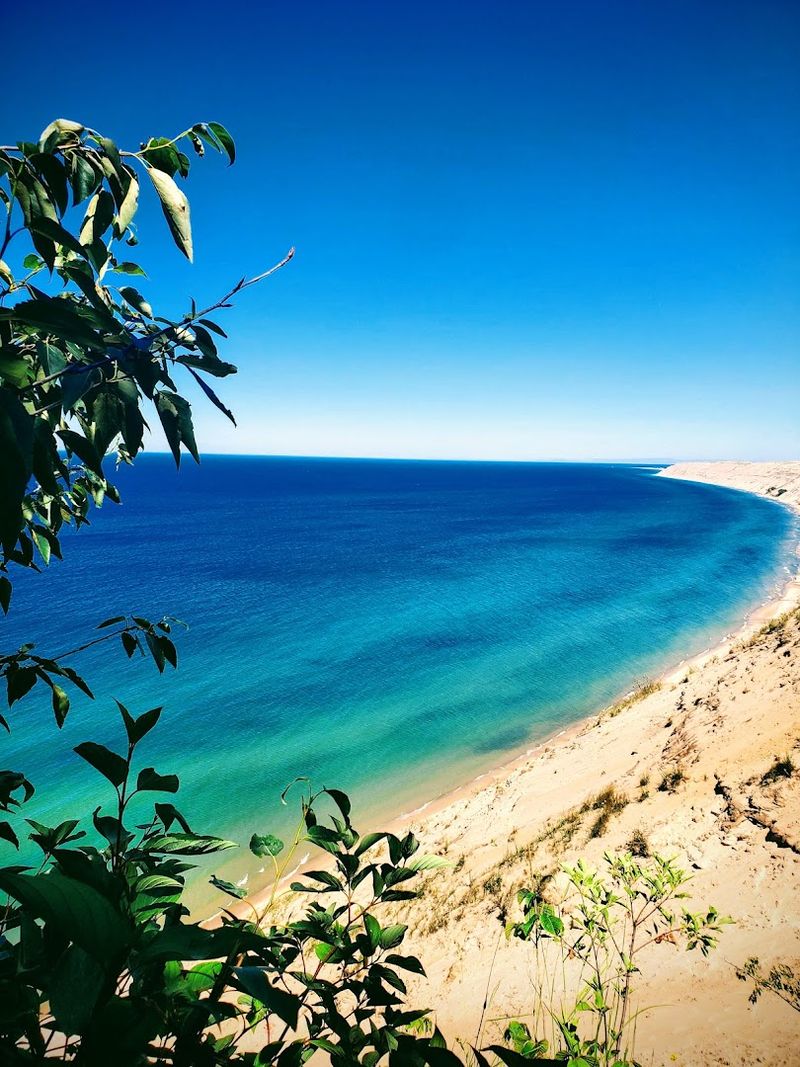
With a 4.8-star rating across more than 800 reviews, Log Slide Overlook holds a rare position among Pictured Rocks destinations — it consistently outperforms expectations. The park is famous for its colored cliffs and kayak tours, but this overlook delivers something structurally different: raw vertical drama and a piece of industrial history that most people never knew existed before arriving.
The combination works because the elements reinforce each other rather than competing. The logging history gives the landscape a human dimension.
The dune gives it physical scale. Lake Superior gives it emotional weight.
None of those three things would be as powerful alone as they are stacked together at the edge of that overlook. Visitors who almost skipped the stop — and many admit they nearly did — tend to describe it as one of the best decisions of their trip.
Compared to Sleeping Bear Dunes further south on Lake Michigan, Log Slide Overlook draws a fraction of the crowds while delivering a view that holds its own by any measure. The Grand Sable Dunes are less manicured, the setting is more remote, and the historical layer adds a dimension that purely scenic stops often lack.
For families, the short walk makes it accessible to younger kids, though the cliff edge requires close supervision — the drop is real and the sand near the rim is loose. For solo travelers and couples, the early morning window offers the kind of quiet that is increasingly hard to find in national parks during peak season.
Log Slide Overlook does not need superlatives to make the case for itself. The view from the top, the history underfoot, and the sheer physical presence of the dune make the stop entirely self-explanatory.
Share this story