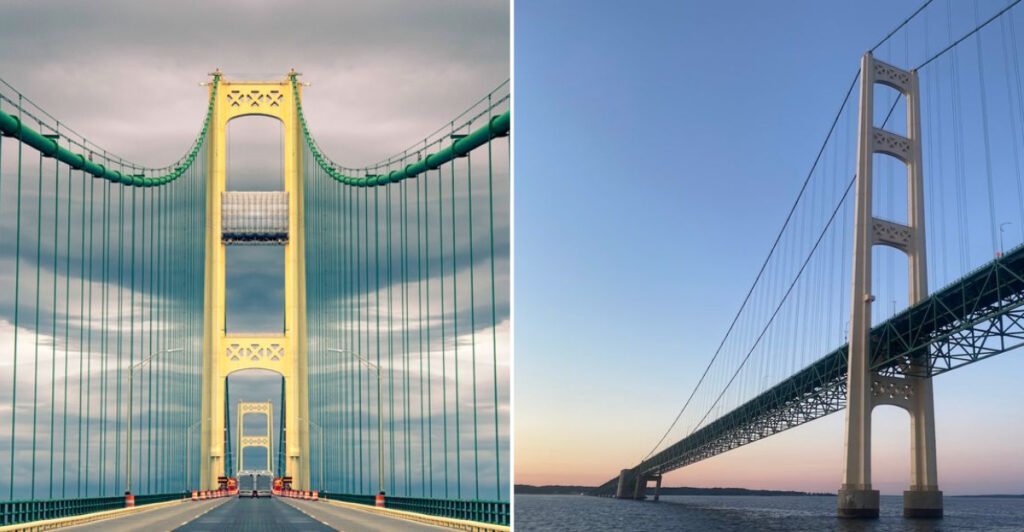
The Mackinac Bridge does not need much help looking dramatic, but sunset turns it into something else entirely. Rising nearly 200 feet above the Straits of Mackinac, the Mighty Mac stretches almost five miles between Michigan’s Lower and Upper Peninsulas, linking the state in a way that feels both massive and deeply familiar.
From the shoreline, the view shifts by the minute as the water catches the light, the towers darken against the sky, and the whole bridge seems to glow between two worlds. It is one of the Midwest’s most unforgettable sights, and the best part is simple: you can watch the whole show for free.
The Sunset View That Stops Traffic — From Shore
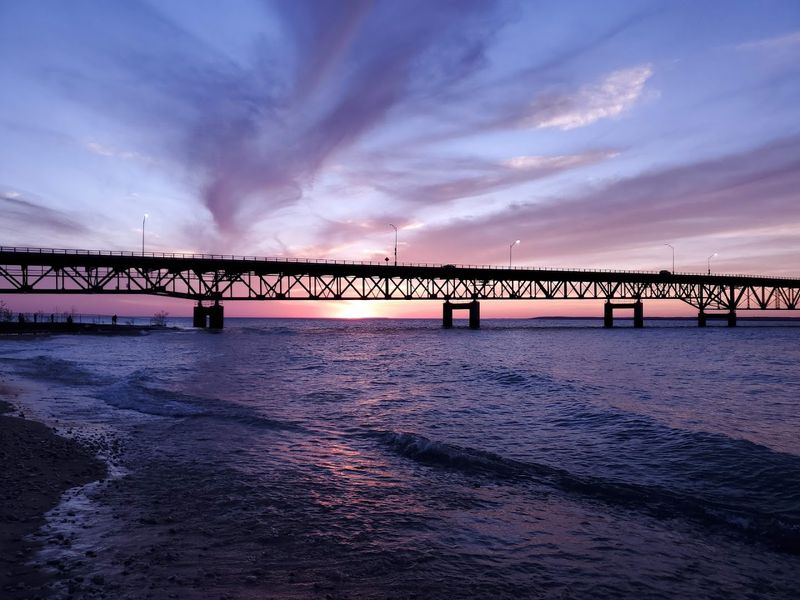
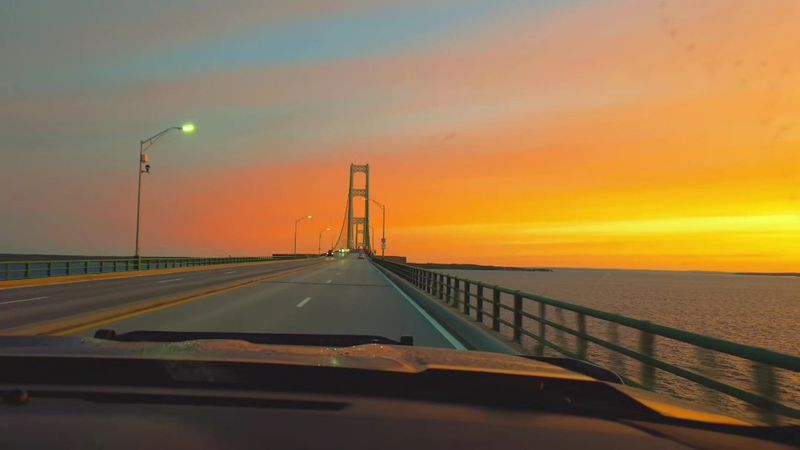
Right around the time the sun drops low over Lake Michigan, the Mackinac Bridge does something remarkable. The twin towers, rising 555 feet above the water, catch the last warm light of the day and glow in shades of copper and amber.
From the beaches near Mackinaw City, the full length of the bridge stretches across the horizon like a giant steel brushstroke painted against the sky.
The best free viewing spots sit along the northeastern shoreline just below the water tower, as well as along the northern beach access points near the bridge’s base. No ticket, no reservation, no entry fee — just open sky and one of the longest suspension bridges in the Western Hemisphere filling your entire field of view.
The water below often mirrors the colors overhead, doubling the visual impact in a way that makes even quick phone cameras produce stunning results.
Timing matters here. The bridge faces roughly westward at its southern end, which means the setting sun lines up almost perfectly behind the structure during summer and early fall evenings.
Arriving 30 to 45 minutes before official sunset gives enough time to find a good angle and settle in. The air along the straits tends to be crisp and breezy, so bringing a light jacket even in July is a smart move.
What makes this particular viewpoint so satisfying is the scale. Photographs rarely prepare first-time visitors for just how wide and tall the bridge actually reads against the landscape.
The two main cables sweep gracefully between towers, and the open-grate center lanes are just barely visible from shore. Standing there as the light fades, the bridge shifts from a transportation structure into something closer to public art.
Five Miles of Steel: What Makes the Mighty Mac an Engineering Wonder
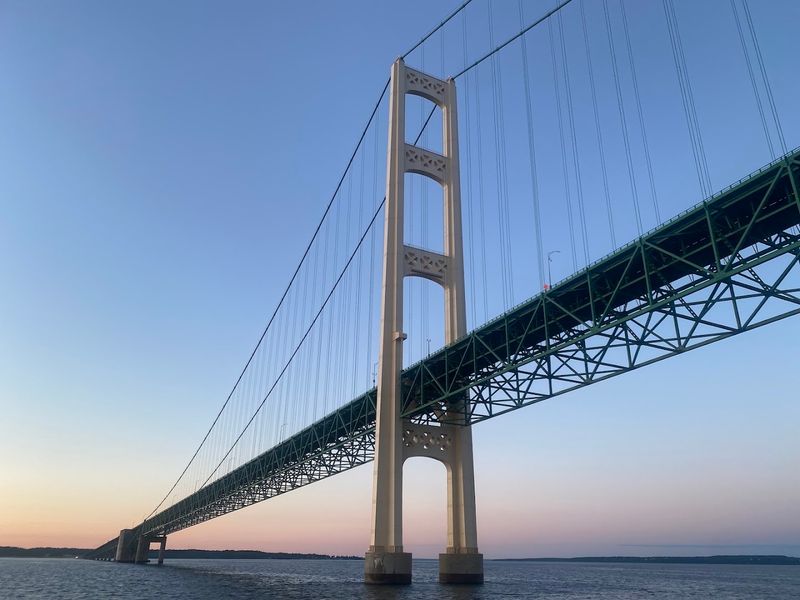
Opened on November 1, 1957, the Mackinac Bridge was designed by engineer David B. Steinman and completed after years of construction across some of the most turbulent freshwater straits in North America.
At the time of its opening, it held the title of the world’s longest suspension bridge between anchorages, stretching 26,372 feet from shore to shore. That record has since changed, but the scale of the structure still commands serious respect from anyone who drives across it or watches a freighter pass beneath its 155-foot navigation clearance.
The two main towers stand 552 feet above the water surface. Each one required massive concrete foundations anchored deep into the lake bed, a process complicated by unpredictable currents and severe winter conditions.
The main suspension span alone measures 3,800 feet, and the full bridge deck carries four lanes of traffic plus two outer lanes with open steel grating — the kind you can actually see through down to the water below while driving.
That grating detail surprises a lot of people. Drivers in the outer lanes can look straight down through the road surface to the straits rushing underneath, which creates a genuinely unusual driving experience.
Some people find it thrilling. Others request the Mackinac Bridge Authority’s driver assistance service, where a staff member will drive your vehicle across for a small fee — a practical option that has existed for decades and speaks to how seriously the bridge authority takes visitor comfort.
The bridge also has a dedicated AM radio channel that plays information about its history and construction while you cross. Tuning in during the five-mile drive turns the crossing into a moving audio tour, making the engineering story feel immediate and alive rather than something you read about later in a museum pamphlet.
Michigan’s Two Great Lakes, Visible at the Same Time
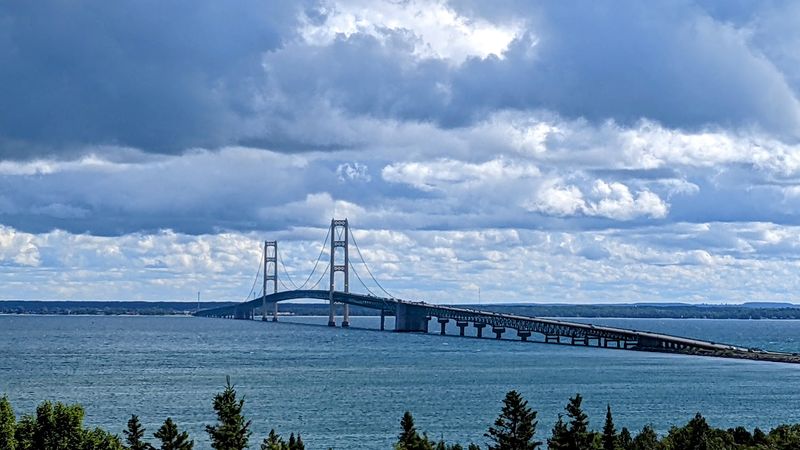
One of the more quietly astonishing facts about crossing the Mackinac Bridge is that you can see two separate Great Lakes simultaneously from the bridge deck. Lake Michigan sits to the west, Lake Huron to the east.
On a clear day, both bodies of water extend to the horizon in different shades of blue and green, separated only by the narrow land masses on either side of the straits. No other single road crossing in the United States offers that same dual-lake perspective.
The color of the water regularly surprises first-time visitors. Several people who have crossed the bridge describe being taken back by what they call tropical colors — vivid aquamarine and teal tones that look more Caribbean than Midwestern.
The clarity of the water in the Straits of Mackinac, combined with the sandy lake bottom and the angle of sunlight, creates those saturated hues that show up especially well in afternoon and early evening light.
Mackinac Island is also visible from the bridge on clear days, sitting a few miles to the east in Lake Huron. The island’s bluffs and tree line are easy to pick out, and ferry boats from Mackinaw City and St. Ignace regularly pass beneath the bridge on their way there.
Watching a ferry from above while crossing adds an unexpected sense of depth and motion to the experience.
Passenger seats have the easier job here. Drivers need to stay focused on the somewhat narrow lanes, particularly in the outer grated sections where crosswinds can push vehicles sideways.
But for anyone riding along, the full panoramic sweep across both lakes and the island beyond makes the five-mile crossing feel far shorter than it actually is.
The Free Museum Tucked Above a Pizza Joint in Mackinaw City
Up a flight of stairs above a pizza restaurant on Central Avenue in Mackinaw City, there is a free museum dedicated entirely to the construction and history of the Mackinac Bridge. It is exactly the kind of place that gets overlooked precisely because it sounds too simple — a small room above a lunch spot — but the collection inside is genuinely compelling for anyone curious about how this bridge actually got built.
The exhibits include original construction photographs, tools used by workers during the 1950s build, and a video that walks through the engineering challenges and human stories behind the project. Building across the Straits of Mackinac required solving problems that had never been solved before at that scale.
Workers dealt with brutal weather, fast-moving currents, and the sheer logistical challenge of assembling steel components in open water. Several workers lost their lives during construction, and the museum acknowledges that history directly.
The free admission makes it an easy addition to any visit, especially on days when the wind off the straits makes standing outside uncomfortable for long. Spending 30 to 45 minutes inside gives the bridge itself a completely different meaning on the drive or walk back out to the viewing areas.
Structures that seem permanent and inevitable start to feel like the result of specific human decisions and hard physical labor.
Central Avenue itself is worth a short walk after the museum. Fudge shops line the main street, and the smell of fresh batches being made drifts out onto the sidewalk in a way that is nearly impossible to walk past without stopping.
The combination of bridge history, lake views, and fresh fudge makes Mackinaw City a legitimate destination rather than just a highway exit on the way somewhere else in Michigan.
Walking the Bridge on Labor Day: Michigan’s Most Unusual Annual Tradition
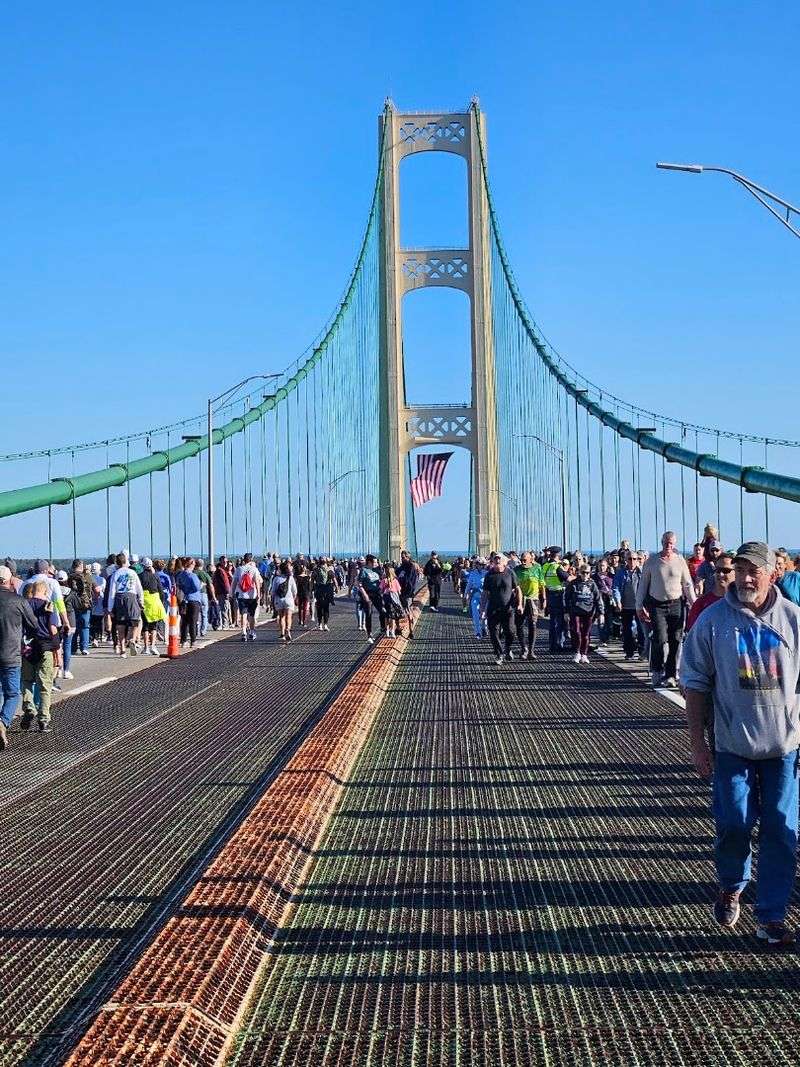
Once a year, on Labor Day morning, the Mackinac Bridge closes to vehicle traffic and opens entirely to pedestrians. Thousands of people from across Michigan and beyond show up to walk the full five-mile span, a tradition that has run for decades and draws everyone from serious walkers to families pushing strollers.
The walk typically takes around one hour at a steady pace, though many people stop repeatedly to take in the views or simply stand still and feel the bridge moving slightly underfoot.
Yes, the bridge moves. That is not a malfunction — it is engineered to flex in response to wind and temperature changes.
Standing on the deck during the walk and feeling that subtle sway is one of those experiences that completely reframes how you think about large structures. The bridge is not rigid.
It breathes, in a sense, and the Labor Day walk is one of the few times civilians can feel that directly.
Planning ahead is essential for the walk. People who complete the full crossing end up on the opposite side of the bridge from where they started, which means arranging transportation back beforehand.
Some participants walk to the midpoint and return. Others coordinate shuttle rides or carpools.
The event draws large crowds early, so arriving before sunrise is not unusual among regulars who want to cross with a thinner crowd and catch the early morning light on the water.
No walking is permitted on the bridge during regular operating days — the Labor Day event is the only opportunity. For anyone who has driven across multiple times and wondered what the deck actually feels like on foot, that single annual morning is worth planning a trip around.
The bridge reads completely differently at walking speed, and the views straight down through the grating are far more dramatic when you are standing still.
Best Spots Around the Straits for Watching the Bridge Light Up at Night
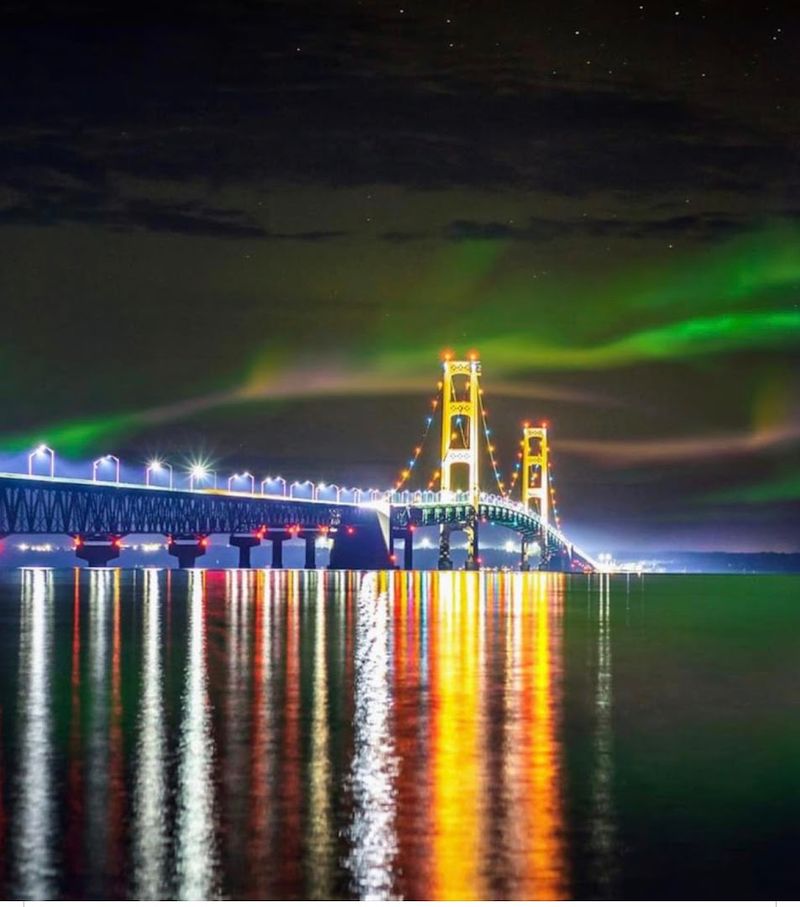
After dark, the Mackinac Bridge shifts into a completely different visual mode. The bridge lighting system outlines the main cables and towers in a glow that reflects across the straits on calm nights, turning the water into a long mirror of blue-white light.
The effect is dramatic from shore and even more striking from a boat passing beneath the structure, where the lit cables arch overhead in both directions like a cathedral ceiling made of steel and light.
The lighting system does require maintenance and is occasionally turned off for repairs, so checking ahead before making a special evening trip is worthwhile. When the lights are running, the northeastern beach areas near Mackinaw City offer clean sightlines without obstructions.
The south end city park near the lighthouse is another strong option — it sits at a slight angle to the bridge that shows both the span and the reflection simultaneously, which makes for better photographs than a straight-on shot.
St. Ignace on the Upper Peninsula side also provides excellent night views from its waterfront. The perspective from the north is slightly different, showing the bridge receding southward over the water rather than spanning across the horizon, which gives the structure a more dramatic sense of depth.
Both towns have waterfront areas accessible in the evening without any entry fees.
One practical note: the crisp air that makes sunset viewing pleasant gets noticeably colder after dark, even in summer. Temperatures near the water drop faster than they do even a few miles inland, and the wind along the straits rarely stops completely.
Layers and wind-resistant outerwear make a significant difference in how long a night viewing session stays comfortable. The bridge is open 24 hours, so there is no rush — but the cold has a way of setting its own schedule.
Crossing the Mighty Mac: Toll Costs, Wind Rules, and What to Actually Expect
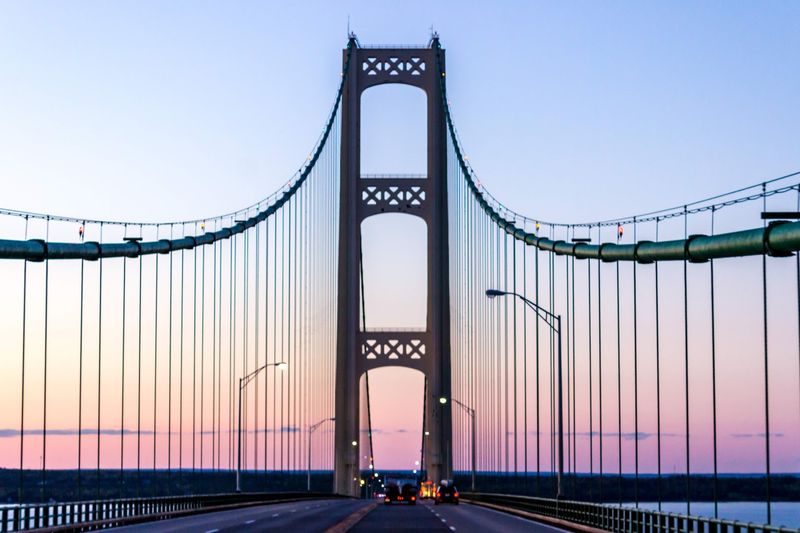
Driving across the Mackinac Bridge costs four dollars for a standard passenger car, one of the more reasonable tolls for a landmark of this scale. Vehicles towing trailers pay more, with the rate scaling by axle count.
The toll is collected on the Upper Peninsula side after crossing from Mackinaw City northward, so southbound drivers pay before reaching the Lower Peninsula. The booths are staffed and move efficiently — when traffic backs up, additional lanes open quickly to keep things flowing.
Wind plays a significant role in how the crossing goes. On high-wind days, the bridge authority enforces speed restrictions, typically limiting trucks and RVs to 20 miles per hour.
In extreme conditions, certain vehicle types like high-profile trucks or motorcycles may be restricted or escorted across. The bridge authority monitors conditions continuously and posts updates through its alert system, which travelers can sign up for before a trip.
Ice melt in early spring occasionally closes the bridge temporarily while falling ice clears from the structure, so late-winter and early-spring travelers should check conditions before committing to a crossing time.
The lanes themselves are narrower than a typical interstate, and the outer two lanes feature the open steel grating that creates that see-through-to-the-water effect. First-time drivers sometimes grip the wheel a little tighter in those outer lanes, which is completely understandable.
Staying in the center lanes is a valid option for anyone who prefers a more solid-feeling road surface beneath them.
For drivers who simply do not want to handle the crossing themselves, the Mackinac Bridge Authority offers a staff-assisted crossing service for a small fee. A trained employee drives your vehicle across while you ride as a passenger. It is a low-key, practical option that removes the stress entirely and lets you focus on the view instead of the lane markings.
Share this story