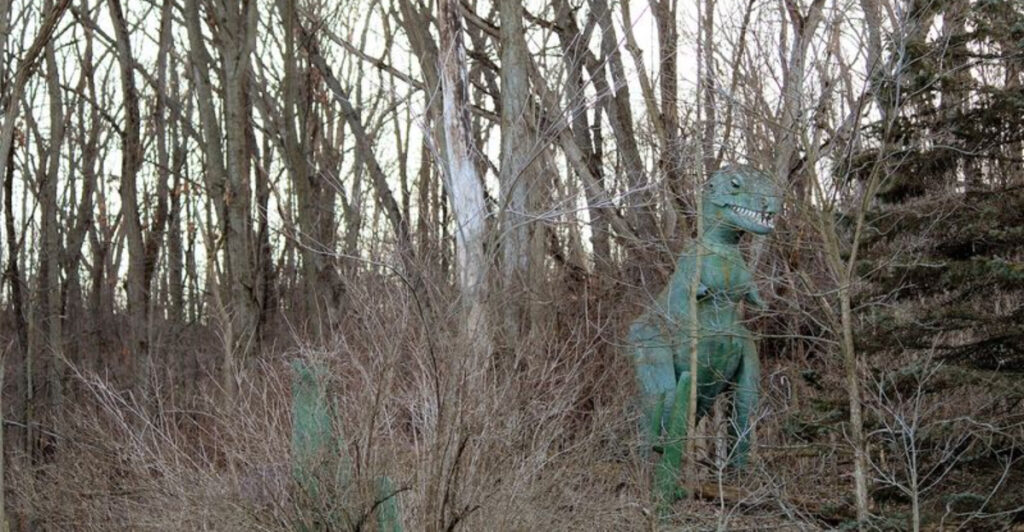
Hidden along a quiet stretch of US-12 in Onsted, Michigan, the ruins of Prehistoric Forest sit frozen in time like a scene from a forgotten world. Once a beloved roadside attraction where families marveled at life-sized dinosaur sculptures scattered through a wooded landscape, the park has been closed for years, yet its concrete giants remain standing.
Overgrown by brush and weather-worn by Michigan winters, the place has taken on a new kind of power that draws curiosity seekers, urban explorers, and nostalgic locals to its fenced perimeter. The dinosaurs never left, and somehow, that makes the whole thing even more fascinating.
First Glimpse From The Parking Lot: Giant Creatures Through The Trees
Pull off US-12 into the gravel lot and the first thing that stops you cold is a dinosaur head poking above the treeline. Not a small decorative piece, but a full, towering concrete sculpture with weathered paint still clinging to its surface.
The scale is unexpected, even from the outside.
Prehistoric Forest sits on a modest lot in Lenawee County, but the park was designed to feel immersive, like stepping into a lost era. The entry area, even in its current state, communicates exactly what the original designers intended.
Drama. Size.
Wonder. The kind of roadside spectacle that used to pull families off the highway without a single advertisement needed.
From the parking lot, the chain-link fence and no-trespassing signs make the boundary clear. But the sculptures visible from that boundary are enough to understand why people still stop here.
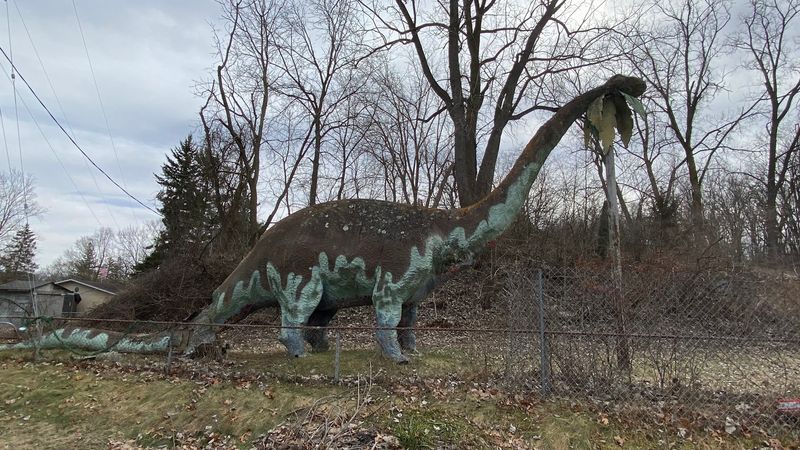
Concrete brontosauruses, stegosauruses, and other prehistoric creatures stand partially hidden by overgrowth, their forms softened by decades of Michigan weather but still recognizable and oddly commanding.
The light filters differently through the canopy here. In late afternoon, it cuts through in long golden streaks that catch the rough texture of the concrete figures, making them look almost alive.
Early morning fog adds another layer entirely, turning the whole scene into something between a nature preserve and a dream sequence.
Visitors who stop just to photograph from the lot often end up spending twenty or thirty minutes simply circling the perimeter, finding new angles and better views through the fence gaps. The park does not need to be open to make an impression.
The sheer presence of those ancient creatures peeking through the trees is enough to make anyone slow down and stare.
The Dinosaurs That Refused To Disappear: Michigan’s Concrete Guardians
Most amusement parks, when they close, get stripped. Rides are sold off, buildings demolished, and the land repurposed.
Prehistoric Forest defied that pattern entirely. The dinosaurs are still there, planted in the same spots where families posed for photographs decades ago, and their refusal to vanish gives the place a strange kind of permanence.
The sculptures were built in a tradition that was popular throughout mid-century America, when roadside attractions competed for the attention of travelers on long family road trips. Dinosaur parks, mystery spots, and giant novelties popped up along major routes across the country.
Prehistoric Forest was Michigan’s answer to that era, a place where the prehistoric past was rendered in concrete and paint and set against a backdrop of real forest.
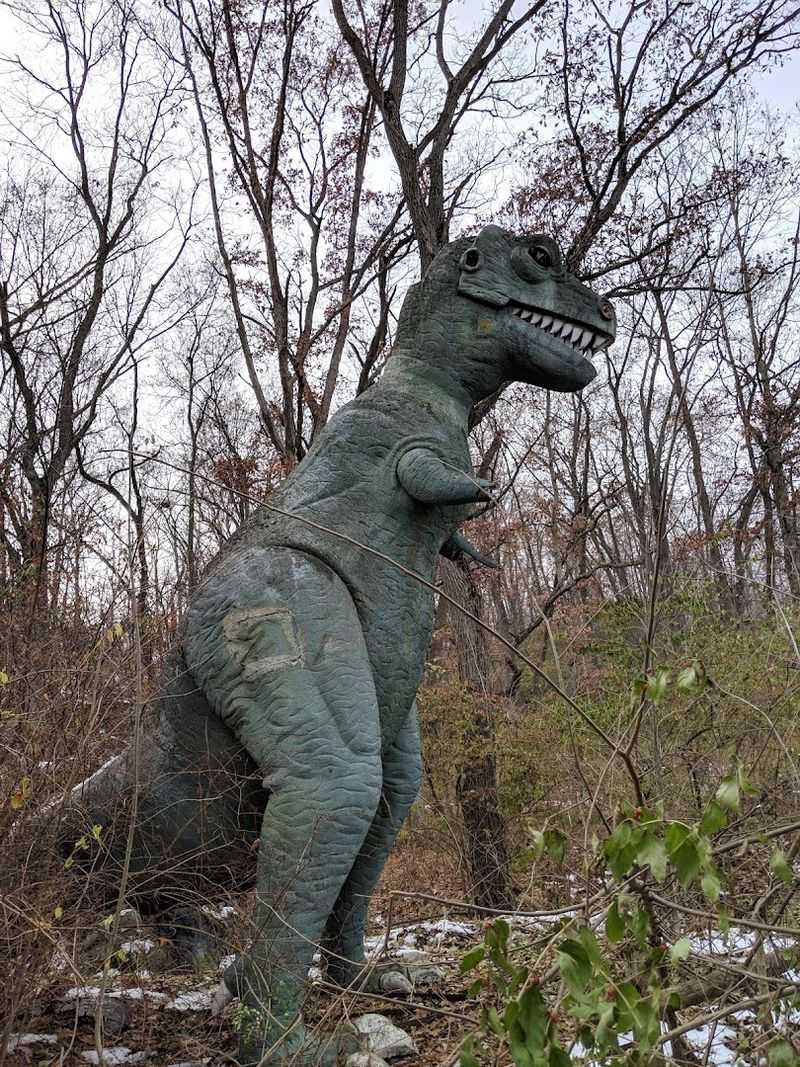
Each figure was positioned to maximize surprise. You would round a bend on the walking path and suddenly find yourself face-to-face with a towering T-Rex or a long-necked sauropod rising above the brush.
The spacing was intentional, designed to create a series of reveals rather than one overwhelming panorama. That design logic still holds, even in ruin.
Some sculptures have cracked over the years, their surfaces split by frost and root pressure. Paint has faded from vivid greens and browns to pale, chalky tones.
But the forms remain structurally intact in most cases, which is a testament to the original construction. Whoever built these figures built them to last, possibly without realizing they were creating something that would outlive the park itself by decades.
Standing at the fence and looking in, the dinosaurs do not look defeated. They look patient, like they have simply been waiting for the next set of visitors to arrive and gawk at them from a respectful distance.
A Nostalgic Detour Through Mid-Century Roadside America
There was a golden window in American road trip culture, roughly spanning the 1950s through the 1980s, when families loaded into station wagons and drove long distances without GPS or streaming services. Entertainment came from the window.
Roadside attractions were the algorithm, and places like Prehistoric Forest were engineered specifically to catch wandering eyes.
Prehistoric Forest opened in the mid-20th century and capitalized on a public fascination with dinosaurs that never really fades. The park offered something tangible that a museum could not quite replicate: the ability to walk among the creatures, stand next to them, and feel genuinely small.
For a child in the backseat of a car rolling through Lenawee County, spotting a dinosaur through the trees was the kind of moment that stuck.
The park drew generations of Michigan families, and its legacy lives on in the memories of people who grew up in the region. Adults who visited as children now bring their own kids to the fence line, pointing out the same creatures their parents pointed out to them.
That layered nostalgia is one of the more unusual things about Prehistoric Forest. It has become a memory site even for people who cannot actually enter it.
US-12 itself is a historic route, one of the old east-west arteries that predates the interstate system. Driving it today still feels like a different pace of travel, slower and more attentive to the landscape around you.
Prehistoric Forest fits naturally into that rhythm. It is the kind of place the old highway was built to serve, a destination that rewards people willing to take the slower road and notice what is hiding in plain sight.
What Vandalism and Time Have Left Behind
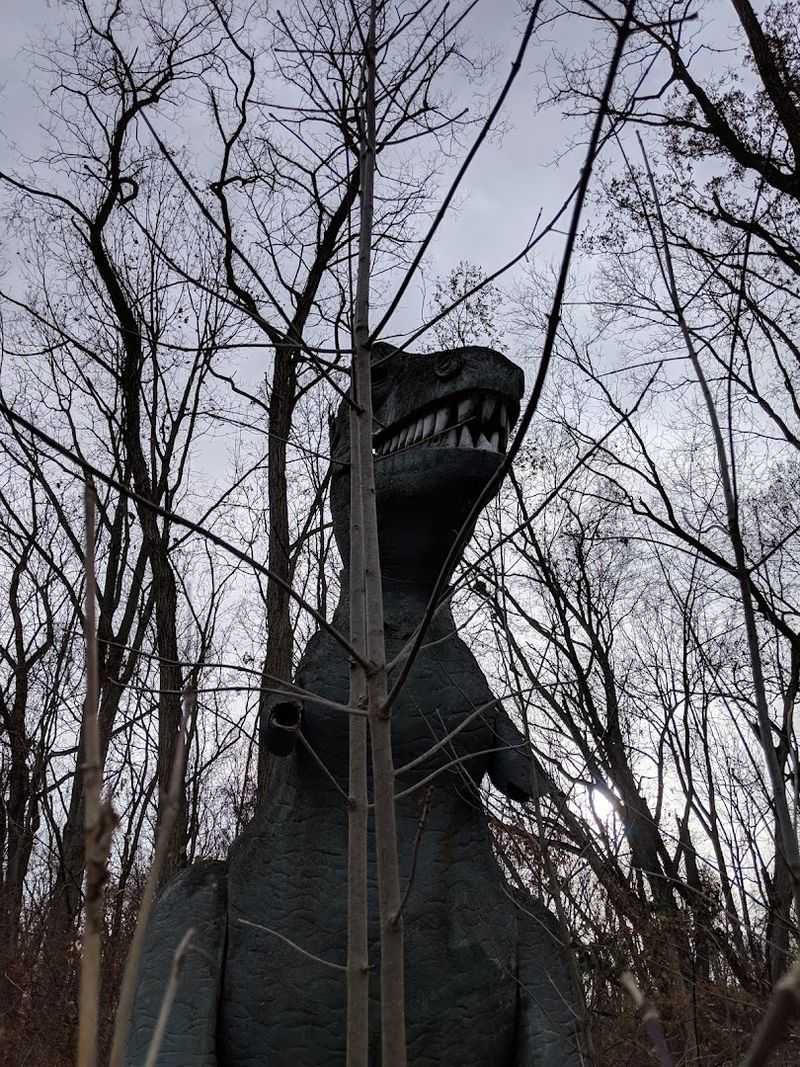
Abandonment does not age everything equally. At Prehistoric Forest, the trees have thrived.
The concrete creatures have endured. But the human-built infrastructure, the walkways, fencing, small structures, and signage, has taken the hardest hits from both weather and trespassers over the years.
Graffiti has marked some of the surfaces, a common fate for any abandoned attraction accessible enough to tempt thrill-seekers. Some of the spray paint is crude, the kind left behind quickly.
Other markings are more elaborate, suggesting people who spent real time inside despite the no-trespassing signs. The layering of tags over years creates its own unintentional record of visits, a rough timeline of who came through and when.
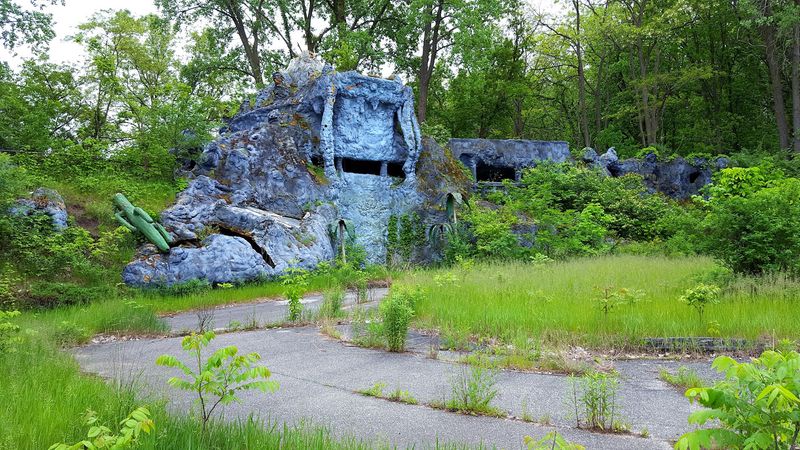
Vegetation has pushed through cracked pavement and reclaimed path edges. Vines climb some of the smaller structures.
Michigan’s freeze-thaw cycle has done its slow structural work on anything that holds water, cracking surfaces and widening gaps over successive winters. The overall effect is less horror-movie ruin and more quiet decay, the kind that happens when a place is simply left alone long enough for nature to start making decisions.
Some visitors express genuine sadness about the vandalism, wishing the park had been maintained or restored rather than left to deteriorate. That frustration is understandable.
The bones of something genuinely interesting are still visible beneath the damage, and it is not hard to imagine what the park looked like in its prime when the paths were clear and the creatures freshly painted.
What remains is still compelling, just in a different way than the original designers intended. The decay itself has become part of the story, an unplanned chapter that adds complexity to a place already rich with history and strangeness.
Onsted, Michigan: The Small Town Holding a Prehistoric Secret
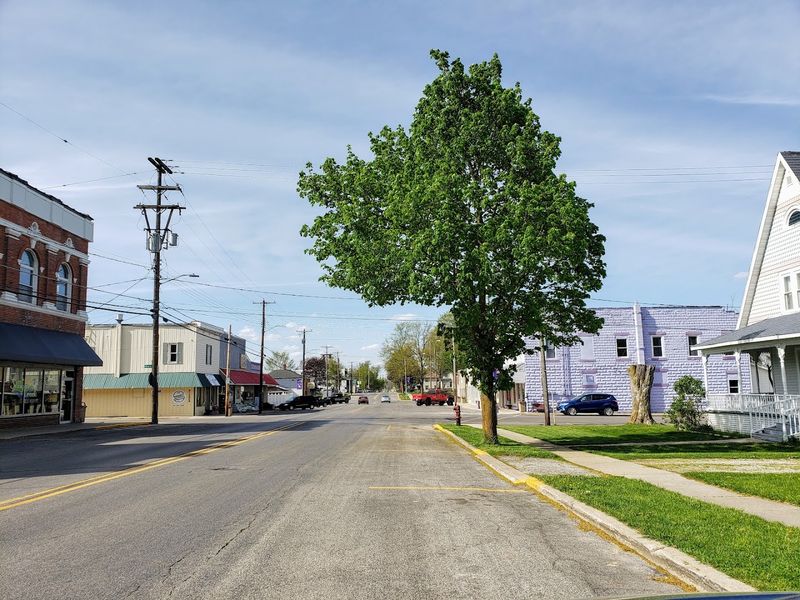
Onsted is not a place most people outside of Lenawee County know by name. It sits in the Irish Hills region of southeastern Michigan, an area defined by glacially formed lakes, rolling terrain, and a landscape that feels genuinely removed from the sprawl of Detroit or Ann Arbor.
The region attracted tourism for generations precisely because of its natural character, and Prehistoric Forest was one of several attractions that once filled the Irish Hills corridor with family-friendly stops.
At its peak, the Irish Hills area was a legitimate destination. Visitors came for the lakes, the mystery spots, and the novelty attractions that lined US-12.
Prehistoric Forest was a flagship stop, the kind of place that anchored a full day of roadside exploration. The broader tourism ecosystem that once supported it has thinned considerably, but the landscape itself remains beautiful and largely undisturbed.
Onsted today is a quiet community, and the presence of an abandoned dinosaur park on its outskirts gives it a particular kind of character. Locals are generally aware of the site, and some have personal connections to it going back multiple generations.
For a small town, carrying the ruins of a once-popular regional attraction is both a curiosity and a quiet point of pride.
The surrounding area still offers reasons to visit beyond the fence line. Nearby lakes provide fishing and kayaking, and the Irish Hills landscape rewards anyone willing to drive slowly and pay attention.
Prehistoric Forest makes a natural anchor point for a day trip through the region, giving travelers a specific destination around which to build a broader exploration of one of Michigan’s most underappreciated rural corridors.
How To Experience The Site Without Crossing The Line
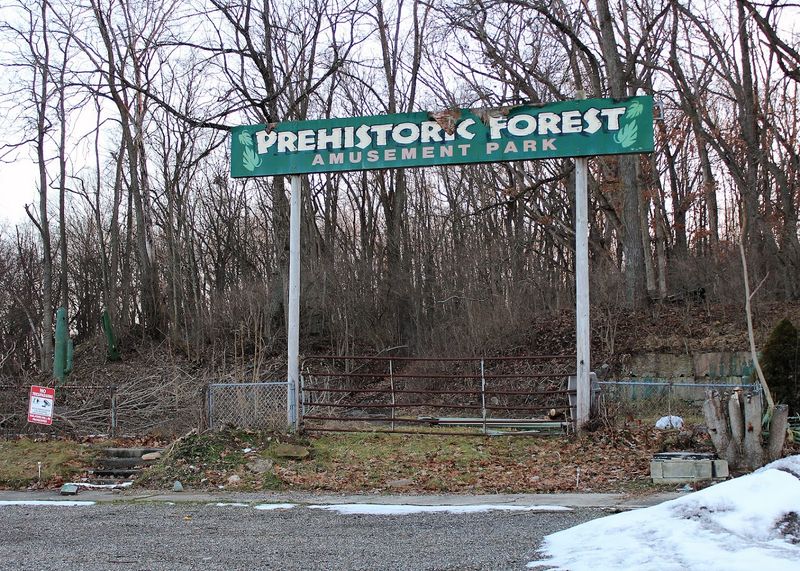
Prehistoric Forest is closed and posted with no-trespassing signs, and that boundary deserves respect both legally and practically. But experiencing the site from the outside is more rewarding than it might sound, especially for anyone who approaches it with patience and the right timing.
The parking lot is accessible and provides a legitimate vantage point. From there, walking slowly along the fence perimeter reveals multiple angles into the park.
Gaps in the vegetation, particularly in late fall or early spring before full leaf-out, open up longer sightlines into the interior. Several of the larger sculptures are visible from public vantage points without any need to enter the property.
Photography works best in the morning or late afternoon when light angles are lower and more directional. The overhead canopy creates interesting shadow play on the concrete surfaces, and the contrast between the organic forest environment and the rigid, manufactured creatures makes for compelling compositions.
Wide shots that include the fence itself can actually strengthen the image, framing the creatures as something just out of reach, which is exactly how the place feels in person.
Bringing a zoom lens or a phone with a strong optical zoom helps considerably. Some of the most interesting sculptural details, cracked surfaces, faded paint patterns, and weathered facial features are only visible up close, and reaching that level of detail from outside the fence requires some magnification.
The visit pairs naturally with a drive along the broader US-12 corridor. Plan for an hour at the site itself, more if photography is a priority, and combine it with stops at nearby lakes or other Irish Hills landmarks.
The site rewards a relaxed pace rather than a rushed stop, so build in time to simply stand, look, and let the strangeness of the place register properly.
Why This Forgotten Park Still Commands Attention Decades Later
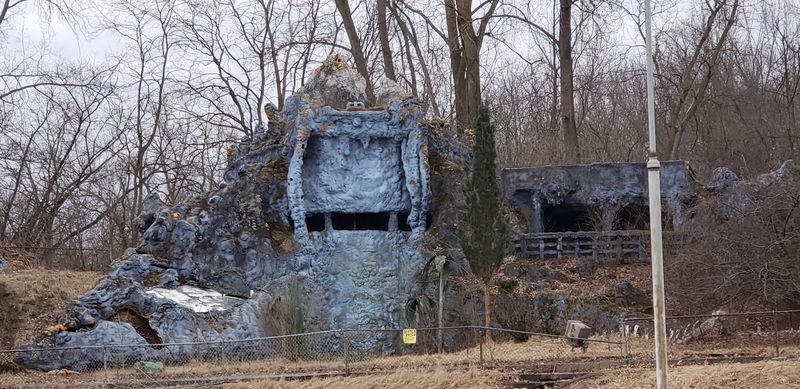
Plenty of abandoned places get forgotten once they close. Prehistoric Forest never quite managed that.
The dinosaurs are too big, too visible, and too strange to simply fade into the background of a rural Michigan highway. They keep the place present in the cultural memory of everyone who drives past, even people who have never stopped.
Part of what sustains the interest is the specificity of the subject matter. Dinosaurs occupy a permanent place in human imagination, particularly childhood imagination.
A park built around them carries a kind of emotional weight that a generic amusement park does not. When Prehistoric Forest closed, it did not just shut down a business.
It put a childhood icon behind a fence, and that friction between memory and inaccessibility is genuinely affecting.
The site also benefits from the broader cultural moment around urban exploration and abandoned places. There is a growing appetite for spaces where time has stopped, where the past is physically present rather than archived in photographs.
Prehistoric Forest delivers that experience with unusual intensity because the subjects themselves, prehistoric creatures, already exist outside of normal time. A ruined dinosaur park has a layered strangeness that a ruined hotel or factory simply cannot match.
For anyone drawn to the intersection of American roadside history, natural beauty, and the particular melancholy of things that once brought joy and now stand quietly in overgrowth, this site is genuinely worth the detour. It does not require entry to make an impact.
The view from the fence is enough to understand why people keep coming back, keep photographing, and keep telling others about a forgotten park in a small Michigan town where the dinosaurs never left.
Share this story