A 130-foot spire rises above the farmland outside Asbury, crowned by a bronze figure that catches the sun long before the rest of the building comes into focus.
It is an unexpected sight in this quiet corner of Warren County, where country roads and open fields hardly suggest that a nationally known pilgrimage destination is waiting nearby.
The National Blue Army Shrine of Our Lady of Fatima is not simply a church with attractive grounds. Spread across 150 acres, it brings together chapels, gardens, statues, walking paths, and sacred spaces inspired by Fatima, Portugal, and other important Catholic sites in Europe.
Visitors come for Mass, confession, retreats, and organized pilgrimages, but the shrine also welcomes those who simply need somewhere calm to think. Nothing here demands that you hurry.
A walk can become a prayer, a chapel bench can hold your attention for an hour, and an ordinary afternoon can feel surprisingly far removed from the rest of New Jersey.
The Blue Army Shrine Brings the Spirit of Fatima to Rural New Jersey
The story behind this Warren County sanctuary begins thousands of miles away in Fatima, Portugal. In 1917, three shepherd children named Lucia dos Santos and Francisco and Jacinta Marto reported a series of apparitions of the Virgin Mary.
The events transformed their small agricultural community into one of the world’s best-known Catholic pilgrimage destinations. The message associated with Fatima emphasized prayer, repentance, conversion, and peace, themes that remain at the heart of the New Jersey shrine today.
Operated by the World Apostolate of Fatima USA, also known as Our Lady’s Blue Army, the National Blue Army Shrine gives American pilgrims a place to engage with that tradition without crossing the Atlantic. Its location at 674 Mountain View Road East in Asbury feels especially fitting.
Rather than sitting in a busy downtown or beside a major tourist strip, the shrine occupies a pastoral corner of Washington Township surrounded by the rolling landscape of Warren County. That setting creates a subtle link to the rural origins of Fatima itself.
The main shrine was built in 1978 and dedicated to the Immaculate Heart of Mary, but the property includes several devotional spaces developed at different times. Together, they create something closer to a pilgrimage complex than a single place of worship.
The experience can be deeply religious, quietly historical, or simply reflective, depending on what brings a person through the gates. Even the name “Blue Army” has roots in the Fatima movement.
It referred to faithful people committed to prayer and spiritual devotion, positioned symbolically against the “Red Army” of Soviet communism during the organization’s early years. That historical context gives the shrine a larger story, but the mood on the grounds is far gentler than the name might suggest.
Here, the focus is on stillness, contemplation, and a message of peace carried from a Portuguese village to the New Jersey countryside.
The 150-Acre Sanctuary Feels Far Removed From Everyday Life
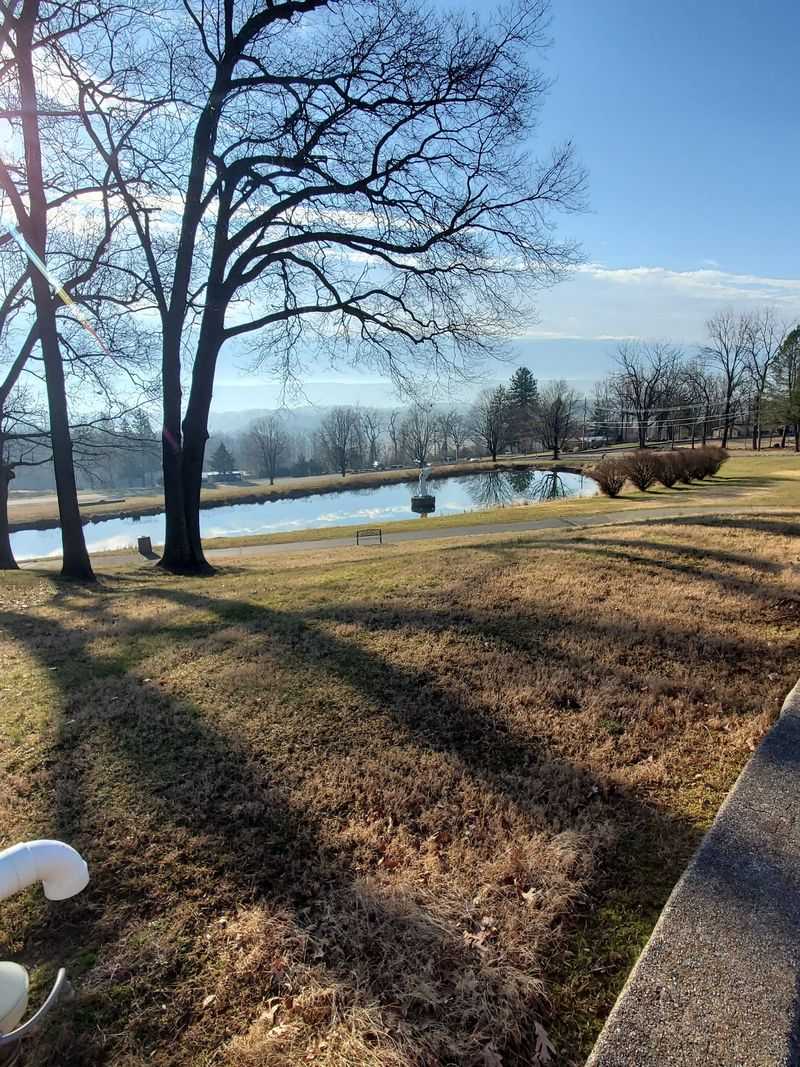
A few minutes after parking, the usual background noise seems to drop away. The property opens into broad lawns, stands of trees, flower beds, and paths that encourage wandering rather than racing from one landmark to the next.
At 150 acres, the shrine has enough room for visitors to spread out, so even a day with multiple groups can still offer pockets of genuine solitude. One person may be following the Stations of the Cross while another sits near the Guardian Angel of the United States Peace Pond.
Families might pause beside the statues of Our Lady of Fatima and the three shepherd children, while retreat groups move quietly between chapels. The grounds contain more than the most prominent attractions, and those smaller discoveries give a long visit its rhythm.
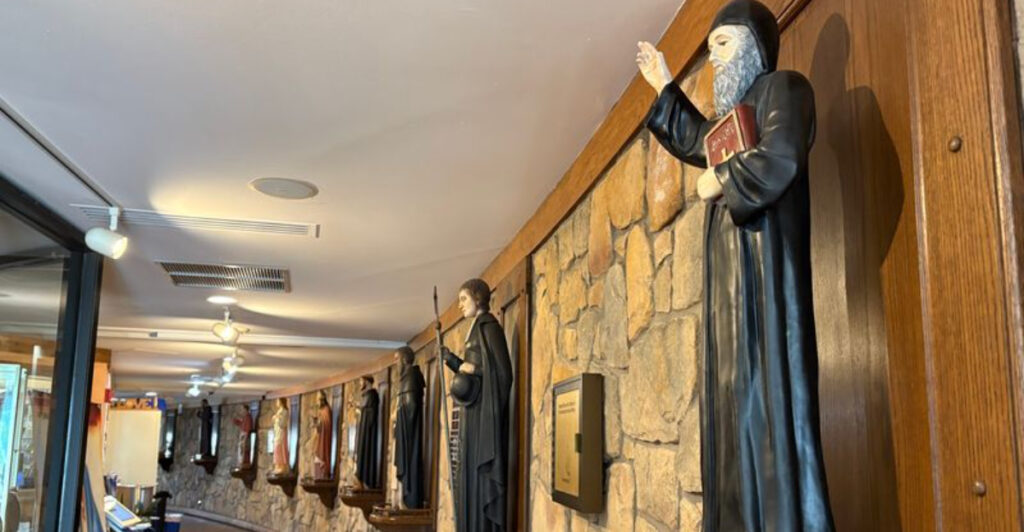
There is a St. Francis of Assisi Garden, a shrine honoring St. Pio of Pietrelcina, statues of Saints Joachim and Anne, a St. Thérèse of Lisieux shrine, and Byzantine icons placed along the Marian Way. The Blue Army Cemetery also holds the graves of important figures connected to the apostolate, including Monsignor Harold Colgan and John Haffert.
None of these spaces feels squeezed into a crowded attraction map. There is grass between them, sky above them, and enough distance to let one experience settle before the next begins.
The grounds are open daily from 9 a.m. until dusk, offering a generous window for an unrushed walk. The gift shop operates from 9 a.m. to 4 p.m. and carries rosaries, prayer cards, books, and other Catholic items, but shopping never becomes the center of the visit.
Comfortable shoes are more useful than a packed itinerary because the property rewards slow exploration. Visitors should also know that pets are not permitted, a rule intended to preserve the calm atmosphere.
The result is a place where the landscape is not decorative scenery around the shrine. It is part of the sanctuary itself, creating enough physical and mental room for an afternoon to unfold at a noticeably quieter pace.
A Soaring Shrine and Bronze Statue Create a Striking First Impression
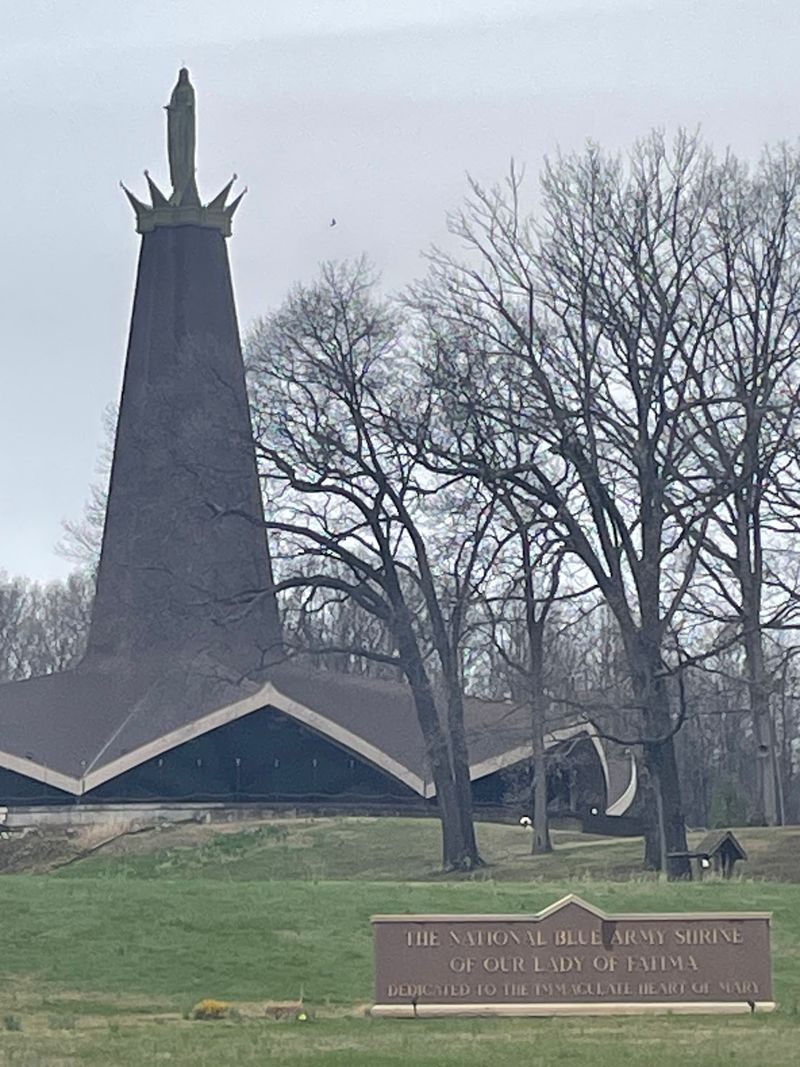
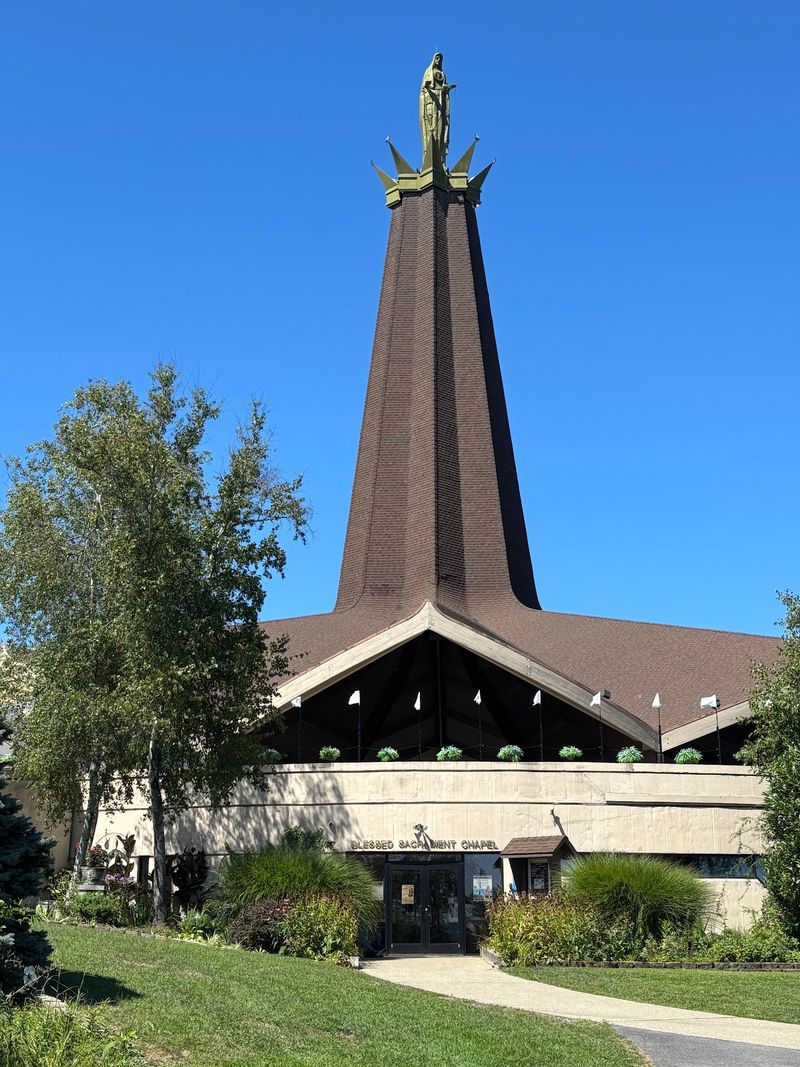
Architecture does most of the talking when the main shrine first comes into view. Its roof sweeps outward in a broad, unusual shape designed to represent Mary’s mantle extending over and protecting her children.
Above it, a 130-foot spire pulls the eye upward to a bronze statue of the Immaculate Heart of Mary. Against a clear Warren County sky, the combination looks both modern and monumental, particularly when the metal catches the afternoon light.
Dedicated in 1978, the structure was built as a visible expression of the Fatima message rather than as a conventional parish church. That intention becomes clearer inside.
The Blessed Sacrament Chapel is considered the spiritual heart of the shrine, and the main sanctuary can accommodate roughly 1,400 people. Its scale allows the site to host major celebrations and organized pilgrimages, yet quieter weekdays reveal another side of the building.
With fewer people present, the size does not feel cold or overwhelming. Instead, the open space seems to absorb small sounds, leaving visitors unusually aware of every footstep and whispered prayer.
The building’s capacity becomes particularly important during the shrine’s Fatima commemorations. On the 13th day of each month from May through October, pilgrims gather to remember the dates associated with the 1917 apparitions.
These observances include confession, a Rosary procession with the statue of Our Lady of Fatima, a speaker, Mass, and additional devotions. Those event days bring movement, music, and a shared sense of purpose to grounds that are otherwise remarkably quiet.
Visiting at an ordinary hour offers the opposite experience, when it may be possible to sit beneath that immense roof with little distraction. Both settings reveal why the structure has become such a recognizable part of the shrine.
The spire provides the visual drama, but the symbolism of the mantle gives the building its emotional weight. It is grand enough to stop a first-time visitor in the parking area, then gentle enough to make staying awhile feel perfectly natural.
The Holy House Chapel Connects Visitors to Sacred Sites in Europe
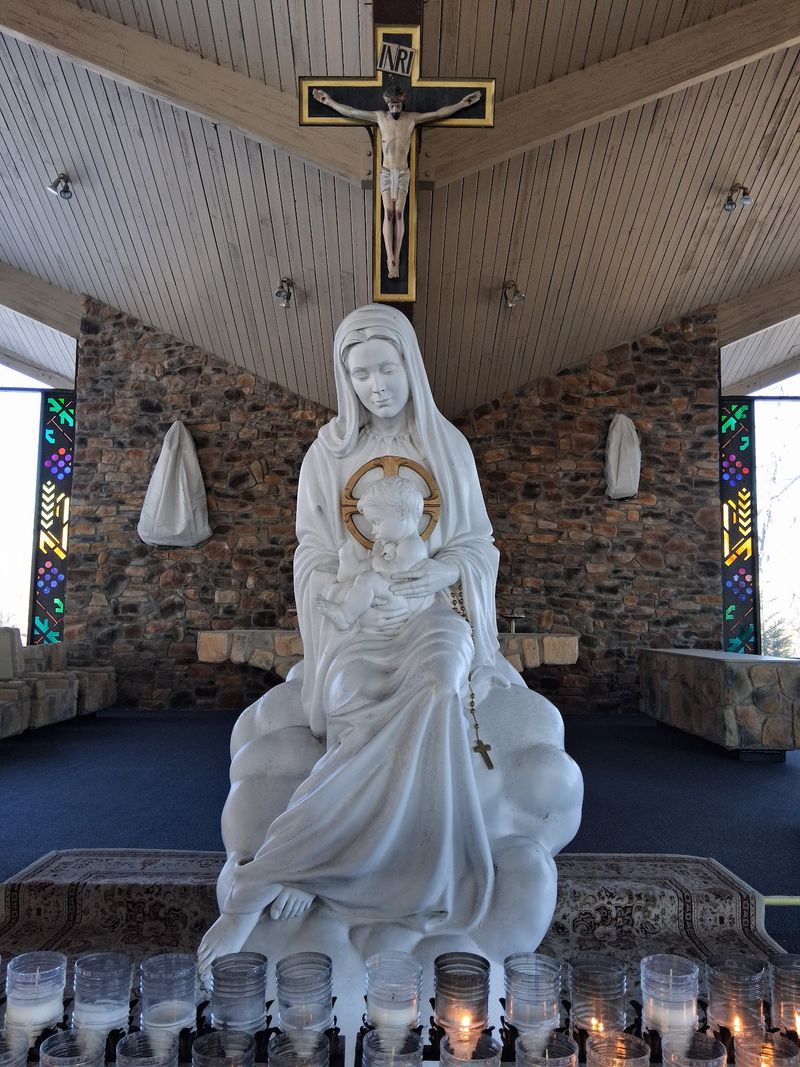
One of the property’s most remarkable spaces is also far more modest than the main sanctuary. Dedicated in 1973, the Holy House Chapel is a scale replica of the Holy House of Loreto, the structure in Loreto, Italy, traditionally honored as the home where the Holy Family lived.
Its significance goes beyond architectural resemblance. During construction, stones from the original Holy House were pulverized and incorporated into the mortar of the New Jersey chapel, creating a physical connection between the two sites.
That detail is easy to overlook from outside, but it changes the way the small interior feels once you know it. The chapel also contains part of an altar from Tuy, Spain.
In Catholic tradition, Tuy is connected to a 1929 vision experienced by Sister Lucia, the surviving Fatima visionary who later became a Carmelite nun. A wooden statue of St. Joseph depicts him as he was said to have appeared during the Miracle of the Sun at Fatima in October 1917.
These elements bring Loreto, Tuy, and Fatima together inside one quiet New Jersey room. Nearby, another chapel strengthens that European connection.
The Capelinha, a Portuguese word meaning “little chapel,” is one of only two exact replicas of the chapel constructed at the site of the apparitions in Fatima. It houses an exact replica of the Pilgrim Virgin Statue carried in processions there, donated by the Portuguese Catholic community.
The Capelinha also serves as a candle house, and the rows of small flames create one of the shrine’s most intimate scenes. Unlike a museum reproduction, neither chapel is meant to be admired quickly and checked off a list.
These are active places of devotion where visitors pray, light candles, and sit in silence. Their importance comes from what they represent, but also from their human scale.
After looking up at the main shrine’s towering spire, stepping into the Holy House feels like moving from a public monument into a private room where history, faith, and craftsmanship have been carefully compressed.
The Rosary Garden Turns a Peaceful Walk Into a Personal Pilgrimage
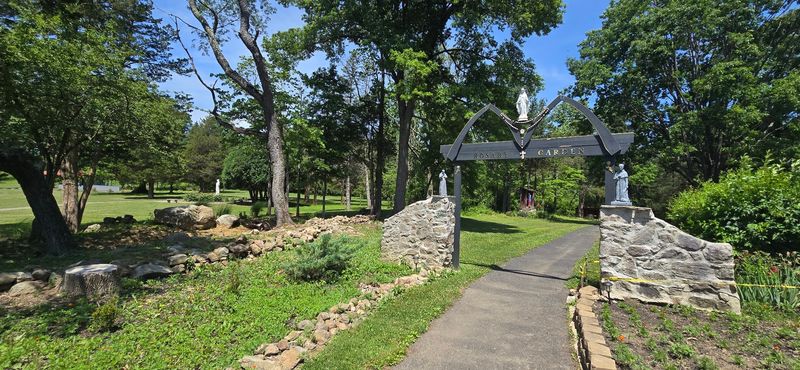
Twenty scenes unfold along the Rosary Garden, each represented by life-size statues that give physical form to the mysteries of the Rosary. Rather than placing the entire devotion inside a chapel, the garden stretches it across the landscape.
Visitors walk between the Joyful, Luminous, Sorrowful, and Glorious Mysteries, pausing at scenes from the lives of Jesus and Mary. The movement matters.
A person cannot glance at everything from one bench or rush through without noticing the distance between moments. Each section creates a natural pause, making the path feel less like an exhibit and more like a structured meditation.
Seasonal changes add another layer to the experience. Spring flowers soften the edges of the statues, summer brings deep green surroundings, and autumn gives the garden a completely different palette.
Even visitors who are not praying the Rosary can appreciate how effectively the space uses art and landscape to slow the body down. Nearby outdoor features make it possible to extend the walk into a broader circuit of the property.
The Stations of the Cross invite another deliberate journey, while the Marian Way connects shrines, icons, statues, and the Peace Pond. Just outside the Holy House Chapel, a statue of the Angel Gabriel represents the first Joyful Mystery and creates a natural link between the indoor and outdoor devotional spaces.
There is no single required route, which is part of the appeal. Someone with an hour might concentrate on the Rosary Garden, while a visitor spending most of the day can move gradually between the garden, the Capelinha, the main shrine, and the smaller outdoor sanctuaries.
The distances turn reflection into something physical, not just an idea. Shoes pick up a little dust, the sun shifts, and the next statue appears around a bend.
By the time the circuit is complete, the walk has created its own sense of progression. It is a pilgrimage in miniature, measured not in international flights or long highway miles, but in footsteps, pauses, and the rare luxury of uninterrupted attention.
Candlelight Prayer and Daily Mass Invite Visitors to Slow Down
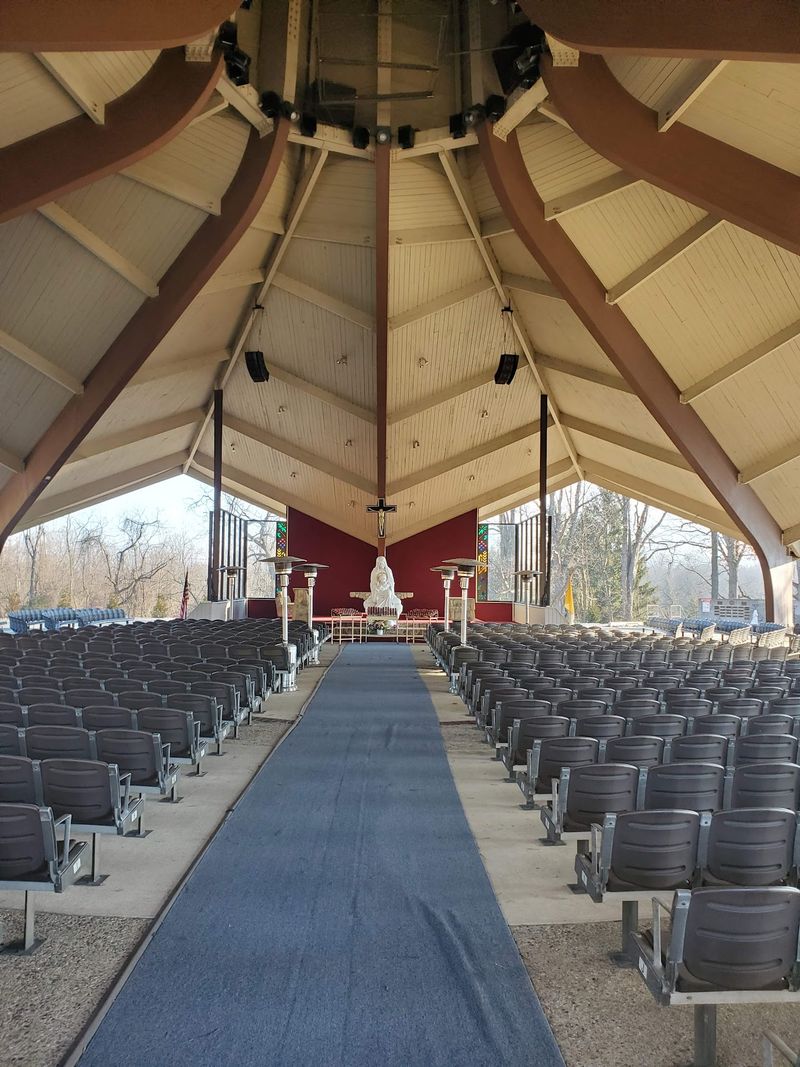
At 11:30 each morning, the Rosary begins and establishes the daily rhythm of the shrine. Mass follows at noon, including on weekends, while confession is available before and after Mass.
Eucharistic Adoration continues after the noon service until 3 p.m. This consistent schedule makes it possible to arrive on an ordinary Tuesday or a quiet Sunday and experience the sanctuary as an active place of worship rather than a historic site preserved behind ropes.
There is no need to wait for a festival or special pilgrimage date. The regularity is part of what makes the experience appealing: prayer happens here every day, regardless of how busy the outside world happens to be.
Those who prefer private reflection can step into the Capelinha or the Holy Family Candle House, where flickering candles turn personal intentions into small points of light. Others may sit in the Blessed Sacrament Chapel or find an outdoor bench away from the main gathering spaces.
The shrine accommodates both communal devotion and the deeply individual kind, without making either feel out of place. Larger groups are welcome as well, though pilgrimages and retreat gatherings of 10 or more people must register in advance with shrine management.
During the monthly Fatima commemorations from May through October, the pace changes as pilgrims gather for processions, talks, Mass, Eucharistic devotions, and the blessing of religious articles. Yet even on those fuller days, the surrounding acreage provides room to step aside and regain a little quiet.
Practical details remain refreshingly simple. Admission is not treated like an attraction ticket, the grounds stay open from 9 a.m. until dusk, and visitors can decide whether to remain for one prayer, one slow walk, or most of the afternoon.
That freedom suits the sanctuary. Peace does not arrive here through elaborate programming or forced silence.
It gathers gradually in candlelight, measured footsteps, a familiar prayer, and the open space between one sound and the next.
Share this story