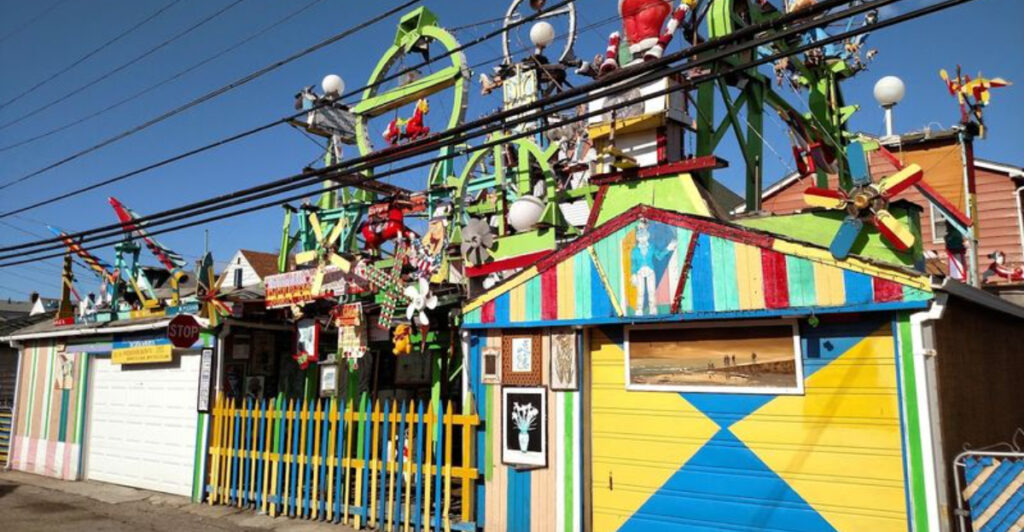
Behind a quiet row of homes on Klinger Street in Hamtramck, Michigan, one of the Midwest’s most unexpected outdoor art wonders hides in plain sight. There are no flashy billboards pointing the way, no grand entrance, and no big announcement telling visitors what they are about to discover.
Still, curious travelers keep finding their way to the alley behind 12087 Klinger St, where a backyard bursts into a world of spinning figures, painted wood, found objects, and hand-built sculptures spread across two connected residential lots. It feels part folk art dream, part neighborhood secret, and completely unlike anything most people expect to find tucked behind a Michigan house.
The Alley Approach That Changes Everything
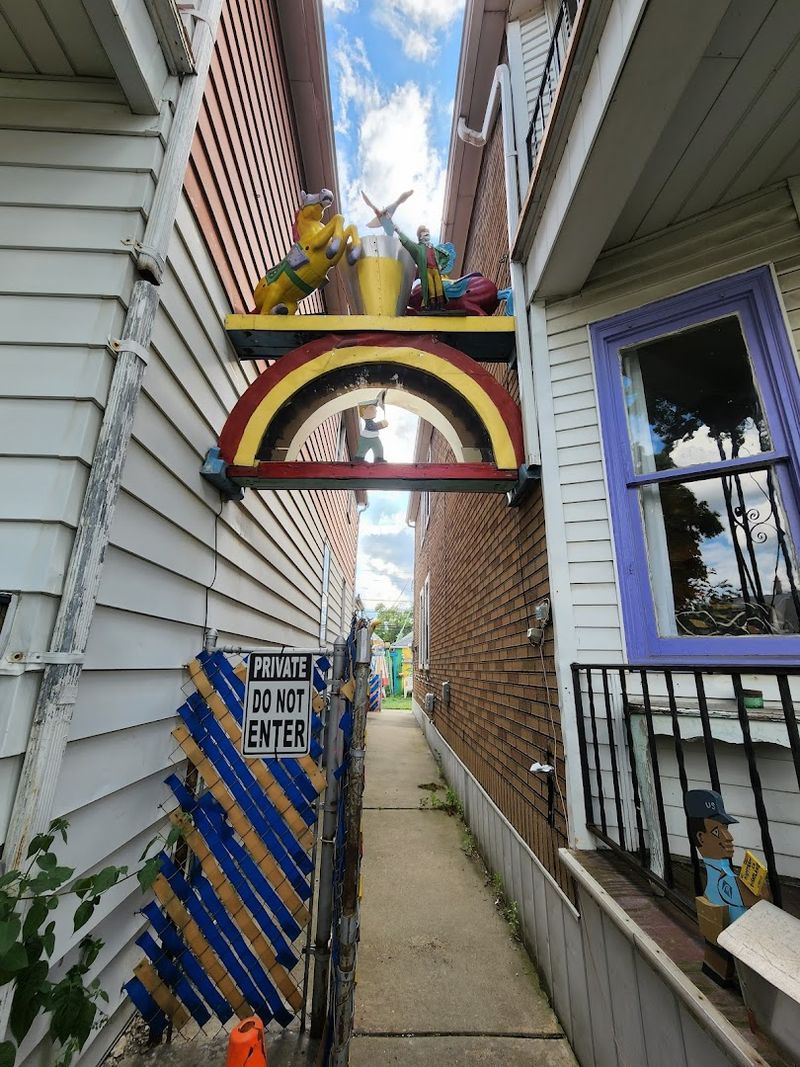
Most art galleries have a front door, a sign, maybe a velvet rope. Hamtramck Disneyland has an alley.
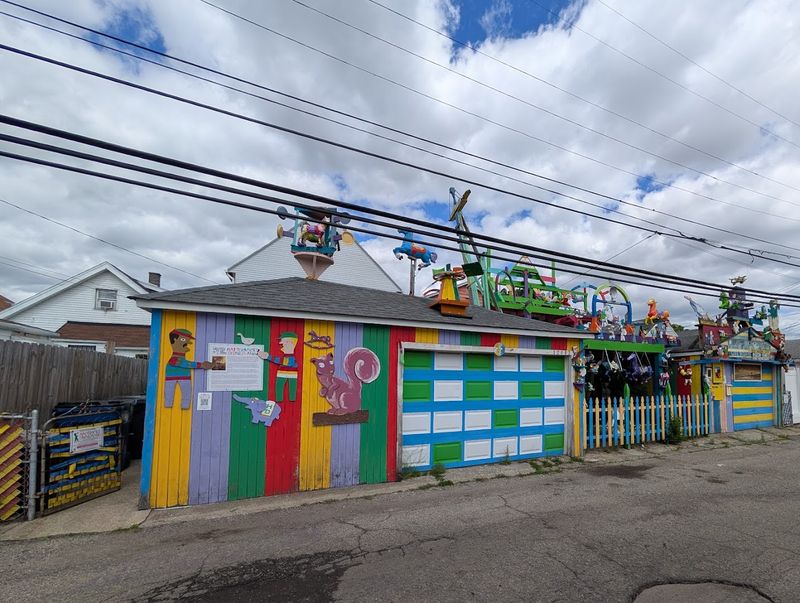
That shift in expectation is exactly what makes the first approach so striking. You drive or walk down a back lane lined with fences and utility poles, and then suddenly color explodes out of nowhere.
The correct entry point is through the alley behind the house, not from Klinger Street itself. The street-facing side has “no trespassing” signs that can confuse first-timers.
Once you round the block and access the alley, the installation opens up in a way that feels completely out of place with the surrounding neighborhood — and that contrast is a huge part of the experience.
The GPS marker on some map apps places the pin slightly off, which has sent more than a few visitors circling the block twice. The trick is to look for the alley running parallel to Klinger Street and follow it until the sculptures come into view.
A posted sign near the entrance confirms that touring the yard is welcome, so there is no need to hesitate once you spot it.
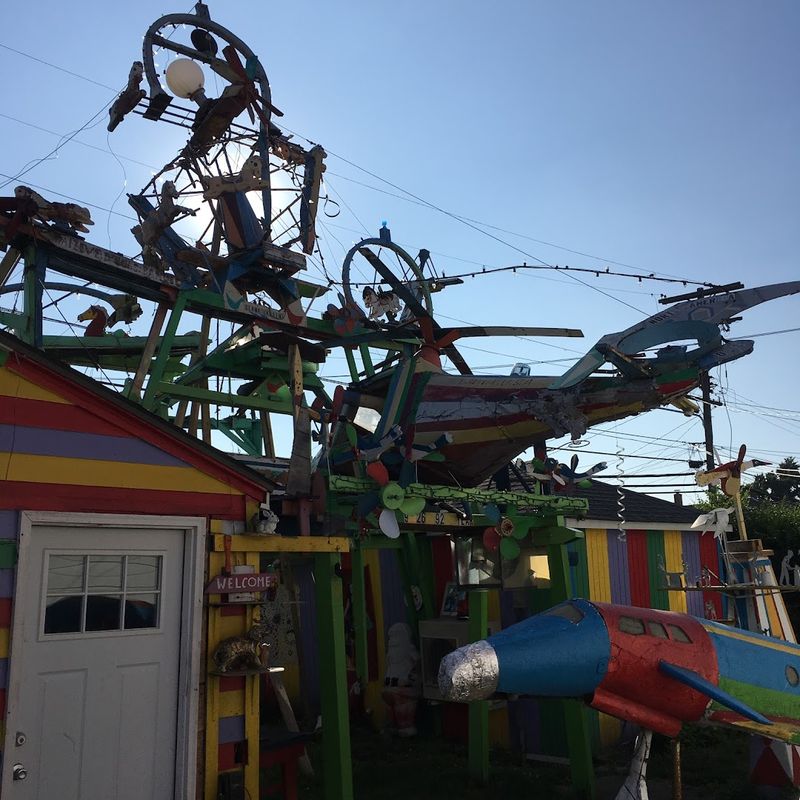
Coming in through the alley also gives you a panoramic first look at the entire installation before you step inside. Pinwheels spin in the wind.
Painted figures peer over fences. Handmade structures rise at odd angles above rooflines.
The whole scene lands like a visual puzzle you immediately want to walk through and decode piece by piece. For a place that never advertises itself, the alley entrance delivers a remarkably powerful first impression.
What Dominic Gerace Built Over Decades in Michigan
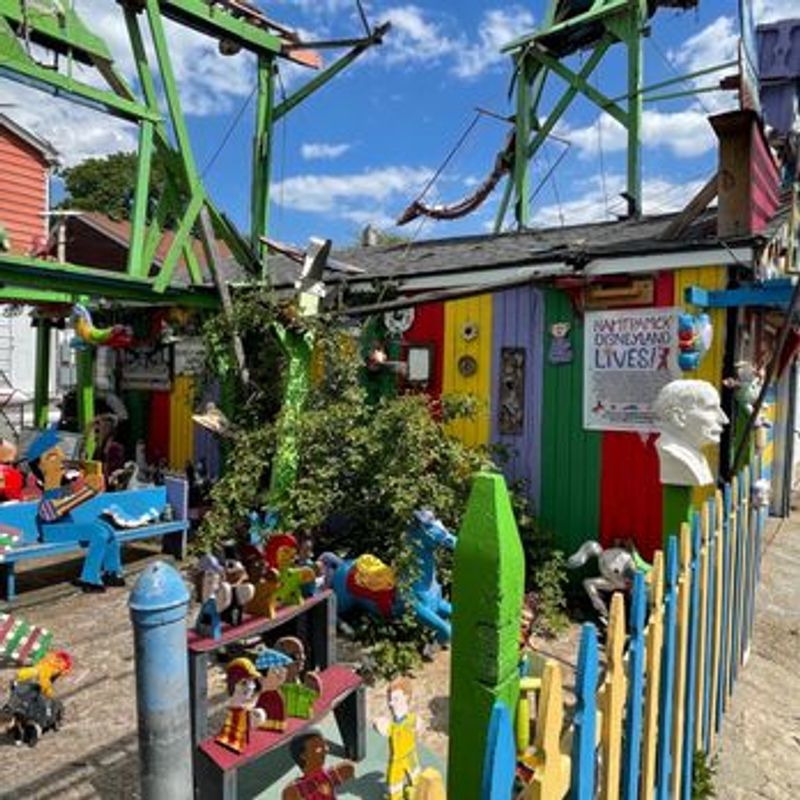
Dominic Gerace, a Ukrainian immigrant who settled in Hamtramck, began building his backyard world sometime in the 1990s. He worked as a maintenance man by trade, but the real work happened after hours, in his yard, using salvaged materials, recycled parts, and an imagination that had no obvious ceiling.
Over time, the installation spread from one lot to two.
Gerace passed away in 2019, but the project he left behind continues to draw visitors from across the country and beyond. The name “Hamtramck Disneyland” was not something Gerace gave it himself — neighbors and locals came up with the nickname, a nod to the sheer density of moving parts, color, and visual chaos packed into such a small residential space.
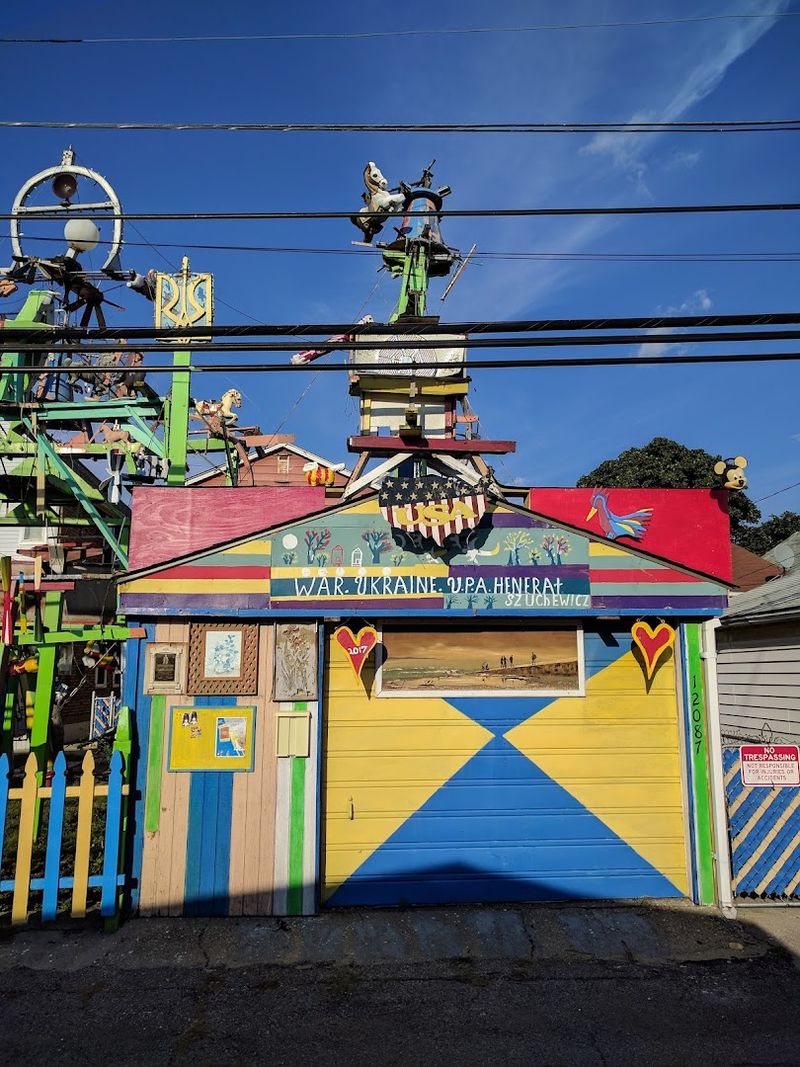
The pieces he created pull from Ukrainian folk traditions, mechanical ingenuity, and pure personal expression. Painted figures, wind-powered kinetic elements, religious iconography, and found-object assemblages all share the same cramped, layered space.
Nothing about it was designed to match. Everything about it was designed to be looked at closely.
After his death, a group connected to the Hatch Art organization stepped in to help preserve and restore the installation. Volunteers have contributed to ongoing restoration work, and people say that on some visits, the restorers themselves are present and willing to walk guests through the pieces currently being repaired.
That living, working quality gives the installation a dimension that most static art spaces simply do not have. Gerace spent decades building something personal in his own backyard, and now that backyard belongs, in some small way, to everyone willing to find the alley.
Kinetic Sculptures, Painted Figures, and Layers You Keep Finding
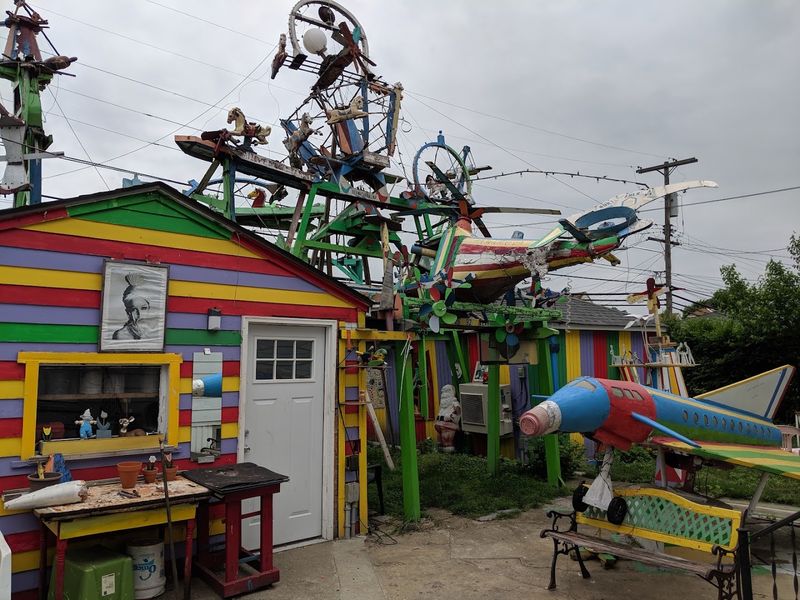
Stand still for a moment inside the installation and you will notice things moving. Pinwheels and wind-driven mechanisms spin at different speeds depending on the breeze.
Painted arms rotate. Hanging objects sway.
The kinetic energy built into so many pieces means the installation is never quite the same twice, which rewards repeat visitors in a way that purely static displays cannot.
Beyond the movement, the sheer density of visual detail is what keeps people rooted in place far longer than they expected. Painted faces look out from wooden panels.
Figures are stacked, layered, and clustered together in arrangements that seem chaotic until a pattern starts to emerge. Ukrainian folk motifs appear alongside mechanical parts, religious imagery, and decorative elements that are harder to categorize.
Children tend to turn the visit into a scavenger hunt, looking for hidden figures tucked into corners or objects mounted high up near rooflines. Adults do the same thing, just with slightly more composure.
The installation rewards slow looking. People who walk through in five minutes miss the details that make the whole thing worth visiting.
Spending twenty to thirty minutes and actually examining individual pieces reveals a level of craft and intentionality that a quick glance completely misses.
Color is everywhere — reds, blues, yellows, and greens applied to wood, metal, and found objects without any apparent concern for coordination. The result is visually loud in the best possible way.
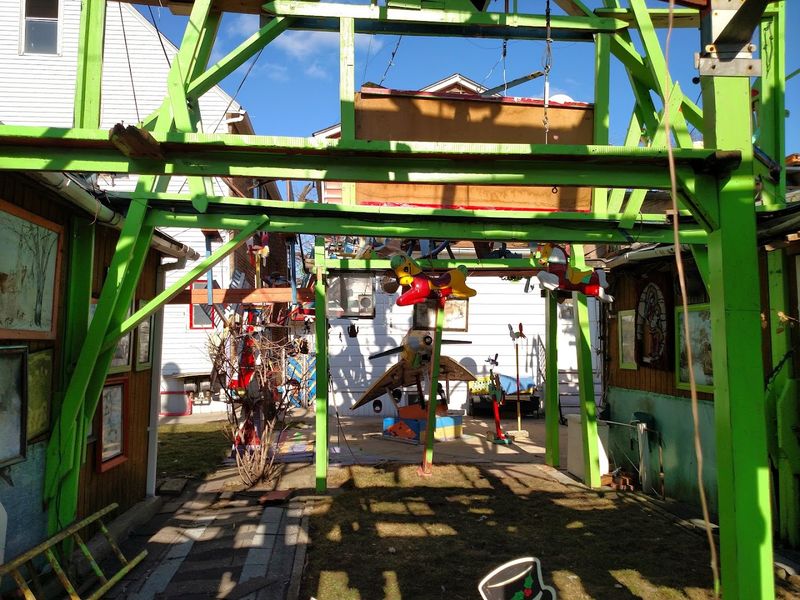
Each corner of the yard introduces something new, and the layered vertical height of the installation means there is always something happening at ground level, mid-height, and above your head simultaneously. It is dense, deliberate, and endlessly interesting to pick apart.
Free, Open 24 Hours, and Asking Only for Respect
No ticket booth. No admission fee.
No scheduled hours. Hamtramck Disneyland is listed as open around the clock, every day of the week, which makes it one of the most accessible art destinations in Michigan.
The installation operates on a trust-based model — visitors are welcome to tour the yard, and a Venmo donation option is posted near the entrance to support ongoing restoration work.
That open-access approach is part of what makes the place feel different from a traditional museum or gallery. There is no staff member directing foot traffic or explaining what you are looking at.
The experience is entirely self-guided, which means it rewards curious, patient visitors who are willing to slow down and look carefully without anyone prompting them to do so.
The request posted at the site is simple: be respectful. The installation sits in a residential neighborhood, and real people live nearby.
Keeping noise down, not touching the artwork, and treating the space like someone’s home — because it is — goes a long way toward preserving the experience for future visitors. The neighborhood around Klinger Street is working-class and lived-in, and the installation exists within that real community context rather than in an isolated gallery setting.
Daytime visits are strongly recommended over evening trips. The natural light helps bring out the colors and details in the artwork, and the surrounding neighborhood feels more comfortable to navigate during daylight hours.
Parking is available on the street, and the walk to the alley entrance is short. For a completely free, no-reservation-required art experience, the low barrier to entry is a genuine strength.
Toss a few dollars into the donation fund on the way out — the restoration crew has earned it.
How Hamtramck Itself Shapes the Experience
Hamtramck is a small, densely packed city completely surrounded by Detroit. It has a long history as an immigrant community, home at various points to Polish, Yemeni, Bangladeshi, and Ukrainian populations, among others.
That layered cultural identity shows up in the neighborhood surrounding the installation, and understanding that context adds a meaningful dimension to what Gerace built in his backyard.
The Ukrainian folk art traditions woven through the installation connect directly to the immigrant experience that defined so much of Hamtramck’s 20th-century identity. Gerace was not creating in a vacuum — he was expressing something rooted in his own cultural background while living in a city that had always been shaped by people building new lives out of old memories.
The backyard installation is, in that sense, a very Hamtramck kind of project.
The surrounding streets have a gritty, unpolished quality that contrasts sharply with the explosion of color and craft inside the installation. That contrast is not a flaw — it is the point.
Art made from salvaged materials in a working-class backyard carries a different weight than the same art placed in a downtown gallery. The neighborhood context is part of the artwork’s meaning, not just its setting.
Hamtramck itself is worth exploring before or after visiting the installation. The city has a dense concentration of restaurants, cultural organizations, and small businesses that reflect its diverse population.
Visiting the installation as part of a longer exploration of Hamtramck gives the whole trip more depth. The backyard art becomes one piece of a larger story about a city that has always found ways to make something extraordinary out of ordinary materials and everyday life.
Comparing It to Howard Finster and the Folk Art Tradition
People familiar with Howard Finster’s Paradise Garden in Georgia will find familiar energy at Hamtramck Disneyland. Both are backyard environments built by self-taught artists working outside the formal art world, using personal vision and found materials to construct something that goes far beyond decoration.
The comparison is not exact — Gerace’s work has its own distinct visual language — but the spirit of obsessive, expansive creation is shared.
Folk art and outsider art as categories have gained serious academic and collector attention over the past few decades, but the best examples of the form were never made with galleries in mind. Gerace built his installation for himself, for his neighbors, and perhaps for some audience he sensed would eventually find its way down the alley.
That lack of commercial intention gives the work a directness that is hard to manufacture.
The use of found and recycled materials is central to the aesthetic. Discarded mechanical parts, painted wood scraps, repurposed household objects — all of it gets absorbed into the installation’s visual logic.
Nothing is precious in the traditional art-world sense, yet the cumulative effect is genuinely impressive. The resourcefulness required to build something this complex from salvaged components is its own form of artistic skill.
For visitors who have spent time with other major folk art environments across the United States, Hamtramck Disneyland fits into a recognizable tradition while still feeling specific to its place and creator. For visitors who have never encountered this category of art before, the installation serves as an excellent and accessible introduction.
Either way, it is the kind of place that expands what most people think art is allowed to look like and where it is allowed to live.
Why This Backyard Belongs on Your Michigan Itinerary
A fifteen-minute stop that genuinely surprises people is rare. Most quick detours deliver exactly what they promise — a brief distraction before the next thing.
Hamtramck Disneyland tends to hold people longer than they planned, not because it is large, but because it keeps offering new things to look at the longer you stay. That quality is harder to engineer than size.
The installation sits at a specific address in a specific city, and that specificity matters. This is not a recreation or a curated version of someone else’s vision.
Dominic Gerace built this in his actual backyard over the course of his actual life. The restoration team working to preserve it is made up of real volunteers with real investment in keeping it standing.
Every element of the place has a direct human connection that most tourist attractions simply cannot replicate.
For anyone building a Michigan road trip, Hamtramck Disneyland works particularly well as an addition to a Detroit-area itinerary. It is close enough to downtown Detroit to fold into a day that includes other stops, and distinctive enough to justify the small detour on its own terms.
The combination of free admission, open hours, and a genuinely unusual visual experience makes it an easy yes for anyone already in the region.
Bring a camera. Wear comfortable shoes for standing and slowly moving through a compact space.
Donate what you can at the entrance. And take the time to actually look at what is in front of you rather than rushing through for a quick photo.
The details are where the real payoff lives, and the whole installation rewards the kind of attention most people reserve for places that charged them admission. This one earns it for free.
Share this story