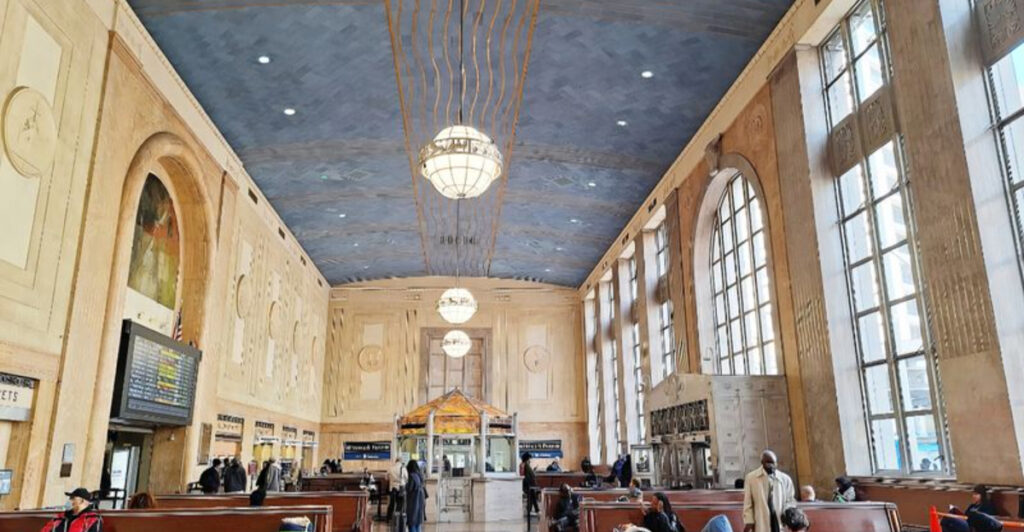
Four enormous globe chandeliers glow above a floor patterned in red, gray, and cream terrazzo, while carved airplanes, ships, and locomotives watch from the walls. This is not the lobby of a glamorous old hotel.
It is Newark Penn Station, where commuters hurry beneath zodiac symbols with coffee in one hand and a phone in the other. The contrast is pure North Jersey: grand architecture, serious transportation, and absolutely no time to dawdle.
Opened in 1935, the station combines Art Deco drama with the everyday bustle of trains, buses, subways, and taxis. Many passengers pass through without looking beyond the departure board, but those who slow down discover one of the state’s finest public interiors.
Its marble, metalwork, sculpted medallions, and luminous glass make an ordinary commute feel unexpectedly cinematic. Newark Penn is not polished into a museum piece, either.
It remains busy, useful, a little gritty, and unmistakably alive.
Newark Penn Station Is More Than a Place to Catch a Train
Stand near the center of the main waiting room during the morning rush and the building’s real personality comes into focus. NJ TRANSIT riders head toward New York, Amtrak passengers check the board for Philadelphia or Washington, PATH trains carry commuters toward Lower Manhattan, and local buses fan out across Newark.
All of that movement converges at 1 Raymond Plaza West, between downtown and the Ironbound. Few American stations manage this many types of transportation under one roof, and even fewer do it inside a landmark that looks ready for a black-and-white movie premiere.
The station also works as one of Newark’s most practical front doors. The Prudential Center is roughly a five-minute walk away, making the building the natural arrival point for Devils games and concerts.
The New Jersey Performing Arts Center, Newark Museum of Art, and Military Park are also within walking distance.
Head in the opposite direction and Ferry Street opens into the Ironbound, where Portuguese bakeries, Brazilian barbecue restaurants, and old-school neighborhood bars offer far better choices than standard station food.
That location gives Newark Penn a role well beyond commuting. It links the city’s business district, entertainment venues, residential neighborhoods, and restaurants without requiring visitors to get behind the wheel.
Even the layout reflects that bigger purpose. The tracks sit above street level, while concourses, waiting areas, bus lanes, and light rail connections operate underneath and around them.
The result can feel hectic at peak times, but it is organized chaos with nearly a century of practice behind it. People come through to work, catch a hockey game, meet family, reach the airport, or transfer between cities.
The architecture may earn the photographs, but the constant flow of Newark life is what keeps the place from becoming a beautiful relic.
A 1930s Landmark Built for the Golden Age of Rail
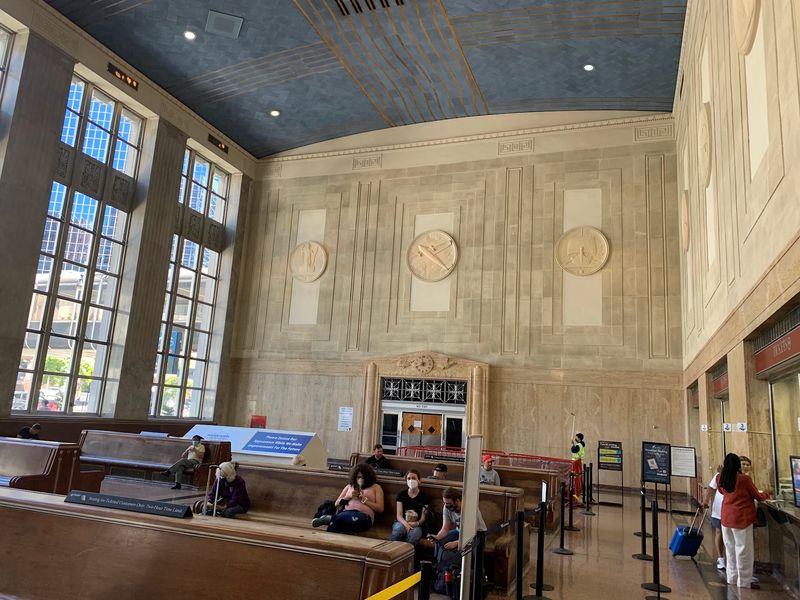
March 24, 1935, marked the first full day of regular train service at the new Pennsylvania Station in Newark. The timing was bold.
America was still dealing with the Great Depression, yet the Pennsylvania Railroad and the City of Newark had invested in a transportation complex that projected confidence on a monumental scale.
The complete project cost approximately $42 million at the time, split between the railroad and the city, and construction continued in stages until 1937.
The celebrated firm McKim, Mead & White designed the station. Its résumé included New York’s original Pennsylvania Station, the grand Beaux-Arts terminal demolished in the 1960s, as well as major civic and university buildings across the country.
Newark’s station took a more modern direction. Rather than copying a Roman bath or classical temple, the architects blended a formal limestone structure with the streamlined curves and machine-age decoration of Art Deco.
The main station house measured about 302 feet long and 79 feet deep, while the elevated train shed stretched roughly 1,200 feet. Beneath it, massive foundations reached approximately 80 feet down to bedrock.
The project was never just about erecting a pretty waiting room. It included electrified rail service, new roads, city subway access, connections with the Hudson and Manhattan Railroad that later became PATH, and lift bridges over the Passaic River.
Newark’s older 1889 station could no longer handle the city’s growth or the rising number of commuters traveling to New York. Its replacement was planned as a true intermodal terminal before that term became standard transit language.
The station earned a place on both the New Jersey and National Registers of Historic Places decades later. What makes it especially valuable is that it still performs the job for which it was designed.
This is 1930s infrastructure carrying modern passengers, not a former terminal converted into shops or event space.
Art Deco Details Turn the Waiting Room Into a Masterpiece
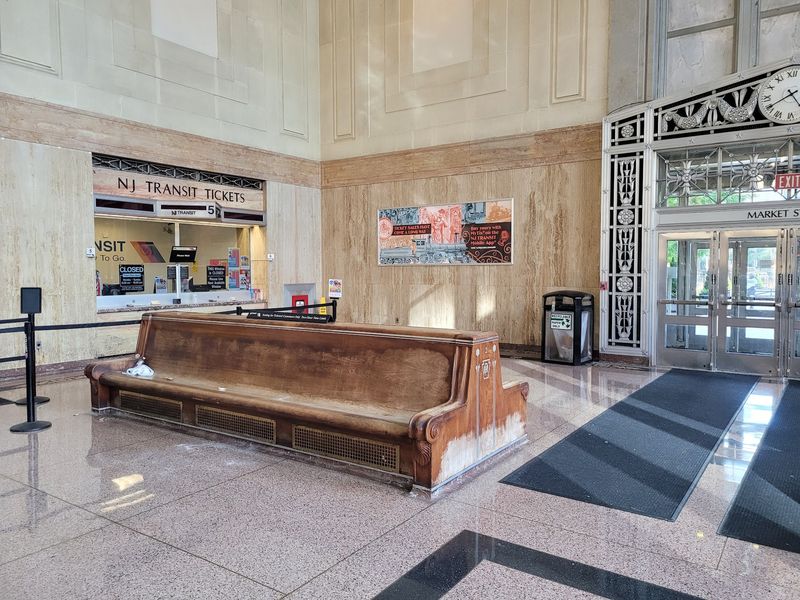
The best way to appreciate the waiting room is to put the departure board out of mind for a minute and look in every direction. Start with the floor.
Its reddish terrazzo forms sweeping bands and geometric patterns, a practical surface made theatrical through color and movement. Along the walls, red marble meets tall sections of travertine, giving the room weight without making it feel gloomy.
Above them sit sculpted medallions illustrating the changing history of transportation. Wagons, ships, steam locomotives, automobiles, and airplanes appear like chapters in a story about human movement.
There is a slightly cheeky message hidden in that sequence. The railroad built the room, yet it gave competing forms of transportation prominent billing.
The original walnut benches are another detail worth examining. Their sturdy frames and curved ends were designed for heavy daily use, but aluminum inlays bearing the Pennsylvania Railroad’s keystone emblem turn ordinary seating into custom furniture.
Aluminum appears throughout the station in grilles, signs, ticket windows, and decorative trim. Today it is an unremarkable material; in the 1930s, its clean silver finish signaled speed, technology, and modern life.
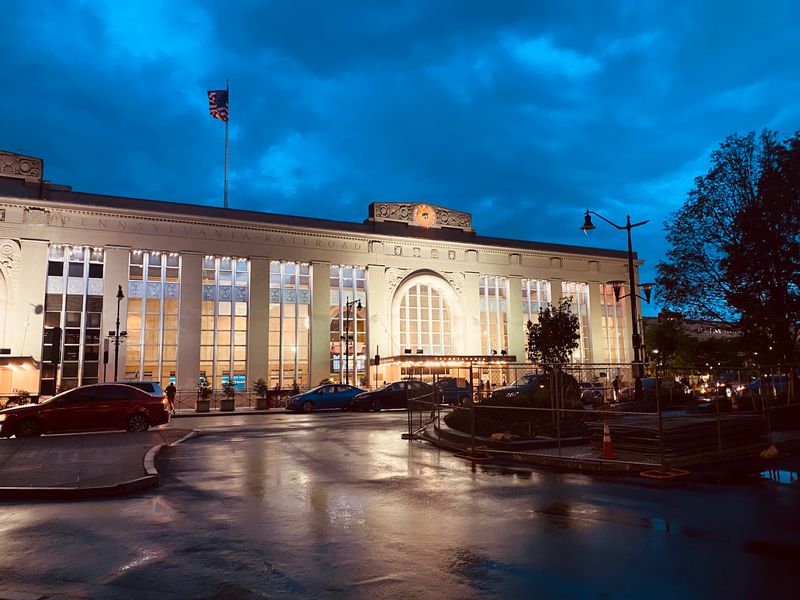
Outside, the same design language continues across a façade of gray Indiana limestone set above a rubbed pink-granite base. Two enormous arched entrance bays dominate Raymond Plaza West.
One was crowned with a clock, while the other carried an astrological design that echoed the fixtures inside. Stylized carvings, fluted columns, metal mullions, and sculpted eagles reward anyone willing to look past the traffic.
None of these flourishes interferes with the station’s function. Curves guide people toward doors and passageways, decorative bands organize the concourses, and durable materials stand up to crowds.
That balance is the building’s cleverest trick. Newark Penn looks ornate, but nearly every beautiful feature was also made to work.
Zodiac Chandeliers and Stained Glass Steal the Show
Then there are the chandeliers, which seem almost comically grand for a room where someone is usually sprinting toward Track 2. Four large globe fixtures hang from the gently arched ceiling, each surrounded by white-bronze metalwork decorated with signs of the zodiac.
The opal-glass spheres cast a soft glow rather than the harsh light found in most modern transit halls. Above them, blue ceiling panels with gold-colored bands deepen the planetarium effect.
The astrological theme was not random. Stars, planets, clocks, and zodiac imagery appeared often in Art Deco buildings, tying architecture to motion, navigation, and an optimistic fascination with the future.
Newark Penn carried the motif from the waiting room to the exterior entrance. The station’s luminous windows deserve a closer look too, though “stained glass” is not quite the full architectural story.
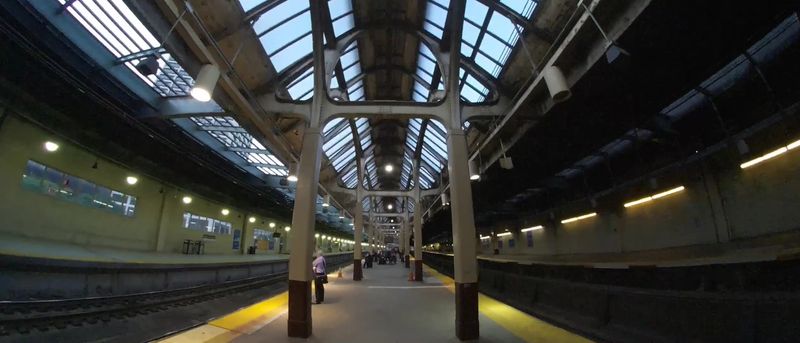
The dramatic south window was originally glazed with translucent alabaster marble, which filters daylight with the warm, mottled appearance of stained glass. Standard glass fills other tall openings, while the covered platforms feature long bell-shaped skylights made with corrugated wire glass.
Those skylights curve overhead in flowing sections, bringing daylight into a space that could otherwise feel like a dark box beneath the tracks. Their wave-like surface repeats the rounded lines found throughout the building.
Together, the alabaster, opal glass, and skylights produce the glowing effect that makes the station feel almost cathedral-like. The comparison is especially convincing during quieter periods, when sunlight catches the stone and terrazzo and the waiting room briefly settles.
A train announcement soon breaks the spell, naturally. That interruption is part of the charm.
These features were not created for a private club or ceremonial hall. They were designed for ordinary passengers, including people too busy checking their platform number to notice that Taurus, Gemini, and Leo are shining above their heads.
The Station Remains One of New Jersey’s Busiest Transit Hubs
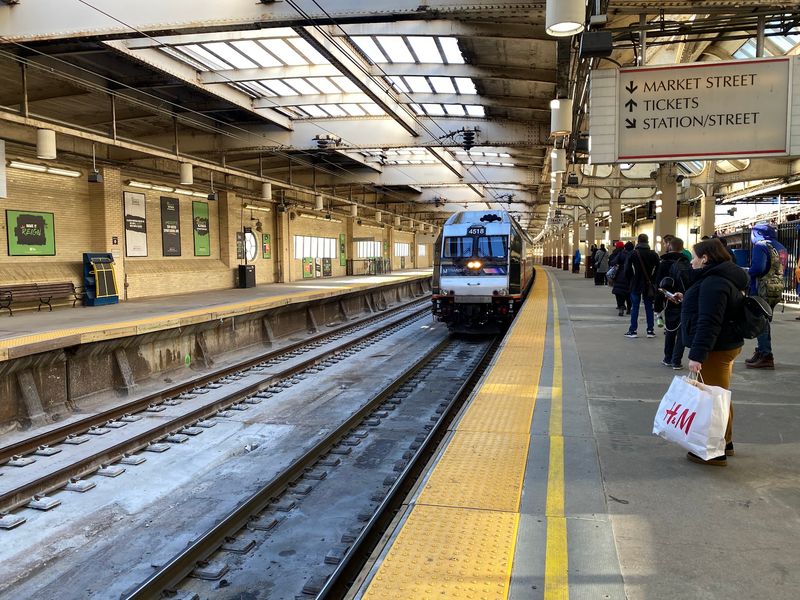
At Newark Penn, the calmest-looking person is often the one who already knows which staircase to use. The station serves NJ TRANSIT’s Northeast Corridor, North Jersey Coast, and Raritan Valley lines, placing it on key routes to New York Penn Station, Trenton, the Jersey Shore, and communities across central New Jersey.
Amtrak trains add longer-distance service along the Northeast Corridor, including connections toward Boston, Philadelphia, Baltimore, and Washington. PATH operates between Newark, Jersey City, and the World Trade Center, while Newark Light Rail links the terminal with Newark Broad Street Station and stops through the city.
Outside, NJ TRANSIT buses connect the station to numerous Essex County neighborhoods and destinations farther afield. That web of service explains why the building feels busy even outside the traditional rush hour.
A Devils game can fill the concourses with red jerseys. A delayed Northeast Corridor train creates an instant crowd around the departure board.
Late-night PATH riders mix with travelers rolling suitcases in from Newark Liberty International Airport. The airport itself is only a few miles south, reached by NJ TRANSIT or Amtrak to the airport rail station and then AirTrain.
Newark Penn’s ticket office is generally open from 6 a.m. to 10 p.m. every day, and 14 ticket vending machines are spread across the complex.
The station never operates like a hushed architectural attraction, so anyone hoping to study the details should expect real transit conditions: announcements, construction barriers, commuters moving quickly, and the occasional last-second platform change.
Midday and weekend mornings usually make looking around easier than weekday peaks. The practical side of the station is precisely what gives the historic setting its energy.
Those zodiac lights still shine because people need illumination. The walnut benches still matter because passengers need somewhere to sit.
Ninety years after opening, the building remains an active machine for moving New Jersey.
A Major Restoration Is Bringing Back Its Original Glory
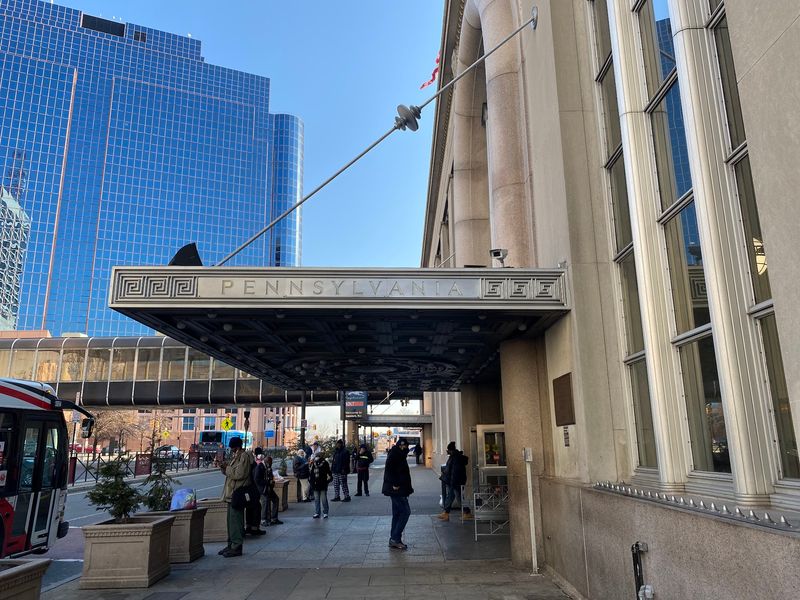
Years of heavy use leave marks, even on pink granite and terrazzo. In 2020, New Jersey announced a five-year, $190 million program to renovate and modernize Newark Penn while preserving the features that make it special.
The work began with a $30 million round of improvements, followed by a much larger group of station, platform, accessibility, and mechanical upgrades. Some of the early changes were straightforward but noticeable.
Crews installed brighter energy-efficient lighting, repainted common areas, restored historic stairwell tile, updated restroom fixtures, cleaned the exterior, and added lighting beneath the Market Street and Edison Place underpasses.
Historic backlit platform signs were restored, drainage and paving were improved, and the four globe fixtures in the main waiting room were upgraded.
The old kiosk occupying part of that room was also removed, giving the landmark interior more breathing space. More substantial work has included restoring original wooden benches, improving heating and cooling equipment, replacing platform doors, adding elevator access, and repairing Platform D.
Plans for that platform cover its deck, canopy, columns, drainage, communications, lighting, cameras, accessible information displays, and the reglazing of its distinctive skylight.
Longer-range improvements have focused on the grand waiting room, concourses, entrances, escalators, elevators, public-address equipment, customer information screens, pedestrian access, and the area around Raymond Plaza West.
Renovating a station this busy is less like remodeling an empty landmark and more like repairing a car while it is traveling down the Turnpike. Work must continue around active trains and thousands of daily trips, and historic materials cannot simply be swapped for whatever is cheapest.
The goal is not to freeze Newark Penn in 1935. It is to let the station keep doing its demanding modern job without sanding away the zodiac symbols, transportation medallions, curved skylights, and walnut benches that make the trip through it unlike any other in New Jersey.
Share this story