An 11,000-year-old mastodon stands in the middle of a Victorian exhibition hall, surrounded by dinosaur tracks, glowing minerals, and an Egyptian mummy. The surprising part is not the collection itself.
It is where you find it: upstairs inside an unassuming brownstone building on Rutgers University’s College Avenue campus. The Rutgers Geology Museum has occupied Geology Hall in New Brunswick since 1872, yet plenty of lifelong New Jersey residents have never stepped through its doors.
Those who do discover an old-school museum in the best sense, complete with wooden cases, a wraparound upper gallery, and specimens connected directly to the state beneath their feet. There are no sprawling crowds or steep admission prices here.
Entry is free, the displays reward close inspection, and the building feels like a surviving cabinet of curiosities from another century. It is compact enough for an easy afternoon visit but strange and substantial enough to keep the whole family talking afterward.
A Hidden Treasure on the Rutgers Campus
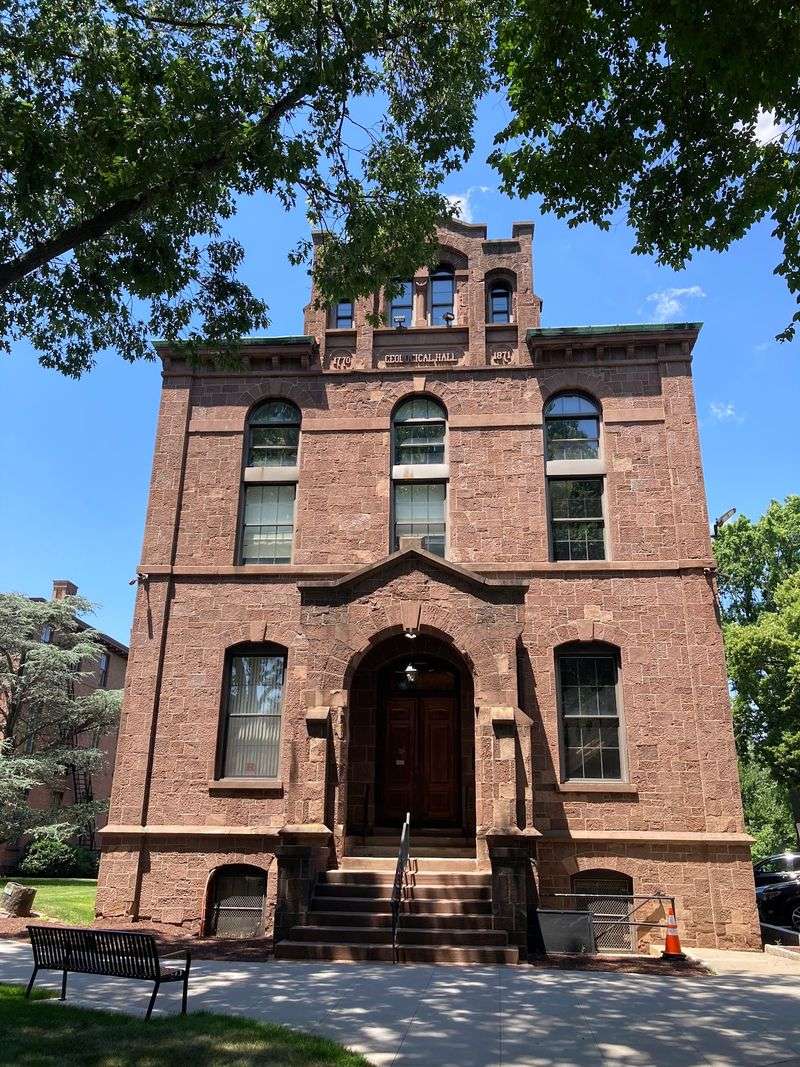
Walk past the iron gates near Old Queens and Geology Hall can be surprisingly easy to miss. It does not have a giant roadside sign, a flashy entrance, or a plaza packed with tour buses.
The reddish-brown stone building simply sits among the historic structures of Rutgers University, looking more like a handsome academic hall than the home of one of New Jersey’s most unusual collections. That low profile is a major reason the museum still feels like a genuine local secret.
Geology Hall was erected in 1871, and the museum was founded the following year by George H. Cook, a Rutgers professor who also served as New Jersey’s state geologist.
Cook wanted the specimens collected by the New Jersey Geological Survey to educate students and the public, a mission the museum continues more than 150 years later. Rutgers identifies it as the oldest geology museum in the United States.
The building has a pedigree of its own. It was designed by Rutgers graduate Henry Janeway Hardenbergh, who later became the architect behind New York City landmarks including the Dakota apartment building and the Plaza Hotel.
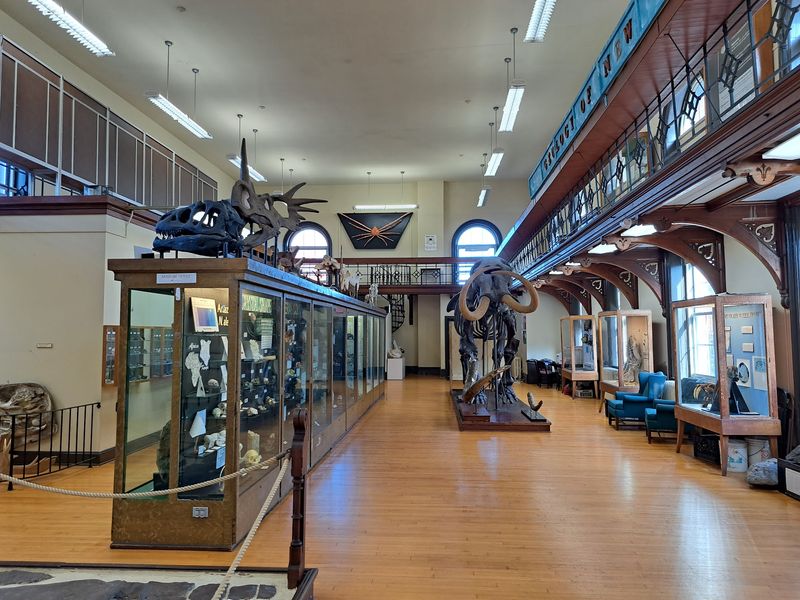
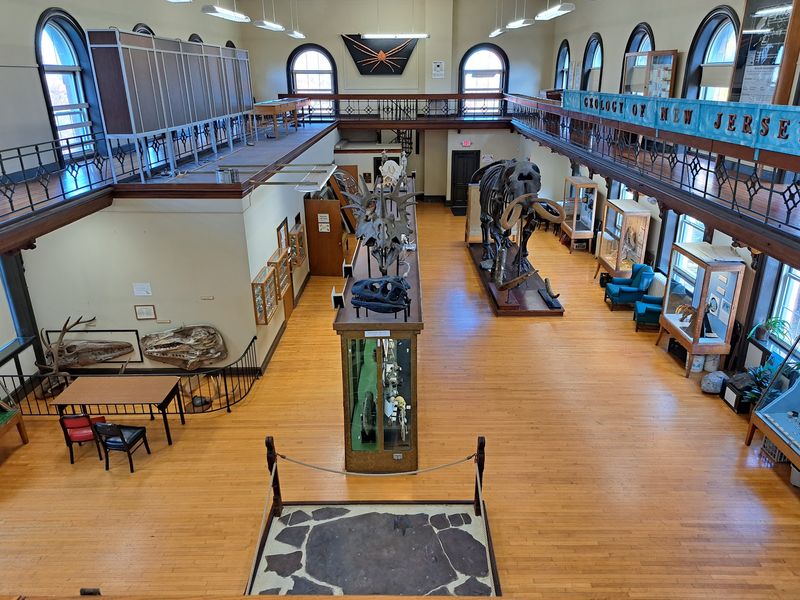
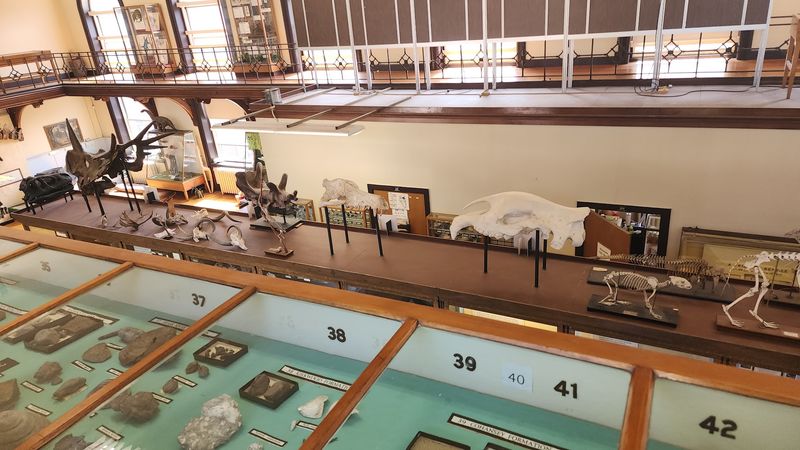
Once upstairs, visitors enter a long Victorian exhibition room with tall ceilings and a narrow gallery wrapping around the space above. The layout has changed over the decades, but it still carries the character of a 19th-century natural history museum.
Glass-fronted cases line the room, large specimens occupy the central floor, and nearly every corner contains something worth examining. Unlike enormous institutions where seeing everything can become a test of endurance, this museum encourages a slower look.
You can circle the cases, climb to the gallery, and double back when an unusual fossil catches your eye. It feels less like checking off attractions and more like being let into Rutgers’ wonderfully eccentric scientific attic.
Meet Manny the Mastodon
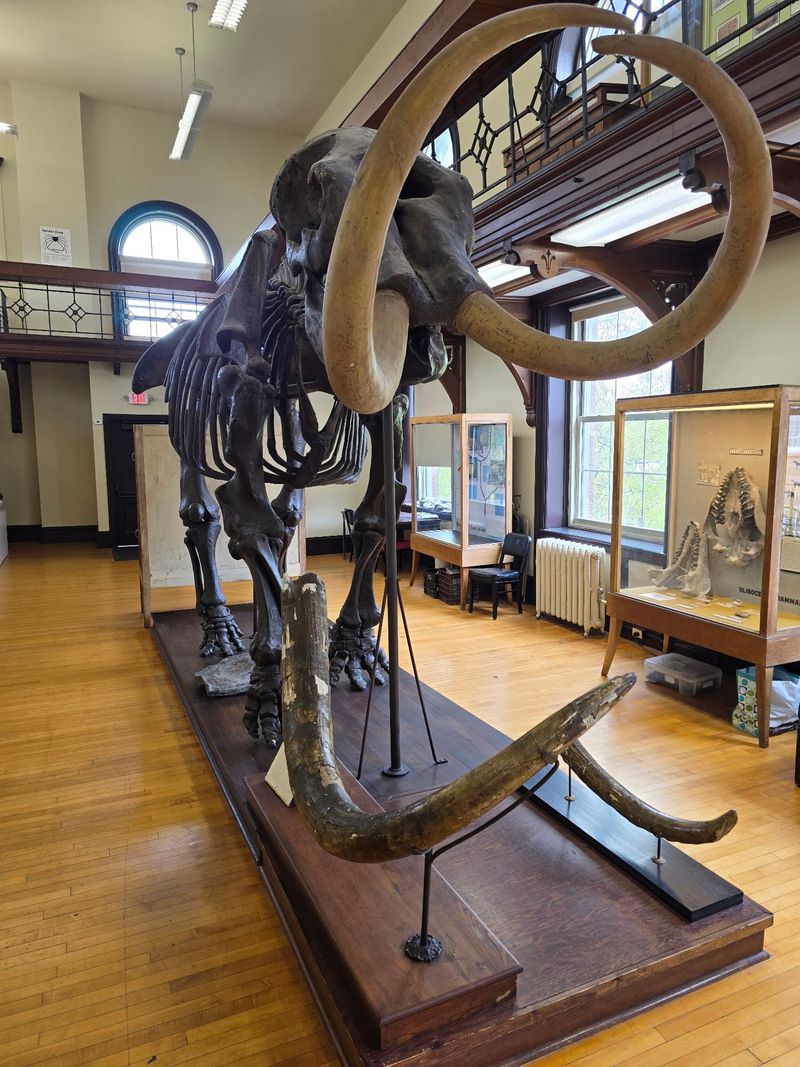
There is no easing into the main attraction. Manny occupies the central floor with long tusks, massive ribs, and the unmistakable stance of an animal that once outweighed nearly everything around it.
The fully articulated American mastodon skeleton is almost complete, making it far more than a decorative replica. These are the remains of a real Ice Age animal discovered in 1869 on a farm in Mannington Township in Salem County.
George H. Cook purchased the specimen, and the skeleton was mounted inside the museum in 1896.
It has watched generations of Rutgers students pass through Geology Hall ever since. Manny lived roughly 11,000 years ago, when the landscape of New Jersey looked dramatically different.
Mastodons roamed wooded areas across North America, feeding on twigs, leaves, and other vegetation with ridged teeth built for crushing rather than grazing. Although they resembled mammoths and modern elephants, mastodons belonged to a separate branch of the proboscidean family tree.
Standing beneath Manny makes those distinctions feel much more interesting than they ever did in a textbook. His size is impressive, but his local connection is what gives the display its punch.
This animal did not come from a distant desert or a famous fossil bed out West. It was found in South Jersey soil.
Younger visitors tend to focus first on the tusks, while adults often linger over the story of the discovery and preservation. The museum has leaned into Manny’s popularity, even making him the subject of a children’s book created by Rutgers students and museum staff.
Yet the skeleton does not need a mascot treatment to hold the room. In the quiet of the old hall, with the upper gallery framing him and antique cases nearby, Manny feels less like an exhibit placed for effect and more like the building’s longtime resident.
After more than a century on display, he has earned the privilege.
Discover New Jersey’s Prehistoric Past
New Jersey’s dinosaur credentials are much better than its Turnpike-and-strip-mall reputation suggests. In 1858, Hadrosaurus foulkii was unearthed in a marl pit in Haddonfield, becoming the first nearly complete dinosaur skeleton discovered in North America.
It was also the first dinosaur skeleton mounted for public display anywhere in the world. Hadrosaurus later became New Jersey’s official state dinosaur, and the Rutgers museum gives this homegrown celebrity its proper place in the story.
The display includes an ankle bone from a Hadrosaurus and a 19th-century painting by wildlife illustrator Robert Bruce Horsfall. The artwork shows the duck-billed animals standing upright and dragging their tails, which was once considered scientifically accurate.
Modern reconstructions position their bodies more horizontally, with their tails held off the ground for balance. That contrast offers a clever lesson in how science changes when new evidence appears.
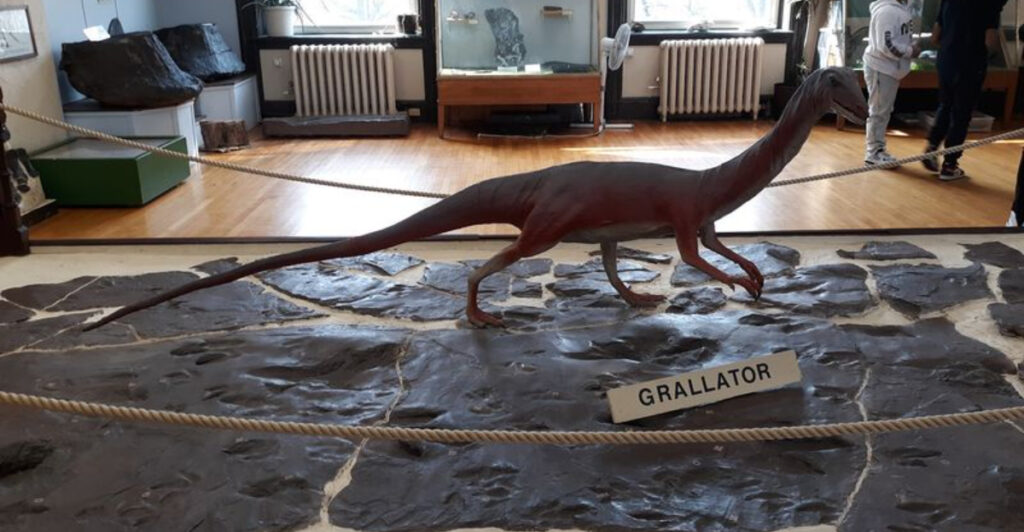
Nearby, a much larger piece of rock provides another direct link to the state’s prehistoric residents. The dinosaur trackway was found in Towaco in Morris County and contains three-toed Grallator prints associated with a small meat-eating dinosaur.
Mud cracks and other markings preserve details of the ancient surface, turning what looks at first like an oversized stone slab into a frozen patch of Jurassic New Jersey. The state was not always dry land, either.
During the Late Cretaceous period, much of the region lay beneath a shallow sea, where mosasaurs hunted as dominant marine predators. Fossils and displays throughout the museum help connect these shifting environments, from dinosaur country to ocean floor to the colder world inhabited by Manny.
That local emphasis is the museum’s real strength. Fossils can sometimes feel detached from everyday life, especially when their labels point to places thousands of miles away.
Here, names such as Haddonfield, Towaco, Mannington, Franklin, and Ogdensburg keep appearing. The exhibits quietly redraw the state map, replacing highways and subdivisions with forests, ancient seas, and animals that vanished millions of years before New Jersey had a name.
More Than Dinosaur Bones and Ancient Fossils
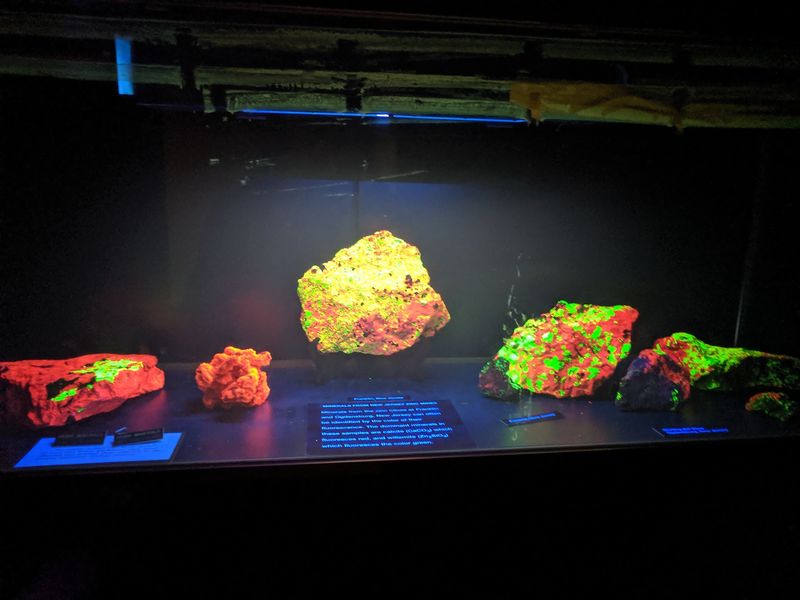
A darkened mineral display can make even the most rock-indifferent visitor stop in place. Under ultraviolet light, specimens from New Jersey’s historic mining districts glow in vivid reds, greens, and oranges, revealing colors that remain hidden under ordinary illumination.
The museum’s fluorescent mineral holdings are especially appropriate for the Garden State. Franklin and Ogdensburg in Sussex County are internationally known for unusual mineral diversity, and many specimens from their former zinc mines fluoresce brilliantly.
A major part of the museum’s collection came from George Rowe, a captain with the New Jersey Zinc Company who donated 2,400 fluorescent specimens in 1940. Another featured display draws from the 6,000-specimen collection assembled by mineral enthusiast Milton Hershhorn.
The cases contain far more than attractive stones. They document New Jersey’s mining history, geological composition, and outsized importance to mineral science.
Then the museum takes an unexpected turn. Iset-Ha, an Egyptian woman believed to have been a priestess, rests here with her sarcophagus and related artifacts.
The mummy dates to the Ptolemaic period, approximately 320 to 30 B.C., and is on loan from the nearby New Brunswick Theological Seminary. Her presence makes more sense once you know that the word “geology” carried a broader meaning when the museum was established.
Early natural history collections commonly brought together anthropology, biology, paleontology, and mineralogy rather than separating them into modern departments. That tradition also explains the enormous Japanese spider crab, whose restored exoskeleton spans roughly 11 feet.
Additional cases hold meteorites and explain how the solar system and layered planets formed. Together, the exhibits make the museum feel delightfully unpredictable.
One moment you are studying zinc minerals pulled from Sussex County mines; the next, you are face-to-face with an ancient Egyptian burial or examining an animal from the waters off Japan.
The subject keeps changing, but the underlying question remains the same: What can physical objects tell us about worlds we never witnessed?
A Free Adventure for Curious Visitors of All Ages
Zero dollars buys a surprising amount of wonder in New Brunswick. General admission is always free, and visitors can ask museum staff for a complimentary scavenger hunt that turns the cases into a low-tech detective game.
That combination makes the museum particularly useful for families looking for an outing that does not require buying multiple tickets, booking a timed entrance, or committing an entire day.
Most people can comfortably explore the hall in about an hour, though children determined to complete every scavenger-hunt clue may stretch that considerably.
The compact space also keeps younger visitors from becoming exhausted halfway through the experience. There is always another attention-grabbing object close by, whether it is Manny’s tusks, a glowing mineral, a dinosaur footprint, or the mummy’s decorated sarcophagus.
Adults are not reduced to supervising from a bench, either. Historical labels, changing scientific interpretations, and the New Jersey connections give grown-ups plenty to investigate on their own.
The museum welcomes everyone from preschoolers to college students and adults, and its educational programs are designed accordingly. Guided group tours explore dinosaurs and paleontology, the Ice Age, geology, and ancient Egypt.
A gentler dinosaur story-time format is available for children around age six and younger, while school and Scout groups can arrange hands-on activities and specialized fossil or mineral programs. Public events add another layer to the calendar, including themed museum nights, lectures, and the long-running annual open house.
Even the small gift shop keeps things approachable, with natural-history items generally priced from about $1 to $20. Because the museum sits on the College Avenue campus, a visit can easily become a wider New Brunswick afternoon.
Old Queens, Kirkpatrick Chapel, and the Schanck Observatory are nearby, while the Zimmerli Art Museum is roughly a 10-minute walk away.
Downtown restaurants and the New Brunswick train station are also close, creating the rare family outing where ancient bones, campus architecture, and lunch can all happen without moving the car.
What to Know Before You Visit
The museum is located inside Geology Hall at 85 Somerset Street in New Brunswick, near the historic core of Rutgers’ College Avenue campus. Look for the black iron gates and the brownstone academic building rather than a freestanding museum entrance.
The New Brunswick NJ Transit station is only a few minutes away on foot, making the train one of the simplest options for visitors coming along the Northeast Corridor. Drivers can look for metered spaces on Somerset Street, George Street, Hamilton Street, or College Avenue.
Nearby public garages and non-Rutgers lots marked with a “P” are another option, while some university lots become available to visitors on weekends. Campus parking restrictions can change, so posted signs matter.
During the academic year, the standard public schedule is Tuesday through Thursday from 10 a.m. to 5 p.m., Friday from 10 a.m. to 4 p.m., and Saturday from 10 a.m. to 2 p.m. The museum is normally closed on Sundays, Mondays, major holidays, and university breaks.
Summer hours are substantially more limited. In 2026, walk-in visits were offered on Thursdays and Fridays during June, Fridays during July, and the museum closed to visitors and tours for August.
Checking the current calendar before leaving home is essential, especially between May and September. Admission remains free during regular public hours.
One important limitation comes with the historic building: the museum is on the second floor, visitors must climb two flights of stairs, and Geology Hall does not have an elevator. Anyone with mobility concerns should contact the museum before planning a visit.
For those able to make the climb, the reward is a museum that still occupies the room built to house it more than 150 years ago. The stairs lead not to a polished modern attraction, but to Manny, glowing minerals, old wooden cases, and one of the most unexpected rooms in New Jersey.
Share this story