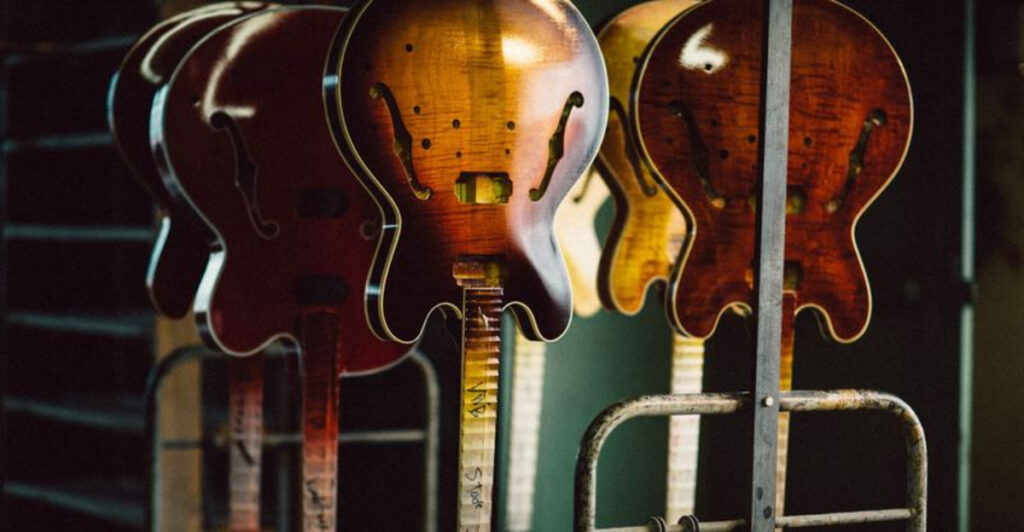
The sound of American music has passed through Kalamazoo in ways most people never realize. Along Parsons Street, the old Gibson factory at 225 Parsons Street once helped shape the future of electric guitars, with instruments crafted by hand inside a building now steeped in rock, blues, and jazz history.
Today, Heritage Guitars keeps that legacy alive in the same historic space, carrying forward the kind of craftsmanship that still feels personal, precise, and deeply connected to the music it serves. Walking through these doors is not just a factory visit.
It is a step into a living piece of Michigan music history, where wood, wire, skill, and sound still come together every day.
The Building That Started It All
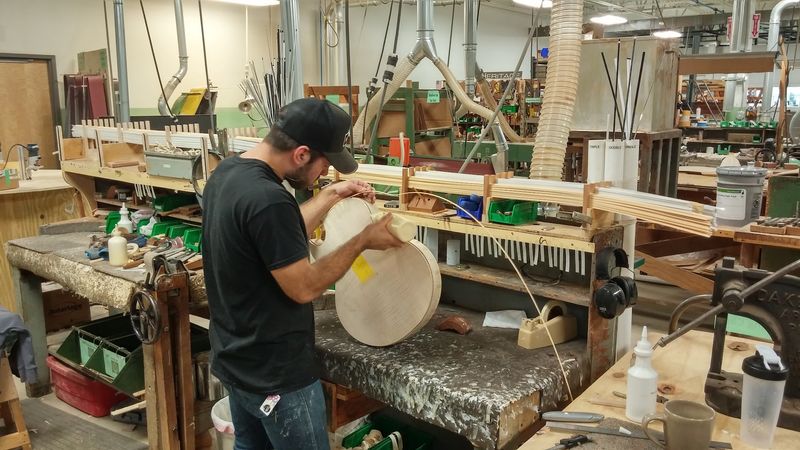
Long before Heritage Guitars occupied this address, the factory at 225 Parsons Street in Kalamazoo was the beating heart of Gibson’s electric guitar production. Gibson moved operations to Nashville in 1984, but a group of dedicated craftsmen refused to walk away from the building or the trade they had spent their careers mastering.
They stayed behind, pooled their knowledge, and launched Heritage Guitars right here on the same factory floor.
The building itself carries unmistakable Midwest industrial character. Red brick walls, wide production floors, and the faint smell of lacquer and sawdust greet you the moment you step inside.
Nothing about the space has been dressed up for tourism or scrubbed into a museum aesthetic. This is a working factory, and it looks exactly like one.
That rawness is actually part of the appeal. Seeing production equipment running in the same rooms where Gibson-era luthiers once worked gives the whole place a sense of unbroken continuity.
The machinery has been updated where necessary, but the bones of the original factory remain intact and unmistakable.
Kalamazoo itself deserves credit for preserving this kind of industrial heritage. Many cities have lost their manufacturing landmarks to demolition or redevelopment, but this building has survived because the people inside it refused to let the craft die.
The address has become something of a pilgrimage point for guitar enthusiasts traveling through Michigan.
Standing outside before you even enter, you can read the layers of history in the facade. Faded markings, worn loading dock edges, and the sheer scale of the structure all communicate that serious work has happened here for a very long time.
The building earns its reputation before a single guitar is even picked up.
Heritage Guitars: Born From Refusal to Quit
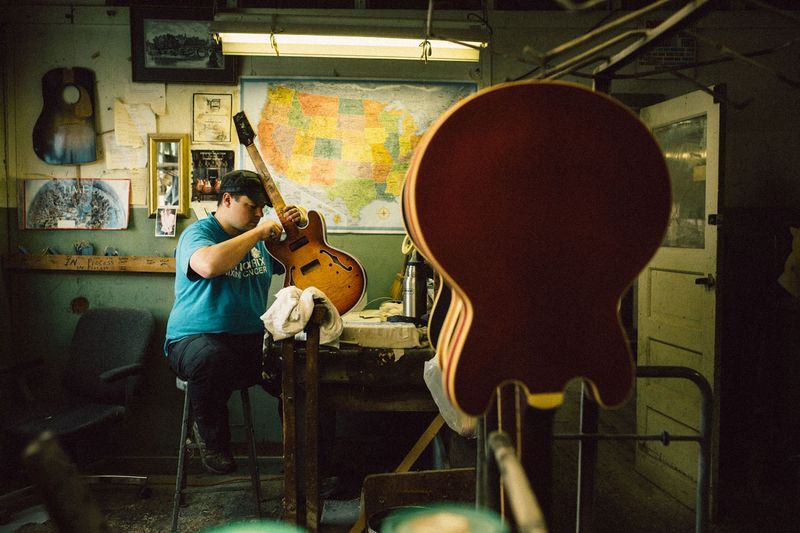
When Gibson packed up and left Kalamazoo in 1984, five veteran employees made a decision that would quietly reshape the American guitar industry. Jim Deurloo, Marv Lamb, J.P.
Moats, Bill Paige, and Mike Korpak chose to stay. They negotiated access to the old factory, acquired tooling and materials, and founded Heritage Guitars almost immediately after Gibson’s departure.
Their timing was bold, their reasoning was simple: the best guitar-making knowledge in the world was sitting right here in Kalamazoo, and walking away from it would be a waste. Every model Heritage produces traces its DNA directly back to the classic Gibson designs these founders had spent their professional lives building.
The H-150, modeled after the legendary Les Paul-style body, remains one of Heritage’s most celebrated instruments.
Players who have made the switch from Gibson to Heritage often describe the difference in terms of consistency and attention to detail. Because Heritage operates on a much smaller production scale, each guitar receives more hands-on time from skilled builders.
That extra time shows up in the playability, the resonance, and the overall feel of the finished instrument.
The company has grown steadily over the decades, attracting a loyal following among professional musicians and serious hobbyists alike. Models like the H-535 semi-hollow and the Super Eagle have earned devoted audiences in blues, jazz, and rock circles.
Heritage guitars have appeared on stages and in studios across the world, often without the fanfare that surrounds larger brand names.
Ownership changed in 2016 when a new investment group acquired Heritage, bringing fresh resources without abandoning the handcrafted approach. Production remains in Kalamazoo, and the founding philosophy of skilled American craftsmanship still drives every guitar that leaves the building.
What a Factory Tour Actually Looks Like
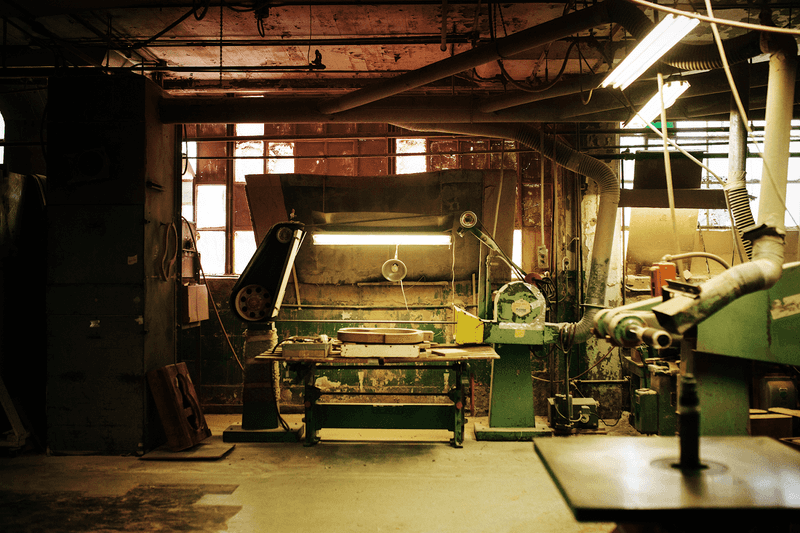
Factory tours at 225 Parsons Street are not scripted, choreographed experiences designed to impress casual tourists. They move through a live production environment where craftspeople are actively working, and that distinction makes them genuinely fascinating.
You are not watching a demonstration staged for your benefit. You are watching a guitar being built.
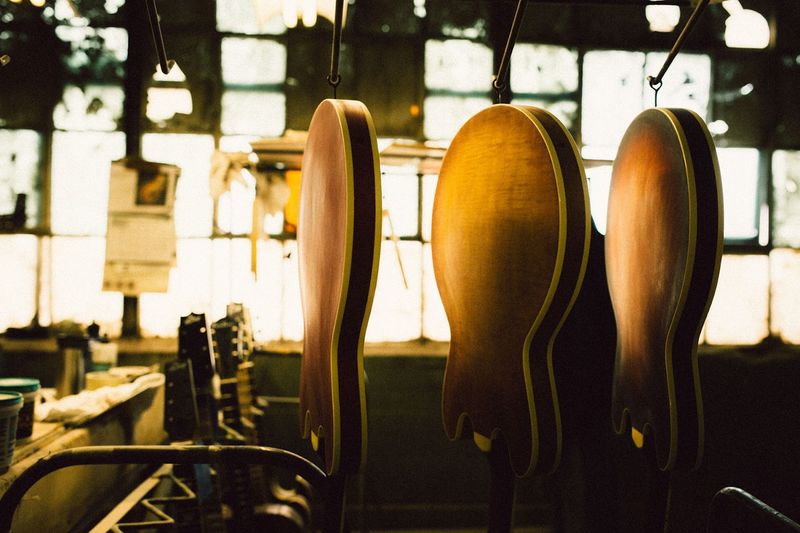
Tours typically begin near the wood preparation area, where raw maple and mahogany are thickness-planed and cut to spec. From there, the route moves through body routing stations, neck shaping benches, and assembly areas before reaching the finishing room where lacquer is applied in careful layers.
Each stage reveals how much manual skill is involved even when machinery assists the process.
The neck shaping station tends to generate the most reaction from visitors. Watching a craftsperson carve and sand a guitar neck by hand, checking the profile repeatedly against their palm and fingers, makes clear why Heritage necks have such a consistent and comfortable feel.
No machine replicates that kind of tactile feedback loop.
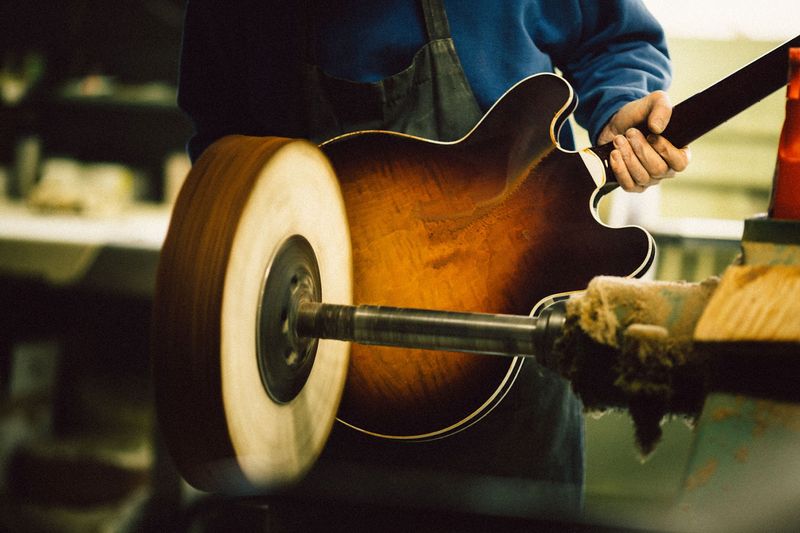
Finishing and buffing is another stage that surprises people. The lacquer process involves multiple coats applied over time, with sanding between each layer.
The final buffing step brings the surface to a mirror-like gloss, and watching it happen live is genuinely satisfying in a way that photographs cannot fully communicate.
Tour availability has varied over the years depending on production schedules and staffing, so reaching out in advance is the smartest move before making a trip. Groups have historically been kept small, which keeps the experience personal rather than crowded.
A production manager or senior staff member typically leads the walk-through, and questions are welcomed throughout rather than saved for a formal Q-and-A at the end.
The Craftspeople Who Keep the Knowledge Alive
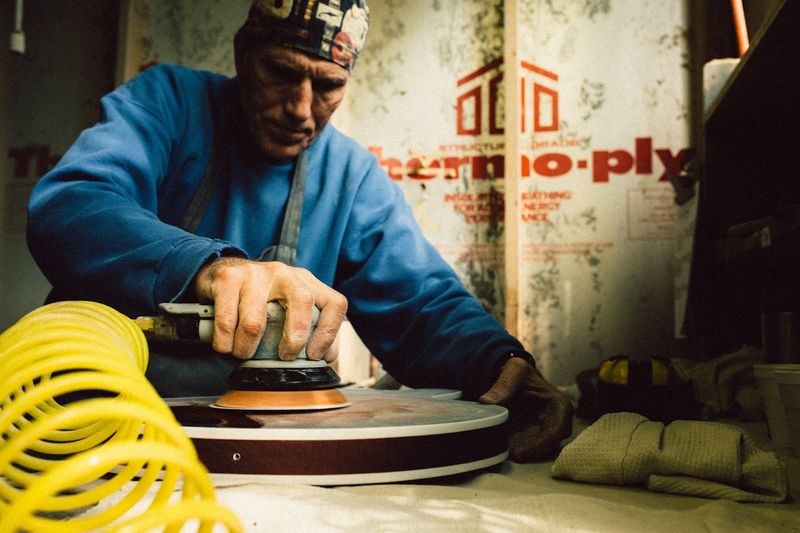
Guitar building at this level is not a skill you pick up in a weekend class. The craftspeople working inside 225 Parsons Street carry knowledge that has been accumulated over decades, passed down through direct mentorship on the factory floor.
Several of the original Heritage employees trained younger builders over the years, creating a chain of expertise that connects the current workforce directly back to the Gibson era.
That depth of experience shows up in ways that are hard to quantify but easy to feel. The way a neck joint is fitted, the care taken when setting the bridge height, the hand-finishing applied to fret ends — these are not steps that get rushed or skipped when you have decades of professional pride invested in the outcome.
The craftspeople here understand that their names are, in a sense, attached to every guitar that leaves the building.
Visitors who have taken the factory tour consistently note how approachable the builders are during the walk-through. Workers do not pause dramatically to explain their process for the cameras.
They keep working, answer questions naturally, and occasionally demonstrate a technique when curiosity is obvious. That lack of performance makes the interaction feel honest.
The workforce at Heritage has always been relatively small compared to mass-production guitar companies. That scale is intentional.
Keeping the team tight means maintaining higher individual accountability for quality. Every person on the floor knows the instruments they work on by the time they reach the shipping stage.
Michigan has a long tradition of skilled manufacturing labor, and the Heritage team fits squarely within that legacy. Their work represents a specific kind of American craft knowledge that takes years to develop and, once lost, is extraordinarily difficult to rebuild from scratch.
Guitar Models Worth Knowing Before You Visit
Knowing the Heritage lineup before you arrive makes the visit considerably richer, especially if you get the chance to play an instrument during or after the tour. Heritage produces a focused range of models, each with a clear lineage and a specific tonal character that reflects the Gibson-era designs the founders grew up building.
The H-150 is probably the most recognized model in the catalog. Its solid mahogany body and maple top follow the same fundamental architecture as the original Les Paul design, and players consistently praise its sustain and warmth.
The instrument has attracted fans across genres, from blues players who want thick, singing lead tones to rock guitarists who need a guitar that cuts through a loud mix.
The H-535 is a semi-hollow thinline that occupies a different sonic territory altogether. Its chambered body produces a slightly airier, more resonant response that suits jazz and blues particularly well.
Several professional players have used the H-535 as their primary touring instrument, drawn to its balance between acoustic warmth and electric punch.
The Super Eagle sits at the top of the lineup in terms of ornamentation and craftsmanship complexity. It features a fully hollow archtop body with elaborate binding and inlay work that takes considerably more time to complete than a standard solid-body model.
Jazz guitarists tend to gravitate toward the Super Eagle for its rich, round tone and its visual presence on stage.
Heritage also produces the Eagle and several other archtop and semi-hollow variants that round out the catalog. Seeing these instruments in person, hearing them played even briefly, and understanding how each one was built in the same building you are standing in changes how you hear them afterward.
Planning Your Trip to Kalamazoo, Michigan
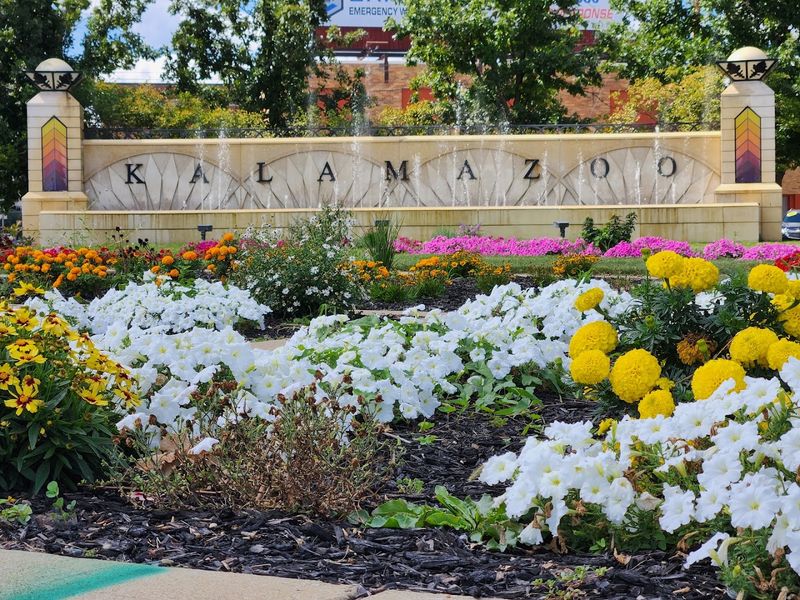
Kalamazoo sits in southwestern Michigan, roughly midway between Chicago and Detroit along the I-94 corridor. That location makes it a logical stop for road trippers moving across the Midwest, and the Heritage factory at 225 Parsons Street is easy to reach from the highway without navigating complicated city traffic.
The surrounding neighborhood is a quiet, working-class industrial area that feels unhurried and unpretentious.
Parking near the factory is generally straightforward. The area around Parsons Street does not have the congestion of a downtown district, so arriving by car is the most practical approach for most visitors.
Public transit options exist within Kalamazoo, but the factory location is more convenient by personal vehicle.
Tour availability is the most important variable to plan around. Heritage has historically offered tours on a scheduled basis, but production demands and staffing can affect availability on any given day.
Contacting Heritage in advance is strongly recommended rather than simply showing up and hoping for the best. The staff has a well-documented track record of going out of their way to accommodate visitors who communicate ahead of time, including arranging off-hours tours for travelers who have come a long distance.
Kalamazoo itself offers enough to fill a full day around a factory visit. The city has a walkable downtown with independent restaurants, a craft brewing scene that has earned regional recognition, and the Kalamazoo Institute of Arts for anyone who wants to extend the cultural experience beyond guitars.
Spring and fall tend to be the most comfortable seasons for a visit, though the factory operates year-round. Summer travel works well if you are combining the stop with broader Great Lakes itinerary.
Arriving mid-morning on a weekday gives you the best chance of seeing the production floor fully active and staffed.
Why This Address Holds a Permanent Place in American Music History
Certain addresses carry weight beyond their zip codes. For guitar players and music historians, 225 Parsons Street in Kalamazoo, Michigan is one of those addresses.
The instruments built here during the Gibson years shaped the sound of electric music across multiple decades and genres. The ES-335, the Les Paul Standard, the Flying V — all of them passed through this building during peak production years.
Heritage Guitars did not simply inherit a building. They inherited a lineage.
The decision to keep producing in Kalamazoo rather than relocating to a cheaper or more convenient facility was a deliberate statement about where quality guitar building belongs. That commitment has paid off in instruments that hold their own against anything produced by larger, more heavily marketed competitors.
The guitar community tends to be deeply aware of provenance — where an instrument was made, by whom, and under what conditions. Heritage benefits enormously from its location and its history, but the guitars have to back up the story.
Based on the response from players who have owned Heritage instruments across multiple decades, they consistently do. The craftsmanship speaks without needing a marketing campaign behind it.
There is also something culturally significant about a small American manufacturer surviving and growing in an era when so much production has moved overseas.
Heritage represents a specific kind of stubbornness — the refusal to believe that handcrafted American instruments cannot compete on quality with anything built anywhere else in the world. That stubbornness has produced some remarkable guitars.
Visiting 225 Parsons Street is not just about seeing guitars being made. It is about witnessing a direct, unbroken line between the golden age of American electric guitar manufacturing and the present day. That line runs right through Kalamazoo, and it shows no sign of stopping.
Share this story