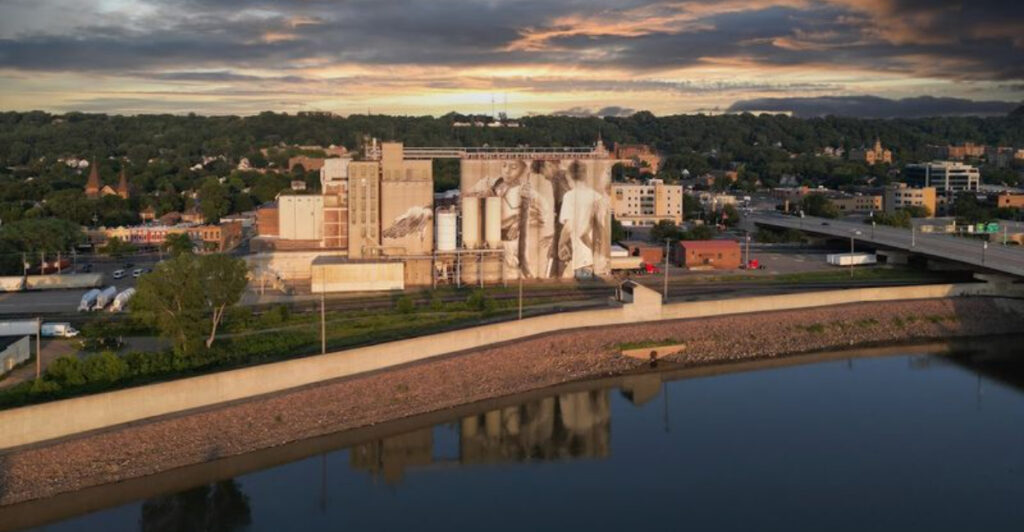
Some public art asks for a quick glance. Silo Art in Mankato demands that you stop, look up, and completely reset your sense of scale. Painted across towering grain silos along Riverfront Drive, these murals turn an industrial landmark into one of Minnesota’s most arresting sights.
The experience is part street-level spectacle, part city portrait, and part reminder that bold art can completely transform an ordinary block. From a distance, the images seem almost impossible in size. Up close, the details become even more impressive, turning a simple walk or drive past the silos into one of the city’s most memorable visual experiences.
The Upward Jolt That Hits Before You Even Park
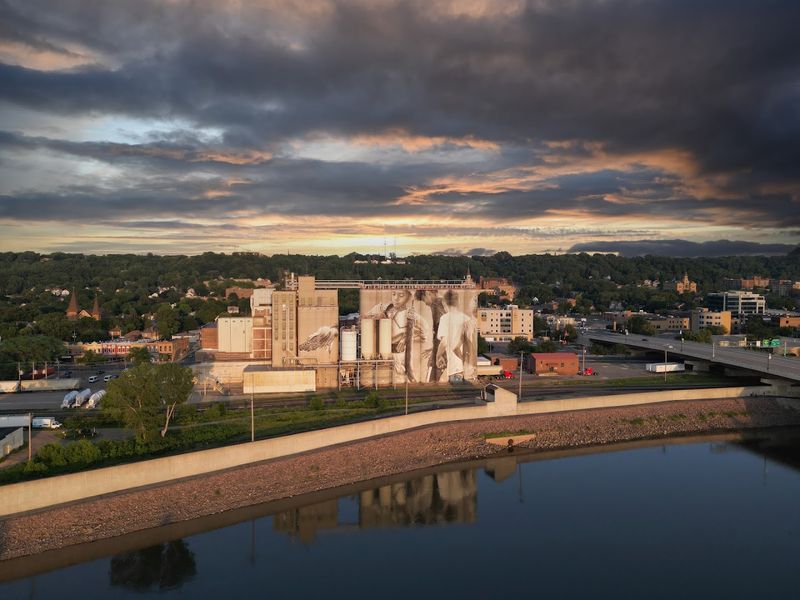
The first surprise at Silo Art is pure scale. You arrive in a working industrial area, then suddenly your eyes shoot upward and stay there, because the murals rise roughly 135 feet above the street and turn familiar storage silos into a vertical gallery.
That height changes how you look, how you move, and even how long you pause at the curb. At ground level, the concrete cylinders still read as infrastructure.
Then the painted forms start taking over, with huge faces, layered colors, and details that become clearer the longer you stand there.
Instead of flattening the surface, the art works with the rounded walls, so the imagery bends, wraps, and reappears as you shift position along the block.
That movement matters here. This is not the kind of mural you absorb in one fixed shot from directly in front. Every few steps reveal a different relationship between scale and detail, and the experience becomes more dramatic when the figures stretch across multiple silos rather than sitting neatly on a single wall.
The setting sharpens the effect. Trucks, pavement, rail-side textures, and industrial geometry make the painted imagery feel even more unexpected, almost like the city decided to place a monumental portrait in the middle of its working backbone.
Nothing about the location is overly polished, which makes the art feel bolder instead of staged. That contrast is what grabs you first. Silo Art does not ease into view with a tidy museum approach or a landscaped entrance.
It arrives all at once, oversized and unapologetic, and turns a practical structure into the kind of landmark that instantly changes the visual identity of its entire stretch of Mankato.
How the Main Mural Wraps a Whole Community Into One Image

The central achievement of Silo Art is not only its height. It is the way the mural uses several silo surfaces to create one connected visual statement, allowing figures and colors to flow around curved concrete in a way that rewards slow looking.
A quick glance catches the monumentality, but a longer look reveals composition, relationships, and surprisingly delicate transitions.
Because the mural wraps around multiple cylinders, the human figures do not behave like flat poster images. A shoulder disappears around a seam, a face stretches into view from one angle, and neighboring forms seem to reconnect when you cross the street or circle the nearby blocks.
That gives the artwork a sense of motion without any actual movement. There is also a civic idea built into the design.
The imagery has been widely described as celebrating local diversity, and that reading fits the experience of seeing distinct individuals held together in a shared composition.
On silos designed for storage and utility, the message lands with extra force because the canvas itself belongs to everyday labor and local infrastructure.
Fine detail is part of the draw. Even from below, you can pick out linework, shading, and color choices that keep the huge faces from turning blunt or cartoonish.
The painters did not rely on size alone to create impact, which is why the mural still holds attention after the first wow moment wears off.
That combination of scale and nuance is rare in public art. Silo Art gives you the instant payoff of a giant landmark, then follows it with subtler discoveries that make the whole composition feel considered rather than merely oversized.
It functions as spectacle, but it also reads as carefully built visual storytelling across an unusually complex surface.
Best Angles Around the Riverfront Blocks in Minnesota
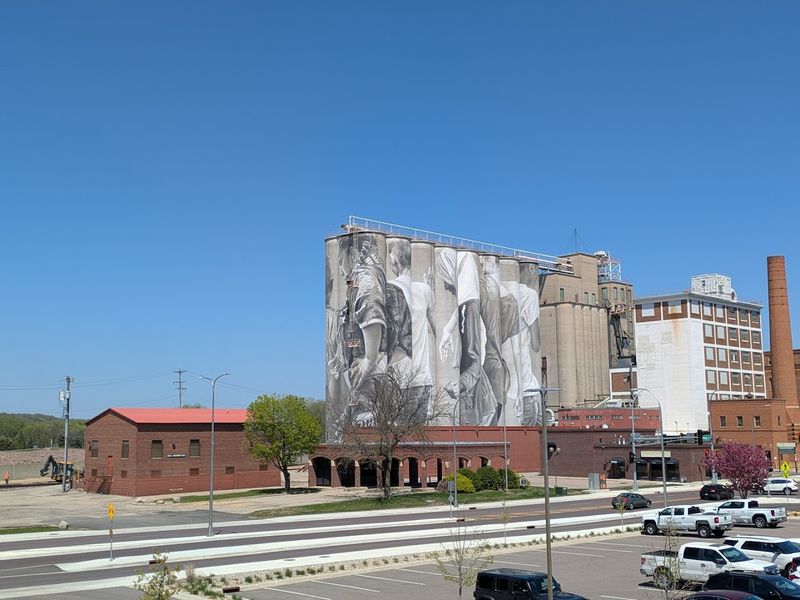
Silo Art is one of those places where your viewpoint changes everything. Standing directly nearby gives you the full neck-craning effect, but some of the best looks come from moving around the surrounding riverfront blocks, where the mural starts to read as a complete urban composition instead of a towering fragment.
Distance helps the scale settle into something legible. That is especially true because the figures wrap and reconnect across rounded surfaces. From one corner, you notice color balance and overall structure.
From another, the curves of the silos hide and reveal different portions of faces and bodies, which creates a rhythm that is hard to appreciate when you stay rooted in one spot for too long.
The nearby streets also frame the artwork differently depending on where you stand. Utility lines, rooftops, industrial edges, and open sky can either tighten the composition or make the mural feel even more expansive.
In some views, the painted forms appear almost compressed into a single wall, while in others they stretch into a sequence that emphasizes how many surfaces are involved.
Because the site is part of a working elevator area, practical boundaries matter. This is best experienced as a walk-around sight rather than a close-access attraction, so plan on observing from public vantage points instead of expecting a museum-style approach path.
That slight distance actually improves the viewing experience by letting the full height remain visible. If you enjoy photography, the route around the surrounding blocks is where the fun begins. You can collect wide shots, side angles, and tighter crops that isolate specific features without losing the industrial context.
The mural does not sit apart from its environment. It gains energy from streets, corners, and open sightlines that keep changing the way it appears.
Why the Industrial Setting Makes the Artwork Hit Harder
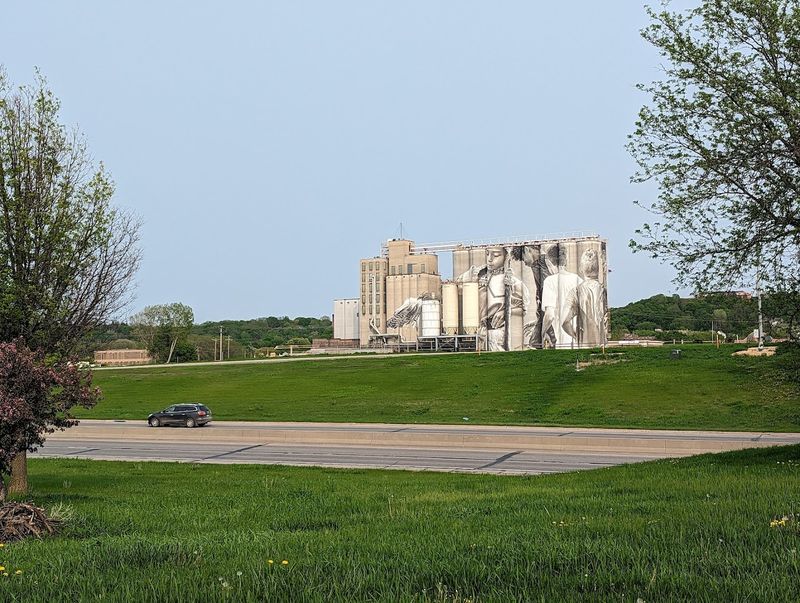
Plenty of murals look good on brick walls in entertainment districts. Silo Art lands differently because it stands inside an industrial landscape that still reads as functional, not decorative.
The grain elevator is a piece of working infrastructure first, and that practical identity gives the artwork more tension, more presence, and more visual authority.
Concrete silos are not soft, inviting surfaces. They are blunt, vertical, repetitive forms built for storage and efficiency, which makes them a striking canvas for portraits and layered color.
Instead of competing with that hardness, the mural uses it, turning the cylinders into monumental supports that add physical weight to the human imagery painted across them.
The surroundings deepen that effect. Pavement, equipment, loading spaces, and the general riverfront industrial context keep the site grounded in daily use rather than turning it into an isolated arts district installation.
You are not stepping into a polished cultural bubble. You are watching art assert itself in a place shaped by work, transport, and utility. That contrast sharpens every visual decision. Bright tones look brighter against gray concrete.
Human forms read as more urgent when they rise out of structures associated with grain, machinery, and commerce.
Even the verticality feels more dramatic because the silos were already built to dominate the skyline before paint amplified their presence.
There is also a civic confidence in choosing this kind of site. Instead of hiding art in a tidy corner, Mankato placed a major visual statement on one of its most commanding industrial structures and let the city live with it in plain view.
The result is not precious or overly curated. It is bold, public, and rooted in the real physical character of the place.
A City Portrait, Not Just a Giant Photo Opportunity

It would be easy for a mural this large to function mainly as a backdrop for photos. Silo Art avoids that trap because the imagery carries civic meaning, not just visual scale.
The work has been described as celebrating local diversity, and that framework helps explain why the mural reads as a public statement rather than oversized decoration.
The faces and figures matter because they bring personhood to an industrial landmark. Grain silos are usually anonymous objects, useful and imposing but emotionally neutral.
Once covered with human imagery, the structures start participating in a larger conversation about who belongs in a cityscape, whose stories deserve height and visibility, and how public art can reshape local identity.
That is part of why the mural feels stronger in person than in a cropped online image. On site, you can see how many individual forms are held together across separate cylindrical surfaces, which mirrors the idea of a community made from distinct people sharing one place.
The concept is clear without becoming heavy-handed or overly literal. The mural also broadens what counts as a cultural landmark in town. Instead of requiring a ticket, an event, or a special occasion, it sits in open view around the clock and inserts art into everyday routines.
Drivers notice it, walkers track it from different corners, and photographers chase changing light across surfaces that were once purely utilitarian.
That public accessibility gives the work a democratic edge. You do not need background knowledge to respond to it, yet the more you consider its setting and composition, the richer it becomes.
Silo Art succeeds because it works on several levels at once: local symbol, urban transformation, visual landmark, and a giant reminder that civic storytelling can happen far above street level.
Why This Mankato Landmark Punches Above Almost Every Mural Stop
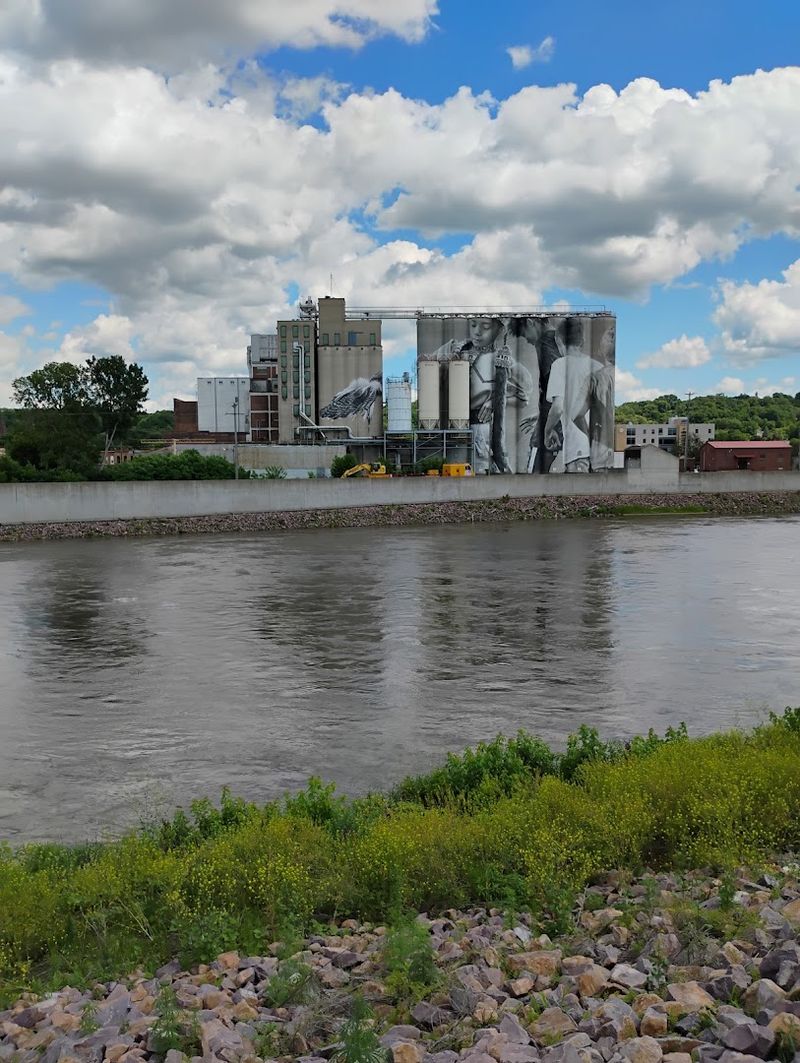
Many mural destinations offer quantity. Silo Art wins on concentration. Instead of sending you across multiple blocks to assemble a greatest-hits collection of painted walls, it delivers one massive, cohesive statement that can compete with the scale of major public artworks anywhere in the country.
The reason it punches so hard is simple: very few murals combine monumental height, cylindrical architecture, community-centered imagery, and an industrial riverfront setting in one composition.
Remove any one of those elements and the piece would still be notable. Together, they create a landmark that is both visually unusual and deeply tied to its location.
There is also discipline in its impact. The site does not rely on flashy gimmicks, digital effects, or a surrounding entertainment complex to tell you that you are somewhere special.
The silos do the work. Their sheer vertical presence, plus the skill needed to place detailed imagery across curved concrete, makes the mural persuasive before any explanation enters the picture.
That is what gives the place editorial heft instead of novelty value. You can talk about scale, public art, urban identity, adaptive use of infrastructure, or photographic drama, and Silo Art holds up under each angle.
It is accessible enough for a casual stop, but layered enough to reward anyone who pays close attention to composition and context.
In the end, this is the rare roadside-scale artwork that does more than decorate a skyline. It changes how Mankato presents itself.
The mural transforms an industrial landmark into a cultural one without stripping away the site’s original character, and that balance is hard to pull off. Look up from Riverfront Drive and the argument becomes pretty convincing all on its own.
Share this story