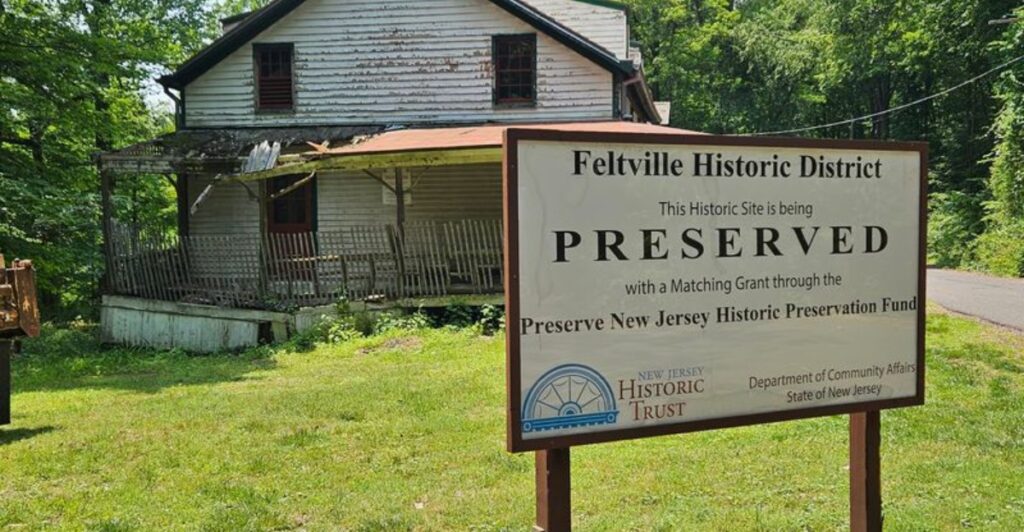
A row of weathered cottages appears through the trees, their broad porches facing a quiet road where factory workers once hurried to begin the day. There are no souvenir shops, reenactors, or carefully staged storefronts here.
Instead, the Deserted Village of Feltville sits quietly inside the Watchung Reservation, surrounded by more than 2,000 acres of woods in Union County. The buildings have changed over time, but the village still preserves the shape and atmosphere of a 19th-century community.
Feltville began as an ambitious mill town, became a summer resort, and slipped into near silence more than once. Today, visitors can walk past worker housing, a restored church and store, stone foundations, and the barn where resort guests once danced.
It is an unusual place where New Jersey’s industrial history has not been polished into something unrecognizable. The past remains visible in crooked porches, old roads, buried foundations, and Blue Brook flowing below the hill.
Step Into the Deserted Village of Feltville
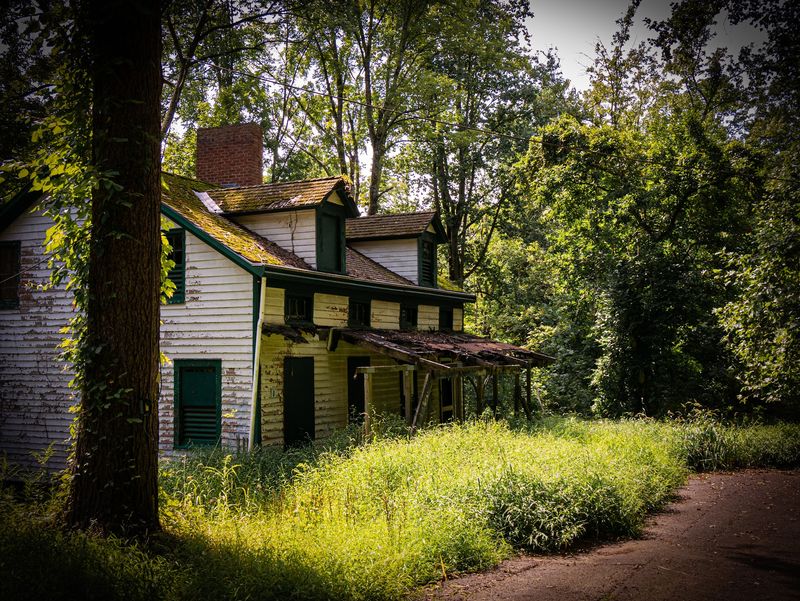
The first surprise is how quickly modern New Jersey seems to disappear. One moment, you are driving through Union County suburbs; the next, you are following Glenside Avenue into the wooded interior of Watchung Reservation.
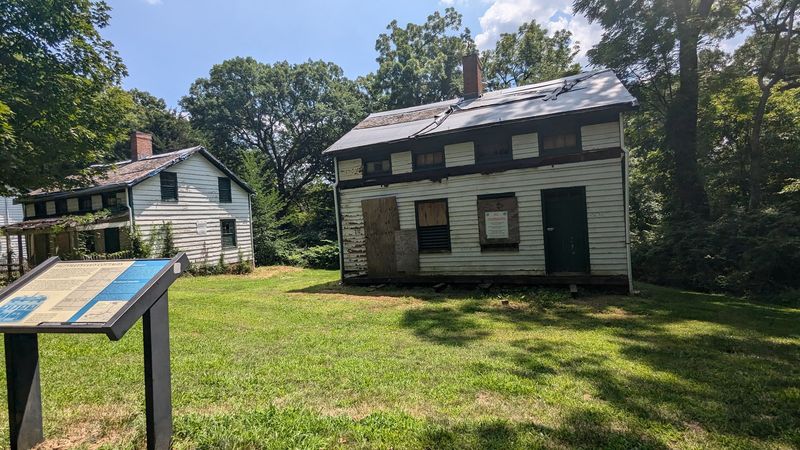
Near the parking area, Cataract Hollow Road leads downhill past a collection of old cottages that look as though their residents simply left and forgot to return. Feltville is not a ghost town in the tumbleweed-and-boarded-saloon sense.
Several buildings have been restored, and some houses have continued to be occupied during parts of the village’s long history. Still, the quiet road, aging porches, empty windows, and scattered stone remains give the place an unmistakably abandoned feeling.
The surviving structures stand far enough apart for the forest to press in around them, particularly when summer leaves are thick, or autumn color fills the valley. Interpretive signs help make sense of what visitors are seeing, from former worker homes to archaeological sites where vanished buildings once stood.
The setting also reveals why this community existed here in the first place. Blue Brook runs through the hollow below, providing the water power that drove the village’s mill.
The bluff above offered room for housing, gardens, a school, a store, and the other pieces of a largely self-contained settlement. There is no admission gate separating the historic district from the surrounding park.
Feltville simply unfolds along the road, making the experience feel more like stumbling across a forgotten neighborhood than entering a formal attraction. That understated presentation is part of its appeal.
Nothing interrupts the illusion with flashy displays, and the worn buildings are allowed to show their age. Even before learning the names and dates, visitors can sense that several different lives have played out here.
David Felt Built a Thriving Company Town in the 1840s
Long before the village carried David Felt’s name, English settler Peter Willcocks established a farm in this section of the Watchung Mountains. Around 1736, he dammed Blue Brook and built a water-powered sawmill, turning the surrounding timber into lumber for farms developing nearby.
His family worked the land for roughly a century before Felt, a successful stationery manufacturer with operations in New York, began purchasing the property in 1844. What followed was an impressive burst of construction.
Between 1845 and 1847, Felt created a mill beside the brook, built two dams to power it, and established housing on the bluff for employees and their families. The settlement soon became known as Feltville.
Felt’s approach reflected his Unitarian beliefs and his interest in improving conditions for working families. Compared with crowded industrial cities of the period, his village offered relatively spacious housing, garden plots, a school, a post office, religious services, and access to hundreds of acres of surrounding farmland.
That did not make Feltville an egalitarian paradise. Felt ran the place firmly enough to earn the nickname King David, and village residents were expected to attend weekly worship services.
However, those services could be led by a priest, minister, or rabbi, and workers were allowed to practice according to their own beliefs. By 1850, about 175 people lived in the community.
Their homes, workplaces, schooling, shopping, and religious life were all concentrated within a compact area controlled by one employer. That makes Feltville an intriguing early example of a planned company town, complete with both its paternal comforts and its limits.
The experiment lasted only about 15 years under its founder. Felt sold the property in 1860 and returned to New York City, reportedly predicting that the village would fall apart without him.
The decades that followed suggest he understood just how much the community depended on his business.
Workers Once Lived and Labored Along Blue Brook
Down at the bottom of the hill, a three-and-a-half-story mill once hummed with presses, polishing equipment, and bookbinding machines. Water diverted from Blue Brook traveled through a raceway and turned a wheel that generated about 12 horsepower.
It was enough to support the production of blank journals, ledgers, and other forms of business stationery, which then made the trip to New York by Conestoga wagon. The mill is gone today, having been demolished in 1930 after it became unsafe, but its location explains the arrangement of everything above it.
Workers could walk from their cottages on the bluff to the factory below, while Felt managed the larger operation from the village. Housing was busy by modern standards.
The surviving cottages were generally divided down the center like duplexes, with separate entrances and staircases for each side. Larger houses may have held four families, while smaller buildings accommodated two.
Census records suggest that some of the modest cottages housed between six and 12 people. Back-to-back fireplaces shared central chimneys, and the yards offered space to grow food.
Life extended beyond the front door. Residents visited the general store for produce from the surrounding farmland, sent letters through the post office, attended worship upstairs in the same building, and enrolled children in a one-room schoolhouse near the present parking area.
Archaeology has filled in details that written records missed. Excavations uncovered wells, walkways, discarded tableware, animal bones, and a stone-lined two-seat privy behind one worker cottage.
Those finds suggest that villagers supplemented store purchases with hunting, fishing, and household gardens. They also reveal differences in wealth from one end of the settlement to the other.
The objects are ordinary, which is precisely what makes them useful. A piece of porcelain or a meal discarded behind a house can say more about daily life than the grander stories of owners and business ventures.
Feltville survives not merely as a collection of old buildings, but as a record of how working families ate, slept, worshiped, and shared limited space.
Feltville Found New Life as a Summer Resort
By the time Warren Ackerman bought the property at public auction in 1882, Felt’s industrial dream had been over for more than two decades. Ownership had changed repeatedly, and later attempts to manufacture goods including silk, cigars, and sarsaparilla had failed.
The former company town had already earned its enduring nickname, the Deserted Village. Ackerman saw something different in the empty buildings and wooded landscape.
Rather than reopening the mill, he transformed the settlement into a country retreat called Glenside Park. This second chapter explains why Feltville does not look exactly as it did during the 1840s.
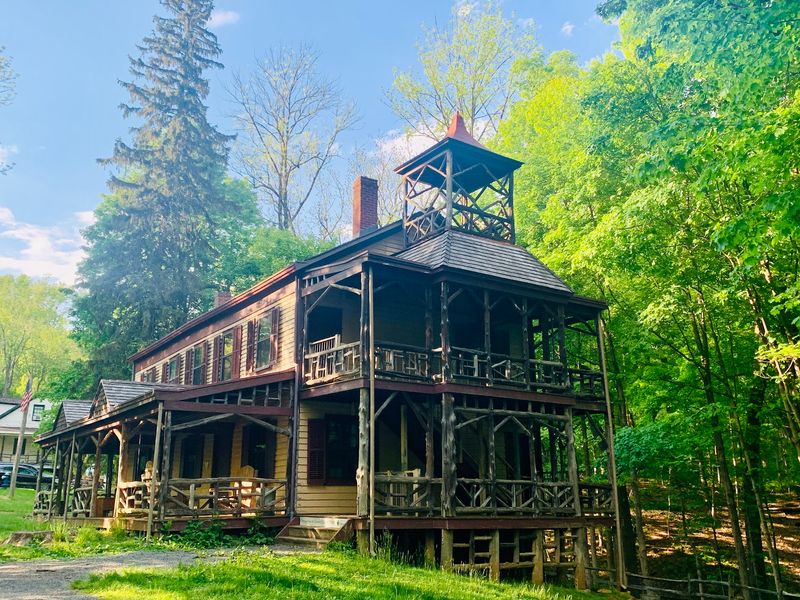
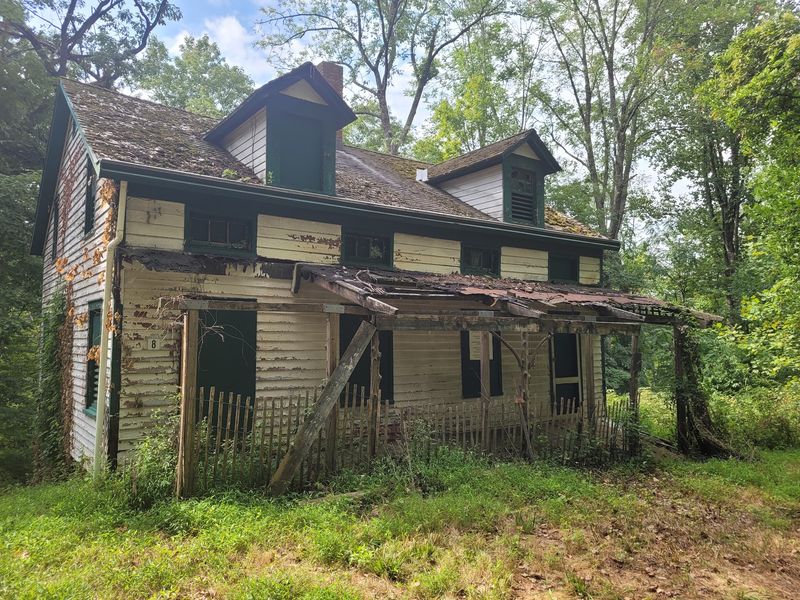
Former worker dwellings were converted into summer cottages, dormers were added to create more usable upstairs space, and wide porches appeared with rustic cedar posts and railings. The alterations gave each building a more individual personality while preserving the bones of the earlier village.
Guests arrived from Newark, Orange, New York City, and other urban areas to spend the season in the cooler Watchung Mountains. Days could include golf, tennis, croquet, baseball, fishing, and horseback riding.
One of the houses operated as an inn where visitors could take their meals, while evening dances brought people together inside a carriage barn built in 1882. Horses and carriages also carried businessmen to the Murray Hill train station, allowing them to commute to Manhattan while their families remained at the resort.
Glenside Park even offered electric streetlights, indoor plumbing, and a steam laundry, substantial comforts for a seasonal destination of that era. The resort flourished for several decades but began losing its hold by 1916.
Automobiles allowed vacationers to travel farther, and the rapidly developing Jersey Shore offered a livelier alternative. Glenside Park faded, leaving the village quiet once again.
Those resort-era porches now contribute heavily to Feltville’s memorable appearance, making the site a visible blend of an 1840s factory town and an 1880s mountain escape.
Historic Cottages and Village Buildings Still Stand Today
Look closely at the Church and Store Building, and one of Feltville’s most unusual arrangements comes into focus. David Felt placed the village’s general store on the first floor and a worship space above it, combining practical and spiritual life beneath one roof.
By 1851, the building also contained a post office. The church welcomed different forms of worship, although attendance itself was expected.
Curiously, the visible steeple was added later and was not present when the upstairs room actually served as the village church. Restored in 1998, the building is the principal structure visitors may approach and enter when it is open for programming.
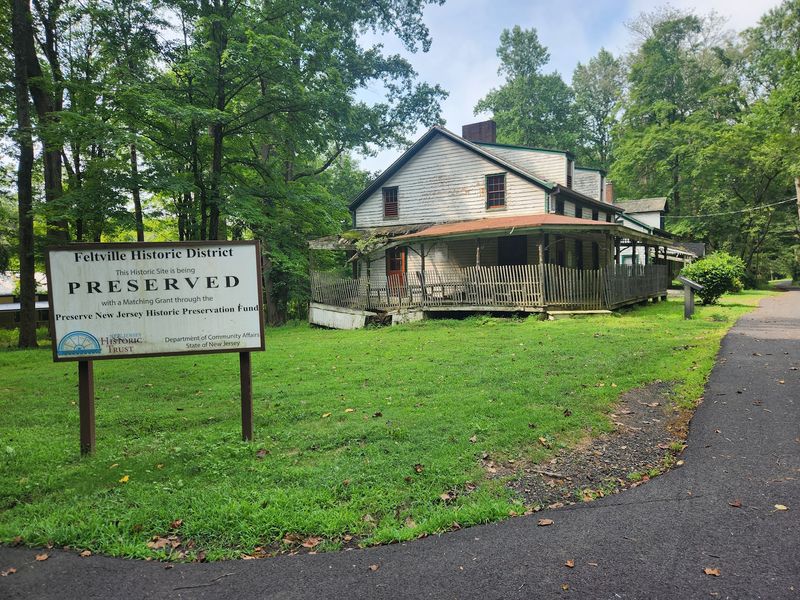
The surrounding houses are best appreciated from the road because some remain in use and others have fragile porches. House Number 12 is especially important because it retains both original entry doors, offering a clear look at how a mill worker’s duplex was arranged.
Elsewhere, four standing buildings form part of an area known as the Commons, once home to managers, skilled employees, and mill workers. The layout hints at the village’s social order, while foundations mark houses that burned or were removed.
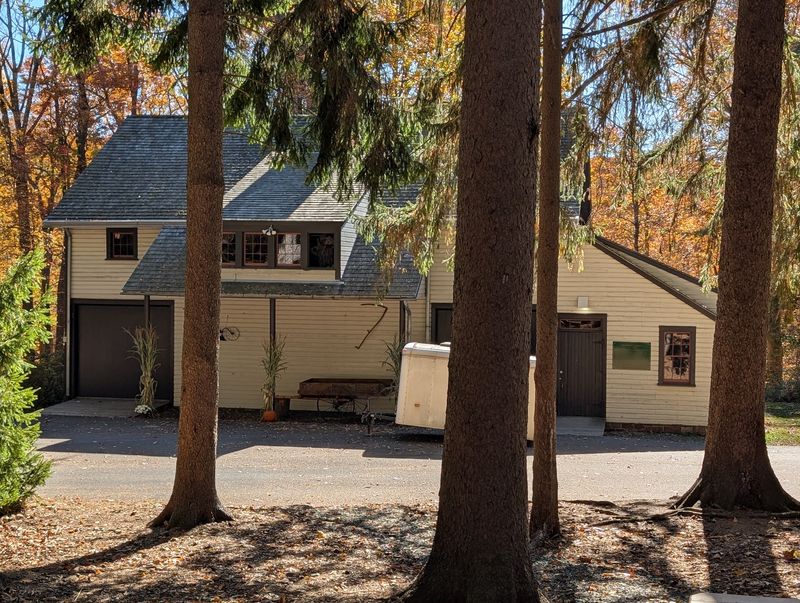
At the far end of Cataract Hollow Road stands Masker’s Barn, built during the Glenside Park era to shelter horses and carriages. Resort guests also gathered there for dances.
The restored barn now serves as a public assembly and educational space. Not everything is above ground.
Archaeological work has located David Felt’s house, which proved far more modest than the “mansion” described in some older accounts. Researchers have also studied buried paths, wells, privies, and domestic artifacts across the site.
Feltville joined the New Jersey and National Registers of Historic Places in 1980, and stabilization projects have helped keep its remaining structures standing. The result is not a perfectly frozen 1840s village, but something more honest.
Every altered porch, exposed foundation, and repaired wall reflects a different period in a place that repeatedly changed purpose without completely disappearing.
Explore the Village on a Walk Through Watchung Reservation
A one-mile self-guided route is enough to connect many of Feltville’s major landmarks without turning the visit into a strenuous hike. The walk begins at the parking lot off Glenside Avenue and follows parts of Cataract Hollow Road, nearby bridle paths, and woodland trails.
One early detour leads to the old Willcocks family cemetery, where five headstones stand beneath the trees. Only one is original, and the stones do not mark the exact graves beneath them, but the plot connects the property to its earliest European settlers.
The older memorial to John Willcocks features a Puritan-influenced Death’s Head design associated with colonial burial markers. Back on the village road, numbered stops identify the former business office, the Church and Store Building, the Commons, worker cottages, and the archaeological location of David Felt’s residence.
A side path descends toward Blue Brook and the former mill site. There is no mill building left to tour, yet the slope, stream, and old industrial landscape make its operation easier to picture.
The road eventually reaches Masker’s Barn before looping visitors back toward the parking area. Because several buildings are occupied or structurally delicate, porches should remain off-limits except at the restored Church and Store when access is permitted.
Dogs are allowed in the reservation but must be kept on a leash. Conditions can also vary with the season, particularly on woodland stretches after rain, so sturdy everyday walking shoes make more sense than anything fancy.
Autumn gives the cottages a dramatic backdrop of red and gold, while winter exposes foundations and architectural details hidden by leaves. In spring and summer, the dense forest restores the sense of isolation that once defined the settlement.
Modern neighborhoods are never very far away, but along Cataract Hollow Road, the quiet houses, old cemetery, and steady movement of Blue Brook still hold the shape of the community that occupied this hollow nearly two centuries ago.
Share this story