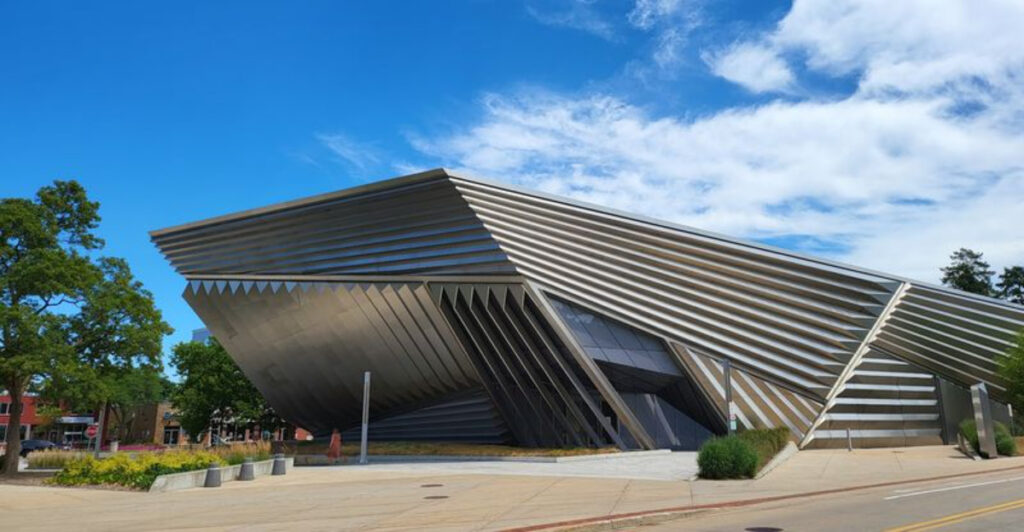
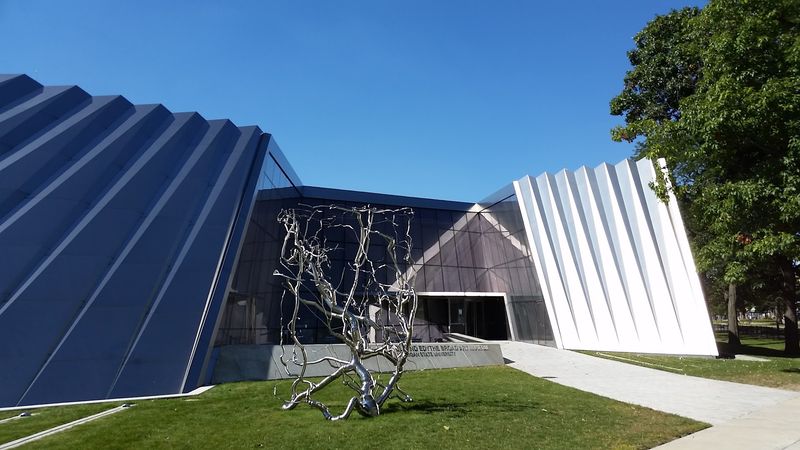
A museum can make a statement before anyone sees a single piece of art. On the Michigan State University campus in East Lansing, the Eli and Edythe Broad Art Museum does exactly that with a jagged, futuristic building designed by legendary architect Zaha Hadid.
The sharp angles and bold exterior have earned international attention, but the experience goes well beyond the architecture. Inside, the MSU Broad brings globally sourced contemporary art, rotating exhibitions, free admission, and hands-on programs for visitors of all ages into one seriously compelling cultural stop.
Whether you come for the design, the art, or the simple thrill of seeing something that feels completely different, this East Lansing museum gives Michigan one of its most memorable modern landmarks.
A Building That Rewrites the Rules of Campus Architecture
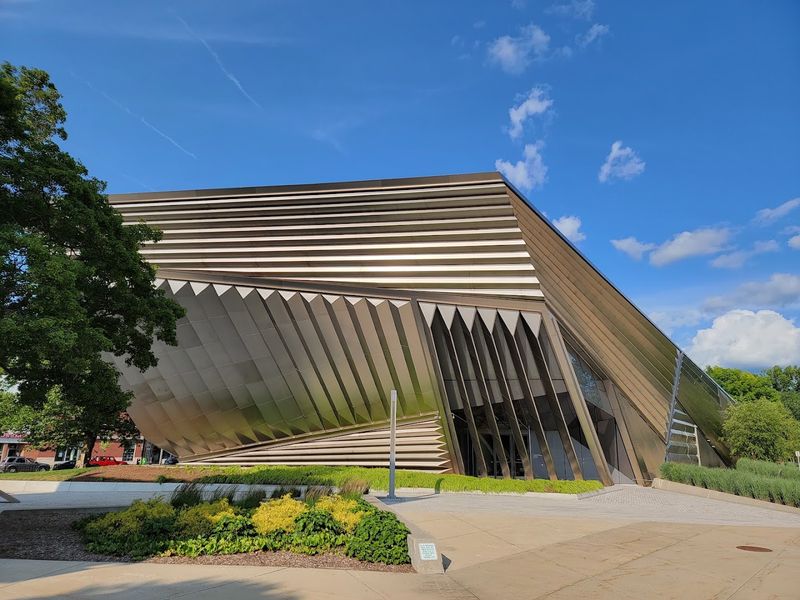
Sharp angles slice through the sky at the corner of East Circle Drive, and if you have never seen the MSU Broad up close, the first encounter is genuinely disorienting in the best possible way. Designed by the late Zaha Hadid — the first woman to win the Pritzker Architecture Prize — the building does not follow a single straight line in the traditional sense.
Pleated stainless steel panels wrap around the structure like a collapsed origami sculpture, catching light differently depending on the time of day and the season.
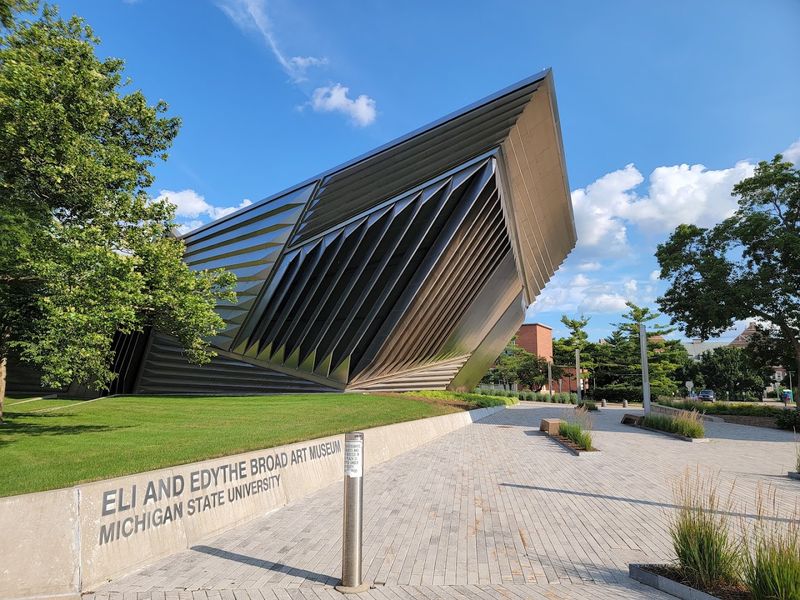
The facade creates a visual tension with the surrounding red-brick buildings of the MSU campus, and that contrast is entirely intentional. Hadid believed that architecture should provoke thought, not just provide shelter.
Every sharp edge and tilted surface on the Broad is a design decision rooted in that philosophy. Even the interior follows through — signage inside the museum is slanted to mirror the building’s geometry, a small but telling detail that shows how thoroughly the design was considered from the outside in.
Standing at street level, the building resembles the prow of a ship cutting through open water, all momentum and forward thrust. The glass portions allow natural light to flood into gallery spaces while keeping the silhouette dramatic from every angle.
Visitors arriving from the main campus path often slow down involuntarily, phones already raised, before they have even decided whether to go inside. That magnetic pull is no accident.
The MSU Broad is one of only a handful of Zaha Hadid buildings in the United States, and it remains one of her most celebrated academic commissions, drawing architecture enthusiasts from well beyond Michigan’s borders specifically to study its construction.
Free Admission and What That Actually Means for Accessibility
No ticket counter. No entry fee.
No membership required. The MSU Broad Art Museum operates on a completely free admission model for the general public, and that single fact changes the entire dynamic of a visit.
When cost is removed from the equation, people who might never set foot in a traditional paid museum find themselves wandering through gallery spaces on a Tuesday afternoon with no particular agenda — and that kind of unplanned discovery is often where the most meaningful encounters with art happen.
Free admission is not a compromise on quality, either. The museum regularly hosts traveling international exhibitions alongside its permanent collection, and the programming calendar runs year-round with lectures, workshops, and special events.
For MSU students, the museum functions almost like an extension of the academic environment, a space where coursework conversations can continue in front of actual objects rather than textbook images. That academic connection gives the exhibitions a rigor and seriousness that purely commercial museums sometimes struggle to maintain.
Families benefit particularly from the no-cost entry. The first Saturday of each month is designated Family Day, when the museum organizes hands-on activities, interactive stations, and games spread across multiple levels specifically designed for younger visitors.
The building is fully wheelchair and stroller accessible, with large elevators and wide staircases that make navigating between floors straightforward. A coat check runs smoothly near the entrance, which matters during Michigan winters when arriving bundled up is non-negotiable.
The gift shop carries books and objects that lean toward expanding ideas rather than generic souvenirs. All of this together creates a cultural institution that feels genuinely open rather than performatively welcoming — a distinction that regular visitors to the MSU Broad notice and consistently appreciate.
Global Contemporary Art With a Provocative Edge
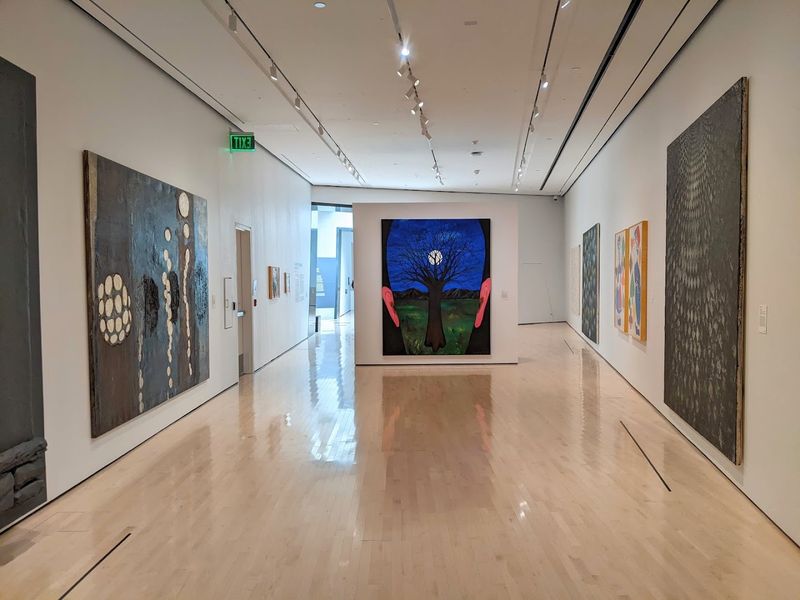
The collection at the MSU Broad is not organized around a single style or movement. Instead, the curatorial approach leans into global contemporary art that addresses social, political, and cultural questions that are very much alive right now.
Works from international artists sit alongside pieces that connect to local and regional histories, creating a dialogue across geography and time that keeps the gallery experience from feeling like a simple chronological survey.
Rotating exhibitions refresh the museum’s offerings on a regular basis, meaning a visit six months apart can feel like an almost entirely different experience. Past exhibitions have drawn from wide-ranging influences, and the museum has displayed significant works including pieces by Old Masters like Rembrandt alongside cutting-edge contemporary installations.
That range prevents the collection from settling into any single aesthetic comfort zone. Some exhibitions challenge viewers directly — addressing displacement, identity, and technology — while others are more formally experimental, using materials and scale in unexpected ways.
One particularly memorable installation described by visitors involved a completely darkened room titled “Darkness,” where the absence of light was itself the medium. Visitors navigating that space without visual reference points experienced the art physically rather than just visually — an approach that is either unsettling or exhilarating depending on your tolerance for sensory disorientation.
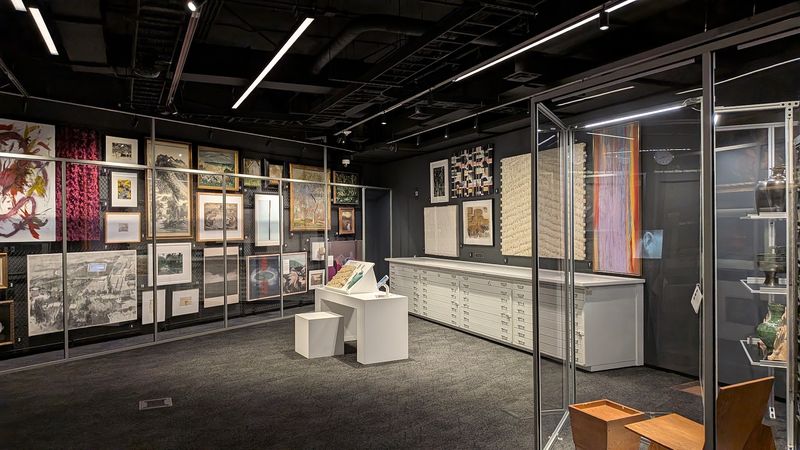
Interactive stations scattered through the galleries offer hands-on engagement for those who prefer a more participatory relationship with the work. The flexible, open gallery layout allows the curators to reconfigure spaces dramatically between exhibitions, so the architecture never overpowers the art — it frames it.
That balance between container and content is one of the harder problems in museum design, and the MSU Broad handles it with consistent skill across exhibitions of very different scales and moods.
Zaha Hadid’s Michigan Legacy and the Story Behind the Commission
Zaha Hadid was already one of the most talked-about architects on the planet when the MSU Broad commission came through, but building in a mid-sized Midwestern university town was a different kind of challenge than her high-profile urban projects. The site on East Circle Drive required a design that could hold its own against a traditional campus landscape without becoming a visual bully.
The result is a building that commands attention through precision rather than sheer size — it is not the tallest or the largest structure nearby, but it is undeniably the most arresting.
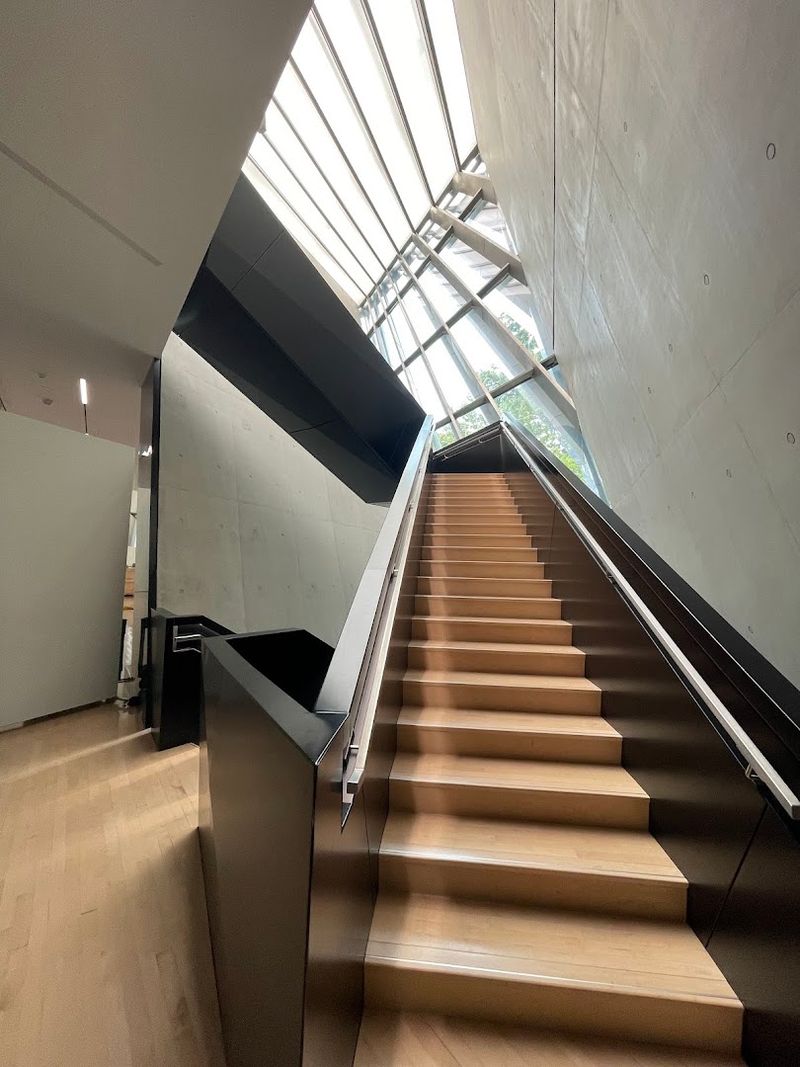
Hadid’s approach extended to the smallest interior details. The bench designs, staircase profiles, and even the angle of the window mullions all follow the same geometric logic as the exterior facade.
Visitors who pay attention to these details start to understand the building as a total design environment rather than a shell wrapped around gallery rooms. That level of integration is rare in institutional architecture, where budget pressures and committee decisions often dilute an architect’s original vision before construction is complete.
The museum opened in 2012, and in the years since Hadid’s death in 2016, the building has taken on additional significance as one of her completed works on American soil. Architecture students and design professionals make specific trips to East Lansing, Michigan, to study the construction methods and spatial sequences firsthand.
The MSU campus has long been celebrated for its landscape, but the Broad introduced a different kind of landmark — one that belongs to the global conversation about contemporary architecture rather than just the local one. For anyone interested in how buildings can function as both functional spaces and bold artistic statements, this is required viewing in person, not just on a screen.
How To Actually Plan Your Visit for the Best Experience
The MSU Broad is open Wednesday through Sunday from 10 AM to 6 PM, and it is closed on Mondays and Tuesdays. That schedule is worth checking before making the trip, particularly for visitors driving in from outside the East Lansing area who might assume standard museum hours apply every day.
Wednesday through Friday tend to be quieter, which suits those who prefer exploring at their own pace without navigating weekend crowds. Saturday draws more families, especially on the first Saturday of the month when Family Day programming runs.
Parking near the museum is straightforward. A metered lot sits directly across the street, and the MSU parking garage is roughly a five-minute walk away — manageable in most weather conditions.
Arriving earlier in the day makes parking easier and gives more time to explore before the afternoon rush. The museum does not require advance reservations for general admission, though checking the website for any special exhibition openings or ticketed events before visiting is a practical step that can prevent surprises at the door.
Inside, the layout spans multiple levels connected by elevators and staircases. The interactive stations tend to be spread across different floors rather than concentrated in one area, so exploring all levels is worthwhile rather than staying on the ground floor only.
The coat check near the entrance runs efficiently and is genuinely useful during Michigan’s colder months — arriving in a heavy winter coat and then trying to navigate gallery spaces comfortably is an avoidable hassle. Staff members throughout the building are knowledgeable and will answer questions about both the art and the architecture without making visitors feel rushed or monitored.
The overall visit typically runs between one and two hours depending on how deeply you engage with the current exhibitions.
Education Programs That Go Beyond the Gallery Walls
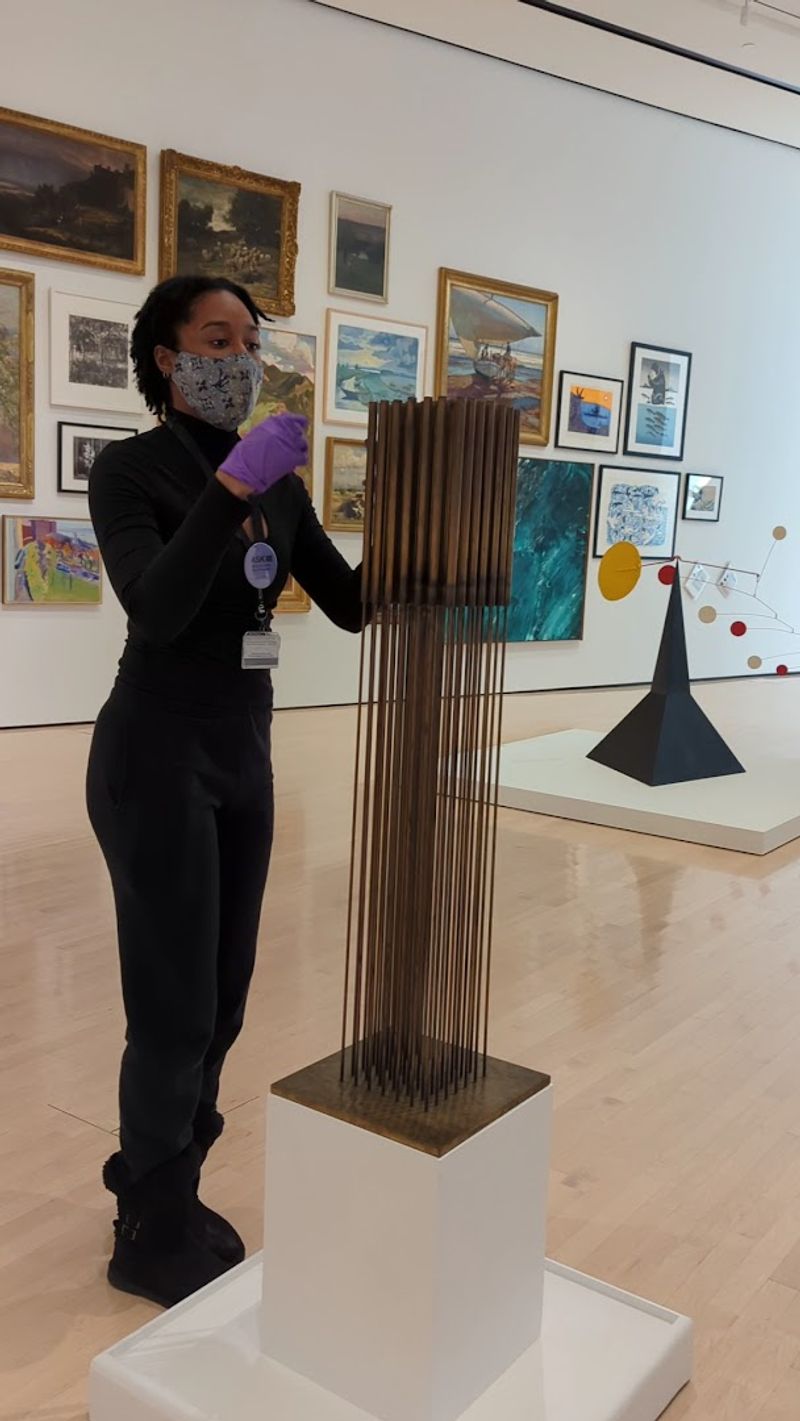
Summer camps at the MSU Broad have developed a strong reputation among East Lansing families, and the feedback from parents reflects that. Kids who attend spend their days doing multiple projects, engaging with the museum’s current exhibitions, and working with staff who treat art-making as serious exploration rather than supervised craft time.
The range of activities covers drawing, sculpture, and media-based work, giving young participants exposure to forms of art they might not encounter in a standard school curriculum.
Beyond summer programming, the museum maintains an ongoing calendar of events aimed at different audiences throughout the year. Lectures bring in artists, critics, and curators who speak directly to the ideas behind current exhibitions, giving visitors a deeper entry point into work that might otherwise feel inaccessible.
These talks are typically free, continuing the museum’s commitment to removing barriers between the public and contemporary art. Community engagement is built into the institutional structure rather than treated as an afterthought, which is why the programming feels cohesive rather than randomly assembled.
MSU students benefit from a particularly close relationship with the Broad. The museum’s position within a major research university means that academic departments across disciplines — from art history to sociology to communications — use the space as a teaching resource.
Exhibitions addressing political and social themes generate genuine classroom discussion that spills into the galleries, creating an environment where art and scholarship overlap naturally. Docents and staff are consistently described as enthusiastic and genuinely informed, which makes a real difference when navigating exhibitions that reward context and explanation.
For younger children, the museum provides a dedicated activity area and age-appropriate materials that make the experience engaging rather than overwhelming. The Broad treats education not as a side function but as central to its entire reason for existing on a university campus.
Why This Museum Stands Apart From Every Other Stop in Michigan
Most regional art museums occupy a comfortable middle ground — solid collections, predictable layouts, familiar programming. The MSU Broad does not operate in that space.
The combination of a world-class architectural commission, genuinely international contemporary art, and a fully free admission model creates something that is difficult to replicate and harder to categorize. It functions simultaneously as a campus resource, a community gathering point, and a destination for serious art and architecture audiences from across the country.
The museum’s scale is part of what makes it work. Large enough to house ambitious traveling exhibitions but compact enough to feel human rather than overwhelming, the Broad hits a size that allows visitors to engage meaningfully with everything on display in a single visit.
There is no fatigue-inducing sprawl, no sense that you are racing through rooms to cover ground before closing time. The building itself rewards slow movement — angles shift, light changes, and spatial relationships between floors reveal themselves gradually as you move through the galleries.
East Lansing is not typically the first city that comes to mind when people plan cultural trips through Michigan. That gap between expectation and reality is exactly what makes arriving at the Broad such a sharp experience.
A Zaha Hadid building alone would be worth the detour for architecture enthusiasts. Add a collection that spans Old Masters to immersive contemporary installations, a robust education program, and year-round free access, and the argument for visiting becomes almost impossible to argue against.
For anyone already on the MSU campus — or passing through the region — skipping the Broad means missing one of the genuinely distinctive cultural experiences Michigan has to offer, not just for students but for anyone with curiosity and an hour or two to spare.
Share this story