Some restaurants just serve food. Others change the way an entire city eats.
Buddy’s Pizza on Conant Street in Detroit did the second thing, and it did it back in 1946 when nobody had ever heard of Detroit-style pizza because Buddy’s was still busy inventing it. Nearly eight decades later, the original location is still standing, still baking in those seasoned steel pans, and still drawing people from across Michigan and beyond who want to taste the real thing at the place where it all started.
The Original Location That Started Everything
There is something grounding about standing in front of a building that has been doing the same thing since 1946. The Conant Street location of Buddy’s Pizza does not announce itself with flashy signage or a redesigned facade meant to look retro.
It simply looks like what it has always been — a neighborhood pizza spot in a working-class corner of Detroit that happened to change American pizza history.
The surrounding area is unpretentious, and the restaurant matches that energy completely. Walk inside and the decades are visible in the best possible way.
The walls hold photographs and memorabilia tracing the restaurant’s long arc through Detroit history. The booths are worn in the way that only comes from generations of actual use, not from a designer trying to manufacture comfort.
What makes this address significant is not just age — it is continuity. The ovens here have been running for nearly eighty years.
The recipes have been refined rather than reinvented. Loyal customers say you can feel the difference between a location that has been perfecting something since the beginning versus one that opened last year following a proven formula.
Parking is available in a fenced lot that is a little oddly shaped but functional. The neighborhood sometimes surprises first-time visitors who expect a more polished setting, but that surprise fades fast once you step inside and smell the garlic and baking cheese.
This is a place that earns its reputation through the food, not the surroundings.
For anyone serious about Detroit pizza, this is the address that matters. Other Buddy’s locations across Michigan are solid.
This one, at 17125 Conant, is the source — and that distinction carries real weight when you are holding a square slice with caramelized cheese edges in your hand.
How Detroit-Style Pizza Was Actually Born
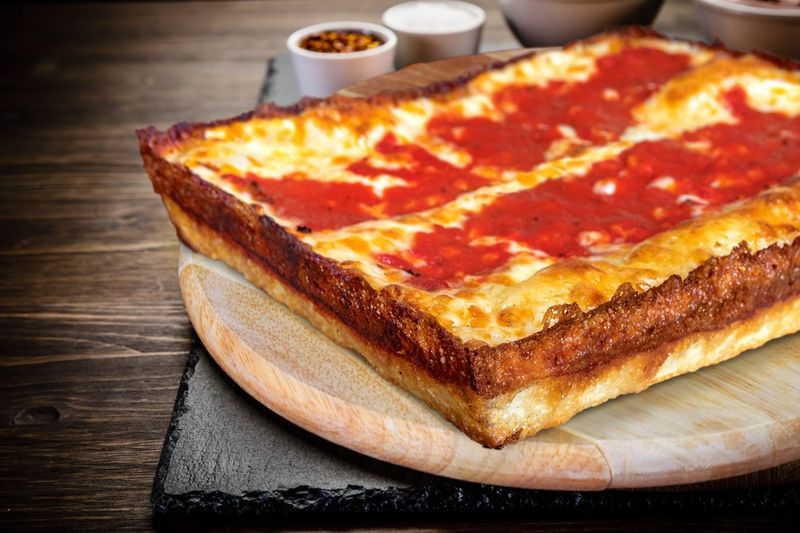
Before 1946, Detroit had no pizza style to call its own. That changed when Buddy’s Rendezvous — as it was originally known — started baking pizza in rectangular steel trays that were originally used as parts trays in the automotive industry.
The shape, the pan, and the method all came together in a way nobody had planned, and the result was something completely new.
The defining characteristic of Detroit-style pizza is the crust. Dough is proofed long enough to develop an open, airy interior with real chew and structure.
The cheese — traditionally Wisconsin brick cheese — gets spread all the way to the edges of the pan, where it melts against the hot steel and caramelizes into a crunchy, lacy border that has no equivalent in any other pizza tradition. That edge is not a byproduct.
It is the point.
Sauce placement also flips the standard script. At Buddy’s, the tomato sauce goes on top of the cheese rather than underneath it.
This keeps the cheese from burning during the longer bake time and creates a layered bite where the sauce hits first, followed by the molten cheese, followed by that extraordinary crust. The combination sounds simple until you taste how precisely it works.
Chicago deep dish gets most of the national attention when people talk about thick pizza, but Detroit-style is a genuinely different product. It is lighter, crispier at the edges, and more structurally interesting than deep dish, which tends toward a denser, more casserole-like result.
Customers who make the comparison usually land on the same conclusion: Detroit-style is its own category entirely, and Buddy’s is where that category began.
Understanding this history makes the first bite at the Conant Street location feel like more than just lunch. It feels like eating something that actually meant something to a city.
The Pizzas You Need to Order and Why
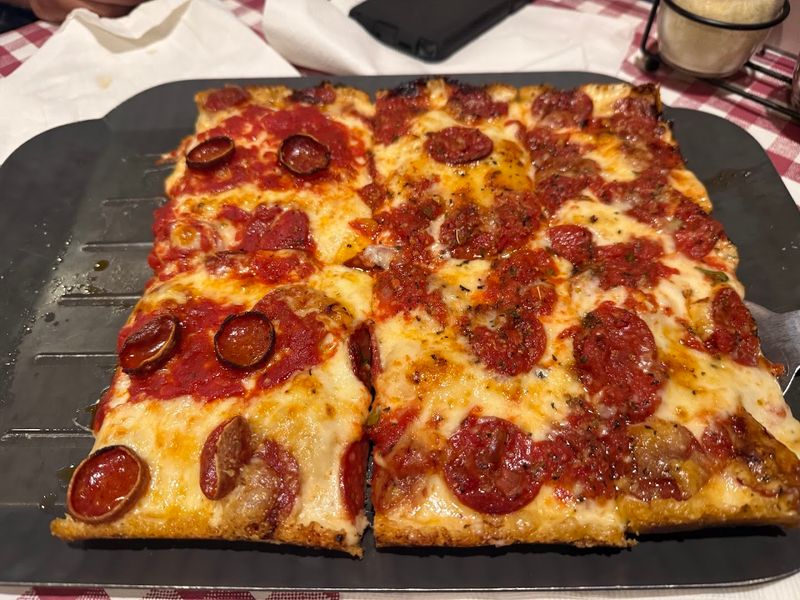
The menu at Buddy’s has grown considerably since 1946, but the pizza is still the main event and a few specific options stand above the rest. The Detroiter is the one most loyal customers point to first.
It features the classic Detroit-style build — brick cheese pushed to the edges, sauce over the top, and a crust that delivers crunch on the outside and genuine softness in the middle. For a first visit, this is the one to start with.
The Old World Pepperoni earns its own devoted following. The pepperoni sits on top of the cheese rather than under the sauce, which means it crisps up and curls at the edges during the bake.
Those curled, slightly charred pepperoni cups hold a small pool of rendered fat that concentrates the flavor in a way that flat pepperoni simply cannot match. Customers who try this version often have trouble going back to anything else.
The Buddy’s Special loads on pepperoni, mushrooms, onions, green peppers, and Italian sausage across the full square. It is an ambitious pizza, but the thick crust and the structural integrity of the Detroit-style base hold everything together without collapsing under the weight.
The Michigan State pizza offers a more unexpected combination — Wisconsin brick cheese, ground beef, fresh spinach, and fresh ricotta — that works far better than it sounds on paper.
During weekdays between 11 AM and 4 PM, a good-sized pizza costs around ten dollars, which is a genuinely hard price to argue with for the quality involved. Buddy’s also offers gluten-free crust baked in foil-lined pans with strict cross-contamination protocols, making it one of the more reliable options in Michigan for people with celiac disease who still want real pizza.
Beyond Pizza: The Antipasto Salad and Soups That Deserve Attention
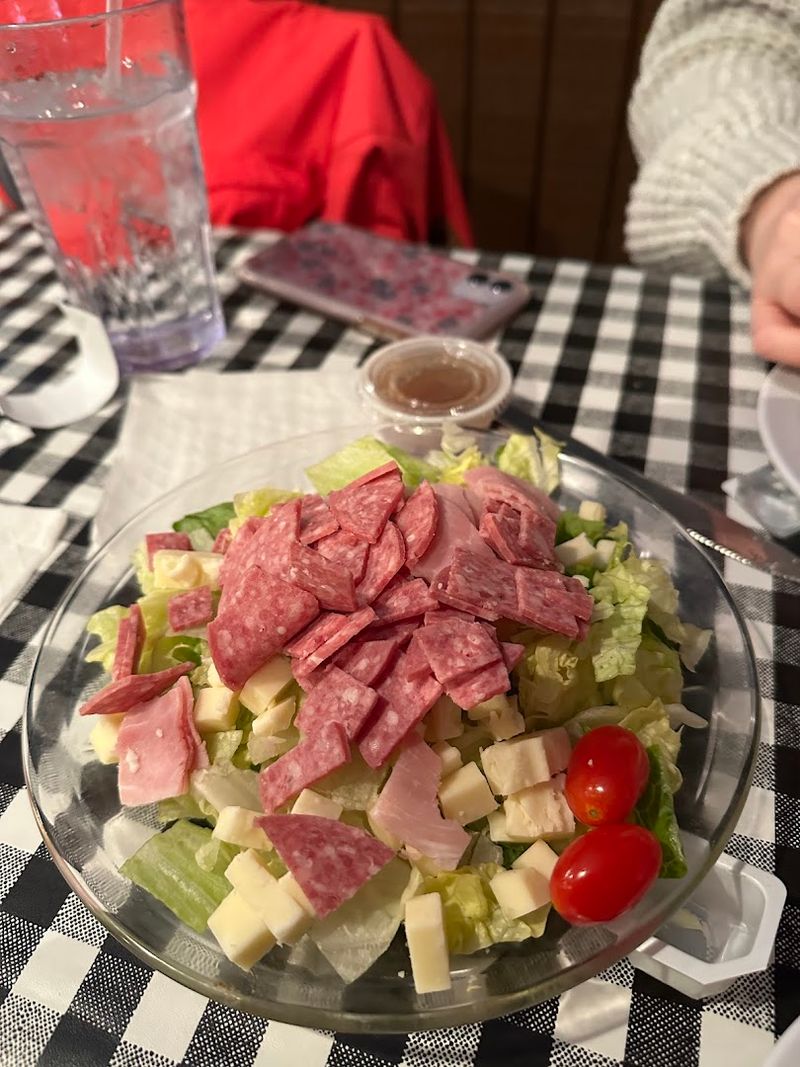
Pizza gets all the headlines at Buddy’s, but the rest of the menu pulls more weight than most people expect on a first visit. The Antipasto Salad comes up constantly among people who eat here regularly, and not as an afterthought.
It is a proper Italian-American antipasto — chopped romaine, ham, salami, Wisconsin brick cheese, and fresh tomatoes with an in-house dressing — and it arrives in a portion size that can genuinely feed three people who came in only thinking about pizza.
The dressing is worth mentioning separately. Several customers describe it as one of the best house dressings they have encountered at any pizza restaurant, which is a specific kind of compliment that usually means something real.
It is not overpowering or acidic, and it ties the components of the salad together without making everything taste the same. The salad earns its place at the table rather than just existing as a pre-pizza formality.
The Minestrone soup has reportedly been on the menu since the early days of the restaurant, and it tastes like something that has been adjusted and improved over sixty-plus years of service. Customers who order it tend to describe it with a kind of quiet satisfaction that suggests it exceeds expectations in a low-drama way.
Buddy Bread — soft, herby, and served alongside marinara for dipping — is another item worth adding to the order. The meatballs and lasagna have also drawn strong praise from customers who ventured beyond the pizza, with at least one visitor calling the meatballs a highlight of the entire meal.
The menu at Buddy’s rewards people who explore it rather than defaulting to pizza alone every single time they visit.
The Interior Atmosphere Inside Michigan’s Most Historic Pizza Spot
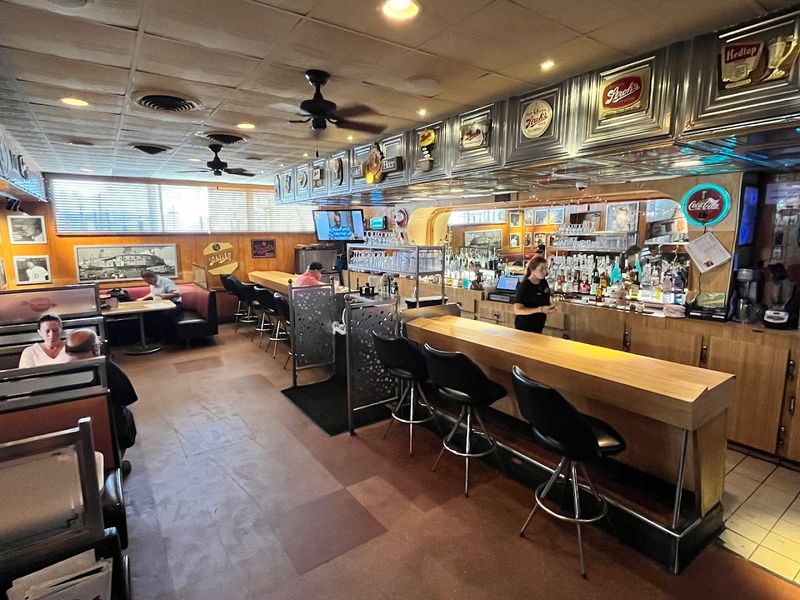
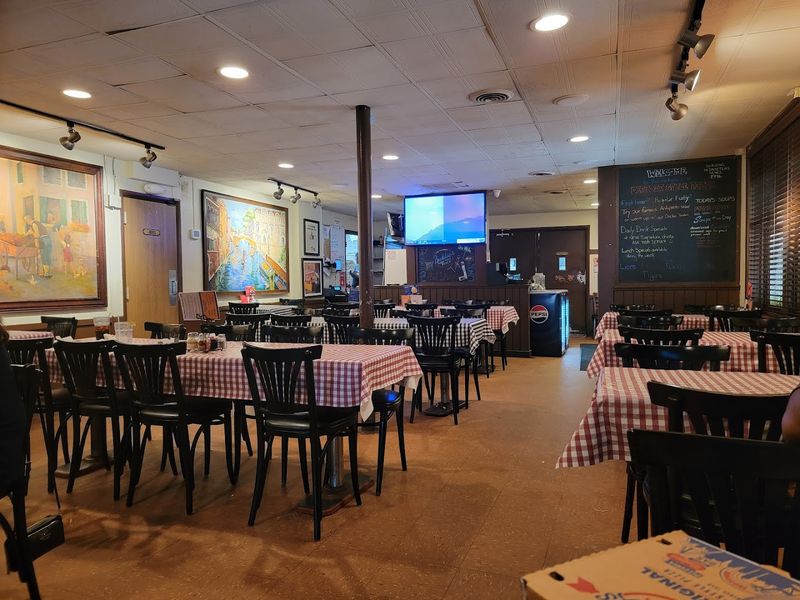
Walking into the Conant Street Buddy’s feels like entering a room that has absorbed a lot of years without trying to hide any of them. The booths are comfortable in the way that only genuine use over decades can produce.
The walls are covered in photographs and memorabilia that trace the restaurant’s history through Detroit — not as a curated museum display, but as the natural accumulation of a place that has mattered to people for a very long time.
Sports play on screens throughout the dining room, and the overall energy is relaxed and unpretentious. The service style matches the setting — friendly without being performative, attentive without hovering.
Several servers at this location have been singled out by name in customer feedback over the years, which suggests a staff that genuinely cares about the experience rather than just moving tables.
The smell hits immediately when you walk in: garlic, baking cheese, and the faint sweetness of caramelizing crust. It is the kind of smell that makes you realize you arrived hungry even if you thought you were only moderately interested in eating.
The kitchen is working constantly, and the rhythm of the place — orders coming in, pizzas going out, the steady low noise of a full dining room — has a comfortable, lived-in quality that newer restaurants spend years trying to manufacture.
Weekends get crowded and the wait can be real, particularly during dinner hours. Going early or on a weeknight makes the experience more relaxed and gives you more time to absorb the room without feeling rushed.
The bar area offers a selection of cocktails including a Michigan Mule made with Vernors and tart cherry, which is exactly the kind of local detail that fits this location perfectly. The space rewards people who slow down and pay attention to it.
Practical Details for Planning Your Visit to Buddy’s on Conant

Buddy’s Pizza on Conant Street is open every day of the week from 11 AM to 9 PM, which gives plenty of flexibility for both lunch and dinner visits. The consistent hours make planning straightforward, though the crowd level varies significantly depending on when you arrive.
Weekday lunch hours between 11 AM and 4 PM are notably calmer and come with the added benefit of a discounted pizza price that makes an already reasonable menu even more accessible.
The address is 17125 Conant Street in Detroit, 48212. Parking is available in a fenced lot adjacent to the restaurant.
The lot is a little unusually shaped, but there is enough space to manage without much difficulty. First-time visitors sometimes find the surrounding neighborhood unexpected, but the restaurant itself is well-maintained and the staff creates an environment that feels welcoming from the moment you walk in.
For groups or families, calling ahead to check on wait times during peak hours is a smart move. Weekend evenings in particular can build up a queue, and the dining room fills quickly once the dinner rush starts.
Arriving before 6 PM on a weekend significantly improves your chances of getting seated without a long wait. Weeknight visits tend to be the smoothest overall experience.
The price point at Buddy’s lands in the moderate range for a sit-down pizza restaurant. Pizzas are available in different sizes, and the menu includes appetizers, soups, salads, pasta, and a full bar with cocktails and spirits.
The Michigan Mule with Vernors ginger ale and tart cherry is a local specialty worth trying alongside the food. Buddy’s also accommodates gluten-free diners with dedicated preparation protocols, making it one of the more thoughtful options in the Detroit area for people managing dietary restrictions.
Why the Original Buddy’s Still Outshines Every Imitation
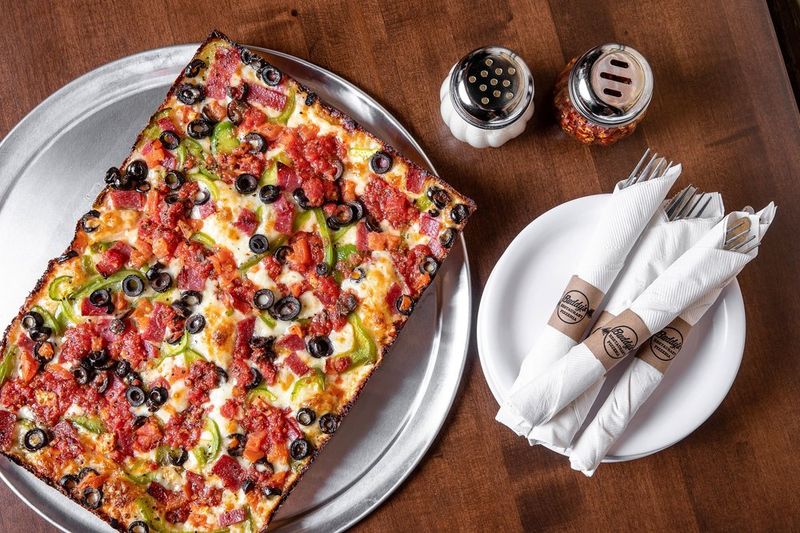
Detroit-style pizza has gone national over the past decade. Major chains have added their own square-pan versions, and dozens of independent pizzerias across the country now advertise the style on their menus.
Tasting the original at Buddy’s makes the difference between those versions and the source material immediately obvious in a way that is hard to articulate but easy to taste.
Part of what separates the Conant Street location from everything that followed is the equipment itself. The steel pans used here have been seasoned over decades of continuous use.
A well-seasoned steel pan conducts heat differently than a new one, and the crust that comes out of a pan with that kind of history has a depth and character that cannot be replicated by buying new equipment and following a recipe. The ovens have memory, and that memory shows up in the finished product.
The recipes at Buddy’s have been refined rather than reinvented. The Minestrone has been on the menu since the early years.
The dough process has been adjusted over time but remains rooted in the same principles that produced the original style. There is a stability to the food here that comes from commitment rather than nostalgia — the kitchen is not coasting on its history, it is actively maintaining a standard that the history demands.
Customers who visit multiple Buddy’s locations across Michigan consistently report that the Conant Street original delivers something the newer locations approach but do not fully match. That gap is not dramatic, but it is real and noticeable to anyone paying attention.
For a pizza style that has now spread across the country, there is still only one place where it began — and that place is still open, still serving, and still getting it right after nearly eighty years of practice.
Share this story