A frosted mug of buttermilk sits beside a deep-fried hot dog, a pile of plain fries, and a pickle spear nearly as long as the bun. Somehow, at Hot Dog Johnny’s, the combination makes perfect sense.
This Route 46 landmark in Warren County has been feeding New Jersey drivers since 1944, back when a roadside stand could build its reputation without social media, delivery apps, or a menu requiring several minutes of study.
The formula remains wonderfully direct: order at the counter, find a seat near the Pequest River, and let the kids make a run for the swings.
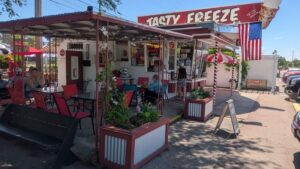
Located at 333 Route 46 in the Buttzville section of Belvidere, the family-run stand is neither a carefully staged throwback nor a modern restaurant wearing vintage clothes. It is the real article, complete with its original tiny stand displayed on the property.
Eight decades later, people still pull over for the same uncomplicated meal—and often bring another generation with them.
The Route 46 Hot Dog Stand That Has Been Drawing Crowds Since 1944
Hot Dog Johnny’s opened on Palm Sunday in 1944, when John Kovalsky and his wife, Louise, began serving customers from a modest stand that shared space with a gas station near the intersection of Routes 31 and 46.
John worked in the Dover mines during the day and at the stand at night, a schedule that makes today’s “side hustle” culture look a little less ambitious.
Customers started calling him Hot Dog Johnny, and the nickname soon became the name of the business. The original location did not remain large enough for long.
Kovalsky purchased land a short distance away along the Pequest River, where the stand could accommodate more customers and offer families a place to sit. The current building, with its unmistakable midcentury roadside appearance, took shape during the 1960s.
The little original stand has not disappeared, either. It remains on the grounds, looking almost impossibly small beside the operation it inspired.
The location was particularly valuable before Interstate 80 redirected much of northern New Jersey’s traffic. Route 46 carried vacationers toward the Poconos and connected communities across Warren County, putting Hot Dog Johnny’s directly in the path of hungry families.
Even after driving patterns changed, the stop remained part of the journey for people who had grown up seeing its sign through the car window. Today, the official address is Belvidere, though locals commonly place it in Buttzville, an unincorporated Warren County community with a name nobody forgets.
The stand is roughly 10 miles east of the Delaware River and about a quarter-mile from the Route 31 junction. It still operates seven days a week, generally from 9 a.m. to 9 p.m.
Monday through Saturday and until 8:30 p.m. on Sunday. Those are impressively serious hours for a place built around one very simple lunch.
Why Hot Dog Johnny’s Keeps Its Menu Short and Simple
There is no burger topped with onion rings here. No limited-edition aioli, no foot-high milkshake, and no chalkboard special featuring an ingredient that needs explaining.
Hot Dog Johnny’s built its name by selling hot dogs, fries, chips, and a small selection of drinks, and it has shown remarkably little interest in complicating the arrangement. The hot dogs are fried in peanut oil, which gives the exterior a deeper color and a little more snap than a steamed dog.
They arrive in soft buns and can be ordered plain or topped with familiar choices such as mustard, ketchup, chopped onions, and a pickle spear. An “everything” order traditionally brings the works without turning the dog into a structural engineering problem.
That restraint is not going to suit everyone. New Jersey has plenty of places where hot dogs come buried under chili, cheese, potatoes, peppers, or enough relish to qualify as a vegetable serving.
Hot Dog Johnny’s belongs to a different branch of the state’s hot dog family tree. Its food is direct, inexpensive, and easy to eat at a picnic table or in the car.
A short menu also helps explain why the counter can handle a crowd. Regulars tend to know their order before reaching the window, and newcomers do not have 40 combinations to consider.
Even when cars are steadily entering the lot on a warm weekend, the line usually moves with the efficiency of a business that has repeated the same routine for generations.
One practical detail is worth knowing before pulling in: the food counter has traditionally operated on a cash basis, although credit cards are accepted online for merchandise.
Current policies and hours can change, but arriving with cash avoids turning a beautifully simple lunch into an unnecessary search for an ATM. At Hot Dog Johnny’s, preparation means knowing how many dogs you want and having a few bills ready.
Plain Fries That Have Become Part of the Local Ritual
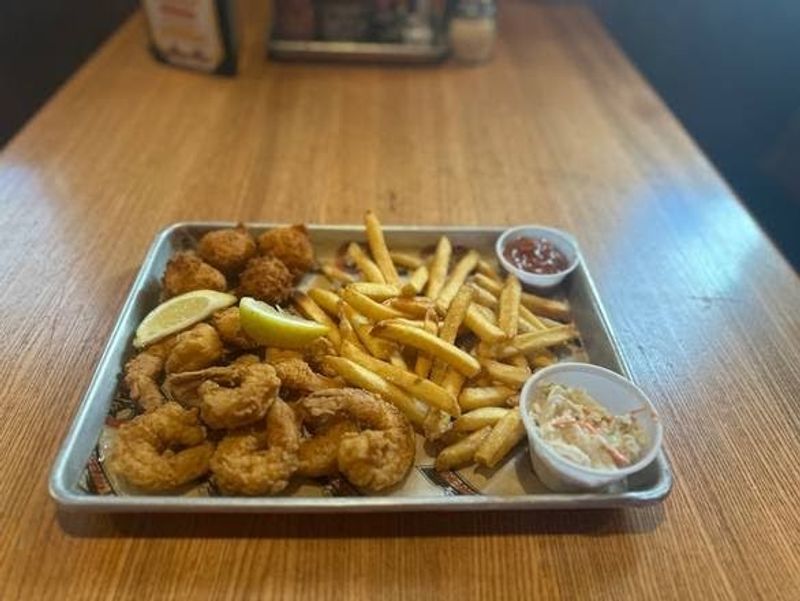
Listen carefully when a family places its order and there is a good chance the fries will be treated as automatic. Nobody pauses to debate truffle seasoning or choose among six dipping sauces.
A serving of fries simply belongs next to the hot dog, as firmly established as mustard on the bun and a cold drink within reach. These are straightforward, golden fries cooked in peanut oil.
They are not disco fries, despite New Jersey’s well-earned affection for potatoes covered in brown gravy and melted mozzarella. Hot Dog Johnny’s is not known for serving gravy-and-cheese fries, and trying to force that identity onto the stand misses what makes it distinctive.
This is one place where plain fries do not feel like the option you settle for. They are the option people have been ordering for decades.
Their appeal depends heavily on timing. Fresh from the fryer, the edges carry a light crispness while the centers remain soft enough to collapse under a bite.
Salt does most of the work. Ketchup is available for anyone who wants it, but there is no elaborate presentation and certainly no garnish placed with tweezers.
The portion also fits the larger meal. A hot dog, fries, and birch beer make a satisfying roadside lunch without requiring a nap in the parking lot.
Families can order several servings for the table, although that plan often ends with one person protecting the final fries as if they were included in a legal settlement. More importantly, the fries complete a pattern that returning customers recognize.
The paper container, the smell of peanut oil, and the inevitable stray fry at the bottom of the bag are all part of the memory. Plenty of restaurants have more dramatic potatoes.
Few can serve a plain order and have someone at the table say, with complete sincerity, that it tastes like childhood.
Birch Beer and Buttermilk Keep an Old Tradition Alive
The safest drink order is birch beer. The more interesting one is buttermilk.
Birch beer is a regional favorite with a flavor that sits somewhere near root beer but has its own herbal, slightly wintergreen edge. At Hot Dog Johnny’s, it has long been paired with hot dogs and fries, traditionally served cold enough to cut through the richness of food straight from the fryer.
For many customers, ordering anything else would feel like requesting wine at a Little League concession stand. Technically possible, perhaps, but spiritually incorrect.
Then there is the buttermilk, the drink that has launched countless family dares. Thick, tangy, and unapologetically old-fashioned, it is not a sweet milkshake hiding behind a rustic name.
It is actual buttermilk, once a much more familiar American table drink than it is today. John Kovalsky reportedly enjoyed it with his hot dogs, and the combination became one of the stand’s signatures.
First-timers tend to fall into three groups. Some order it because they genuinely love buttermilk.
Others take a sip, make a thoughtful face, and quietly return to their fries. The third group spends the entire meal trying to convince a relative to taste it.
All three reactions count as participating in the tradition. What matters is that Hot Dog Johnny’s has kept the option alive without sanding down its oddness.
A modern restaurant might turn it into a maple-buttermilk frappe, add whipped cream, and charge accordingly. Here, the point is the drink itself.
Along with more familiar soft drinks, birch beer and buttermilk give the stand a flavor profile that belongs specifically to this stretch of Route 46. Hot dogs are sold everywhere.
A hot dog beside a frosty serving of buttermilk, with the Pequest River moving behind the table, narrows the possibilities considerably.
Riverside Picnic Tables Turn a Quick Bite Into an Outing
On a pleasant afternoon, the best seat is not inside. Carry the food toward the grass, claim a picnic table, and the Pequest River becomes the backdrop to lunch.
The water runs directly behind the property, softening the sound of Route 46 and making the stop feel more spacious than the words “hot dog stand” might suggest. This setting was part of John Kovalsky’s plan when he moved the business from its original gas-station location.
He wanted more than an efficient counter. He wanted a place where families could meet, eat, and stay for a while.
The mix of patio tables, grassy areas, river views, and covered seating still supports exactly that kind of visit. The swing set may be the smartest feature on the property.
It is simple, old-fashioned, and positioned to give restless children somewhere to go after finishing half a hot dog and three fries. Parents can linger over birch beer while keeping an eye on them, a modest luxury anyone who has traveled with young kids will immediately understand.
Nothing about the grounds feels overly managed. There are no timed reservations, branded lawn games, or admission fees disguised as “experiences.” You order food, choose a table, and decide for yourself how long the break should last.
Some customers eat quickly before getting back on Route 46. Others stretch lunch into a relaxed pause beside the river.
The large parking area helps preserve that easy rhythm, particularly for groups meeting from different directions. Travelers approaching from Interstate 80 can use Exit 12 and follow the road through Hope, while drivers coming north on Route 31 reach the stand shortly after the Route 46 junction.
The result falls somewhere between a roadside lunch and a tiny public picnic. It costs little, requires almost no planning, and gives everyone room to breathe before climbing back into the car.
Why Generations of New Jersey Families Keep Coming Back
Patricia Fotopoulos was eight years old when she stood on crates and handed sodas to customers at her parents’ new business. She later took over the stand, carrying forward the operation John and Louise Kovalsky started in 1944.
That bit of family history explains more about Hot Dog Johnny’s than any vintage sign or retro color scheme could. The continuity behind the counter is matched by continuity on the other side.
Adults return with children and grandchildren, repeating stops they once made with their own parents. They remember the swings, the pickle spear, the birch beer, and the moment the stand came into view along Route 46.
The food does not have to recreate every detail of a childhood visit perfectly. It only has to provide enough familiar signals for the memory to rush back.
New Jersey has no shortage of beloved food institutions, but many are deeply tied to their immediate neighborhoods. Hot Dog Johnny’s has a slightly different relationship with its regulars because so many first encountered it while traveling.
It became associated with drives to the Poconos, summer outings, visits to relatives, or long rides through Warren County. The destination mattered, but so did the stop along the way.
That is also why its lack of polish feels essential rather than accidental. Replacing the counter with touch screens or expanding the menu into three laminated pages might make the business more contemporary, but it would change the ritual.
The pleasure lies in how little explaining the place requires. Pull in, order a dog and fries, choose between birch beer and a brave encounter with buttermilk, then find a table near the river.
More than 80 years after Palm Sunday 1944, Hot Dog Johnny’s remains recognizably itself. In a state where roads, storefronts, and family routines can change almost overnight, that kind of consistency is rare—and deeply comforting.
Share this story