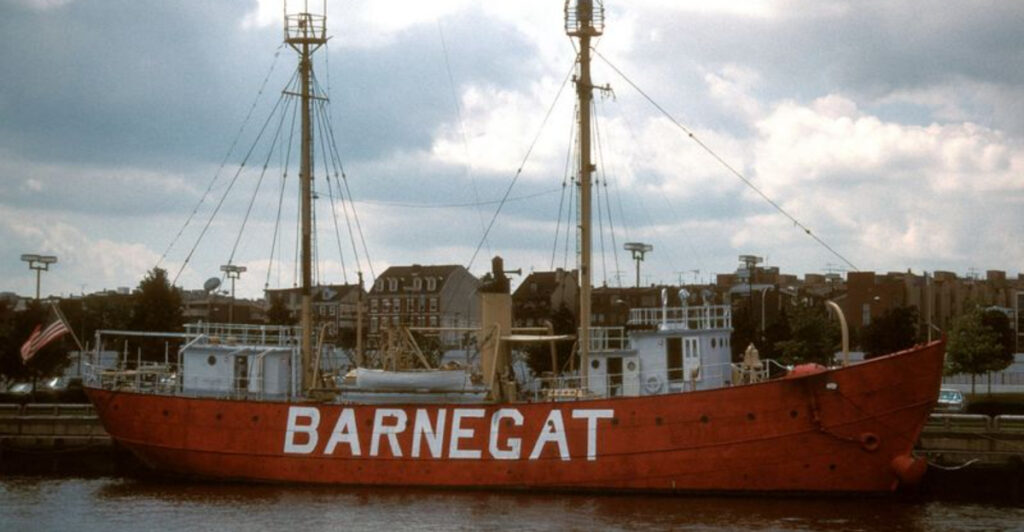
Two skeletal masts rise above the Camden waterfront, hinting at a vessel that is far easier to overlook than it should be. Below them sits the Lightship Barnegat, its steel hull stained by rust and its decks weathered by decades of uncertainty.
It does not have the polished guns of the nearby Battleship New Jersey or the tidy exhibits of a conventional maritime museum. Yet this 130-foot ship once performed an essential job: holding its position in dangerous water and warning passing vessels away from shoals.
Built in Camden in 1904, the Barnegat spent more than six decades serving as a floating lighthouse, navigational marker, and wartime examination vessel. Its journey eventually carried it to Philadelphia and then back to the city where workers first assembled its hull.
Today, LV-79 is endangered, inaccessible to ordinary visitors, and still waiting for a secure future. The rust may be obvious, but so is the history underneath it.
Built in Camden to Guard the Jersey Coast
Long before Camden’s waterfront had an aquarium, a concert venue, or a battleship museum, the city was busy turning steel into some seriously impressive vessels. The New York Shipbuilding Company constructed Lightship No. 79 in Camden in 1904, giving the ship a hometown connection that makes its return to the city feel almost too neat to be accidental.
At 130 feet long, 28 feet across, and approximately 668 tons, LV-79 was sturdy rather than glamorous. Its steam-powered machinery allowed it to travel between assignments, but its most important skill was staying put.
A lightship was stationed where building a permanent lighthouse was impractical, serving as a floating navigational sign in water that could punish even experienced captains. LV-79’s first assignment was Five Fathom Bank, a shoal about 15 miles from the Cape May Lighthouse.
From 1904 until 1924, it warned commercial traffic away from shallow water along one of the busiest approaches to the Delaware Bay. The location exposed the vessel and its crew to open-ocean weather, including fog, winter cold, heavy swells, and storms that could make remaining anchored feel like an endurance sport.
After two years as a relief vessel, filling in wherever another lightship was unavailable, LV-79 received the name most New Jerseyans now recognize. In 1927, it was permanently assigned to the Barnegat station off the Jersey Shore.
That same year, the original first-order Fresnel lens was removed from Barnegat Lighthouse, and the ship became a crucial offshore marker for passing vessels. The arrangement sounds odd today—a lighthouse that could pitch, roll, and tug at its anchor—but it solved a real navigational problem.
The Barnegat was built to be seen, heard, and trusted, especially when the coast itself disappeared behind fog.
Life Aboard a Lighthouse That Floated
Imagine reporting for work at a lighthouse, except the floor never stops moving and leaving the building requires another boat. That was the basic bargain aboard the Barnegat.
Crewmembers lived where they worked, sharing a compact steel vessel anchored offshore for extended periods. Their job was less about traveling from port to port than maintaining a precise position while the Atlantic tried to shove them somewhere else.
The ship’s most visible equipment stood on its two masts. Each mast carried three oil-fed lanterns, creating an elevated signal that mariners could identify at night.
When fog swallowed the lights, the Barnegat switched to louder methods. A steam-chime whistle sounded every 20 seconds, while a submarine bell sent vibrations through the water that vessels equipped with underwater receivers could detect.
Before radar, GPS, and electronic chart plotters became everyday tools, that combination of light and sound could mean the difference between a safe passage and a hull torn open on a shoal. Keeping it all working demanded constant attention.
Lanterns needed fuel and maintenance, machinery required care, and the anchor system had to hold the ship on station through changing tides and rough weather. The crew also had to watch for passing traffic, record conditions, and remain ready for emergencies.
There was no stepping outside for a quiet break when the weather turned nasty; outside was the problem. The routines could be monotonous, but the responsibility was enormous.
Commercial vessels depended on the lightship being exactly where charts said it would be, producing the correct signals on schedule. That reliability is what made the Barnegat valuable.
It was not designed to chase adventure across the ocean. It was designed to remain steady in an unsettled place, night after night, while everyone else used its warning to keep moving.
Wartime Duty on the Delaware River
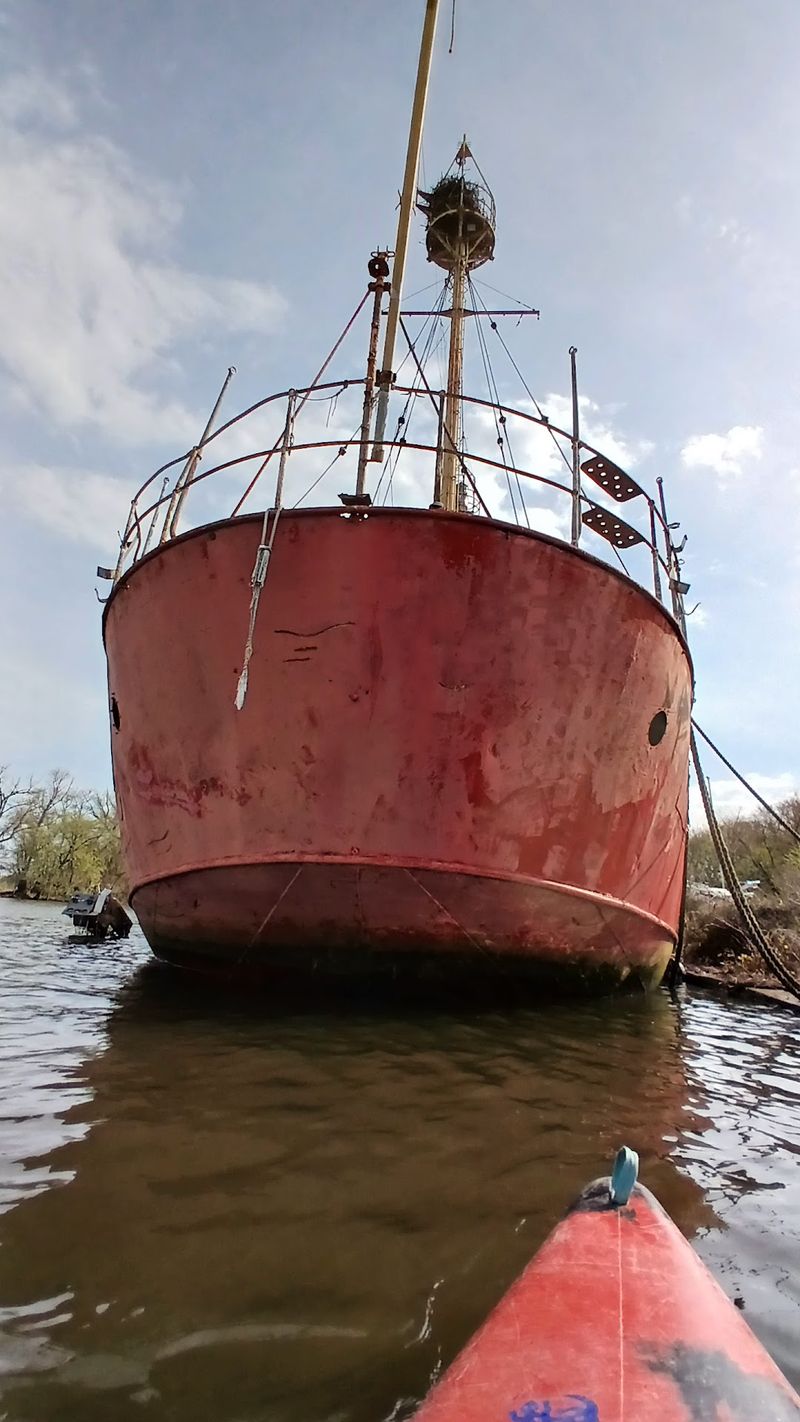
In 1942, the Barnegat traded its familiar station off the Jersey Shore for a job shaped by wartime anxiety. The United States was fully engaged in World War II, enemy submarines threatened shipping along the East Coast, and the Delaware River provided access to shipyards, refineries, factories, and the busy ports of Philadelphia, Camden, and Wilmington.
A vessel entering that corridor could not simply sail through without questions. Reassigned to Edgemoor, Delaware, LV-79 began serving as an examination vessel.
Instead of warning mariners about shoals, its crew helped determine who was approaching one of the region’s most strategically important waterways. Incoming ships could be stopped and asked to provide their identity, cargo, home port, and last port of call before receiving clearance to continue upriver.
It was careful, unglamorous security work, but that suited the Barnegat perfectly. This was already a vessel built around vigilance, clear signals, and long hours in a fixed position.
The mission had changed; the patience required had not. Its Edgemoor assignment also placed the ship close to the industrial region that had created it.
Camden’s New York Shipbuilding Corporation produced naval and commercial vessels during the war, while facilities throughout the Delaware Valley worked around the clock. Protecting access to those operations mattered far beyond New Jersey.
The Barnegat remained on examination duty until 1945, when the war ended and the ship returned to its namesake station. There it resumed the quieter business of guiding maritime traffic along the coast.
That return says plenty about the vessel’s versatility. It could serve as a beacon in dangerous offshore waters, then become a checkpoint during a global conflict, and afterward slip back into its old routine.
The work rarely attracted headlines, but for more than two decades after the war, its lanterns and signals remained part of life along the Jersey coast.
From Penn’s Landing Back to New Jersey
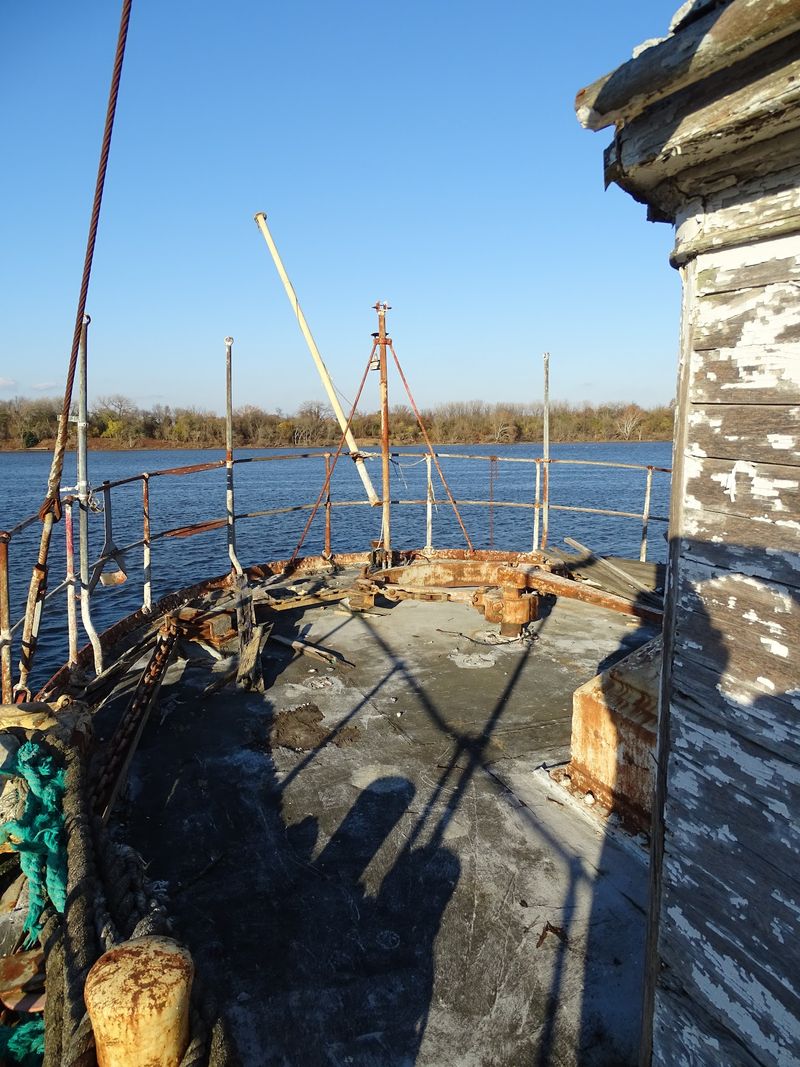
Decommissioning came on March 3, 1967, ending roughly 63 years of federal service. By then, radar, automated buoys, and other navigational technology had made staffed lightships increasingly unnecessary.
The Barnegat had spent most of its existence helping other vessels avoid becoming wrecks; retirement presented the ironic problem of keeping the lightship itself from disappearing. Its first post-service destination was the Chesapeake Bay Maritime Museum in St. Michaels, Maryland.
The museum received the vessel as a donation, but owning a historic steel ship is not like adding another display case. Dockage, painting, mechanical work, hull repairs, and protection from water intrusion create a maintenance bill that never politely takes a year off.
Unable to sustain those costs, the museum sold the Barnegat in 1970 to a preservation group that brought it to Penn’s Landing in Philadelphia. There, the ship joined a floating collection on the Delaware River and gained a second life as a public maritime artifact.
It was added to the National Register of Historic Places in 1979, recognized for its importance to engineering, transportation, and maritime conservation. The listing offered prestige, but prestige does not scrape rust or replace steel plate.
The organization responsible for the vessel eventually disbanded, and the Barnegat was sold again. During the 1990s, it was moved across the river to Pyne Poynt Marina in Camden.
The plan was to restore the ship and eventually display it along the city’s waterfront. That vision would have placed LV-79 near the community where shipyard workers built it, creating a satisfying full-circle ending.
Instead, money and resources ran short. The proposed museum never opened, restoration stalled, and the Barnegat settled into a long limbo.
It had made it home to New Jersey, but home did not yet come with the protection it needed.
Rust and Neglect Threaten a Maritime Treasure
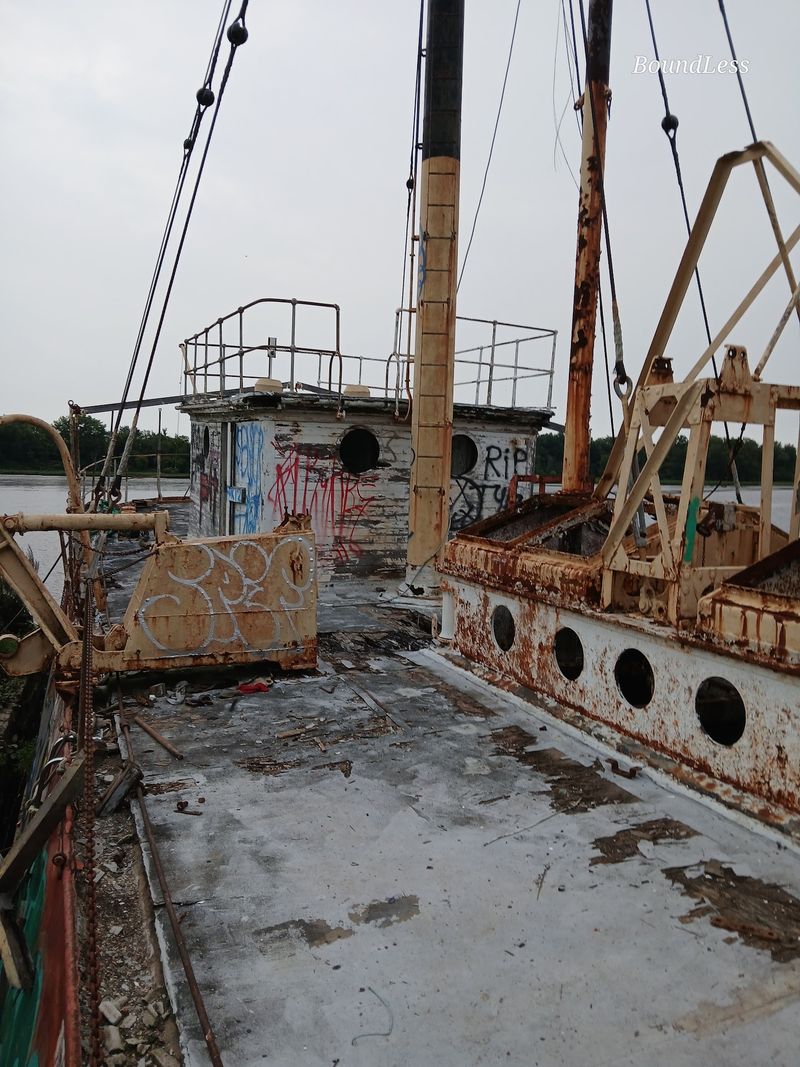
Steel ships can look indestructible right up until water proves otherwise. Rain finds openings, paint fails, metal corrodes, and each delayed repair makes the next one more complicated.
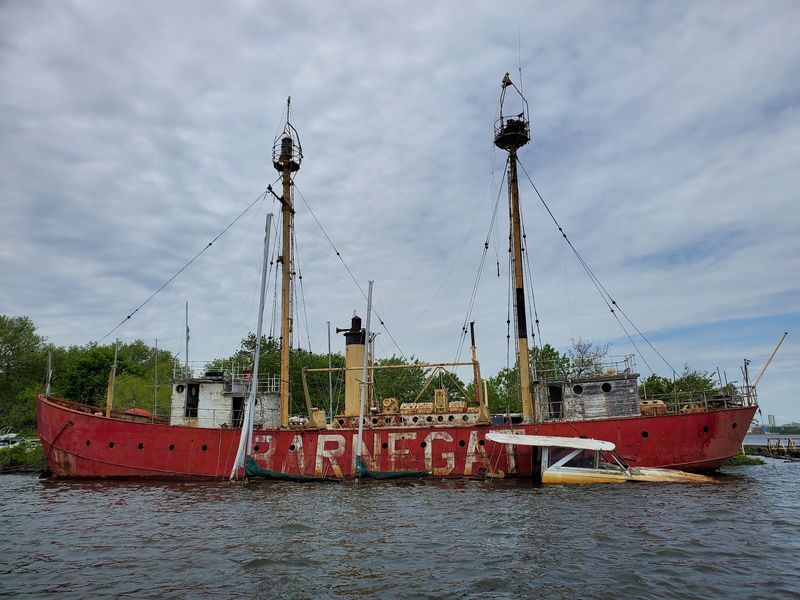
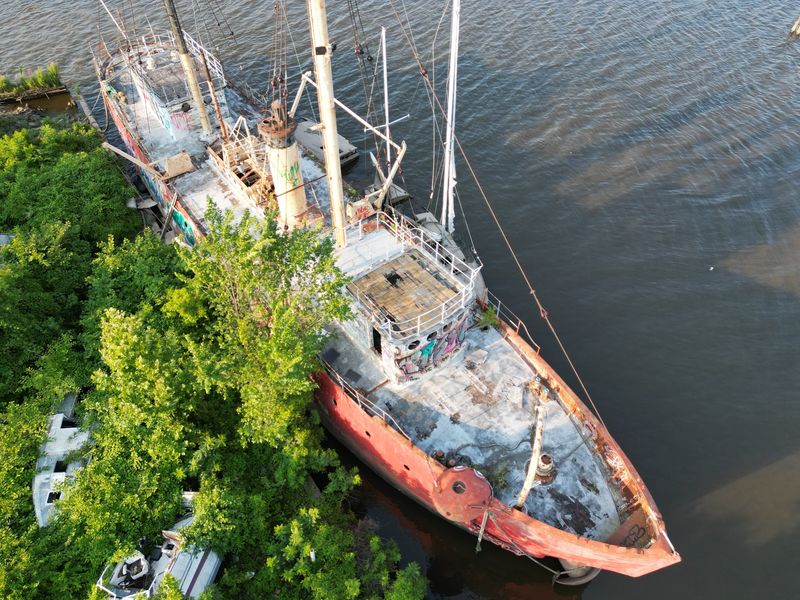
Years of exposure at the Camden marina have left the Barnegat in visibly poor condition, with rust, weather damage, vandalism, and neglected surfaces replacing the crisp working appearance it once carried.
Preservation New Jersey placed the ship on its 10 Most Endangered Historic Places list in 2018, warning that it faced the possibility of demolition by neglect.
That phrase sounds bureaucratic, but the meaning is brutally simple: a landmark can deteriorate until saving it becomes financially or structurally unrealistic. Restoring LV-79 would require far more than a fresh red coat of paint.
Maritime engineers would need to evaluate the thickness and stability of the hull, inspect the decks and internal framing, address water infiltration, and determine which historic components could be retained. A proper preservation plan would also have to establish priorities, estimate costs, and identify a sustainable use for the vessel.
Even after a major restoration, the maintenance clock would immediately start again. Public access presents another complication.
The Barnegat is not currently a conventional attraction with posted admission, regular hours, guided tours, or a safe route onto its decks. Visitors should not assume they can reach or board the vessel, and the marina setting must be respected.
Depending on the available public viewpoint, its two masts may be easier to spot than the hull itself. One important piece of the ship has already found safer ground.
Its bell was removed, restored, and unveiled in 2020 at the Seventh Street bayside pavilion in Barnegat Light, preserving a physical connection between the vessel and the Shore community whose name it carries. The bell survived because somebody acted.
The much larger question is whether the rest of the ship can receive the same attention before corrosion makes the decision.
A New Chapter May Still Be Waiting
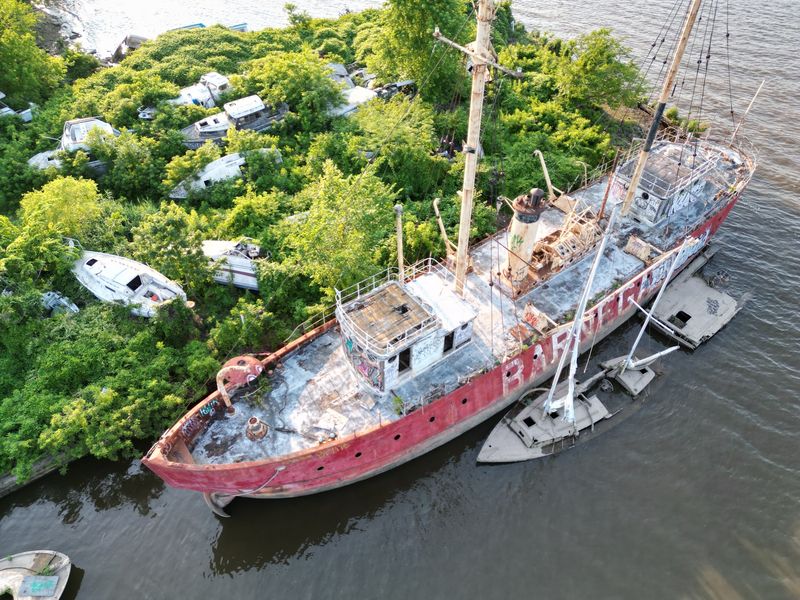
A hopeful turn arrived in 2023 when Camden County purchased the marina property and the Barnegat, bringing the endangered vessel under public ownership.
That change did not instantly produce a restored hull, an opening date, or a museum plan, but it did resolve one of the biggest obstacles facing any preservation effort: who would take responsibility for the site and the ship.
The surrounding waterfront is already changing. Camden County launched a multimillion-dollar first phase of improvements at Wiggins Park Marina in 2024, including new concrete floating docks, steel piles, electrical upgrades, and sanitary pump-out services.
Those projects are focused on marina infrastructure rather than a complete restoration of LV-79, so expectations need to remain realistic. The Barnegat is still not open for tours, and no firm public timetable has transformed it into a visitor attraction.
Even so, public ownership gives preservation advocates something more concrete than the stalled private museum dream of previous decades. The ship has the raw material for a remarkable Camden story.
It was built in the city, protected commercial traffic near Cape May, served off Barnegat, screened vessels during World War II, spent years at Penn’s Landing, and returned across the Delaware to the place where its working life began.
Few artifacts connect South Jersey’s shipbuilding industry, Shore navigation, wartime security, and modern waterfront redevelopment in one 130-foot package.
Restoration would be expensive and technically demanding, but other surviving American lightships show that these vessels can become compelling museums and community landmarks when long-term maintenance is built into the plan. For now, the Barnegat remains a weathered silhouette rather than a polished exhibit.
Its lanterns are dark and its whistle no longer sounds every 20 seconds, yet the old ship is still performing one final kind of duty—reminding Camden how much history can sit quietly along the water.
Share this story