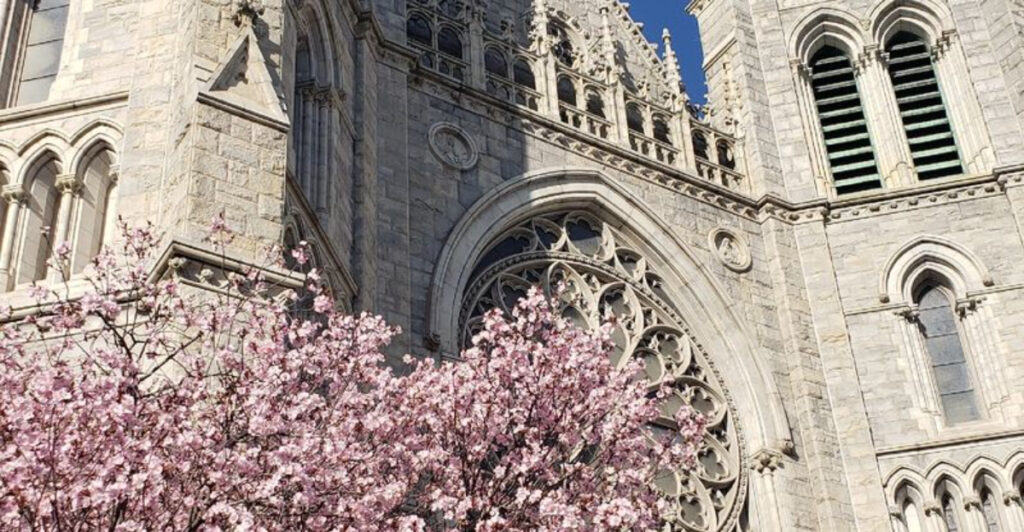
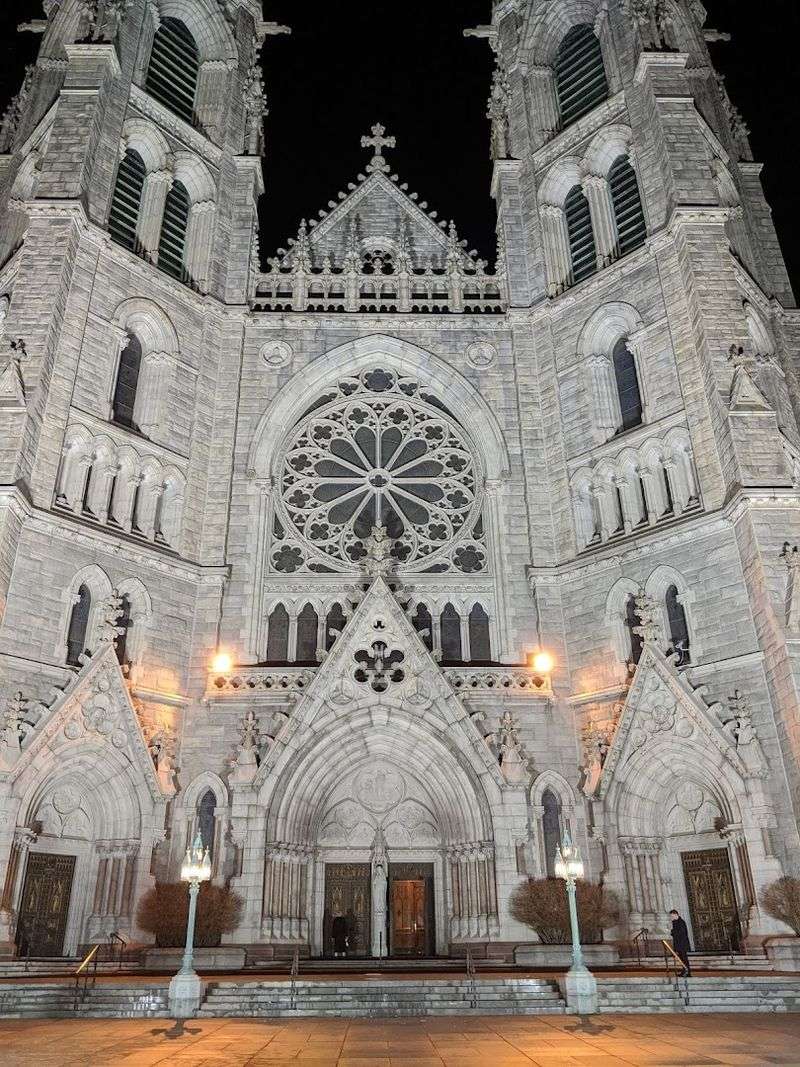
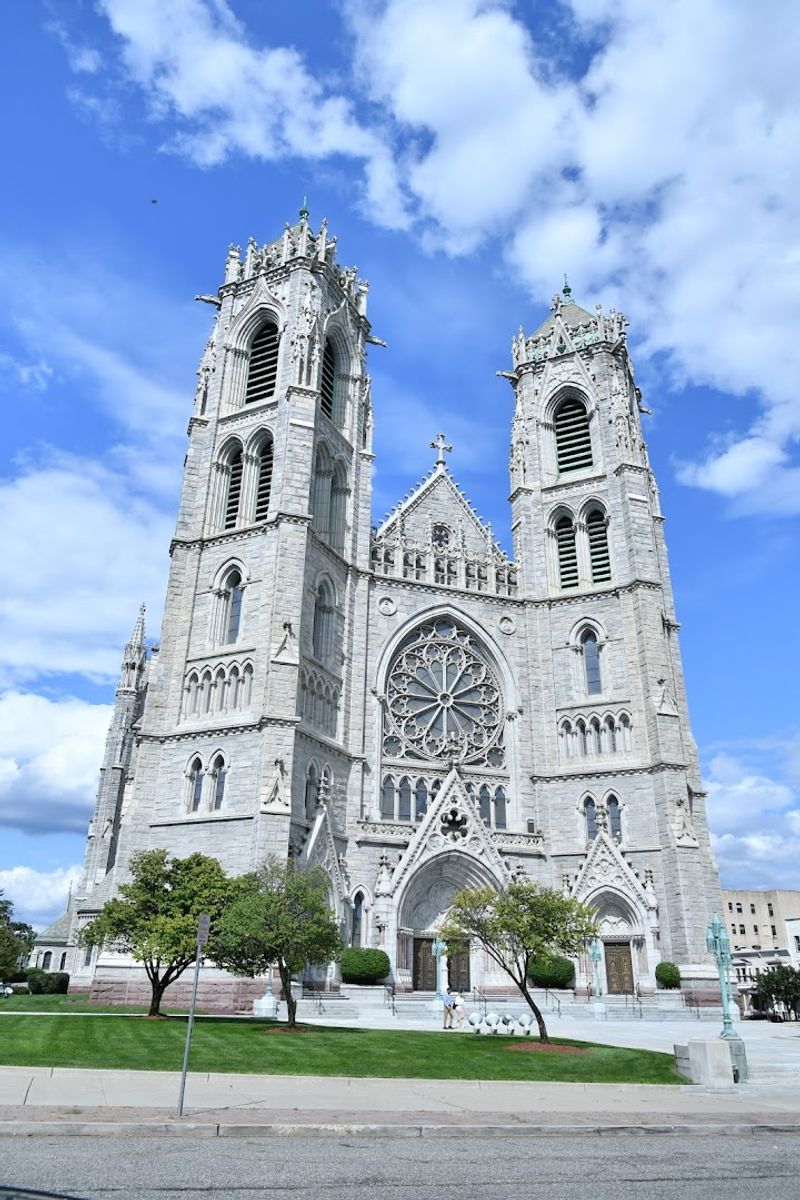
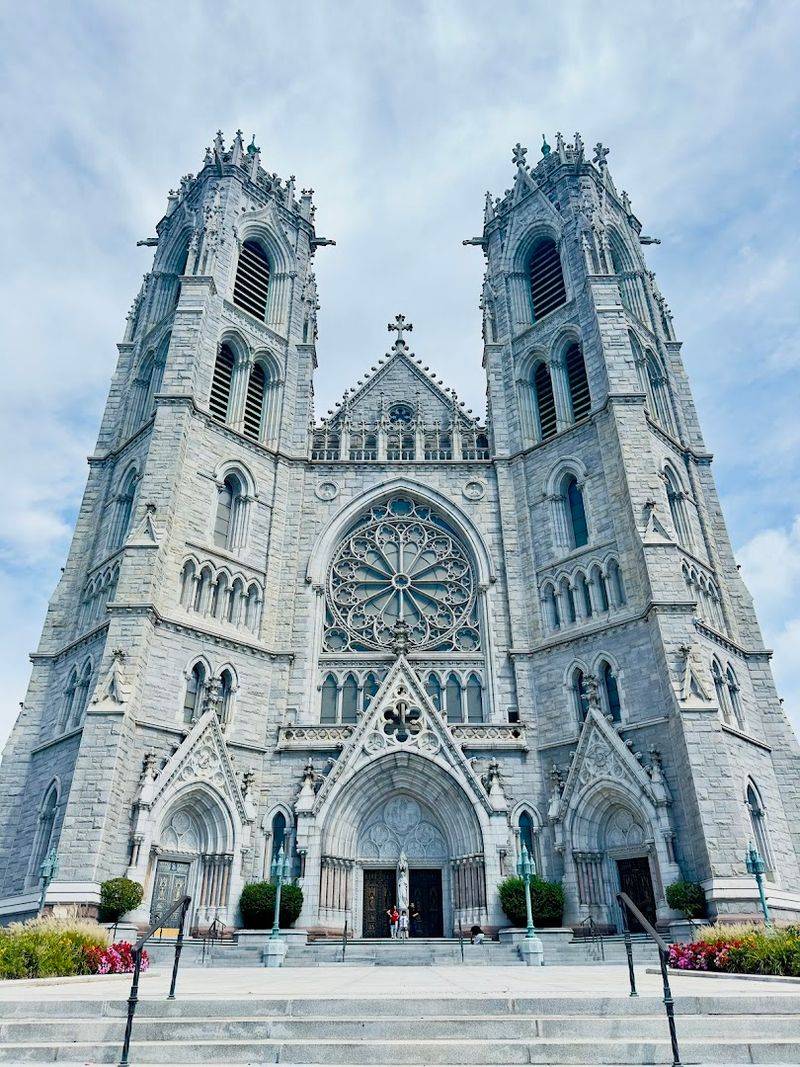
The first thing that gets you is the window. Not the whole cathedral, not even the twin towers, but that huge rose window over the entrance, glowing above Ridge Street like Newark decided it deserved its own little piece of Chartres.
Then your eyes move up and out, and suddenly you’re standing in front of a French Gothic giant with 232-foot towers and a copper spire rising nearly 300 feet into the air.
This is the Cathedral Basilica of the Sacred Heart, and for a lot of people who only know Newark by airport signs, that first look feels like a plot twist.
The building sits on Newark’s highest point beside Branch Brook Park, covers roughly 45,000 square feet, and is longer and taller than St. Patrick’s Cathedral in Manhattan.
It took decades to finish, cost far more than anyone expected, and still manages to feel less like a monument and more like a living part of the city.
For all its grandeur, it doesn’t come off as distant or untouchable. It feels rooted in Newark, shaped by the city’s ambition, immigrant history, and stubborn sense of pride.
The Newark cathedral that feels lifted from medieval Europe
Walk up to the Cathedral Basilica from Branch Brook Park and the comparison arrives fast. This does not look like the church most people expect to find in New Jersey.
The style is French Gothic, the kind that brings to mind the great cathedrals of northern Europe, and the building leans into that identity with pointed arches, a granite façade, tall towers, a steep slate roof, and a copper fleche over the crossing.
Church leaders officially shifted the design in 1913 away from an earlier English-Irish Gothic approach and toward French Gothic, looking to cathedrals such as Notre-Dame and Chartres for inspiration.
Its setting helps sell the illusion. Because the cathedral stands on the highest point in Newark right beside Branch Brook Park, it doesn’t feel boxed in by the city.
Instead, it rises above the neighborhood with exactly the kind of visual drama Gothic architecture was meant to create. The scale only adds to the effect.
The cathedral is often compared to Westminster Abbey, and it is longer and taller than St. Patrick’s Cathedral in New York City, which is not a detail people tend to forget once they hear it. Then there are the features that keep the building from feeling like a generic imitation.
The west tower holds fourteen bells cast in Padua, Italy. The pews and woodwork were made from Appalachian oak.
The bronze doors came from Rome, and the altar marble from Pietrasanta in Italy. All of it gives the cathedral a layered personality.
It has the splendor of Europe, sure, but also the grit and specificity of Newark. That mix is what makes it memorable. It doesn’t feel dropped in from somewhere else. It feels like Newark built something audacious and pulled it off.
Why this Gothic landmark stands among America’s most stunning churches
Big churches are not hard to find in the United States. Cathedrals that genuinely leave you staring for a minute are much rarer, and this one earns its place in that company.
The Cathedral Basilica of the Sacred Heart stands out because it combines sheer scale, careful craftsmanship, and a sense of cohesion that many grand buildings never quite achieve.
It is the seat of the Archdiocese of Newark, was dedicated in 1954, and later received the designation of minor basilica, but what makes it unforgettable is less about titles and more about how confidently every part of it works together.
Start with the silhouette. The twin towers rise 232 feet, the spire reaches nearly 300 feet, and the front façade is anchored by a 36-foot rose window that ranks among the cathedral’s most famous features.
The building is massive without feeling clumsy. The proportions feel intentional, the ornament never gets fussy, and the exterior manages to look dramatic from nearly every angle.
Inside, the effect continues. This is not one of those oversized churches where the grandeur fades once you’re through the doors.
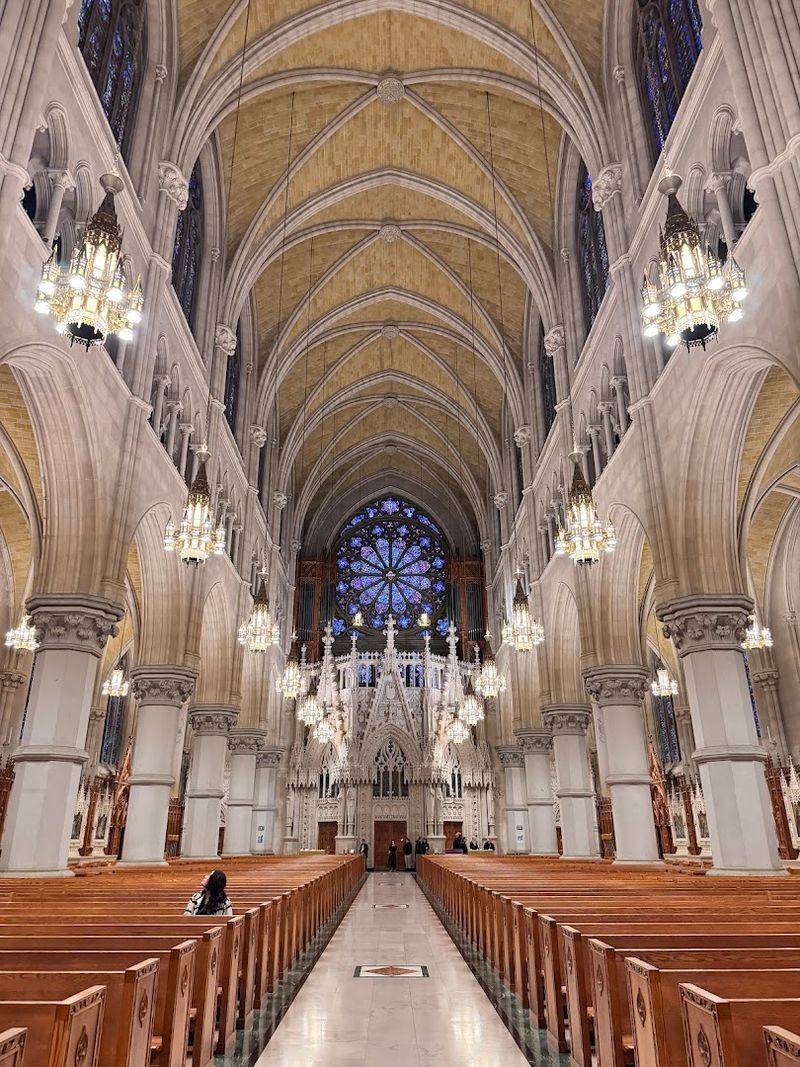
The hand-carved wood, imported marble, stonework, stained glass, and bronze details all hold up under scrutiny. The cathedral also houses a Schantz organ with 9,513 pipes, one of the features that helps keep the place active as a cultural landmark rather than just a historic one.
Concerts, recitals, and major liturgical events still fill the space with sound and life. That matters.
A lot of old buildings are impressive once and then quietly settle into the background. This one keeps giving you reasons to pay attention.
It is architecturally serious, visually unforgettable, and rooted in the life of the city around it. That’s why it belongs in the conversation with America’s most striking churches, not as a regional surprise, but as the real thing.
The long road from 19th-century dream to finished masterpiece
This cathedral did not rise all at once. It took generations, shifting architectural plans, and a level of patience that feels almost unthinkable now.
The story starts in the 19th century, when Bishop James Roosevelt Bayley first pushed for a grand cathedral for Newark. The land for the current site was purchased in 1871 for $60,000, construction began in January 1898, and the cornerstone was laid in June 1899.
The cathedral would not be formally dedicated until October 19, 1954. That kind of timeline turns a building into something larger than a construction project.
It becomes a civic obsession, a promise people keep renewing over decades. Even the design evolved midstream.
In 1913, church leaders decided to abandon the earlier English-Irish Gothic direction and commit more fully to French Gothic, explicitly drawing inspiration from Notre-Dame and Chartres.
By 1918, enough progress had been made to support the steel-backed slate roof and the towering copper fleche over the crossing, and by the 1920s the work had shifted toward the interior, including heating tunnels, the crypt, limestone walls, and Gustavino vaulted ceilings.
The money, as you’d expect, was a constant challenge. Early estimates came in around $1 million, but the final cost rose to roughly $18 million, funded largely through donations and church collections across the archdiocese.
Even in the 1950s, the finish line was not guaranteed. Archbishop Thomas Walsh had to launch a final campaign through the Cathedral Builders’ Association to raise the money needed to complete it.
That struggle is part of what makes the finished cathedral feel so substantial. You are not just looking at stone and glass.
You are looking at nearly a century of ambition, fundraising, revisions, and refusal to quit. The building feels grand because it is grand, but also because so many people spent so long insisting that Newark deserved something extraordinary.
Inside the soaring sanctuary of the Cathedral Basilica of the Sacred Heart
The exterior gets the gasps. The interior is what makes people fall silent.
Step through the bronze doors and the whole experience changes from impressive to immersive. The nave stretches out beneath vaulted ceilings, the limestone pulls your eyes upward, and the space is arranged with the kind of scale that makes even casual visitors slow down.
Nothing inside feels accidental. The cathedral’s interior work in the 1920s included the crypt, limestone walls, and Gustavino vaulted ceilings, and that combination still gives the place a richness that newer churches rarely match.
It is formal without feeling cold and ornate without tipping into clutter. One of the most meaningful features is the ring of chapels around the sanctuary, each one reflecting the communities that shaped Catholic life in Newark.
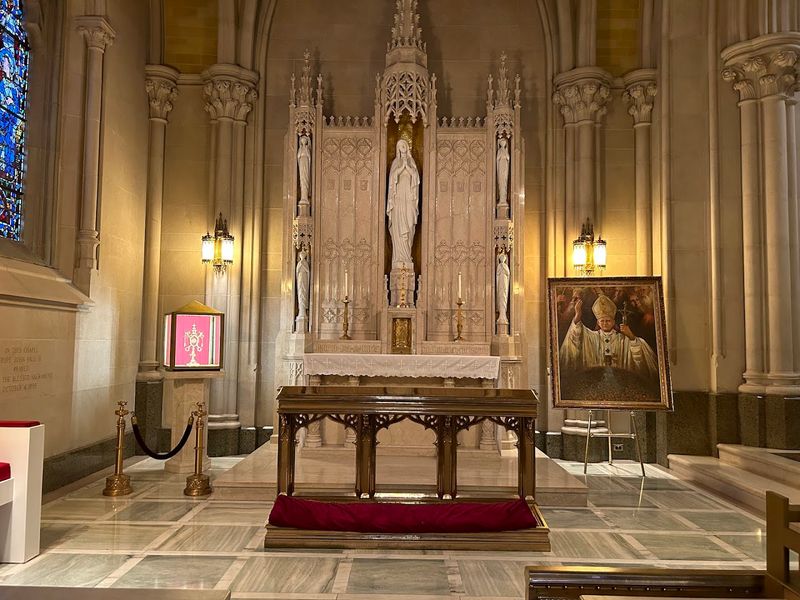
There is St. Patrick for the British Isles, St. Lucy Filippini for Italian and Portuguese worshippers, St. Boniface for German speakers, St. Stanislaus of Kraków for Polish, Slovak, and Hungarian communities, and St. Anne for Hispanic, African, and Asian communities. That detail gives the building more than visual beauty.
It gives it human texture. This is not just a grand church with imported stone and old-world aspirations.
It is also a record of the people who built the city and prayed here across generations. Behind the main altar, the Lady Chapel of Our Lady of Grace adds another layer of drama with an altar of Carrara marble and hand-cut crystal chandeliers.
The pews, made from Appalachian oak, ground all that grandeur in a kind of tactile warmth. Even with all its scale, the cathedral never feels empty of meaning.
Five former bishops of Newark are buried in the crypt, and the church remains the mother church of the archdiocese, hosting major liturgies, ordinations, and diocesan events. It is a landmark, yes, but it is also still very much in use, which gives the entire sanctuary an energy that goes beyond architecture.
The stained glass, rose window, and organ that leave visitors speechless
If you had to narrow the cathedral’s magic down to three things, glass, light, and sound would make a strong case. The stained glass alone is enough to hold people in place for longer than they expect.
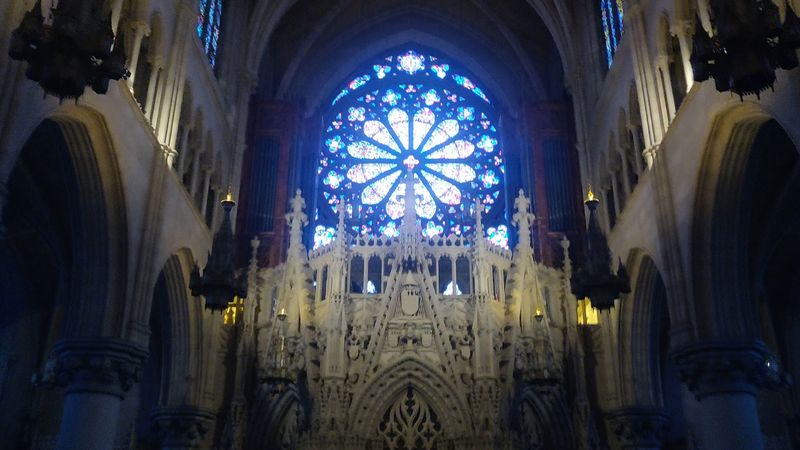
Made in Munich, the windows are often described as among the finest in the world, and once daylight starts moving through them, the claim stops sounding like promotional language and starts sounding pretty reasonable. The colors shift across the stone in a way that softens nothing and yet transforms everything.
The building still feels distinctly Gothic first, but the reds, blues, and golds give it a pulse. Then there is the rose window, which is the kind of feature that sounds impressive on paper and somehow looks even better in person.
It spans 36 feet and dominates the main façade with absolute confidence. Outside, it gives the front of the cathedral its signature look.
Inside, it pours in light with a level of drama that feels almost theatrical. Some churches have a handful of standout details.
Here, the rose window feels like a full event. The organ completes the experience.
Installed in the mid-1950s and later rebuilt and expanded, the Schantz organ contains 154 ranks, 193 stops, and 9,513 pipes, making it the largest church organ in New Jersey. That would already be enough to impress people who care about music, but what makes it special is that it is not there merely to be admired.
It still gets used. The cathedral’s concerts and recitals continue to draw listeners into the building, which means the place is not frozen in its own grandeur.
It breathes. Light changes with the hour. Music fills the nave. Visitors look up, then listen, then usually look up again. Plenty of beautiful buildings become static over time. This one still knows how to perform.
Why this Newark treasure belongs on every New Jersey bucket list
New Jersey has no shortage of places locals bring up with pride. The Shore gets its loyalists.
Cape May has its charm offensive locked down. Princeton, Liberty State Park, and a few fiercely defended diners always make the cut.
The Cathedral Basilica of the Sacred Heart deserves to be right there with them, not as a niche church stop, but as one of the state’s truly great landmarks. It has the kind of scale and visual force that makes an outing feel memorable even before you know the history.
Once you do know the history, it only gets better. Part of its appeal is how naturally it fits into a real Newark day.
The cathedral sits beside Branch Brook Park, so a visit pairs easily with a walk through one of the city’s most beloved green spaces. In spring, when the cherry blossoms pull crowds into the park, the basilica feels even more cinematic.
But it works just as well on an ordinary afternoon, when the city is moving around it and the building quietly continues being extraordinary. It also tells a fuller story about Newark than the lazy stereotypes ever do.
This is a city of ambition, artistry, layered immigrant histories, and civic pride, and the cathedral gathers all of that into one place. Its chapels reflect the communities that shaped the archdiocese.
Its materials came from Italy, Germany, Appalachia, and beyond. Its long construction story mirrors a city that has weathered hardship and kept building anyway.
That is what gives the basilica its staying power. It does not feel like a detached attraction or a one-note photo stop.
It feels like Newark at its most ambitious, ornate, resilient, and underestimated. By the time you leave, the surprise is no longer that such a cathedral exists in New Jersey.
The surprise is that more people still don’t know it’s there.
Share this story