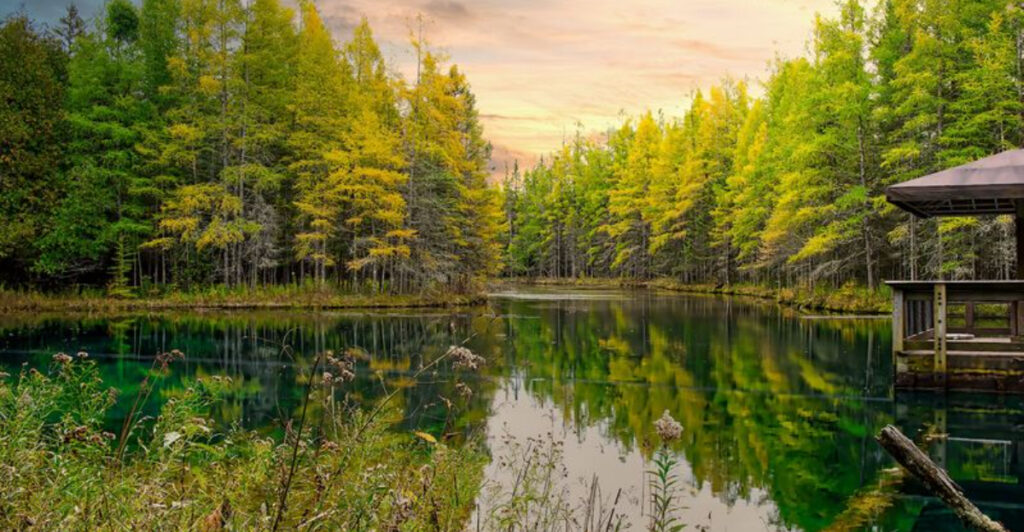
The first glimpse of Kitch-iti-kipi feels like Michigan is showing off a secret it somehow kept perfectly preserved. Hidden inside Palms Book State Park near Manistique, this Upper Peninsula spring sends thousands of gallons of crystal-clear, 45-degree water bubbling up every minute, creating a turquoise pool so transparent you can see straight to the sandy bottom 40 feet below.
Giant trout drift through the water, sand swirls from hidden vents, and the whole scene feels almost too vivid to be real. Whether you cross it on the hand-powered observation raft or simply stand there trying to take it all in, Kitch-iti-kipi is the kind of Michigan natural wonder that makes people go quiet for a moment.
The First Glimpse: A Pool That Doesn’t Look Real
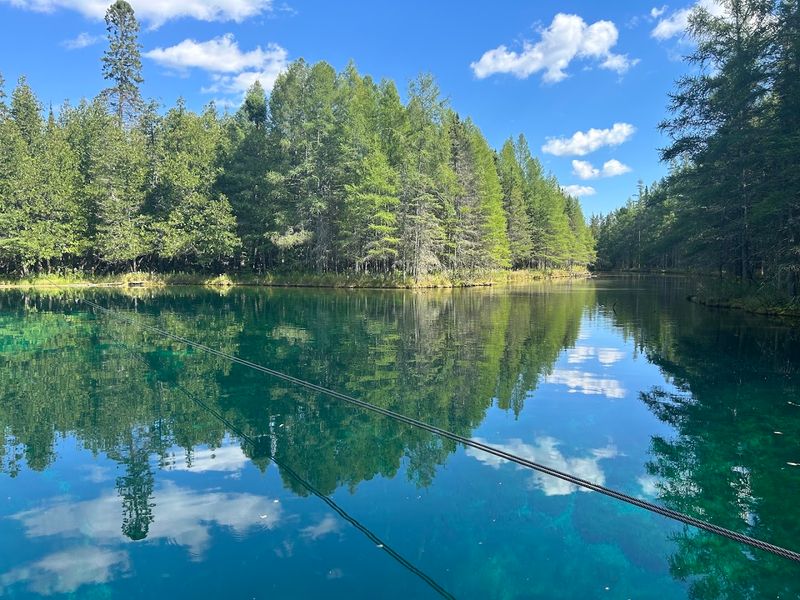
Standing at the edge of Kitch-iti-kipi for the first time, most people go quiet. The color of the water doesn’t match anything you’d expect to find in Michigan — it’s a deep, glowing turquoise that looks more like something out of the Caribbean than the Upper Peninsula.
The spring sits inside Palms Book State Park, framed by tall pines and hardwoods that reflect off the glassy surface in shades of green and gold.
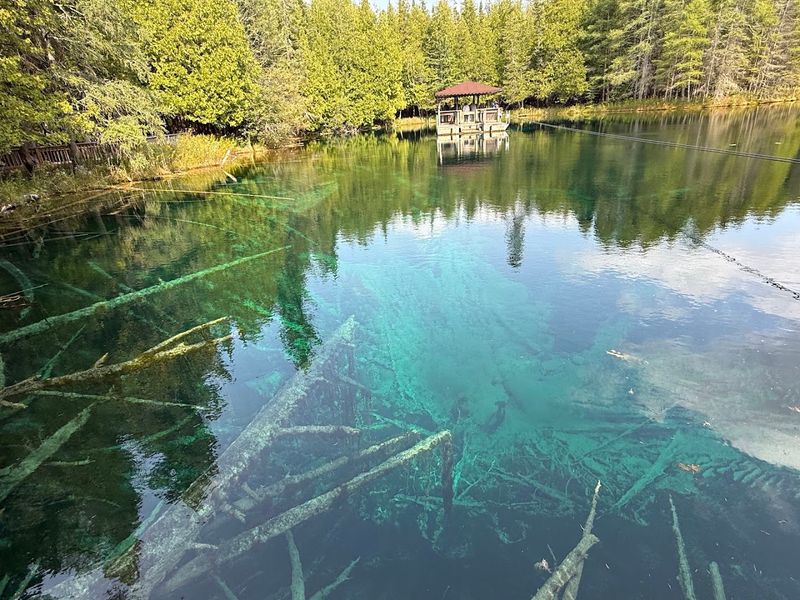
The pool stretches roughly 200 feet across, and the water is so clear that the bottom appears close enough to touch even though it plunges 40 feet down. No murk, no algae bloom, no underwater haze — just pure, unfiltered visibility from surface to sand.
That clarity comes from the constant flow of fresh groundwater pushing upward through the limestone bedrock beneath, filtering itself naturally as it rises.
The spring discharges around 10,000 gallons of water per minute at a steady 45 degrees Fahrenheit year-round, which keeps the pool from freezing in winter and from warming up in summer. That consistency creates an environment where the water looks almost the same in January as it does in July, though the surrounding landscape shifts dramatically with each season.
Early morning light hits the surface at an angle that makes the turquoise color almost glow from within. Late afternoon brings a warmer tone as sunlight filters through the tree canopy.
On overcast days, the water takes on a cooler, more dramatic blue-green. Sunny days remain the best for visibility all the way to the bottom, but honestly, the spring looks stunning no matter what the sky is doing above it.
Riding the Self-Operated Raft Across the Spring
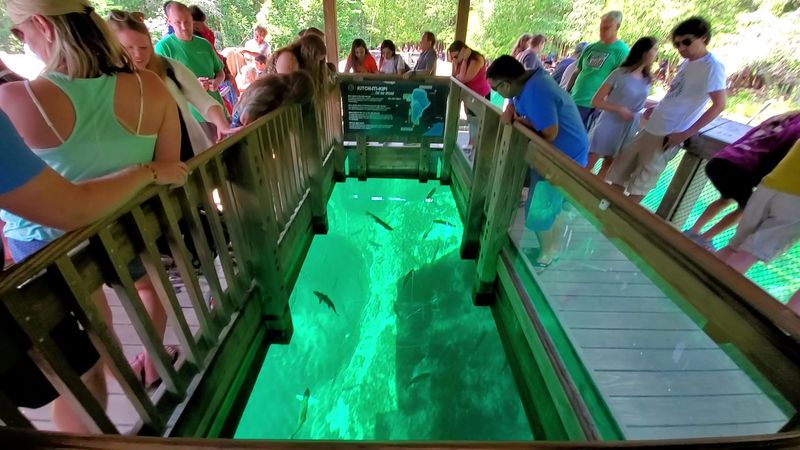
Getting out onto the water requires no boat license, no guide, and no staff — just a willingness to grab a wheel and pull. The observation raft at Kitch-iti-kipi is a flat wooden platform attached to a cable that stretches across the 200-foot length of the spring.
Riders take turns spinning a large hand wheel mounted on the raft to pull themselves across, and the whole system runs entirely on human power and mutual cooperation.
There’s no engine, no motor, no operator in charge. Whoever feels like turning the wheel volunteers, and the rest of the group simply watches the water below as the raft glides slowly across the surface.
The pace is slow enough to really absorb what’s happening beneath your feet, which is the entire point of the experience.
Cut into the center of the raft is a large rectangular viewing window, essentially an open hole in the platform that lets riders look straight down through the water column. From that opening, you can watch trout and perch moving lazily below, observe the sandy bottom shifting with the current, and see the spring vents pushing plumes of sand upward in slow, hypnotic spirals.
The depth makes it feel like staring down into an aquarium with no glass.
Turning the wheel is not as easy as it looks. The cable offers real resistance, and volunteers who work it across the full length usually finish with tired arms.
Plenty of riders are happy to let others take a turn, which creates a casual, friendly dynamic among strangers sharing the raft. The ride across and back takes around 10 to 15 minutes depending on how long people stop to stare through the viewing window, which is usually quite a while.
What Lives 40 Feet Below the Surface in Michigan’s Biggest Spring
The fish at Kitch-iti-kipi are not shy. Brown trout and yellow perch cruise through the water column in full view, completely unbothered by the raft overhead or the faces pressed against the viewing window above them.
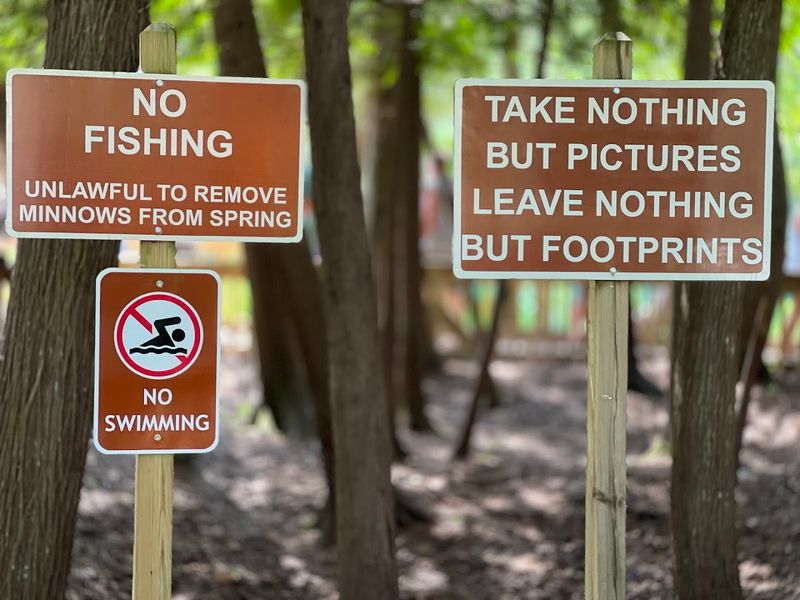
Because fishing is strictly prohibited in the spring, these fish have had no reason to fear humans for generations, and their behavior shows it. They move slowly, deliberately, and close to the surface in a way that wild fish almost never do.
Some of the trout visible from the raft are noticeably large — thick-bodied fish that have lived in the spring long enough to grow well beyond what most anglers would ever pull from a river. The 45-degree water temperature keeps their metabolism steady year-round, and the constant flow of fresh groundwater keeps oxygen levels high, creating near-ideal conditions for cold-water species to thrive in.
Beyond the fish, the real spectacle happens at the floor. The spring vents push water upward with enough force to lift and tumble the sand around them, creating small erupting columns that swirl and resettle in an endless loop.
From the raft, those vents look like tiny geysers working in slow motion across the bottom. The sand shifts constantly but never clouds the water, because the flow rate is strong enough to carry particles along without stirring up sediment into the water column.
No swimming is allowed in the spring, which protects both the ecosystem and the water clarity. Sunscreen, body oils, and physical disturbance would quickly degrade the visibility and disrupt the delicate balance that makes the spring so remarkable.
The rules feel strict until you realize how fragile the whole system actually is — and how much effort goes into keeping it looking exactly like this.
The Ojibwe Name and the History Behind the Spring
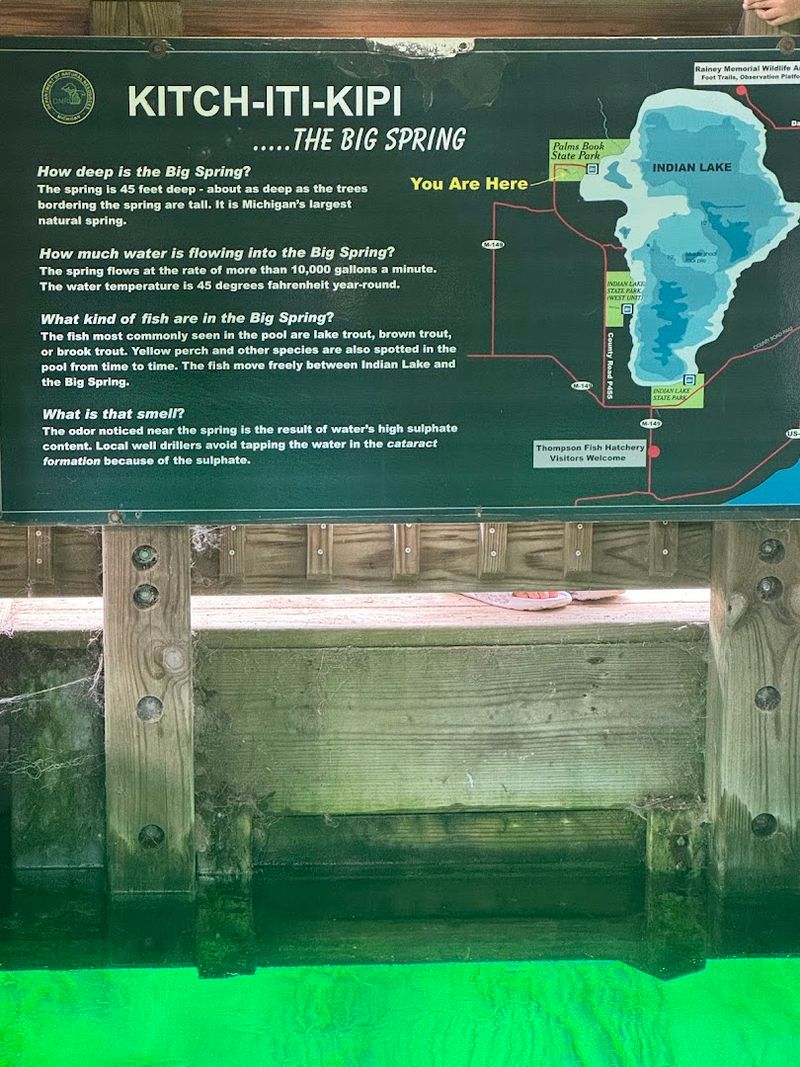
Kitch-iti-kipi translates from Ojibwe to “the big cold water,” and the name fits with an accuracy that no marketing team could improve on. The spring has been known to Indigenous peoples of the region for centuries, long before European settlers arrived in the Upper Peninsula.
Its unusual clarity and steady temperature made it a reliable landmark and a source of fresh water in a landscape that could be harsh and unpredictable through long northern winters.
The land surrounding the spring changed hands over time, eventually becoming part of a private logging operation in the late 1800s. A local businessman named John Bellaire fell so attached to the spring that he spent years campaigning to have it preserved as a public space.
His efforts paid off in 1926 when the state of Michigan acquired the property and established Palms Book State Park specifically to protect the spring and make it accessible to the public.
Interpretive boards positioned along the wooden walkway near the raft landing explain the geology, ecology, and cultural history of the site in straightforward language. They cover how the aquifer system feeds the spring, why the water maintains its temperature, and what the surrounding ecosystem supports.
Reading through them before or after the raft ride adds significant depth to what might otherwise feel like a quick look at pretty water.
The spring has carried a 4.8-star rating across thousands of reviews, a number that reflects consistent satisfaction rather than seasonal novelty. People return across multiple decades and bring different generations with them, treating it less like a tourist attraction and more like a natural landmark that deserves to be witnessed in person.
The history behind it makes the water feel even more worth protecting than it already appears.
Every Season Shows a Different Side of the Spring
Summer gets the most traffic, and for good reason — warm air temperatures, longer daylight hours, and full foliage around the spring make the visit feel lush and vibrant. The contrast between the cool turquoise water and the surrounding green canopy is at its richest from June through August.
Weekends in peak summer can bring lines for the raft, so arriving early in the morning or on a weekday dramatically reduces wait time.
Fall transforms the approach entirely. The hardwoods surrounding the spring shift through amber, orange, and deep red, and those colors reflect off the water’s surface in a way that photographs struggle to fully capture.
The crowds thin out compared to summer, and the cooler air temperatures make the walk to the raft more comfortable. Many regulars consider fall the single best time to visit, balancing good visibility with manageable crowds and scenery that stands on its own.
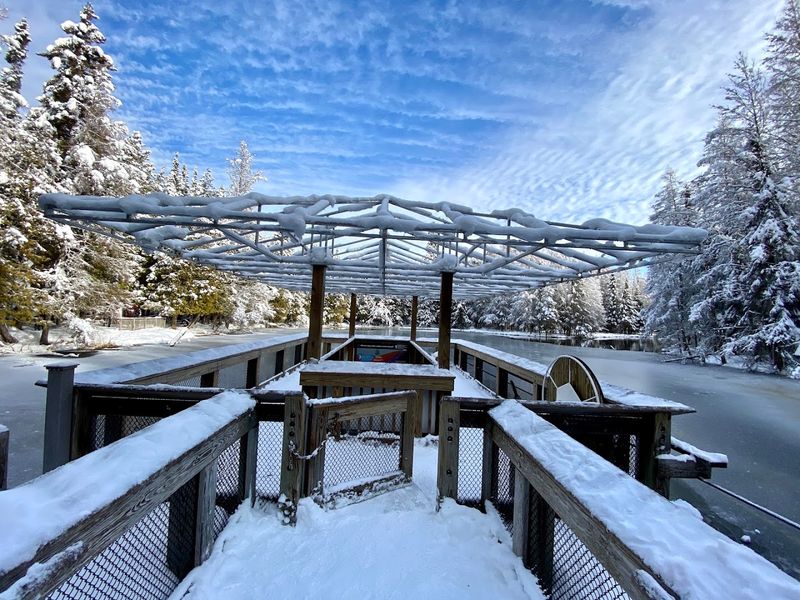
Winter visits are sparse and quiet in a way that feels almost private. The gift shop and restrooms close for the season, so planning ahead matters — bring layers, wear waterproof footwear, and expect an unplowed parking lot after fresh snowfall.
The spring itself never freezes, which creates a surreal visual: steaming, crystal-clear turquoise water surrounded by snow-covered banks and bare trees. Fish are still visible, the vents still bubble, and the raft is typically still accessible, though you may be the only ones out there.
Spring thaw brings mud and variable conditions, but also a quieter window before summer crowds arrive. The water level can run slightly higher during snowmelt season, and the surrounding forest starts to green up quickly.
Each season reframes the same spring in a genuinely different way, which is why so many people come back more than once rather than treating it as a single-visit destination.
Practical Details for Planning Your Visit to Palms Book State Park
Palms Book State Park sits along Sawmill Road outside Manistique in Michigan’s Upper Peninsula, roughly two hours west of the Mackinac Bridge. The park requires a Michigan Recreation Passport for entry, which is a vehicle sticker available at the gate or bundled with Michigan license plate renewals.
Out-of-state visitors can purchase a day pass at the entrance. The fee is modest and directly supports the maintenance of the park and the spring itself.
Operating hours run from 8 AM to 10 PM daily, giving visitors a wide window that includes both morning light and evening visits. The raft operates during daylight hours and is free to use once inside the park.
There is no timed entry system or reservation requirement, so showing up and walking straight to the raft is entirely possible during off-peak times. Weekend afternoons in July and August tend to bring the longest wait for the raft.
The walkway from the parking area to the raft landing is paved and accessible for wheelchairs and strollers during warmer months, making the spring reachable for visitors with limited mobility. Dogs are welcome on leash, which is a detail that matters to a lot of travelers who don’t want to leave their pets in the car during a stop.
The picnic area near the entrance has tables and grills, making a full afternoon out of the visit a realistic option.
A gift shop on site sells souvenirs, snacks, and Kitch-iti-kipi merchandise ranging from magnets to apparel. Restrooms with running water are available during the warmer months.
Cell service in the area can be spotty, so downloading offline maps before arriving saves frustration. The whole experience — raft ride, viewing, and a wander through the gift shop — fits comfortably into 45 minutes to an hour for most visitors.
Why Kitch-iti-kipi Stands Apart From Every Other Michigan Natural Attraction
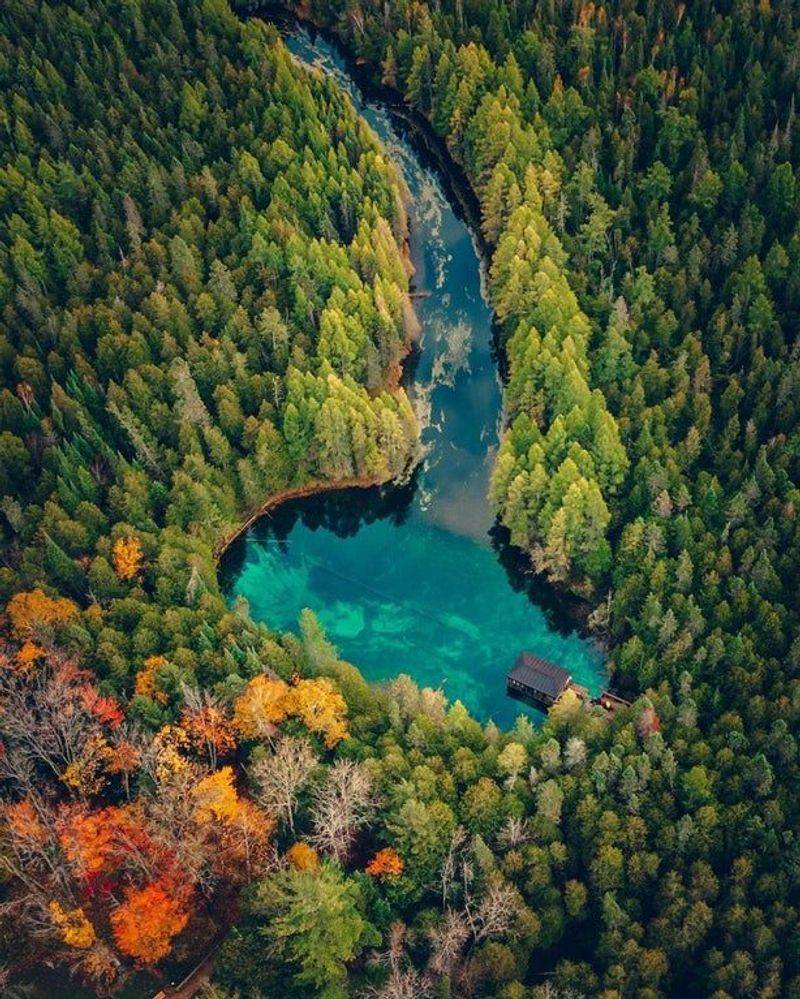
Michigan has no shortage of natural attractions — waterfalls, dunes, lighthouses, forests, and hundreds of miles of Great Lakes shoreline. Kitch-iti-kipi occupies a different category entirely.
The combination of extreme water clarity, significant depth, constant temperature, abundant visible wildlife, and an interactive raft experience produces something that has no direct comparison anywhere else in the state. It’s specific, strange, and unlike anything most people have seen before.
The viewing window on the raft is the key detail that elevates the experience beyond a simple scenic overlook. Standing at the edge of the spring and looking across the surface gives you one impression of the place.
Hovering over the viewing hole with 40 feet of clear water beneath you gives you a completely different one. The depth becomes physical and slightly vertiginous in a way that photographs never quite convey.
That gap between expectation and reality is exactly why so many visitors describe the place as unreal when they first encounter it.
No two visits produce identical conditions. Light angle, cloud cover, season, crowd size, and even the behavior of the fish on a given day all shift the experience in small but noticeable ways.
Someone who visited in summer and returns in winter is essentially seeing a different spring — same water, same vents, same fish, but framed by snow and silence instead of green canopy and laughter from other rafters.
The spring has earned its reputation not through aggressive promotion but through consistent delivery. People drive hours out of their way specifically for this stop, and the vast majority leave satisfied enough to recommend it without hesitation.
That kind of sustained word-of-mouth over decades says more about Kitch-iti-kipi than any single review ever could. The water simply speaks for itself.
Share this story