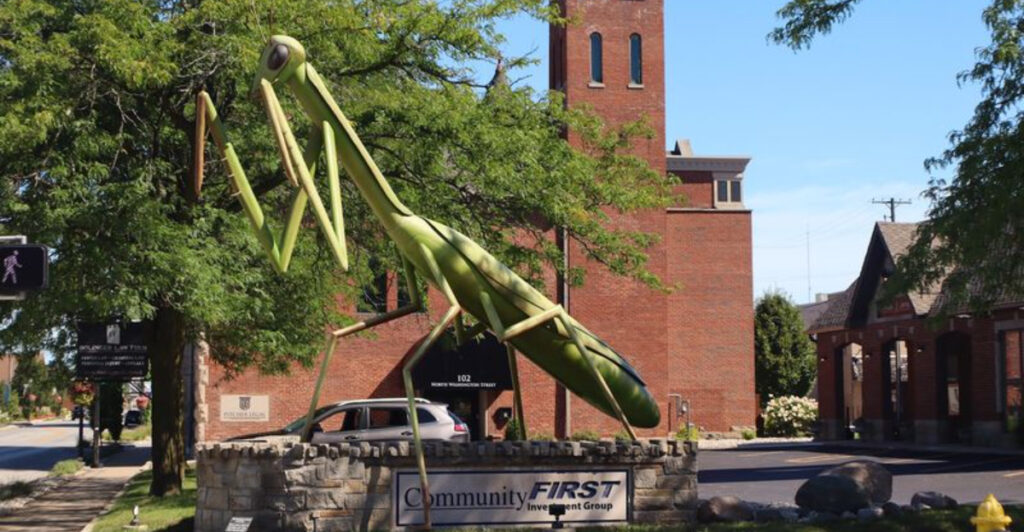
You don’t expect to be greeted by a towering praying mantis in the middle of an Indiana downtown, which is exactly why KokoMantis has become one of Kokomo’s most photographed landmarks. Standing 17 feet tall, this whimsical public sculpture welcomes visitors with bold colors, playful design, and a personality that perfectly reflects the city’s creative spirit.
Positioned in the heart of downtown, it’s an easy stop while exploring local shops, restaurants, and public art installations nearby. Whether you’re chasing quirky roadside attractions or simply looking for something memorable, KokoMantis proves Indiana’s most unexpected sights often become its most unforgettable.
The Corner Where the Giant Bug Takes Over
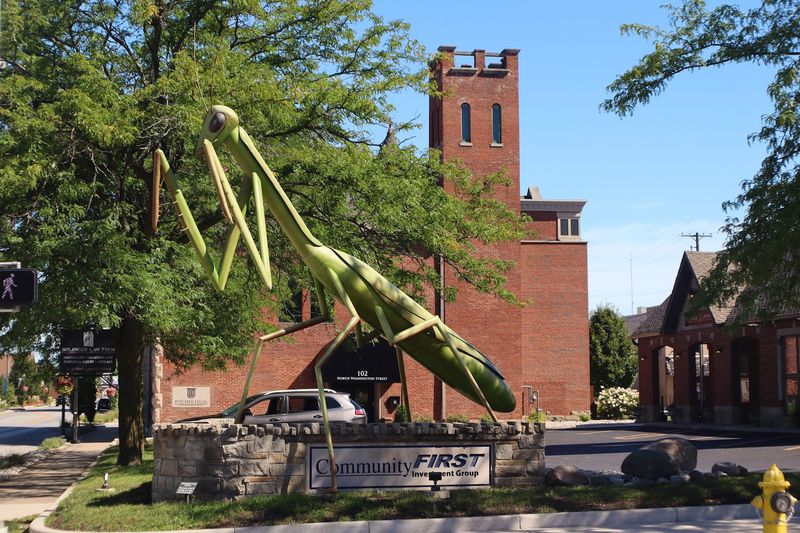
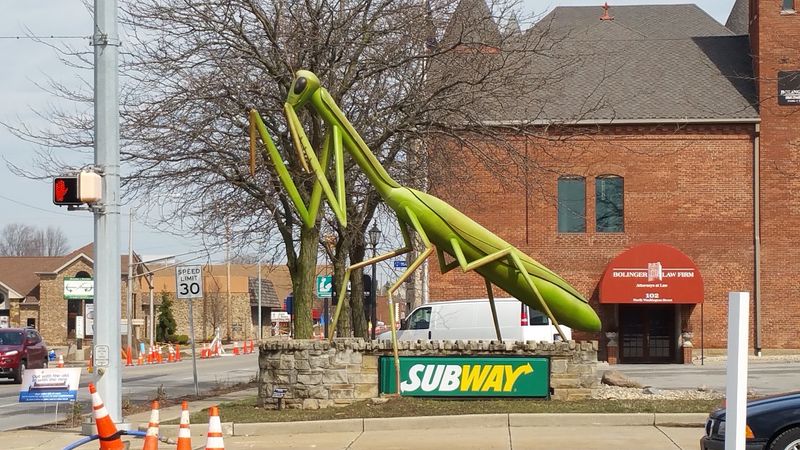
You do not ease into KokoMantis. The sculpture takes command of its corner immediately, lifting a long insect body high above the street and turning an ordinary downtown intersection into a double take.
Before any close reading of craftsmanship or symbolism begins, the scale does the work, because a praying mantis this large changes how the whole block is seen.
That oversized presence matters in a place where streets, storefronts, and sidewalks are built to human dimensions.
Against brick, pavement, traffic signs, and passing cars, the sculpture reads almost like a creature that wandered in from a comic book panel and froze in place. It is playful, slightly strange, and impossible to confuse with decorative filler.
The best first view usually comes from a little distance rather than directly underneath. From across the street, the proportions click into place: folded front legs, narrow abdomen, raised head, and the unmistakable alert posture that makes a mantis look both elegant and predatory.
Even if you know what you are about to see, the sheer height lands harder in person. There is also something effective about finding this kind of monument in the middle of everyday movement.
Cars pass, people run errands, downtown keeps functioning, and over all of it stands a huge metal insect like the neighborhood mascot no one would invent in a planning meeting. That collision between normal city rhythm and giant bug spectacle gives the piece its spark.
For a first encounter, KokoMantis works fast. It is bold enough for a quick stop, clear enough to appreciate from the curb, and unusual enough to reset your expectations for what a downtown landmark can be. Some attractions need setup. This one just rises over the corner and lets the surprise hit.
Steel Anatomy Up Close
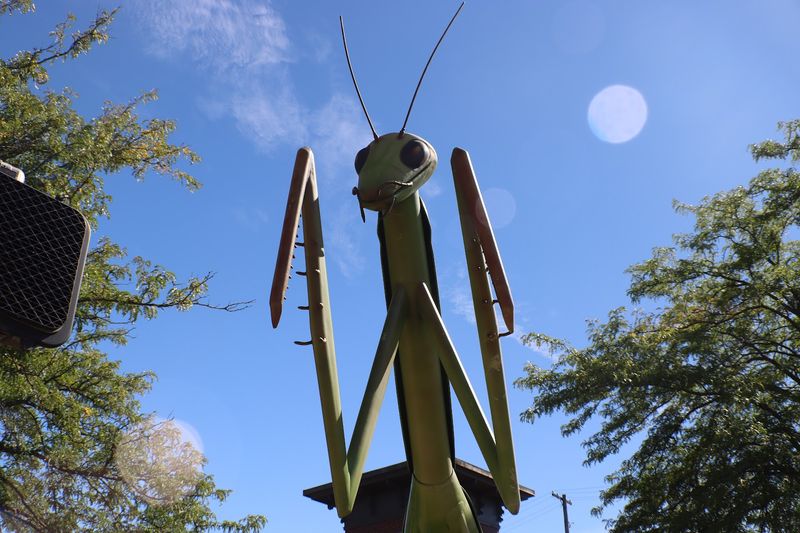
Step closer and KokoMantis shifts from giant joke to serious fabrication. The silhouette grabs you from a block away, but the metalwork is where the sculpture earns a longer look.
This is not a smooth, simplified cartoon bug with a vague outline and a novelty label attached. The sculpture’s form closely follows the anatomy of a praying mantis.
Legs angle with intention, the body stretches in recognizable segments, and the head carries the focused, slightly uncanny stance that makes real mantises so visually memorable.
In steel, those familiar biological cues become sharper, because hard edges and welded surfaces emphasize each bend and joint.
That material choice is a big part of the sculpture’s character. Metal gives KokoMantis a toughness that suits an outdoor landmark, but it also adds an industrial crispness that fits a Midwestern downtown setting.
Instead of trying to soften the insect into something cute, the fabrication keeps its strangeness intact while still making it accessible and fun.
From certain angles, the limbs look almost mechanical, which adds another layer to the appeal. A praying mantis already resembles a tiny machine designed for patience and precision, so building one at giant scale in metal pushes that association further.
You end up looking at both an insect and a piece of engineered public art at the same time. This is why a short photo stop can stretch unexpectedly. You notice the line of a foreleg, then the shape of the thorax, then how the sculpture balances visual realism with exaggeration.
KokoMantis does not need motion to hold attention. The stillness helps, because it gives every welded contour a chance to read clearly against the sky and surrounding buildings.
Why This Indiana Landmark Works So Well Downtown
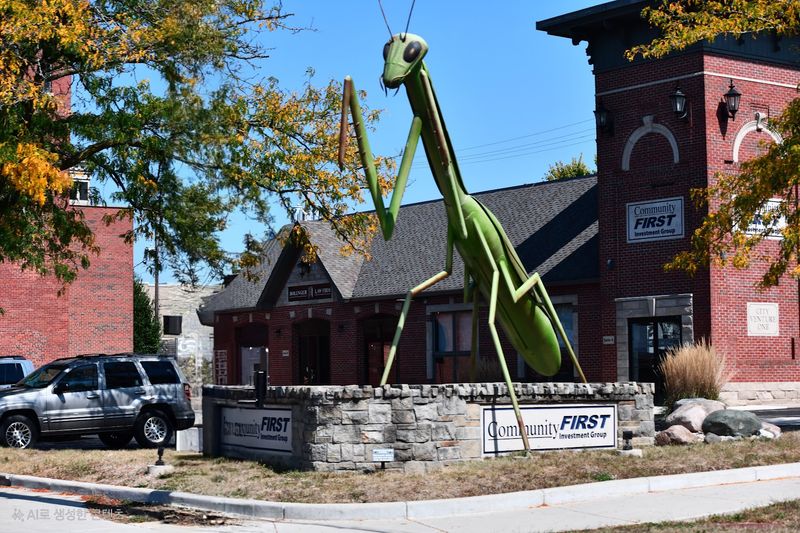
Some large public sculptures look stranded, as if they were dropped into an empty patch of land and left to fend for themselves. KokoMantis benefits from the opposite setup.
Its placement in downtown Kokomo gives it context, scale contrast, and a steady flow of ordinary activity that makes the whole encounter more entertaining.
Because it sits at a visible corner on West Sycamore Street, the sculpture operates like an urban exclamation point. You can approach it while driving, walking, or simply passing through the area, and each method changes the reveal slightly.
A moving car gets the sudden roadside surprise, while a slower walk gives the bug time to grow taller with every step.
The surrounding streetscape helps more than you might expect. Buildings and intersections create sightlines, so the mantis can pop into view between practical pieces of downtown life instead of occupying a secluded art plaza.
That contrast keeps the sculpture from becoming overly polished or ceremonial. It stays weird in a very useful, public way.
Accessibility also matters here. KokoMantis is not hidden behind gates, admission desks, or a long interpretive setup that turns a quick look into a chore.
The attraction is direct. You arrive, orient yourself, and within seconds you are standing near a giant steel insect that appears ready to supervise the block.
That ease makes it ideal for both intentional stops and accidental discoveries. Someone planning a photo break can reach it without much friction, while someone unfamiliar with downtown Kokomo can suddenly find the trip improved by a piece of oversized metal absurdity.
In a city center, a landmark has to compete with errands, traffic, and schedules. KokoMantis does that by being visible, immediate, and impossible to ignore.
More Than Novelty – A Real Local Character
KokoMantis lands as a roadside attraction at first, but the longer you look at its place in Kokomo, the more it reads like a neighborhood character.
It is big, strange, and funny on arrival, yet it also seems woven into the routine visual life of downtown. That combination gives the sculpture unusual staying power.
Public art can struggle when it depends entirely on novelty. Once the surprise fades, there has to be a second reason for people to keep noticing it.
KokoMantis has that second layer because the form is distinctive enough to function like a symbol. A giant mantis is not generic civic decoration.
It is specific, memorable, and easy to identify from a distance. Over the years, the sculpture has become a familiar part of downtown Kokomo rather than merely a one-time curiosity.
It is referenced as a familiar point in town, revisited for photos, and treated less like an object on display than as a recognizable presence on the street. That kind of informal adoption says a lot about how public art succeeds.
The piece also avoids the stiffness that can make monumental sculpture feel distant. Even though it is made from metal and stands tall over the corner, it does not come across as solemn or guarded.
Its insect subject keeps the tone light, while the scale keeps it dramatic. Those two qualities let it belong to daily life without fading into the background. That is a hard balance to hit. Too silly, and the sculpture becomes disposable.
Too serious, and it can feel disconnected from the place around it. KokoMantis threads the middle neatly, giving Kokomo an icon that works in photos, in casual directions, and in memory as a downtown figure with its own quirky authority.
How to Get the Best Photos Without Fighting the Scale
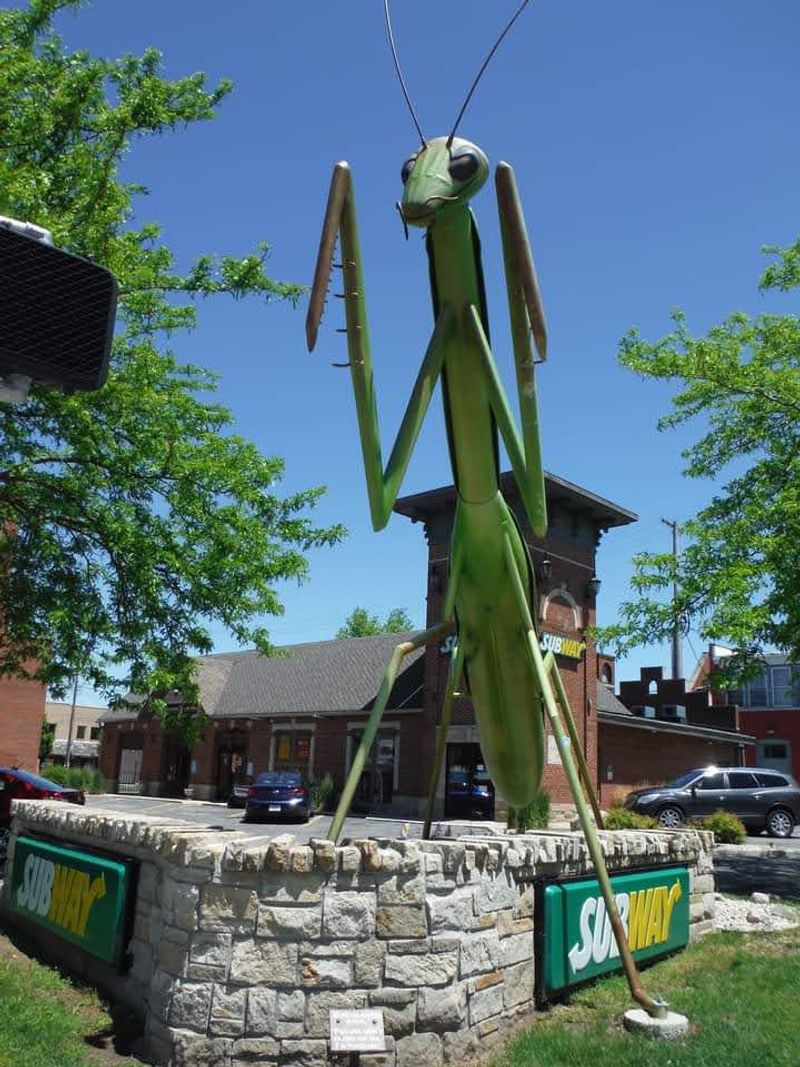
KokoMantis is easy to photograph badly for one simple reason: it is tall enough to overpower a quick snapshot. Stand too close, point your phone upward, and the sculpture can flatten into disconnected limbs and glare.
A better approach starts by backing up and letting the full silhouette settle into the frame. Across-the-street views usually do the heavy lifting.
From there, the mantis reads as one complete figure instead of a collection of parts, and nearby buildings help show scale.
If you want the photo to explain why this stop is fun, context matters almost as much as the sculpture itself. A giant bug against open sky is interesting.
A giant bug towering over a functioning downtown corner is much stronger. Human scale also helps. A person in the shot, even near the base rather than directly under it, makes the height legible at a glance.
Without that reference, tall roadside art can shrink on screen. With it, KokoMantis regains the visual punch you get in person when the legs and body rise above cars and street signs.
Light changes the mood more than the subject. Bright daylight highlights the lines of the metalwork and makes the sculpture look crisp and graphic.
Later in the day, shadows can add drama, especially around the legs and underside, but darker conditions may hide some of the detail that makes close views rewarding.
If you only have a minute, take two types of images instead of ten near-identical ones. Get one wide shot that proves where the sculpture lives, then move in for a tighter detail of the head or forelegs.
That pair tells the full story: KokoMantis as a downtown giant, and KokoMantis as a carefully built piece of metal art.
The 24-Hour Stop That Fits Any Route
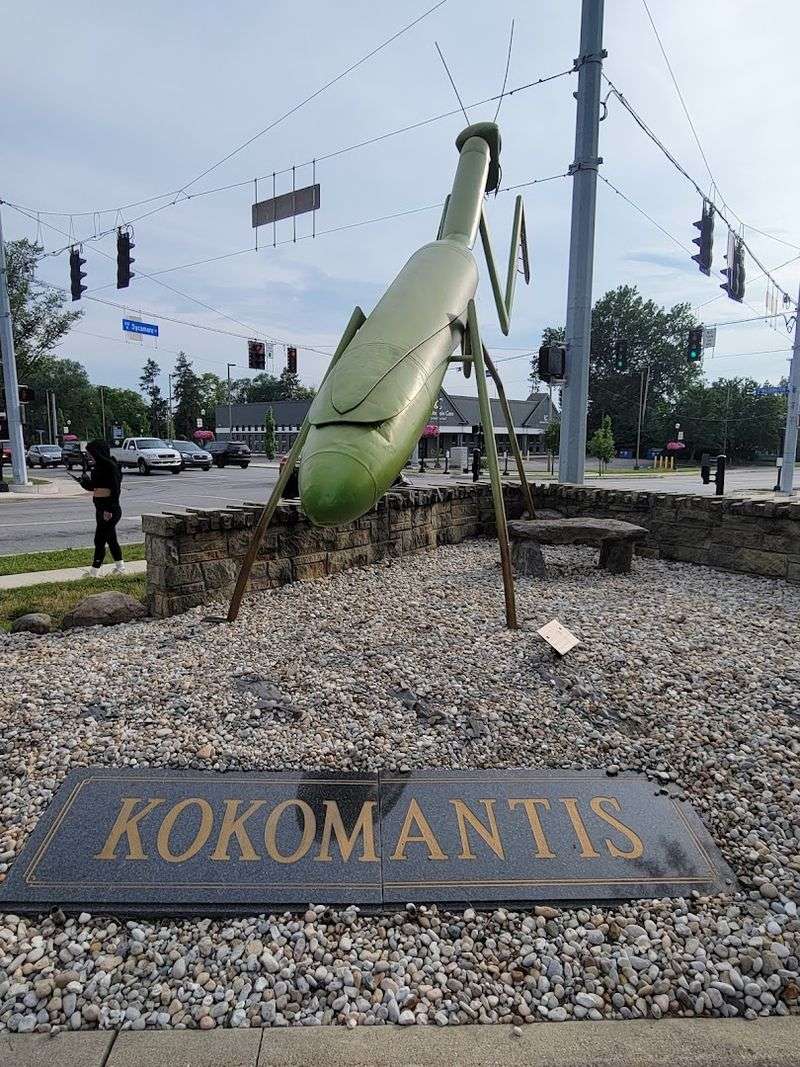
KokoMantis has one practical advantage that immediately raises its value as a roadside stop: it is available whenever your route puts you near downtown Kokomo.
Because it is an outdoor public sculpture, it can be viewed at any time of day, so it works for planned visits, casual detours, and those spontaneous stops that happen when something unusual catches your eye at exactly the right moment.
That flexibility changes the tone of the visit. You are not building a day around entry times, tours, or a narrow operating window.
Instead, KokoMantis can slide neatly into almost any schedule. If you are in the area for another reason, it is easy to add a few minutes for photos.
If you are driving through, the sculpture can become the reason you briefly pause downtown. Its compact footprint helps too. This is not a sprawling attraction with layers of navigation and decision-making.
The point is direct access to the sculpture itself, which makes the stop clean and efficient. You can appreciate the full visual impact quickly, then spend more time only if the details and photo angles pull you in.
That makes KokoMantis especially good for travelers who like odd landmarks but do not want a long commitment. There is very little friction between arrival and payoff.
The corner location is visible, the subject is obvious, and the sculpture delivers exactly the kind of oversized visual surprise the name promises.
Even the short duration becomes part of the appeal. Not every memorable stop needs a ticket, a line, or an afternoon.
Sometimes a city gets a lift from one excellent piece of public weirdness placed exactly where it can interrupt routine in the best possible way. KokoMantis understands that rhythm, which is why a brief stop can still feel complete.
The Sharpest Reason to Stop in Kokomo
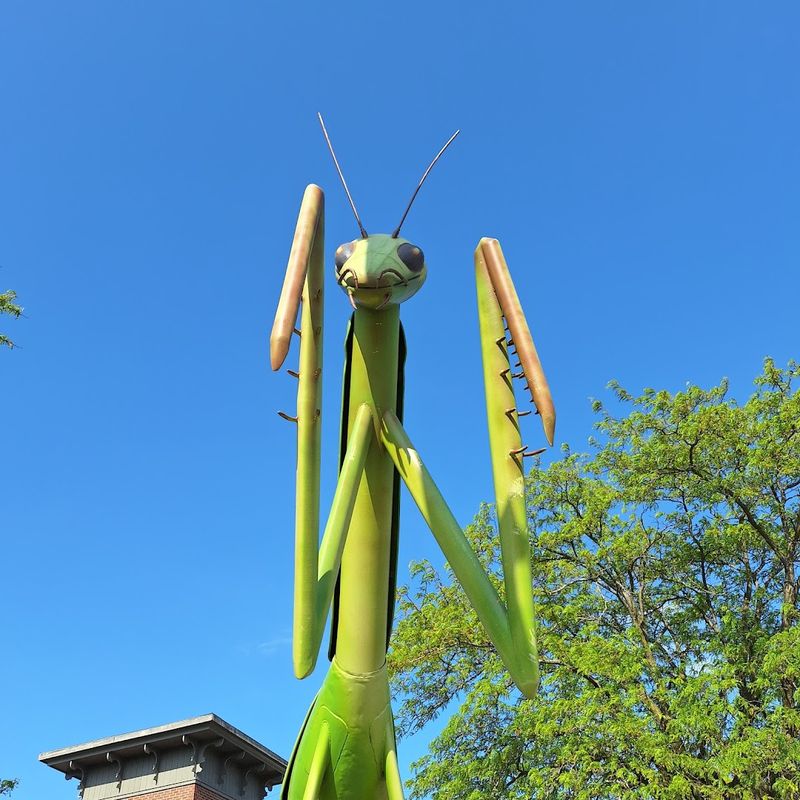
Plenty of roadside attractions earn attention by being large, but size alone rarely carries the whole experience. KokoMantis stands out because the scale is attached to a subject that is already visually intense.
A praying mantis has angles, posture, and built-in tension, so enlarging it to downtown-monument size creates a landmark that is both funny and unexpectedly commanding.
That gives Kokomo something stronger than a random oversized object. The sculpture has shape, attitude, and instant recognizability.
You can describe it in a few words and the image lands right away: giant metal mantis on a downtown corner. Very few local landmarks are that easy to picture before you ever arrive, and that clarity is part of why it works so well.
It also succeeds without overcomplicating the stop. There is no puzzle to solve about why it matters once you are standing there. The appeal is immediate, then layered. First comes surprise.
After that comes craft, placement, scale, and the odd pleasure of seeing a steel insect seem perfectly at home in a small Indiana downtown.
For travelers, that makes KokoMantis a clean addition to an itinerary. For locals, it functions like a visual signature, the kind of piece that can anchor directions, photos, celebrations, and casual repeat sightings.
It is unusual enough to attract newcomers, yet stable enough to become part of daily scenery without losing its edge.
If the question is whether one sculpture can define a stop, KokoMantis makes a strong case. It is accessible, distinctive, and instantly readable from curbside to camera roll.
Most important, it avoids blandness completely. You leave with a clear image of Kokomo’s giant guardian bug, and that is a far better outcome than another forgettable street corner.