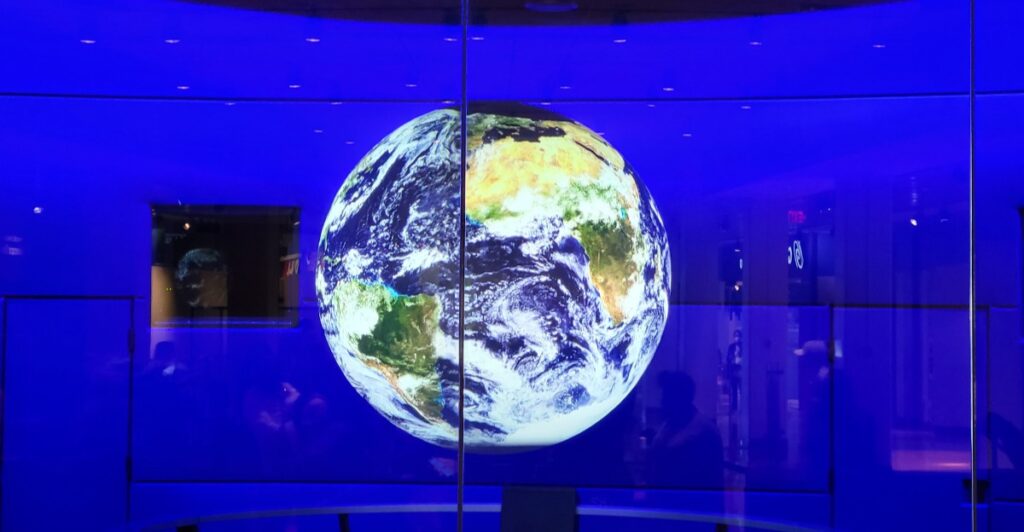
An 18-foot globe suddenly shrinks overhead. A wall of color changes one tiny square at a time.
A tunnel asks you to crawl forward without seeing your own hands. Then, somewhere between an optical illusion and a three-story climbing structure hanging over an atrium, you realize Liberty Science Center is not especially interested in letting your senses relax.
This 300,000-square-foot Jersey City landmark inside Liberty State Park has built much of its appeal around making visitors touch, test, climb, question, and occasionally stare at something twice because the first look simply did not make sense. The result lands somewhere between science museum, giant experiment, playground, and interactive art space.
Some installations manipulate what your eyes tell you. Others deliberately take vision away.
Even the building’s biggest sculpture changes shape above your head. If you prefer museums where everything stays safely behind glass, this place has other plans.
Liberty Science Center Turns Perception Into Part of the Experiment
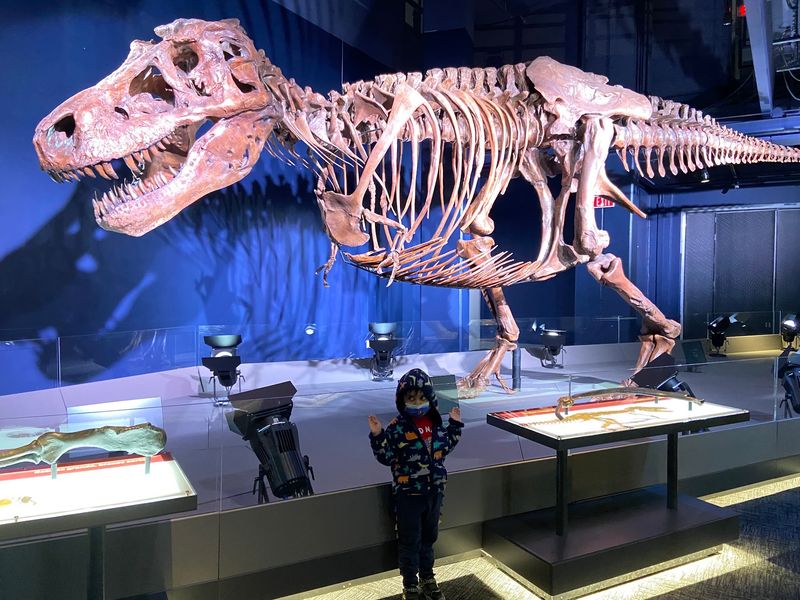
The fun starts with a simple problem: your brain is very confident, even when it is completely wrong. On the third floor, the permanent Wonder Why exhibition leans into that weakness with hands-on activities built around observation, reaction, strength, and visual perception.
Visitors can test their reaction time, tackle different routes on a rock wall, make fluorescent minerals glow, and explore optical illusions that demonstrate how quickly the brain fills in gaps or misinterprets visual information. Nothing requires a physics degree, and that is part of the point.
You interact first and figure out what happened afterward. One moment you are looking at a visual puzzle that seems obvious, and the next you are realizing your eyes have quietly handed your brain some very questionable information.
That hands-on approach extends far beyond a single gallery. Liberty Science Center has 12 museum exhibition halls, giant aquariums, live animals, a 3D theater, laboratories, wind simulators, and the Jennifer Chalsty Planetarium, all packed into its sprawling building near the Hudson.
But Wonder Why captures the center’s personality especially well because it turns basic curiosity into the exhibit itself. There is no pressure to stand quietly and admire something from six feet away.
You pull, hang, stare, compare, retry, and occasionally call someone over because you need another pair of eyes to confirm that the strange thing you just saw was not entirely in your head. In a place devoted to explaining how the world works, admitting that our senses are surprisingly easy to fool is a pretty entertaining place to begin.
The Optical Illusions Will Make You Question What Your Eyes Are Seeing
Some museum displays tell you the answer before you have had time to form the question. The better moments at Liberty Science Center work the other way around.
An optical illusion catches you first, your brain confidently settles on an explanation, and only then do you discover why that explanation falls apart. Wonder Why specifically includes visual-perception activities designed to explore the limits of the mind’s eye, making the gallery one of the easiest places in the building to lose a few minutes arguing with your own vision.
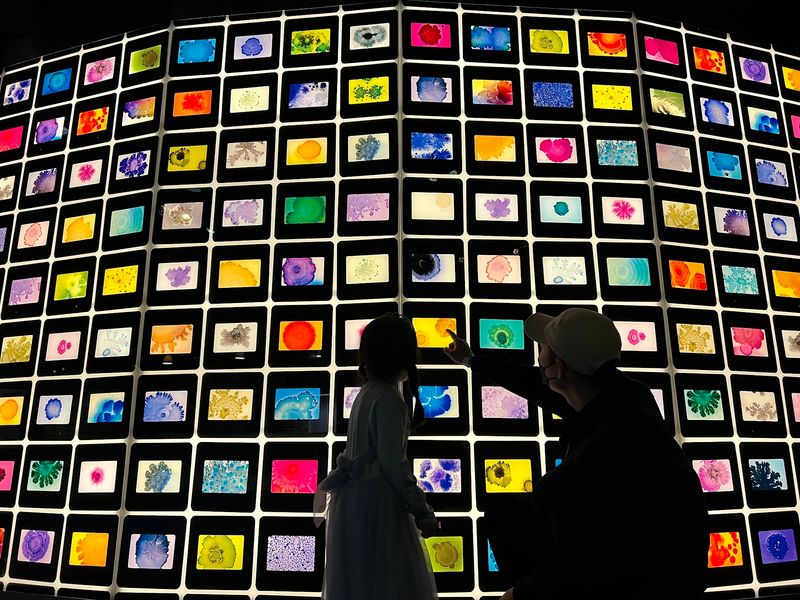
That playful uncertainty fits surprisingly well with the art scattered through the center. On the fourth floor, Pixel Art turns visitors into the artists.
The installation contains 952 individual pixel dials, and each dial can produce more than 1,000 possible color combinations. Rotate enough of them and a giant wall gradually becomes a picture, pattern, word, or whatever else the previous visitor did not think to erase.
It sounds simple until you stand close to it, where the image dissolves into individual circles and colors; move farther away and the pieces suddenly organize themselves into something recognizable.
That shift between seeing parts and seeing a whole is exactly the sort of perceptual trick that makes Liberty Science Center more interesting than a straightforward collection of demonstrations.
The installations are visually satisfying, but they also keep nudging you toward the same question: how much of what you “see” is actually being assembled inside your brain? Even visitors who normally sprint through explanatory panels tend to slow down when the evidence is right in front of them.
Few things encourage careful observation quite like discovering that your first glance cannot be trusted.
The Touch Tunnel Takes Vision Completely Out of the Equation
There is one particularly effective way to stop your eyes from misleading you: turn off the lights entirely. Liberty Science Center’s Touch Tunnel does exactly that for 80 feet.
Located on the third floor, the crawl-through passage is completely dark, forcing visitors to navigate by feeling the walls and surfaces around them instead of looking for the route ahead. The concept could hardly be simpler, yet the experience becomes strange almost immediately.
Distances feel different when you cannot see them. Corners seem sharper.
A short stretch of tunnel can feel suspiciously long when you have no visual landmark telling you how much progress you have made. You start paying attention to texture, direction, balance, and the placement of your own hands in a way that rarely happens during an ordinary walk across a room.
The tunnel has become one of Liberty Science Center’s signature attractions, and its longevity makes sense. There are no giant screens or elaborate digital effects doing the work here.
Darkness is the special effect. It turns an everyday action—moving from one place to another—into a miniature sensory experiment.
The experience also makes the center’s larger theme of perception suddenly personal. Optical illusions show that sight can be unreliable; the Touch Tunnel demonstrates how heavily most sighted people depend on it anyway.
Once vision disappears, touch and spatial awareness have to take over. That makes reaching the exit oddly satisfying, even though you have technically accomplished nothing more dramatic than crawling through an 80-foot passage.
Afterward, the brightly lit exhibit floor feels almost excessive. Your eyes have returned, and suddenly you notice just how much information they had been feeding you all along.
The Infinity Climber Makes the Atrium Feel Like a Giant Floating Playground
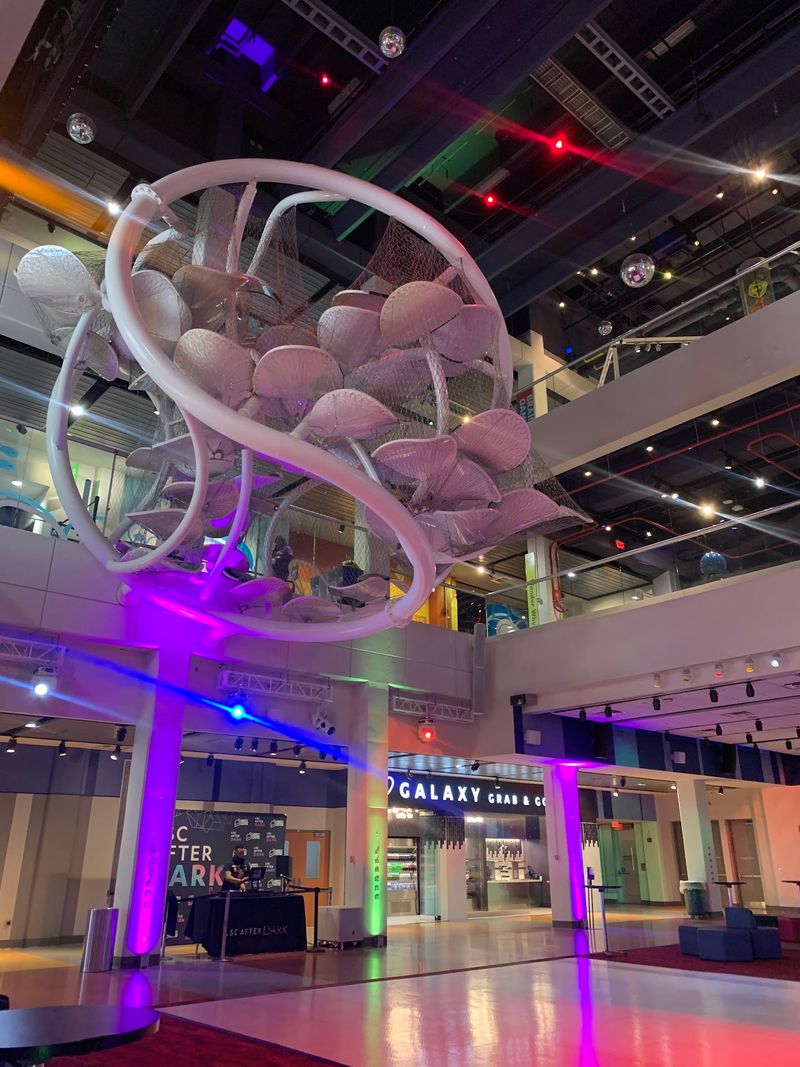
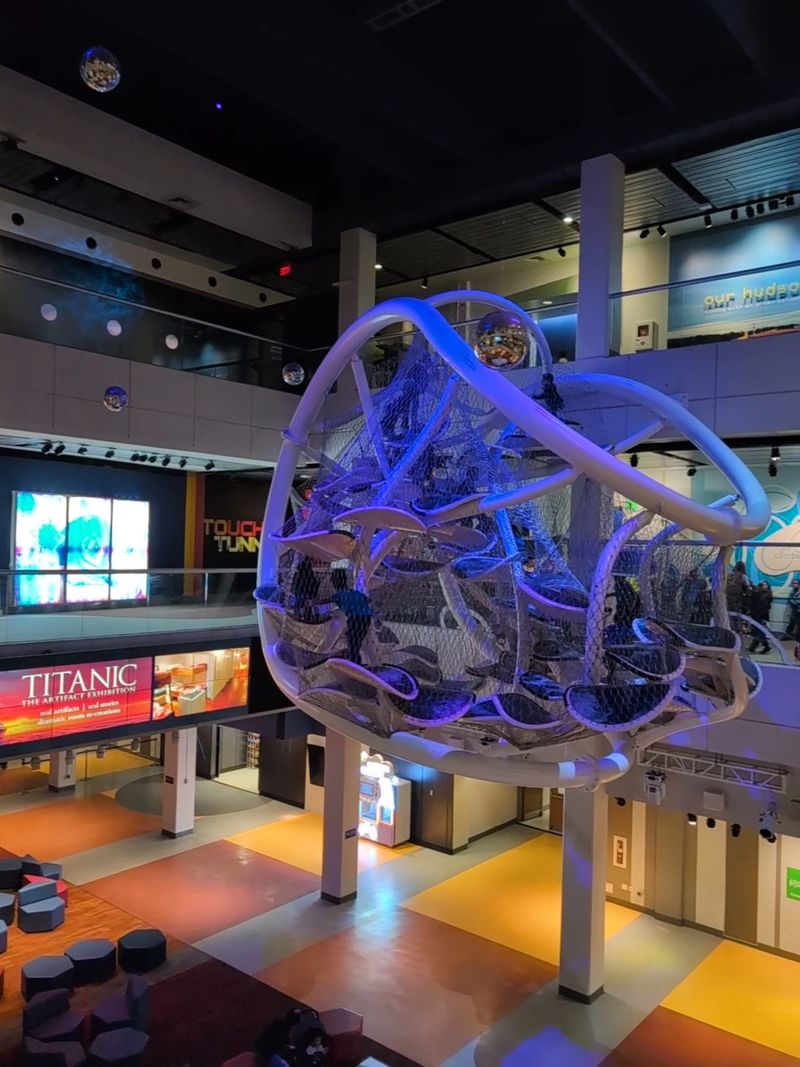
Look up inside the atrium and the laws of ordinary playground design appear to have been politely ignored. Infinity Climber is a 21,000-pound suspended climbing structure attached to the wall of the three-story space, with 64 petal-like platforms forming multiple routes through a web of steel and wire.
The entire structure measures 26 feet wide, 24 feet deep, and 19 feet tall, while more than 19 miles of hand-threaded wire mesh surround the climbing area. Liberty Science Center describes it as the world’s first suspended climbing play space of its kind.
From below, it looks closer to a piece of oversized kinetic sculpture than something you are supposed to crawl inside. Then you notice people moving through it.
The experience becomes a practical lesson in balance, engineering, distance, and spatial awareness without ever announcing itself as one. Routes branch away in different directions, platforms hang above open space, and the structure’s cantilevered design makes the whole thing appear far less grounded than your instincts would prefer.
That slight visual unease is part of its appeal. The protective mesh is there, of course, but your eyes still register the open atrium beneath you.
Climbers need to be at least 42 inches tall, so very small visitors will have to watch from below. For everyone else, it is one of those rare science-center installations where the lesson arrives through your knees, hands, and sense of balance rather than an explanation on a sign.
Even spectators get something out of it. Watching a 21,000-pound structure seemingly float off an atrium wall makes engineering feel considerably less abstract than it did in school.
The Hoberman Sphere Blurs the Line Between Art and Engineering
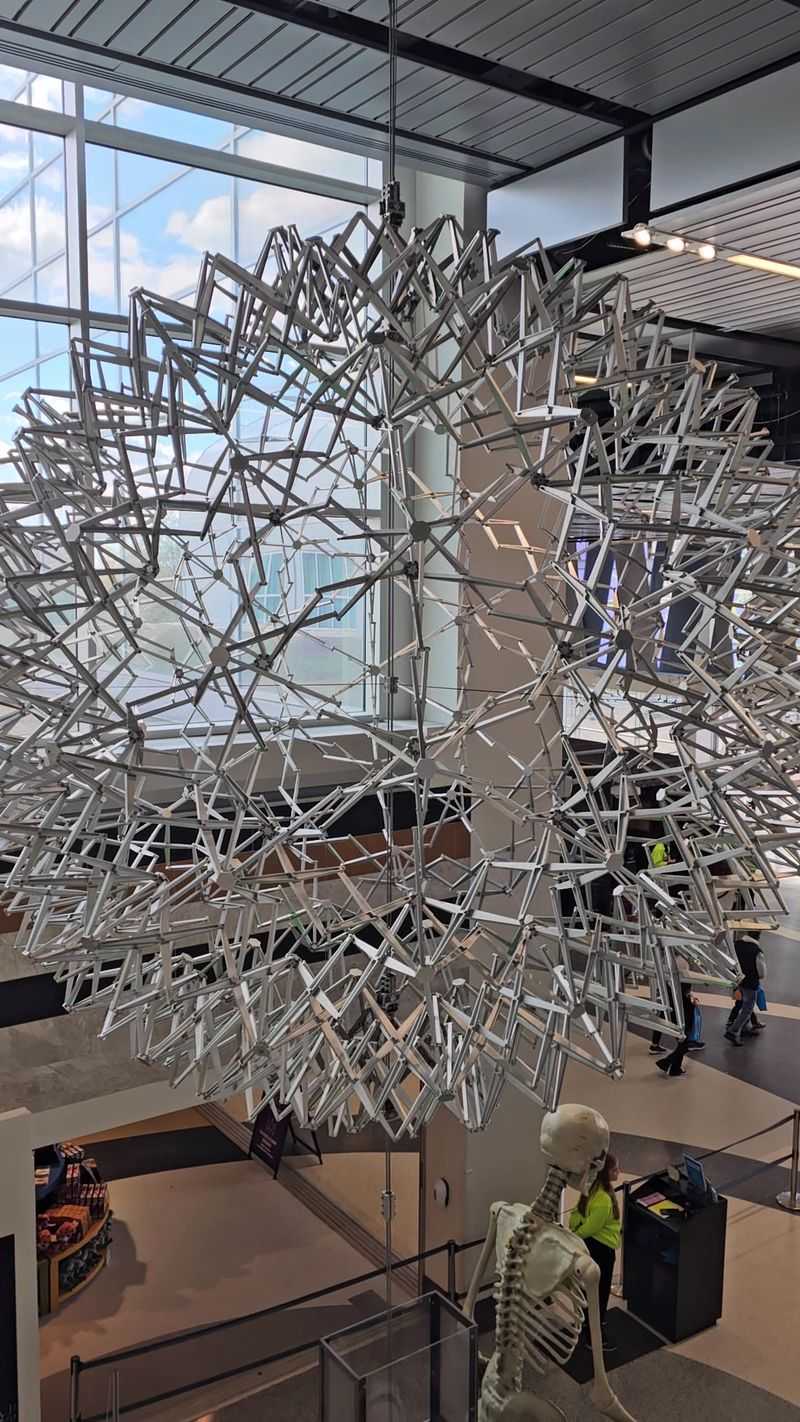
Before interactive walls and digital installations became museum staples, Liberty Science Center already had a gigantic object overhead that refused to keep the same shape. The Hoberman Sphere has been part of the center since the original facility opened in 1992.
Created by artist and engineer Chuck Hoberman, the motorized sculpture uses hundreds of scissor-like connectors to expand and contract while maintaining its spherical form. Fully opened, it reaches 18 feet in diameter.
Collapsed, it shrinks to just 4.5 feet. It weighs roughly 700 pounds.
Those numbers are impressive, but they do not quite explain the effect of standing beneath it. The real pleasure comes from watching what looks like a dense mechanical globe slowly bloom outward, becoming dramatically larger without changing into something else.
It is sculpture, geometry, engineering, and a very satisfying mechanical trick rolled into one. The movement feels almost organic until you look closely and see the repeating joints making everything possible.
That is where the second-floor mezzanine becomes useful. Visitors can get a closer look at the engineering and design behind the sphere rather than treating it as decorative scenery suspended above the crowd.
It also sets the tone for the rest of Liberty Science Center remarkably well. Here is an artwork that teaches you something simply by moving.
It looks impossible at first, understandable after closer inspection, and somehow no less impressive once you know the trick. Plenty of exhibits explain scientific principles with diagrams.
The Hoberman Sphere gives you an 18-foot-wide demonstration hanging over your head and lets curiosity handle the rest.
There Is Much More to Explore Once Your Brain Stops Playing Tricks on You
Eventually the sensory games spill into nearly every corner of the building. Dream Machine, on the third floor, asks visitors to work bicycle pumps that trigger combinations of color, sound, and scent connected to emotions including happiness, disgust, and hope.
The installation was created by experience designer and multimedia artist Emilie Baltz and originally debuted at New York’s Panorama Festival before becoming a permanent Liberty Science Center attraction.
One floor up, Brain Games swaps sensory confusion for puzzles, coding challenges, Platonic solids, patterns, and a robot that visitors teach to navigate a maze.
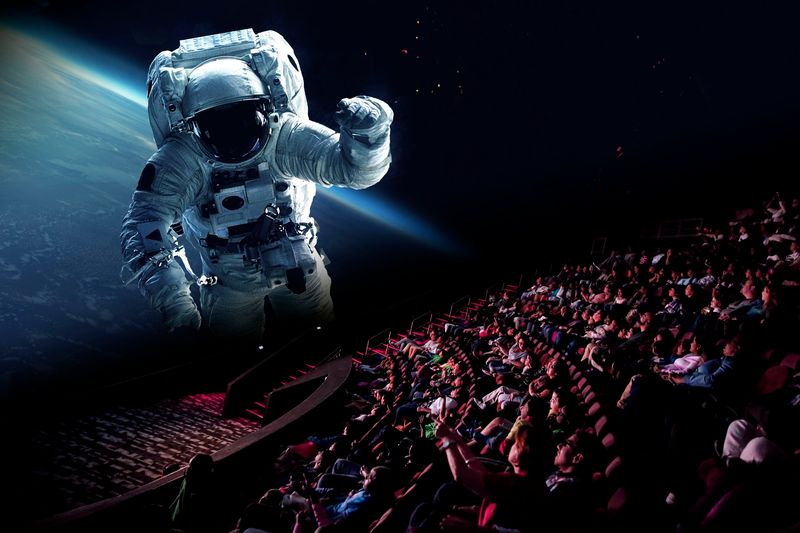
Then there is the Jennifer Chalsty Planetarium, where scale itself becomes the illusion. Its 89-foot dome makes it the largest planetarium in the Western Hemisphere, transforming a seat in Jersey City into a viewpoint for trips through planets, stars, and deep space.
The practical side is refreshingly straightforward. Liberty Science Center sits at 222 Jersey City Boulevard inside Liberty State Park, with parking on site and road access from the New Jersey Turnpike via Exits 14B and 14C.
Hours vary by date; for example, the published schedule for October 2, 2026 runs from 10 a.m. to 4 p.m., while that weekend runs from 10 a.m. to 5 p.m. That changing daily schedule is worth keeping in mind because planetarium shows, animal presentations, demonstrations, and other programs are timed throughout the day.
The permanent attractions, though, are what give the place its identity. A shrinking sphere, a completely dark tunnel, a wall made from nearly a thousand color-changing pixels, and a climbing structure suspended above an atrium all keep returning to the same idea: reality gets much more interesting once you stop assuming your first impression is the correct one.
Share this story