Long before movie studios had soundstages, green screens, and enough artificial lighting to turn midnight into noon, filmmakers in West Orange had a much more basic problem: they needed the sun to cooperate. Their solution was a small, tar-paper-covered building that could actually rotate to follow daylight.
Known as the Black Maria, the unusual structure on Thomas Edison’s laboratory grounds became the world’s first purpose-built motion-picture studio and helped turn short experimental films into something people would eventually pay to watch. The original disappeared more than a century ago, but its story is surprisingly easy to step into today.
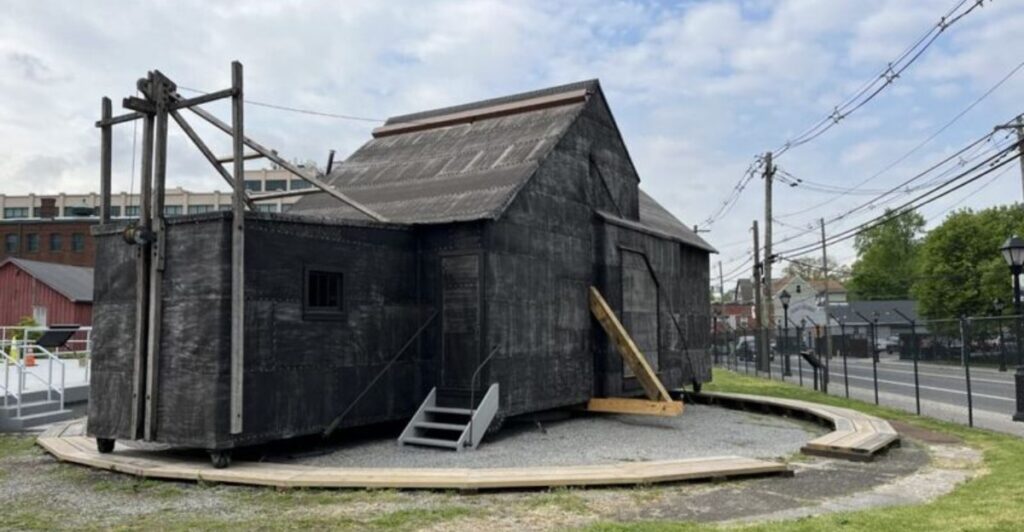
At Thomas Edison National Historical Park in West Orange, visitors can enter a full-scale replica of the Black Maria and see just how primitive early filmmaking looked before Hollywood was even part of the conversation. It is strange, clever, slightly awkward-looking, and one of the most fascinating pieces of New Jersey’s technological history.
The Black Maria Put New Jersey at the Beginning of Movie History
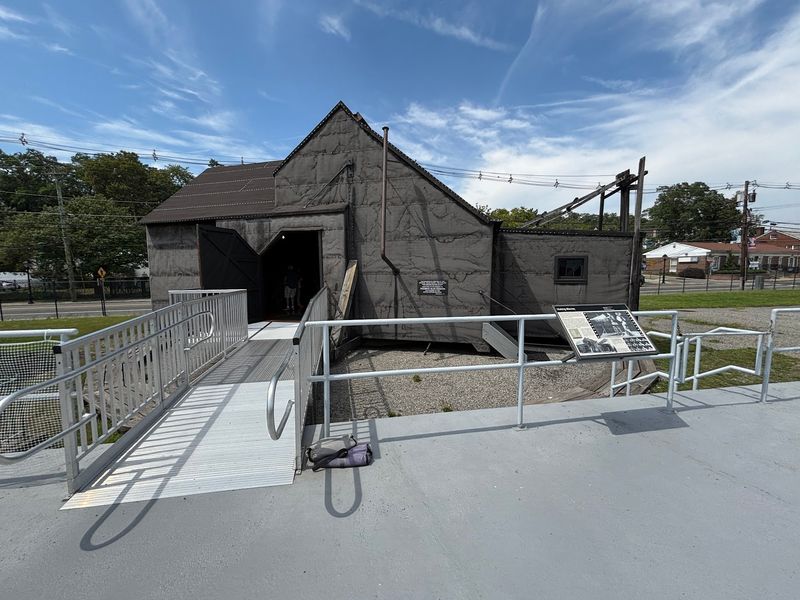
The movie business did not begin with glamorous actors strolling through studio gates in Los Angeles. One of its most important early chapters unfolded behind an industrial laboratory in West Orange, where Thomas Edison and a team of experimenters were trying to figure out how moving images could become practical entertainment.
Edison had begun experimenting with motion pictures by the late 1880s, while much of the technical work was carried out by employees including William Kennedy Laurie Dickson and William Heise.
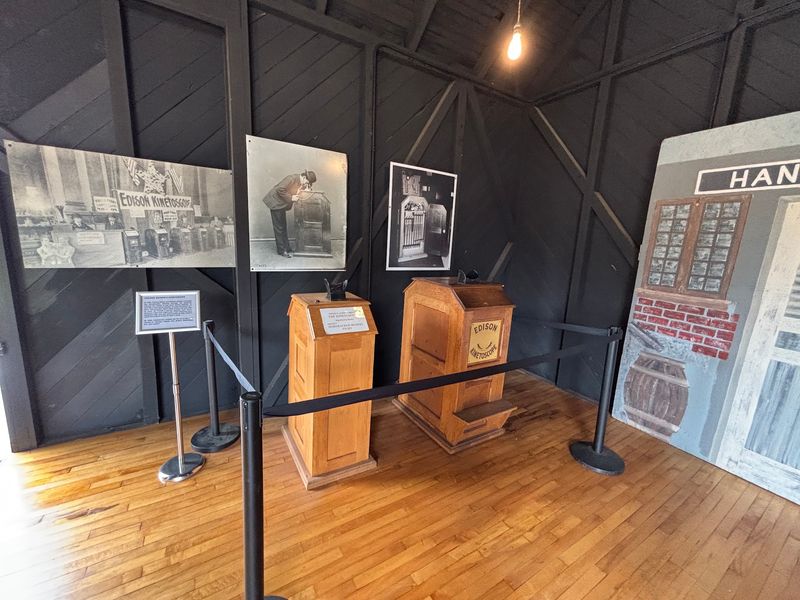
Their work eventually produced the Kinetograph, an early motion-picture camera, and the Kinetoscope, a viewing machine that allowed one person at a time to watch a short film through a peephole.
The next problem was obvious. If people were going to keep paying to see moving pictures, somebody had to keep making new ones.
That led to construction of a dedicated filming space on the West Orange laboratory grounds in the early 1890s. Completed in 1893, the Black Maria is generally recognized as the first building constructed specifically for making motion pictures.
It was hardly glamorous. Compared with later movie palaces and enormous Hollywood soundstages, the place looked more like a backyard shed built by an unusually ambitious inventor.
But inside it, Edison’s team began producing a steady stream of short films designed for the new Kinetoscope system. The movies often lasted only seconds rather than hours, and there were no sprawling sets or complicated plots.
Performers simply had to do something visually interesting enough to hold a viewer’s attention. That modest setup helped establish the basic relationship that still drives the entertainment business today: make something people want to watch, then build a way for them to watch it.
West Orange happened to be where a major part of that equation came together.
Edison Built a Film Studio That Could Literally Follow the Sun
Imagine trying to film indoors when your most important piece of lighting equipment is 93 million miles away. That was essentially the situation Edison’s motion-picture team faced.
Electric lighting existed, of course, but the available lamps were not powerful enough to illuminate early motion-picture film properly. The Black Maria was therefore designed around natural light, and nearly every strange feature of the building made sense once the sun entered the equation.
Part of the roof could be opened, allowing daylight to pour onto the performance area inside. Even more remarkable, the studio was mounted so that it could revolve around a central pivot on a circular track.
As the sun moved across the sky, workers could reposition the building to maintain the strongest possible light. It was less like a traditional studio and more like an enormous piece of camera equipment.
The exterior was covered in dark tar paper, giving the structure the almost featureless black appearance visitors immediately notice today. Filming conditions inside were not exactly luxurious either.
Early performers worked under intense sunlight with the roof open above them, while the bulky Kinetograph captured brief movements on flexible film. Everything about the operation was engineered around the limitations of early motion-picture technology.
That is what makes the Black Maria so interesting to see in person. Modern filmmaking hides much of its technology behind polished sets, digital cameras, and post-production tricks.
Here, the mechanics were impossible to hide. The entire building existed because the camera needed sunlight, and the whole structure could physically move to get it.
The design feels almost comically elaborate now, but in the early 1890s it was an ingenious answer to a problem nobody had needed to solve before.
The Strange Black Building Got Its Name From a Police Wagon
There was nothing elegant about the nickname Black Maria. In late-19th-century slang, a “Black Maria” was a police patrol wagon used to transport prisoners, and Edison’s employees apparently thought their peculiar new studio looked enough like one for the name to stick.
Look at the building today and the comparison is not difficult to understand. The tall, boxy structure is wrapped in black material, with a sloping roof and an appearance that falls somewhere between industrial shed, oversized camera, and Victorian-era contraption.
It certainly does not resemble anyone’s idea of a movie studio now. The nickname is also pronounced differently than many first-time visitors expect.
Historically, “Maria” in this phrase was pronounced more like “Ma-RYE-ah.” What started as workplace slang ended up becoming one of the most recognizable names in early film history. The building’s dark exterior was practical rather than decorative, with tar paper covering its wooden construction.
Inside, the layout was stripped down to what filmmakers actually needed: enough room for performers, a camera, simple backgrounds, and sunlight. There were no dressing-room corridors, elaborate production offices, or glamorous studio commissaries.
Even the original structure had a relatively short life. As motion-picture technology improved and production methods changed, the odd revolving studio became obsolete.
Edison opened a newer glass-enclosed film studio in New York in 1901, and the original Black Maria was eventually dismantled in 1903. Its physical disappearance might have reduced it to an obscure footnote if the studio had not played such a visible role in the surviving record of early filmmaking.
Instead, photographs of the black building became an instantly recognizable image from the experimental era when nobody yet knew exactly what movies would become.
Some of America’s Earliest Movies Were Made Inside These Walls
One of the Black Maria’s most famous stars was not an actor at all. He was Edison employee Fred Ott, and his big contribution to movie history involved taking a pinch of snuff and sneezing.
Filmed on January 7, 1894, Edison Kinetoscopic Record of a Sneeze — better known as Fred Ott’s Sneeze — lasts only a few seconds, but it became the earliest copyrighted motion picture known to survive. That tiny film gives a pretty good sense of what audiences initially found exciting about the new medium.
A person moving, dancing, boxing, performing a trick, or simply sneezing could suddenly be captured and replayed. Edison’s staff produced hundreds of subjects in and around the Black Maria.
National Park Service records estimate that William K. L.
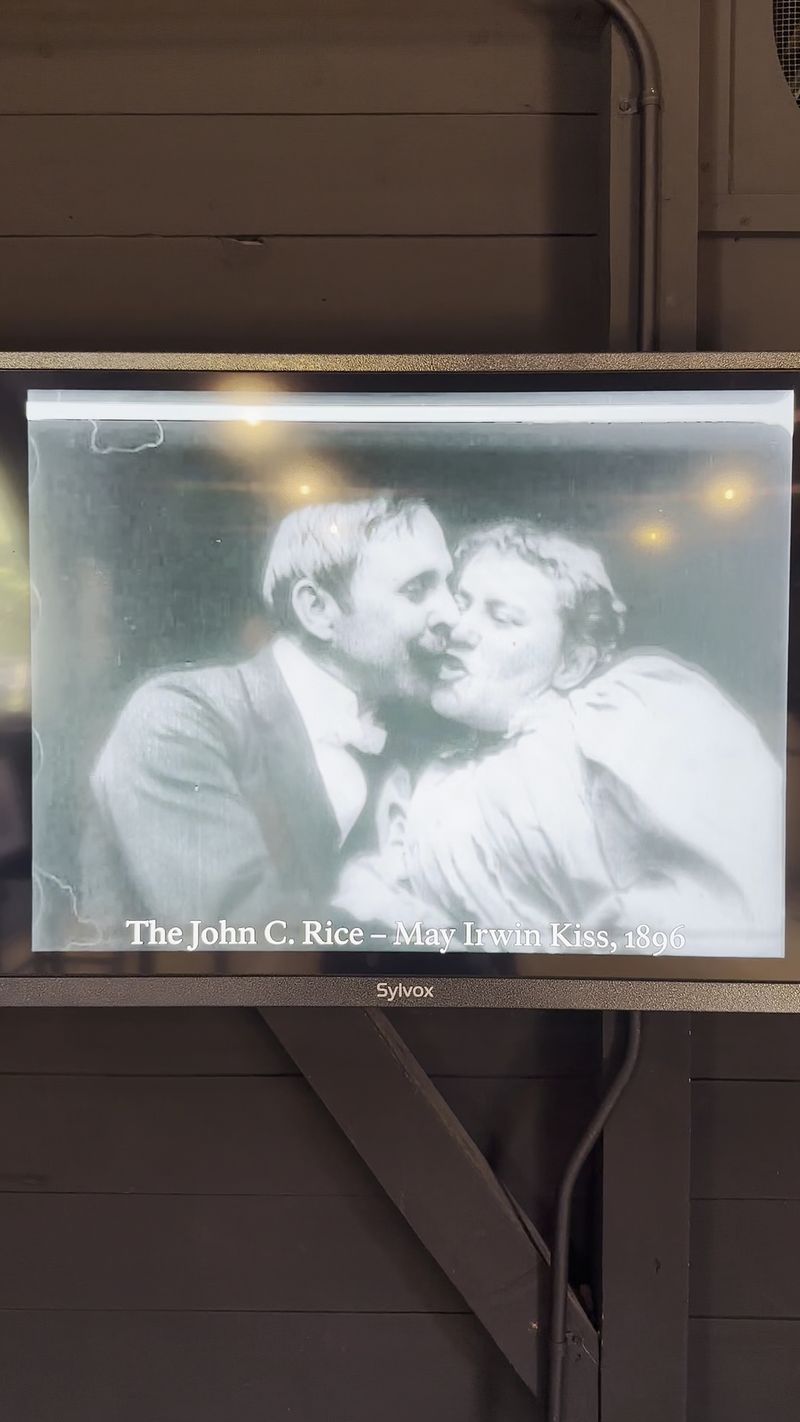
Dickson and William Heise created between 200 and 300 films there, capturing everything from athletic performances to dancers and novelty acts. One famous example, The Kiss from 1896, showed performers May Irwin and John Rice reenacting a brief kiss from a Broadway production.
Other films featured strongmen, dancers, boxers, and performers whose routines could be understood without dialogue. That was convenient because these early pictures were silent and extremely short.
Viewers initially encountered many of them through Kinetoscopes, standing at machines and watching individually rather than sitting together in a theater. The first commercial Kinetoscope parlor opened on Broadway in New York in April 1894, where customers could pay to peer into machines containing different films.
Seen from that perspective, the Black Maria starts to feel less like a strange historical building and more like a content factory from the 1890s. New viewing technology had arrived, audiences were curious, and Edison’s operation needed a constant supply of new things for them to watch.
Today You Can Step Inside a Full-Scale Replica in West Orange
The Black Maria standing at Thomas Edison National Historical Park is not the original building, but visitors are not limited to admiring it from behind a fence. The full-scale replica can be entered when open, giving the place a completely different impact than old photographs ever could.
The current structure was built in 1954 and later became part of the historic site preserving Edison’s West Orange laboratory complex. After being closed to public entry for decades, it underwent a major rehabilitation and officially reopened in April 2024.
The work included repairs to floors, windows, and doors, replacement exterior sheathing, electrical upgrades, and a new accessibility ramp. The result is a much more hands-on introduction to early filmmaking.
Inside are interpretive displays along with a replica Kinetograph, replica Kinetoscopes, period-style clothing and hats, a recreated storefront backdrop, and video presentations showing films associated with the Black Maria era. Being able to stand inside is the important part.
From outside, the building looks almost cartoonishly crude compared with a modern movie studio. Once you are inside, its design becomes easier to understand.
This was a working solution to a very specific technological problem, built during a period when the rules of filmmaking were still being invented. The replica sits within the courtyard of the Laboratory Complex at 211 Main Street in West Orange, surrounded by structures connected with Edison’s much larger research operation.
Because National Park Service schedules and building access can change with staffing and season, checking current operating information before visiting is sensible.
But when the Black Maria is accessible, stepping through the doorway offers something rare: the chance to physically enter a reconstruction of the space where commercial motion-picture production was still an experiment.
The Rest of Edison’s Laboratory Complex Makes the Trip Even Better
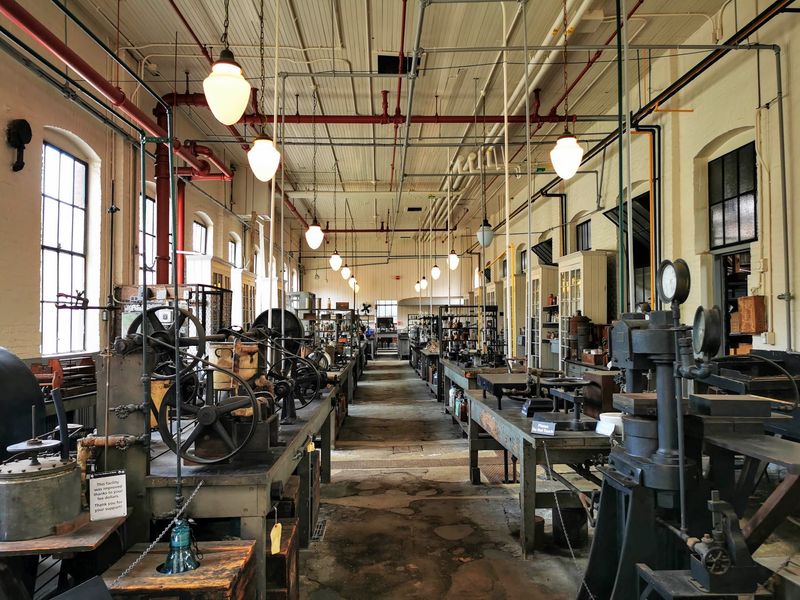
The funny thing about visiting the Black Maria is that the world’s first purpose-built movie studio is only one piece of what survives in West Orange. Walk back into the larger laboratory complex and the scale of Edison’s operation becomes much clearer.
Edison opened his West Orange laboratory in 1887, creating a sprawling research and manufacturing environment where teams could develop inventions and then work out how to produce them commercially.
The Main Laboratory Building still contains spaces tied to that work, including Edison’s multi-level library, machine shops, exhibits, and areas devoted to sound recording and other experiments.
Nearby buildings and courtyard structures include the chemical laboratory, pattern shop, blacksmith facilities, storage areas, and the distinctive water tower that appears in historical photographs of the complex. The contrast with the Black Maria is useful.
The little black studio can make early filmmaking seem like an isolated eccentric experiment, but the surrounding buildings show that it emerged from a much larger system of research. Motion pictures developed alongside Edison’s continuing work on phonographs, recorded sound, batteries, electrical technology, and materials.
A separate part of the national historical park preserves Glenmont, the Edison family estate in nearby Llewellyn Park. Edison purchased the property in 1886, and the 29-room house became home to Edison, his wife Mina, and their family.
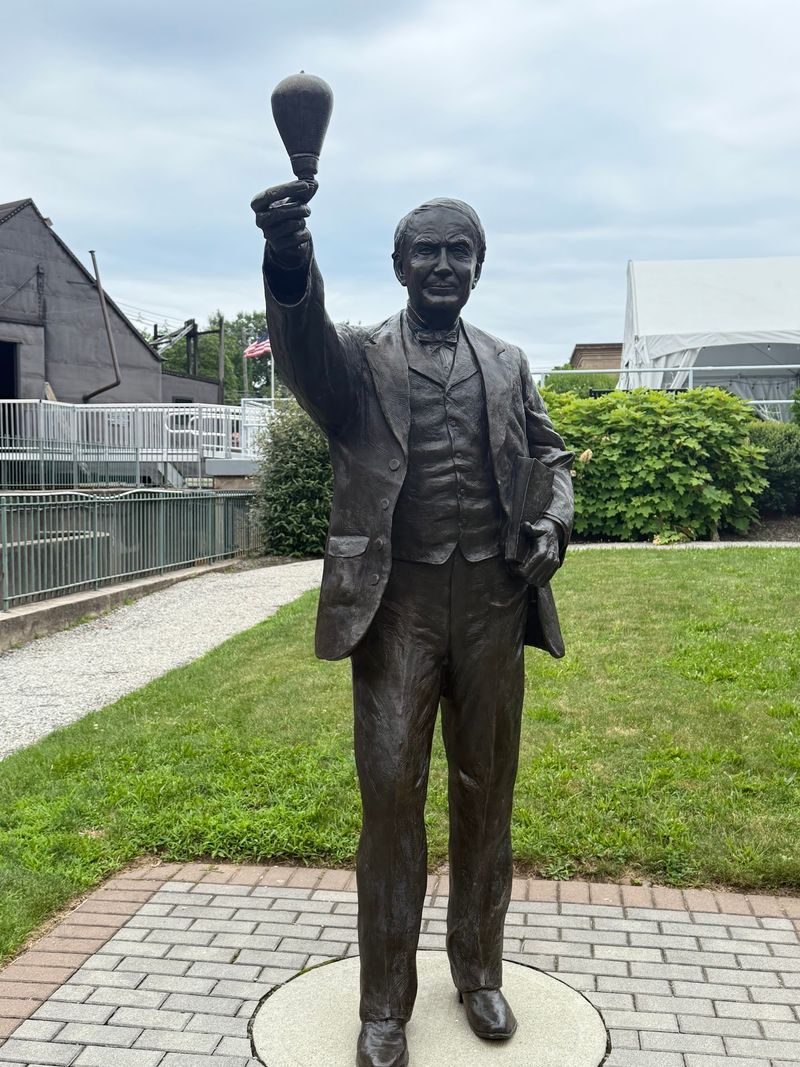
Together, the laboratory and estate give a broader picture of the man and the operation behind the famous inventions without pretending Edison worked alone. The National Park Service specifically notes the contributions of other inventors to motion-picture development, including figures working outside Edison’s organization.
That context actually makes the Black Maria more interesting. It was not the place where one person magically invented cinema.
It was one remarkably strange building in a much bigger international race to figure out how moving images could be recorded, reproduced, and eventually turned into an industry.
Share this story