A face the size of a small room appears to be pushing straight out of a quiet meadow in Hopewell, and that is only the beginning. A few steps away, an enormous hand reaches through the ground.
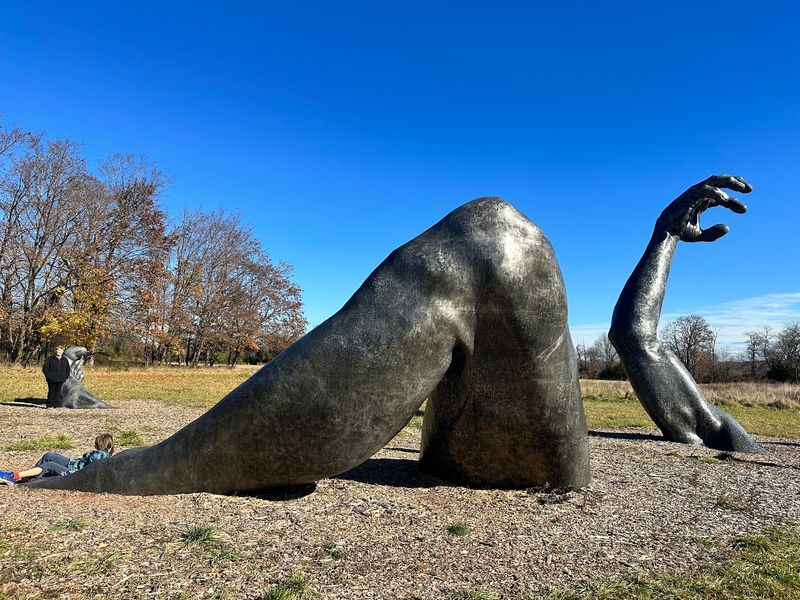
Farther across the grass, a bent knee and a giant foot complete the strange illusion of a man trapped beneath the landscape. This is The Awakening, Seward Johnson’s monumental sculpture at St. Michaels Farm Preserve, and seeing it in person is much more interesting than simply standing in front of it.
The artwork stretches roughly 70 feet across the meadow, with its separate aluminum pieces positioned so the earth itself becomes part of the scene. Walk around it and the proportions shift.
Back up and the figure starts to come together. Move closer and individual pieces become sculptures of their own.
Better still, the whole thing sits beside miles of walking paths, turning one of New Jersey’s most unusual works of outdoor art into the centerpiece of a very easygoing Hopewell adventure.
A Giant Appears in the Middle of a Hopewell Meadow
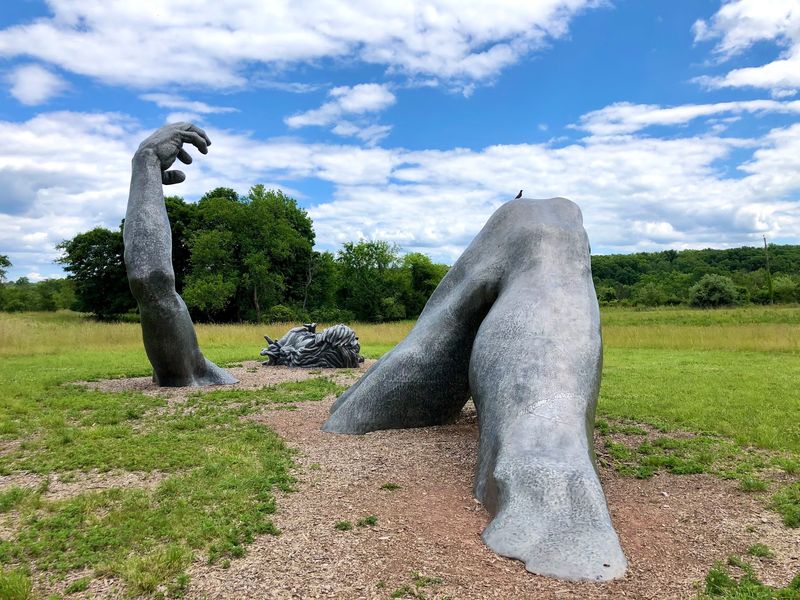
There is no gallery doorway, velvet rope, or carefully controlled viewing angle here. The Awakening sits outdoors at St. Michaels Farm Preserve in Hopewell Township, surrounded by fields, walking paths, woods, and the kind of broad Central Jersey sky that makes its scale even harder to judge at first.
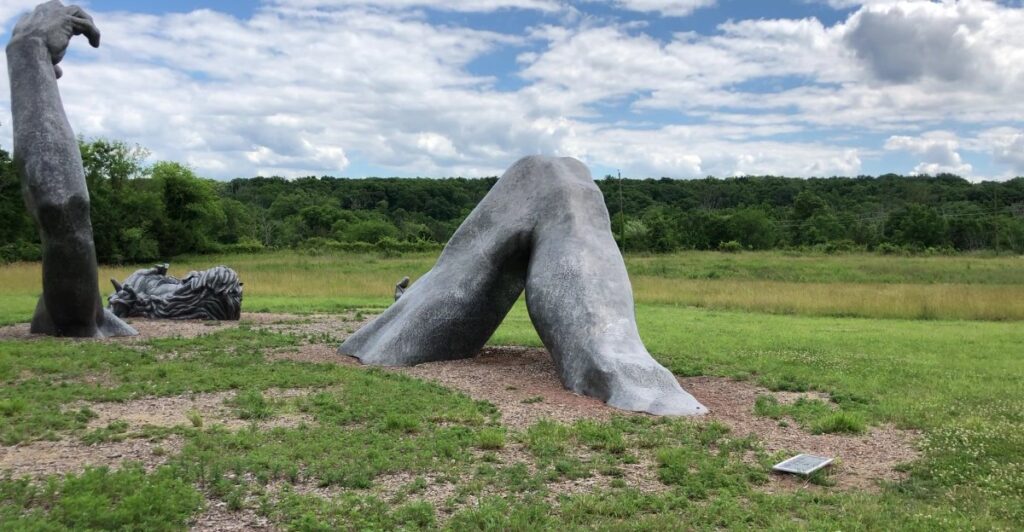
The sculpture depicts a bearded giant apparently trying to pull himself out of the earth. His head, one arm, one hand, one leg, and one foot emerge at different points across the ground, while the rest of his body exists mostly in your imagination.
That fragmented design is what makes the first encounter so effective. From a distance, the pieces begin to read as one enormous figure.
Get closer and the illusion breaks apart into a collection of oversized body parts, each substantial enough to command attention on its own. Johnson created the work in 1980, decades before it arrived in Hopewell.
The version now installed at St. Michaels is made from patinated aluminum and was placed at the preserve in 2023 as part of a larger celebration of the late New Jersey sculptor. What began as a special installation has become a longer-term fixture, with local arts organizers saying the sculpture will remain at the preserve indefinitely.
That feels appropriate because the setting does much more than provide empty space around the artwork. Tall grasses, changing crops, winter fields, and summer greenery alter the scene throughout the year.
Instead of looking like something dropped onto a lawn, the giant appears to be part of the landscape itself, which is exactly why the first glimpse can stop an otherwise ordinary walk in its tracks.
The Awakening Stretches an Incredible 70 Feet Across the Landscape
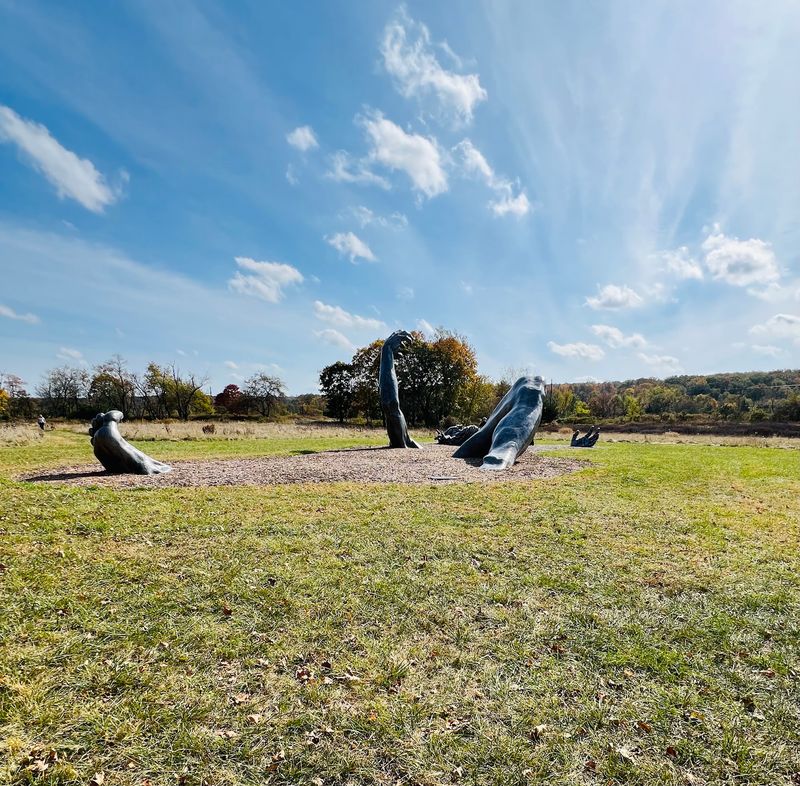
Seventy feet is one of those measurements that sounds impressive without really registering until you see what it means on the ground. Here, it means walking from one enormous piece of a human figure to another while your brain tries to assemble them into a single body.
The sculpture measures roughly 70 feet from end to end and rises to about 17 feet at its highest point, but those numbers only hint at the effect. Johnson did not create one complete giant and bury most of it.
Instead, The Awakening consists of five separate sculptural elements arranged to suggest that a colossal man is trapped underground. The head alone measures more than 14 feet in one dimension, while the towering right arm reaches more than 21 feet high.
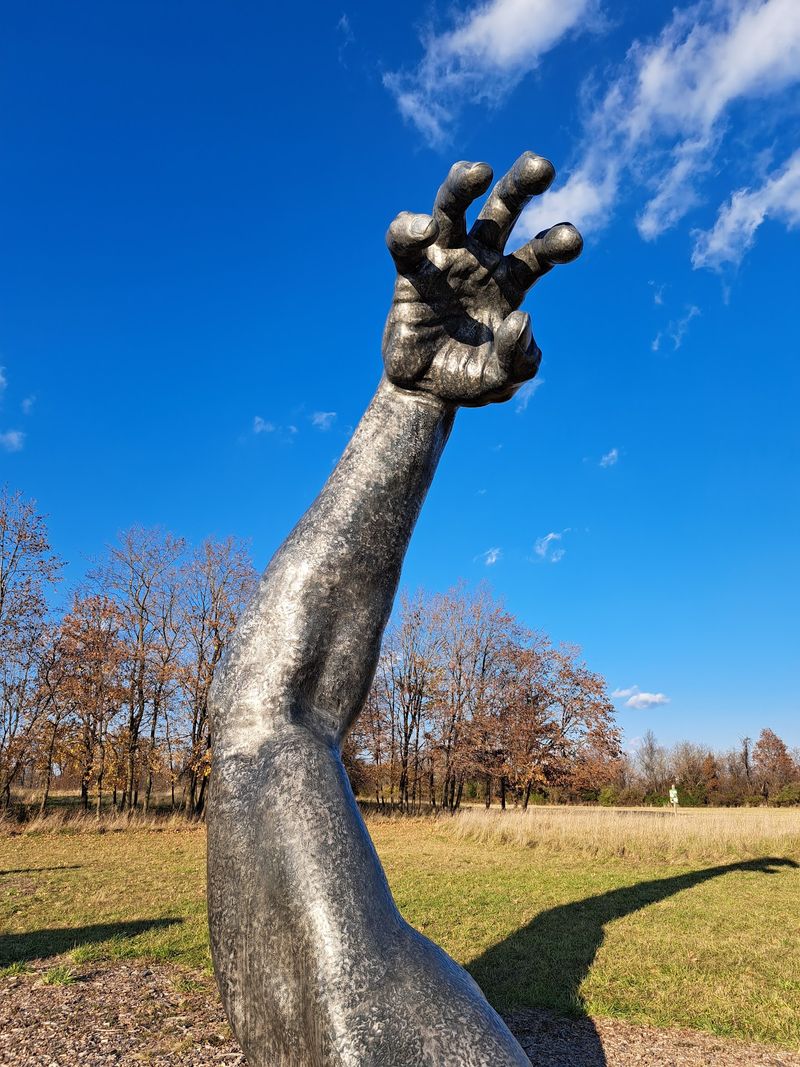
Nearby, a huge hand presses upward and a knee and foot appear to break through the surface farther away. Because the components are separated by open ground, the empty spaces become part of the sculpture.
You mentally fill in shoulders, torso, hips, and legs that are not actually there. That trick gives Johnson an almost absurd amount of scale without needing to construct an entire 70-foot human figure.
It also creates some wonderfully strange moments. Stand beside the head and you may lose sight of the foot.
Move toward the raised arm and suddenly the face seems farther away than expected. Children can look tiny beside a single hand, while adults posing near the head barely reach the level of its cheek or beard.
The artwork feels enormous without being a single towering object, and that horizontal spread suits the preserve perfectly. Rather than dominating the skyline, the giant seems tangled up in the meadow, as though the landscape has caught something much bigger than it knows what to do with.
Seward Johnson Designed the Sculpture to Look Like It Is Breaking Free
Long before The Awakening arrived in Hopewell, Seward Johnson had built a career around making people stop and take a second look. The New Jersey-born sculptor became especially well known for life-size figures placed in ordinary public settings, often showing people reading newspapers, sitting on benches, having conversations, or going about everyday routines.
He also founded the Johnson Atelier and Grounds For Sculpture in Hamilton, two institutions that helped make Mercer County an unexpectedly important destination for contemporary sculpture. The Awakening takes his interest in recognizable human figures and blows it up to a completely different scale.
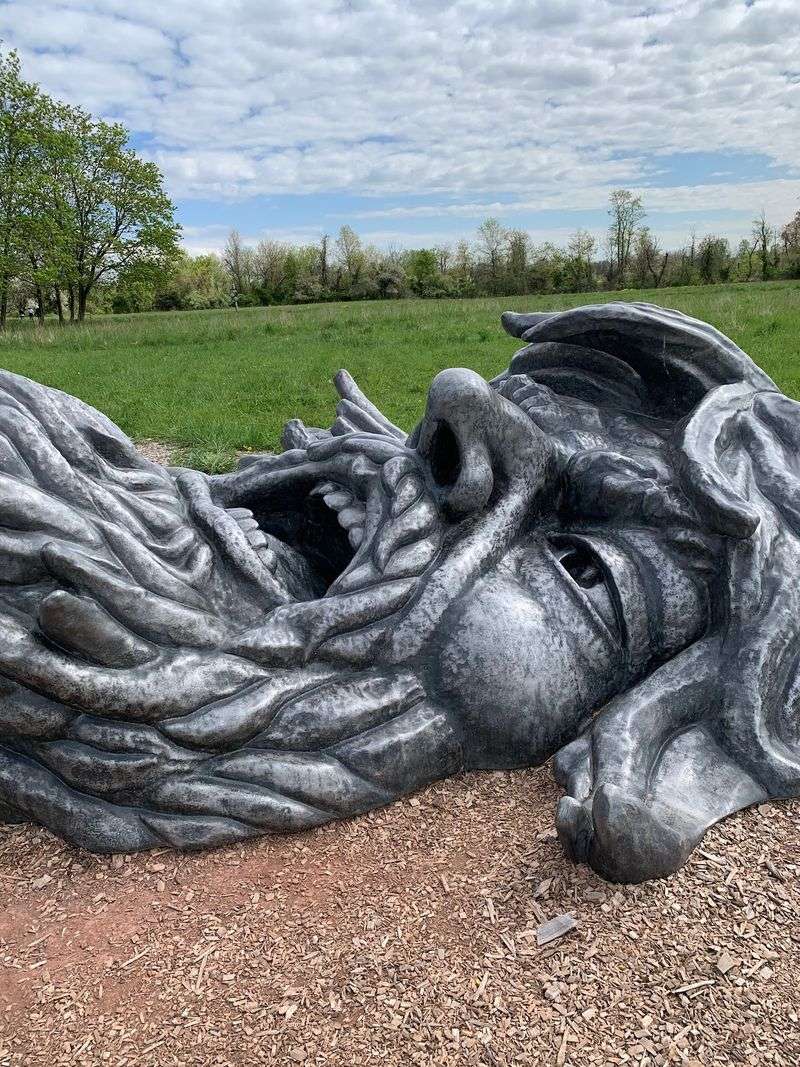
Instead of catching someone in an everyday moment, Johnson created a giant in what looks like a moment of panic or tremendous effort. The figure’s mouth is open, his face strains upward, and his arm reaches dramatically toward the sky.
Whether he is waking, escaping, sinking, or simply annoyed about being buried in a New Jersey field is left to the viewer. Johnson’s concept had a practical streak behind it, too.
He explained that allowing only parts of the figure to emerge from the earth meant he could suggest an enormous man without sculpting the entire body. It is a clever bit of artistic economy that also became the work’s defining visual idea.
Created around 1980, the sculpture has had a long public life, and Johnson’s Hopewell Valley connections make its current setting feel especially fitting. He lived and worked in the area and was closely associated with Central Jersey’s arts community until his death in 2020.
At St. Michaels, one of his biggest pieces now occupies one of Hopewell Valley’s biggest open spaces, where farmland and sculpture have enough room to play off each other rather than compete for attention.
Every Few Steps Reveal a Completely Different View
Walk clockwise around the sculpture and it starts playing tricks almost immediately. From one spot, the head and reaching arm line up closely enough that your mind builds a believable body beneath the grass.
Move several yards and that same arm suddenly appears detached, almost like a separate abstract monument. Continue around and the foot comes into the foreground while the face shrinks in the distance.
There is no obvious “correct” place to stand, and that is a big part of the fun. The local arts council even encourages visitors to circle the entire work and pay attention to which angle becomes their favorite.
The closer you get, the more the giant stops feeling like one image and starts revealing small details. The beard, open mouth, fingers, fingernails, wrinkles, and textured surfaces become much more noticeable at human scale.
Beneath the head, you can study the way the sculpture meets the ground rather than simply staring at the dramatic expression from across the field. Distance changes the mood as well.
Seen from farther along the meadow, the giant can look almost comical, like a fantasy character who has chosen an inconvenient place to wake up. Up close, the face becomes much more intense.
Photography changes with every few steps, especially because there is no wall or fixed backdrop behind the work. Clouds, trees, open sky, meadow grasses, and seasonal colors all slide in and out of the frame depending on where you stand.
Morning light can emphasize one side of the face while late-day shadows change the depth around the hand and arm. It is an unusually interactive piece without asking visitors to touch buttons, scan codes, or understand an artist’s statement.
The interaction is simply walking, looking, backing up, and realizing that the sculpture you saw 30 seconds ago has already turned into a different picture.
St. Michaels Farm Preserve Makes the Setting Part of the Artwork
The meadow around the giant has a story almost as layered as the sculpture. St. Michaels Farm Preserve now covers more than 400 acres along the edge of Hopewell Borough, combining agricultural fields, hedgerows, woodland, streams, and long open views toward the surrounding countryside.
Before becoming protected open space, the property was associated for decades with St. Michael’s Orphanage and Industrial School. The institution operated from the late 1890s until 1973, and its large main building was eventually demolished.
Development could easily have changed the property beyond recognition. Instead, D&R Greenway Land Trust led an effort that raised more than $11 million to preserve the land, completing the purchase in 2010 and later expanding the preserve.
Today, active farming still occupies a substantial portion of the property, while visitors use roughly six miles of farm roads and paths. That combination gives The Awakening a setting that feels unusually alive.
You may hear birds in the hedgerows, spot a hawk working the fields, or watch the landscape change dramatically between planting season, high summer, fall, and winter. Nearly 100 bird species have been documented at the preserve, including indigo buntings, rose-breasted grosbeaks, scarlet tanagers, warblers, kestrels, and herons.
The giant does not overpower any of that. In fact, there are plenty of places on the trail network where it disappears entirely from view.
Then a turn or rise in the path brings part of it back into sight, sometimes from far across a field. That disappearing-and-reappearing quality makes the installation feel less like an isolated attraction and more like another landmark within the landscape.
A piece about a figure emerging from the earth has ended up in a place where the earth, rather than a museum building, gets to provide the frame.
You Can Turn the Sculpture Stop Into a Longer Meadow Walk
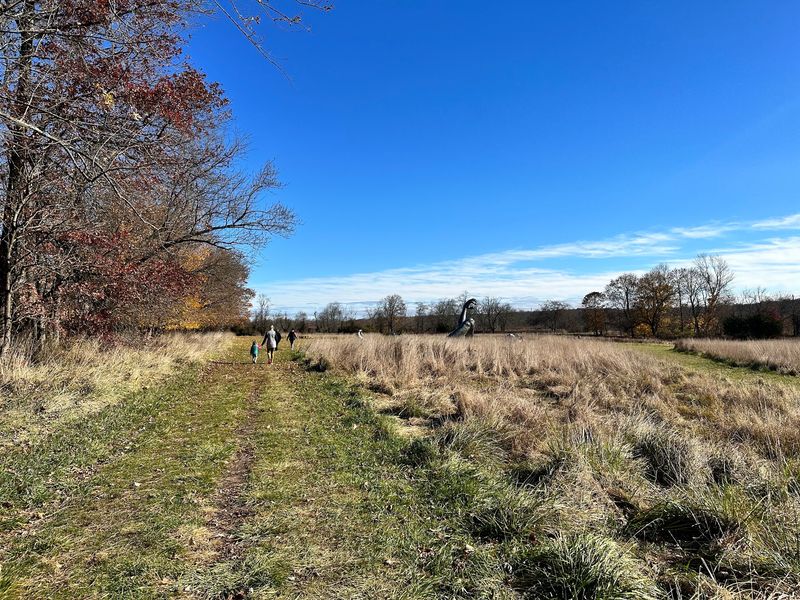
One of the nicest things about seeing The Awakening is that the experience does not need to end once you have walked around the giant. St. Michaels Farm Preserve has about six miles of farm roads and walking paths, so it is easy to add anything from a short wander to a much longer loop.
Many routes follow broad former farm roads or mowed field edges, making this less of a rugged hiking destination and more of a place for an unhurried walk through open country. Head deeper into the preserve and the scenery gradually shifts from agricultural fields and hedgerows into wooded sections.
East of Aunt Molly Road, a roughly one-mile loop passes through a distinctive area of widely spaced mature oaks and hickories that has an almost savanna-like appearance before running near Bedens Brook and stands of red cedar. Elsewhere, an overlook near Aunt Molly Road opens up views across the preserve toward Hopewell and the Sourland Ridge.
The property’s history remains visible in less obvious ways, too. Trails pass near the former orphanage site, and portions of the land continue to be actively farmed, preserving an agricultural use that predates the current trail network.
The sculpture therefore works surprisingly well as either the main event or simply the strangest thing encountered along a larger walk. Someone interested mostly in art can spend time circling the five giant pieces and head back.
Someone who wants more mileage can keep following field edges and wooded paths until the 70-foot man has become a tiny shape in the distance. Eventually even that disappears, replaced by farms, birds, trees, and the open sweep of the Hopewell landscape.
Share this story