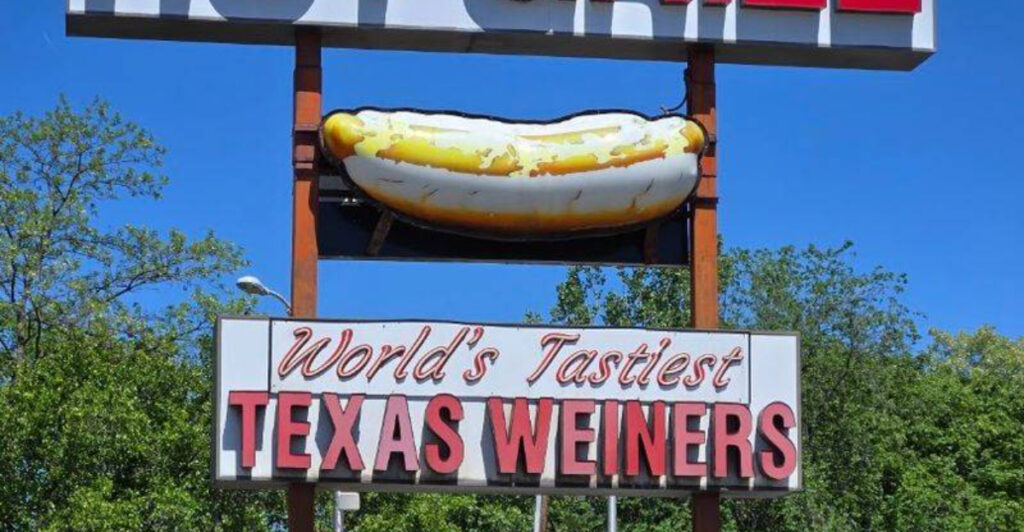
The first thing you notice is not the menu. It is the enormous roadside sign hovering over Lexington Avenue, complete with a sculpted hot dog and the confident promise of the “World’s Tastiest Texas Weiners.”
That is a bold claim for a low-slung Clifton restaurant facing a municipal park, but Hot Grill has had more than six decades to stand behind it.
Inside, custom beef-and-pork dogs disappear into hot oil, emerge browned and snappy, and get buried beneath mustard, chopped onions, and a dark, spiced meat sauce. Orders move quickly, counter chatter bounces toward the kitchen, and regulars barely need to glance at the menu.
Hot Grill is not interested in reinventing lunch. It is preserving a distinctly North Jersey ritual—one built around deep fryers, secret seasoning, gravy-soaked fries, and the wonderfully efficient phrase “all the way.” Since 1961, that formula has turned a humble hot dog into serious local comfort food.
Hot Grill has been serving Clifton from its roadside spot since 1961
Friday the 13th usually inspires caution. Carmen La Mendola, Domenick Sportelli, Nick Dorris, and Peter Leonidas apparently saw it as a perfectly good day to open a restaurant.
Hot Grill welcomed its first customers on October 13, 1961, starting with a small building and just 20 counter stools. The four partners had a straightforward goal: bring the Paterson-area Texas wiener tradition to customers in Clifton.
Their location at 669 Lexington Avenue, directly across from Nash Park and near the meeting point of Routes 46 and 21, gave them a highly visible roadside perch. The restaurant did not stay small for long.
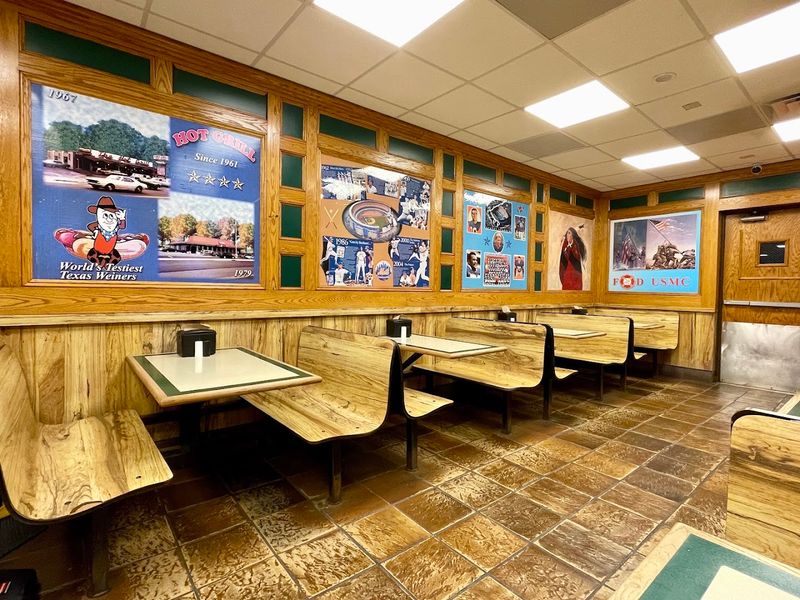
Seven years after opening, long lines encouraged the owners to renovate and add booths, expanding capacity to about 60 people. Another major expansion during the 1980s increased seating to 145.
Those numbers explain why Hot Grill feels bigger than the typical hot dog stand even though it still operates with the urgency of one. The business has also remained connected to the founding family.
Carmen’s daughter, Cristina La Mendola, officially joined the operation in 2017 as its second generation, with an emphasis on keeping the familiar recipes intact. Hot Grill currently opens at 9 a.m. daily, remaining open until midnight from Sunday through Thursday and until 2 a.m. on Fridays and Saturdays.
Those late hours make sense. A Texas wiener tastes just as appropriate after an evening out as it does during a hurried lunch break.
What began with four partners and a row of stools has become one of Passaic County’s most recognizable places to eat, yet its identity remains tied to that original 1961 idea: serve uncomplicated food quickly and make it taste exactly the way customers remember.
Deep-frying gives the custom beef-and-pork hot dog its unmistakable snap
Watch one of these dogs reach the fryer and the difference becomes clear. Hot Grill does not rely on grill marks, smoke, or an elaborate collection of toppings to create character.
Its signature wiener uses a custom blend of beef and pork, and the entire dog is deep-fried until the exterior tightens and browns. The result lands somewhere between crisp and juicy: a lightly blistered outside that gives way with a satisfying snap, followed by a softer, savory center.
That contrast is the foundation of the whole dish. A steamed dog might become lost beneath chili sauce and onions, while a heavily charred one could overwhelm them.
Frying creates enough texture to hold its own without turning the frank into a distraction. Deep-frying hot dogs is hardly unusual in North Jersey, where several legendary stands have developed their own methods and levels of doneness.
Hot Grill’s version, however, belongs specifically to the Paterson-style Hot Texas Wiener tradition. The Library of Congress documented that regional food culture in the 1990s, describing the style as a deep-fried hot dog finished with mustard, onions, and distinctive chili sauce.
At Hot Grill, the beef-and-pork blend gives the dog a slightly richer flavor than a straightforward all-beef frank, which matters because the toppings are anything but shy. The bun remains soft, creating another useful contrast with the fried exterior.
Take the first bite before overthinking it. You get pillowy bread, crisp-edged meat, sharp mustard, raw onion, and warm sauce almost simultaneously.
It is messy enough to require attention but compact enough to disappear alarmingly quickly. Ordering two is less an act of excess than an acknowledgment of how this particular hot dog works.
The famous Texas wiener goes all the way with mustard onions and chili sauce
Around here, “all the way” is not a motivational slogan. It is an ordering instruction, and possibly the most important three words a first-time customer can learn.
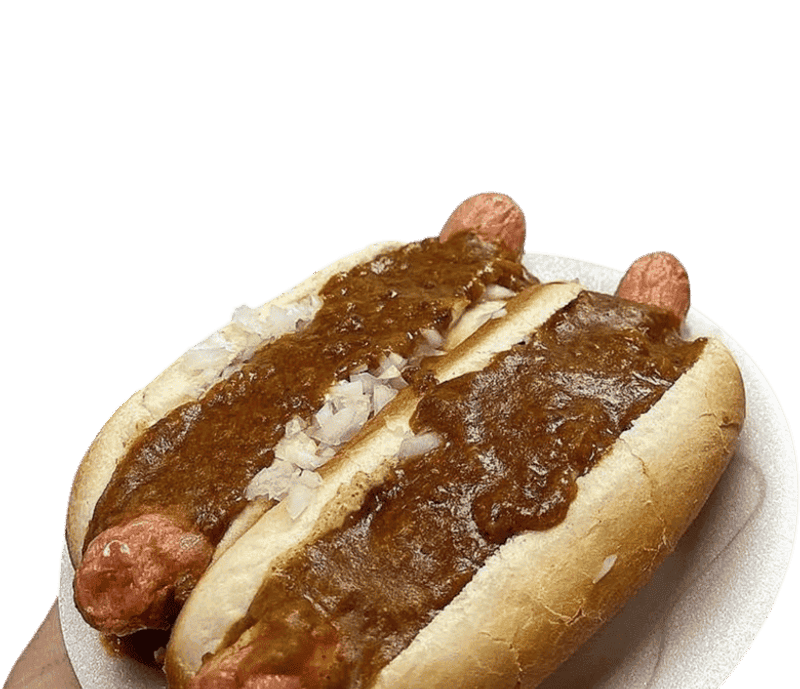
Ask for a Texas wiener all the way and the fried dog receives mustard, finely chopped raw onions, and Hot Grill’s chili sauce. The order of operations matters more than it may appear.
Mustard goes close to the dog, bringing acidity and a little heat. The onions contribute crunch and a fresh bite.
The warm meat sauce settles over everything, softening the sharpest edges while tying the components together. Nothing needs to be piled six inches high.
The appeal comes from balance rather than spectacle. Despite the name, this style is a North Jersey creation, most closely associated with nearby Paterson rather than the Lone Star State.
The “Texas” label traditionally referred to the chili-like topping and its supposedly Southwestern kick, although the seasoning has stronger connections to the Greek immigrant cooks who helped establish the regional style.
That backstory makes the dish wonderfully New Jersey: an American hot dog, prepared by frying, dressed with a Greek-influenced meat sauce, and named after a state hundreds of miles away.
Hot Grill helped carry the tradition into Clifton and made “all the way” part of the local vocabulary. The same treatment can also be applied to burgers and other sandwiches, but the wiener remains the clearest expression of it.
Ketchup would only clutter the arrangement. Cheese is available for anyone seeking extra richness, though the standard trio already does plenty of work.
The finished dog is salty, tangy, meaty, lightly spicy, and crunchy in several different ways. It is not fancy, but it is extremely specific—and that specificity is why regulars tend to order it without hesitation.
A secret meat sauce turns a simple hot dog into a North Jersey classic
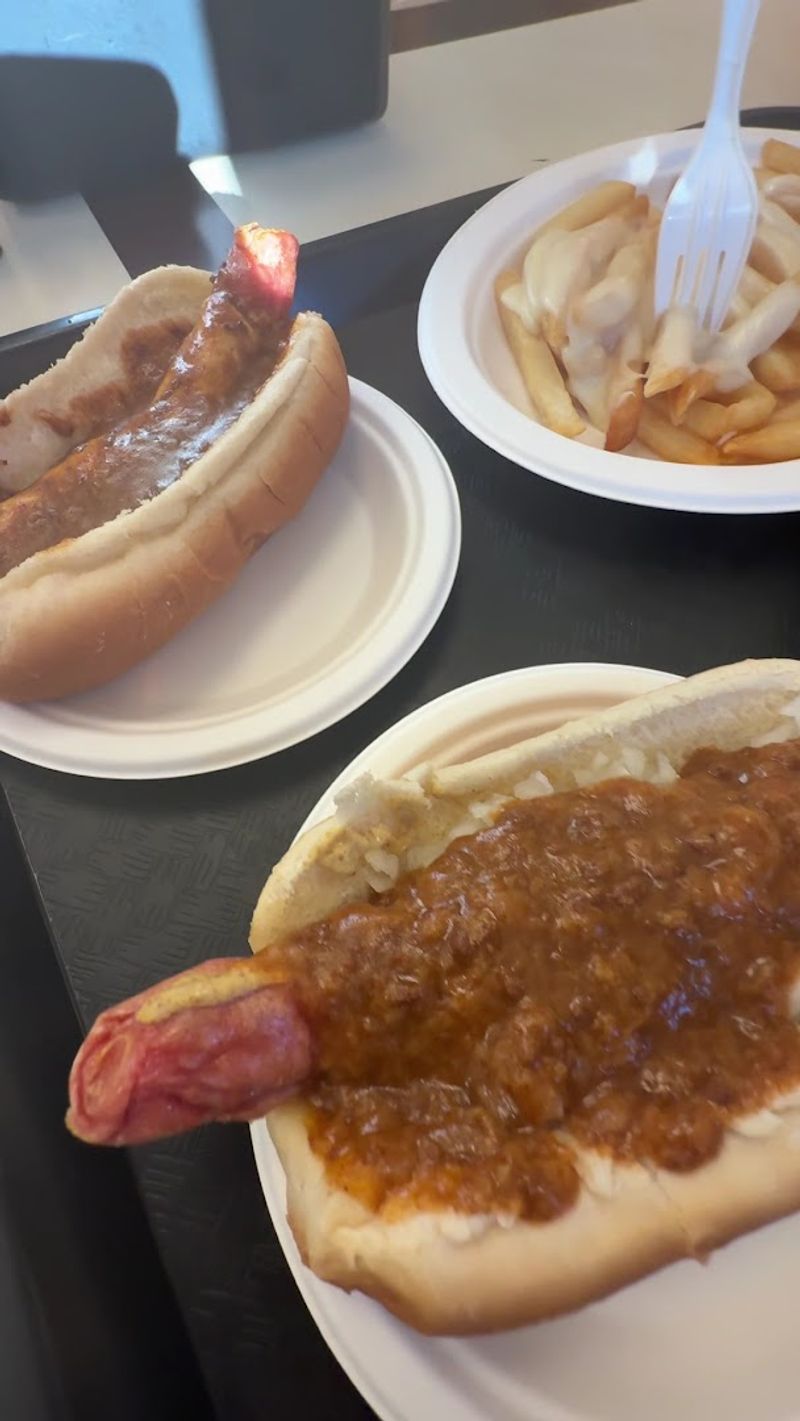
The hot dog may provide the snap, but the sauce supplies the personality. Hot Grill guards the precise recipe, which is sensible considering how strongly customers associate that flavor with the restaurant.
This is not a thick bowl-style chili loaded with beans, peppers, or large chunks of meat. It is a finer, pourable tomato-and-beef sauce designed to cling to a hot dog without turning the bun into immediate wreckage.
The flavor begins savory and tomato-rich, then reveals warmer spices that distinguish it from an ordinary burger-joint chili.
Archival interviews conducted with Hot Grill co-owner Nick Dorris in 1994 described the broad framework of the regional sauce as chopped beef, onion, tomato paste, chili powder, paprika, cinnamon, cumin, and other seasonings.
A mixture of white bread and water was traditionally used to help thicken it. The exact proportions—and any adjustments made since—remain the important secret.
Scale is another clue to the sauce’s importance. The Hot Grill kitchen was documented using a 90-gallon water-jacketed kettle, large enough to prepare several batches each week.
That is not a garnish being made as an afterthought. It is a central production job requiring consistency, patience, and someone who knows when the texture is right.
The warmer spices are what make the sauce linger in your memory. Cinnamon and cumin do not announce themselves like they would in a dessert or taco seasoning.
Instead, they sit beneath the tomato and beef, adding an earthy, aromatic quality that becomes more noticeable after a few bites. Spread over a fried wiener with mustard and raw onion, the sauce completes a combination that has fed generations of North Jersey families.
Without it, Hot Grill would serve a very good deep-fried hot dog. With it, the restaurant serves something unmistakably its own.
The no-frills booths and fast-moving counter preserve the old-school experience
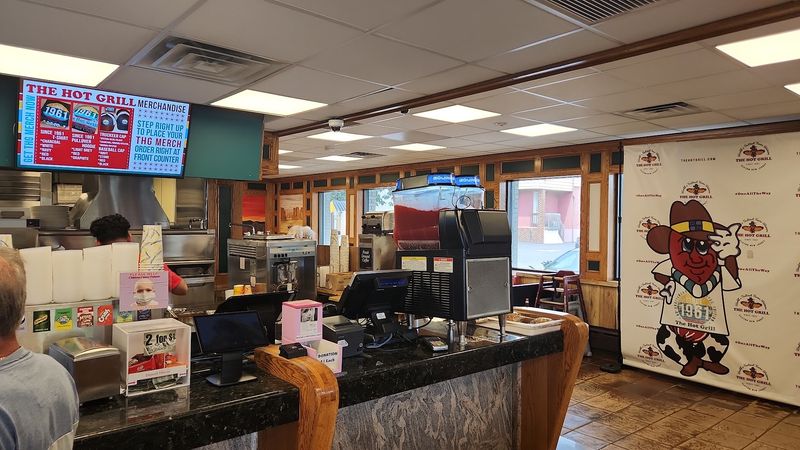
Lunchtime does not unfold quietly at Hot Grill. Customers gather near the counter, orders are taken in quick bursts, and staff members call those orders back toward the busy preparation line.
Hearing “two all the way” shouted across the room is part of the soundtrack, not a sign that anyone has lost control. The system has been refined through decades of rushes, including lunch periods documented by folklorists and photographers as far back as 1994.
Newcomers may spend a moment figuring out where to stand or whose turn comes next. Regulars operate on instinct.
They know what they want, keep their order compact, and move aside while the kitchen handles the rest. The dining room reflects the same practical approach.
There are counters, tables, and rows of booths rather than decorative installations designed for social media. The menu hangs where people can see it, though plenty of customers never look up.
Hot Grill’s gradual expansion from 20 stools to seating for 60 and eventually 145 gave the restaurant room for families, larger groups, and generations of regulars without erasing the quick-service rhythm of the original stand. That combination is a major part of its charm.
You can sit in a booth and settle in, but the food still arrives with the speed and directness of a counter lunch. The setting feels old-school because it continues to perform an old-school job.
It offers a reliable place where teenagers, construction crews, grandparents, night-shift workers, and hot dog pilgrims can all eat the same straightforward meal. There is no need for manufactured nostalgia when the restaurant has been repeating its own rituals since 1961.
The shouted orders, ketchup bottles, paper wrappers, busy fryer, and steady shuffle of customers create a living tradition—one that feels more authentic because no one appears to be making a big production out of preserving it.
Cheese-and-gravy fries burgers and classic sandwiches round out the menu
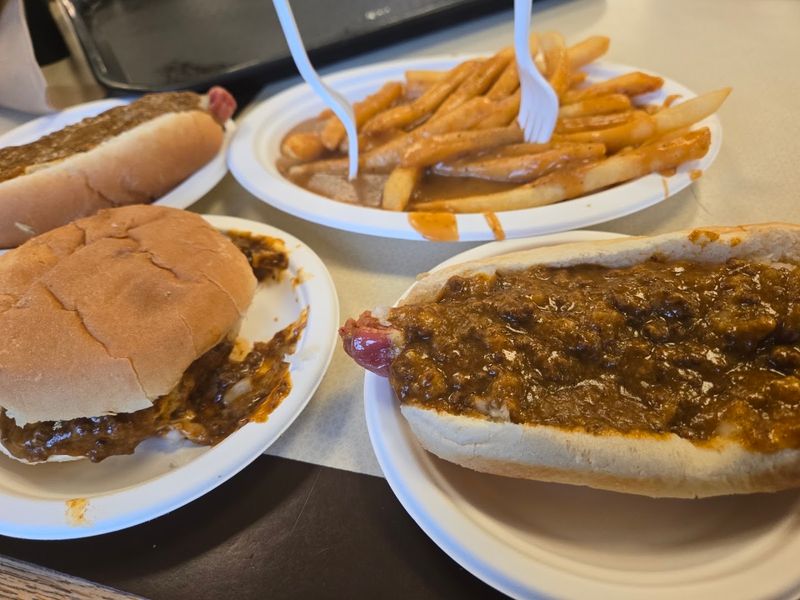
A plate of fries arrives beneath a glossy layer of brown gravy, followed by melted cheese that turns every forkful into a salty, starchy tangle. This is Hot Grill’s other essential comfort-food move, and it pairs naturally with the sharper flavors of an all-the-way wiener.
The fries can also be ordered with chili sauce, cheese, gravy, or combinations of the three. Restraint is technically possible, though it seems slightly beside the point.
The broader menu follows the same unfussy logic. Hamburgers, cheeseburgers, and double cheeseburgers can receive the all-the-way treatment, placing mustard, onions, and chili sauce over a beef patty instead of a frank.
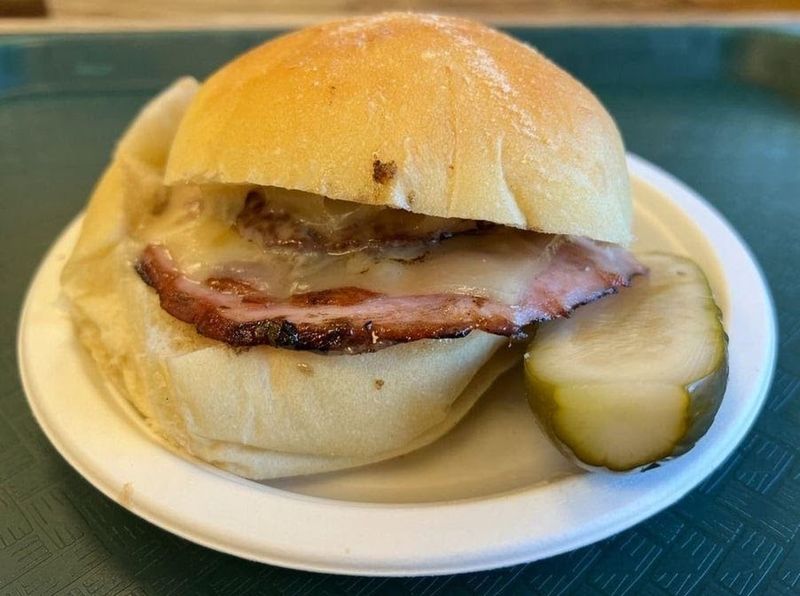
Roast beef is another longtime favorite, available as a sandwich or platter, while the sandwich board includes turkey, grilled cheese, tuna salad, bacon-lettuce-and-tomato, fried fish, and grilled chicken.
Breakfast is served throughout the day, so eggs, omelets, and breakfast sandwiches remain an option even when everyone else at the table is ordering chili dogs.
Current delivery listings give a sense of the restaurant’s still-accessible pricing, with plain fries around $3.90, a double cheeseburger around $7.55, and a roast beef platter around $8.40, though counter and third-party prices can differ. None of these dishes is plated for dramatic effect.
Burgers are compact, sandwiches are familiar, and fries are meant to be attacked before the gravy cools. That simplicity keeps the Texas wiener at the center of the experience while giving groups enough choices to avoid ordering six identical meals.
Still, the classic combination is difficult to improve upon: two dogs all the way, fries with cheese and gravy, and something cold to drink. By the final bite, the paper is spotted with chili sauce, the fries have absorbed the gravy, and the whole meal feels exactly as indulgent as an old-school North Jersey hot dog lunch should.