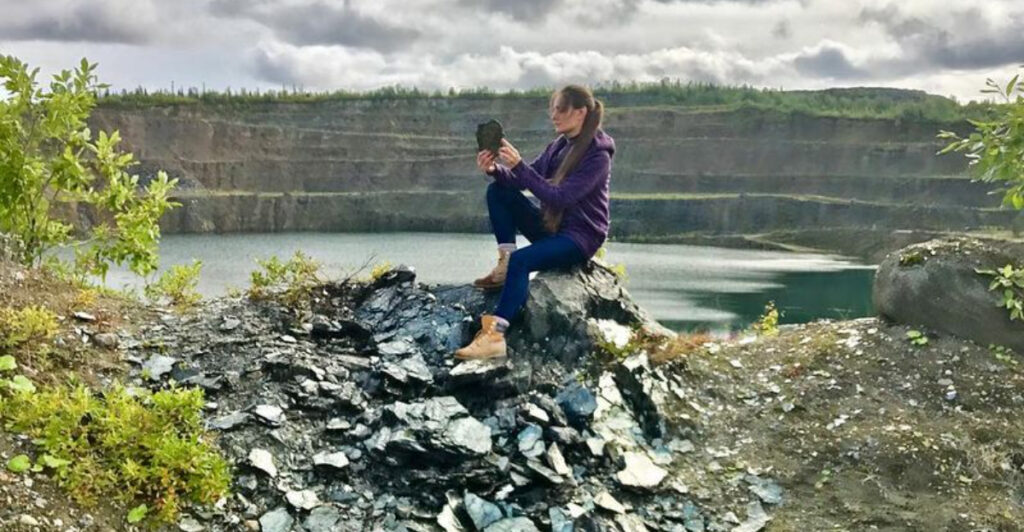
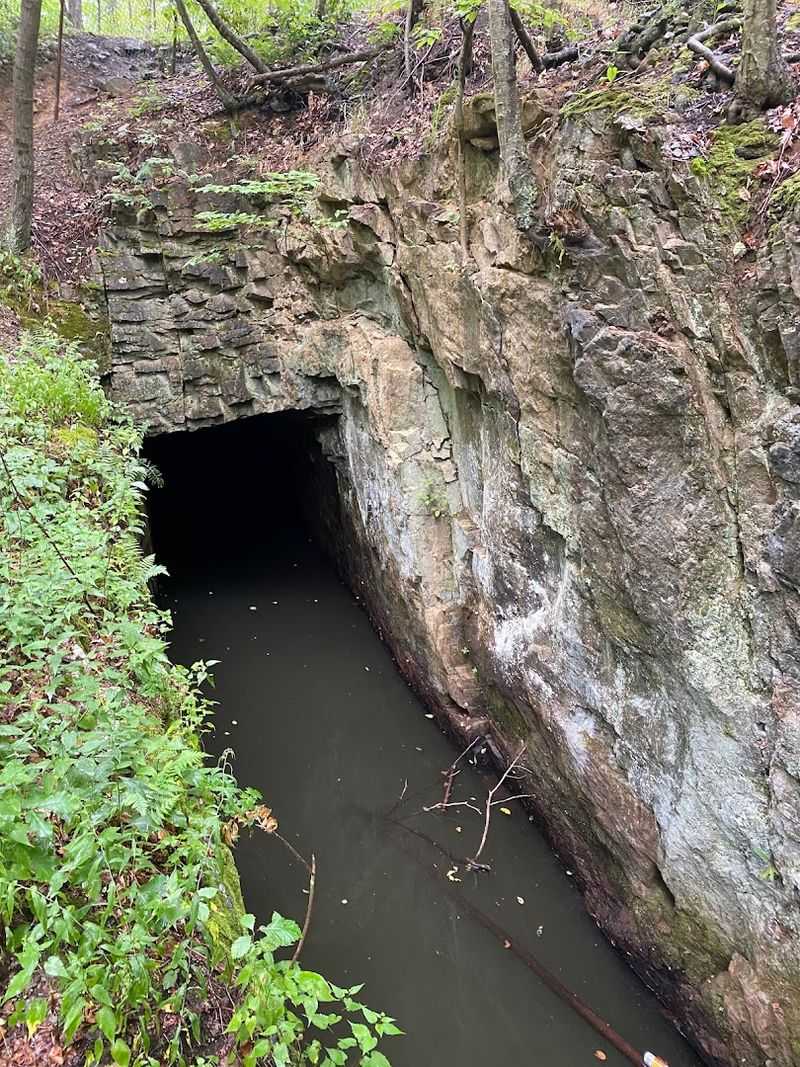
Behind a chain-link fence on Sparta Mountain, dark water fills a chasm that once rang with blasting, railcars, and the grind of industrial machinery.
It looks like a quiet woodland pond until you realize the opening drops into an abandoned iron mine—and that Thomas Edison once bet a large piece of his fortune on the rocks beneath your feet.
During the 1890s, the famous inventor tried to turn this rugged corner of Sussex County into an automated mining empire. He built crushers, conveyors, magnetic separators, company housing, and an entire processing plant designed to make low-grade New Jersey ore profitable again.
The plan was ambitious, expensive, and ultimately crushed by cheaper competition from Minnesota.
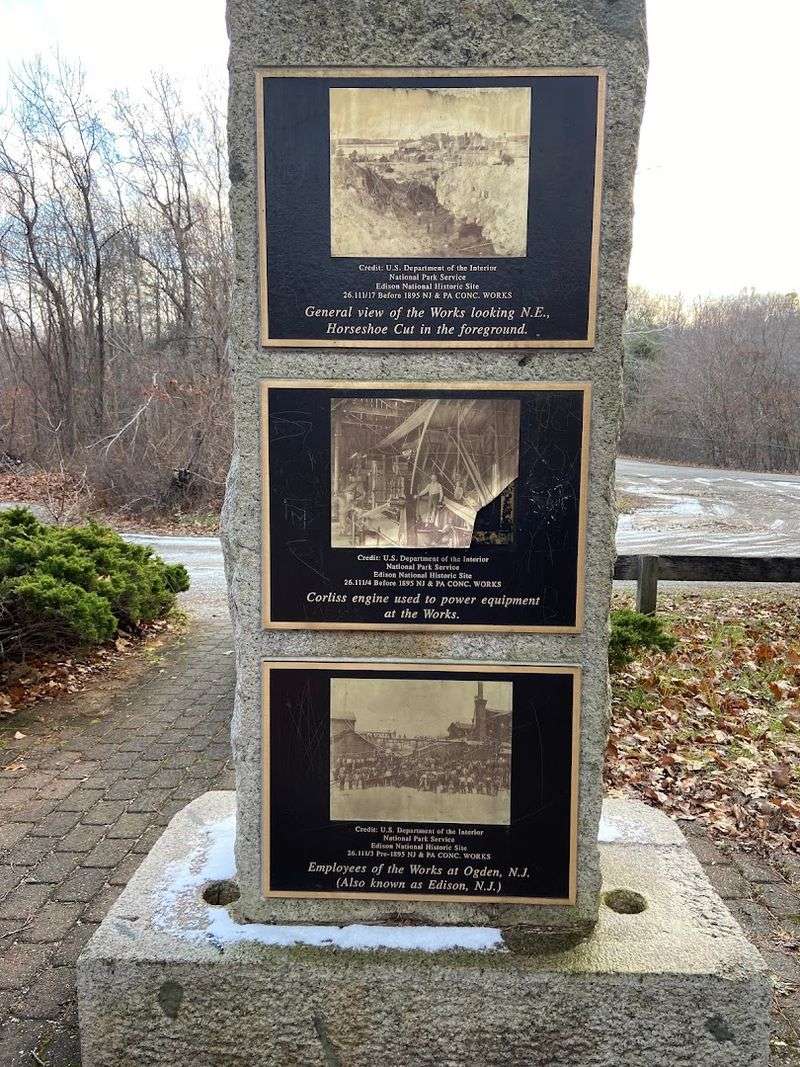
More than a century later, the machinery is gone and the mountain has grown back, but the story remains scattered through the forest in flooded pits, stone foundations, old rail grades, and one modest monument marking Edison’s spectacular industrial gamble.
Sparta Mountain’s iron mines were already centuries old when Edison arrived
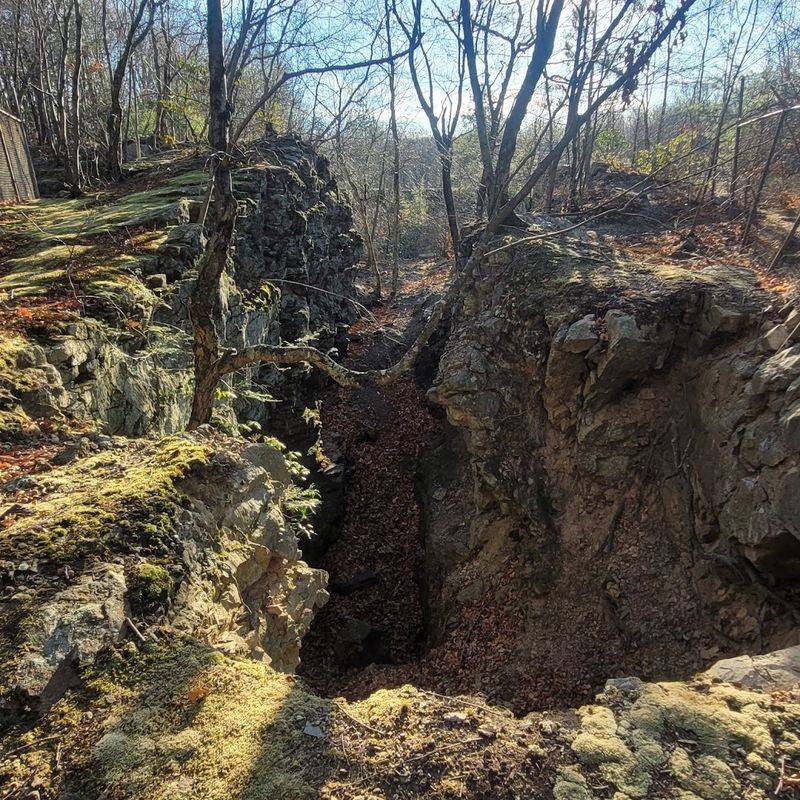
Long before Edison brought electromagnets and industrial-scale crushers to Sussex County, Sparta Mountain was being dug, blasted, and picked apart for iron.
Ore was discovered near the Wallkill Valley in 1772, and the Horseshoe Mine opened while the American Revolution was creating an urgent appetite for iron tools, weapons, hardware, and building materials.
Additional workings followed, including the Ogden, Knoll, Davenport, Victor, Roberts/Pardee, and Vulcan mines. By the 1800s, mining was not a curious side business here.
It shaped settlements, created jobs, and helped turn the New Jersey Highlands into one of the country’s important early iron-producing regions. More than 100 mines operated in the ancient rock of the Highlands during the 18th and 19th centuries.
Getting that ore off the mountain was its own challenge. Workers initially relied on mule-drawn wagons traveling rough roads toward local forges and, later, the Morris Canal at Lake Hopatcong.
The Ogden Mine Railroad, completed in the 1860s, finally gave the mines a more dependable link to larger transportation networks. Production on Sparta Mountain reportedly peaked around 1880, when approximately 91,000 tons of ore were removed.
That success did not last. The easiest and richest deposits were becoming harder to find, while mines farther west were beginning to supply iron more cheaply.
Eastern operators were left with enormous quantities of rock containing magnetite, but not enough concentrated iron to process profitably using traditional methods. To most investors, that sounded like the beginning of the end.
To Edison, it sounded like a problem waiting for a machine.
Edison transformed five old mines into a sprawling industrial experiment
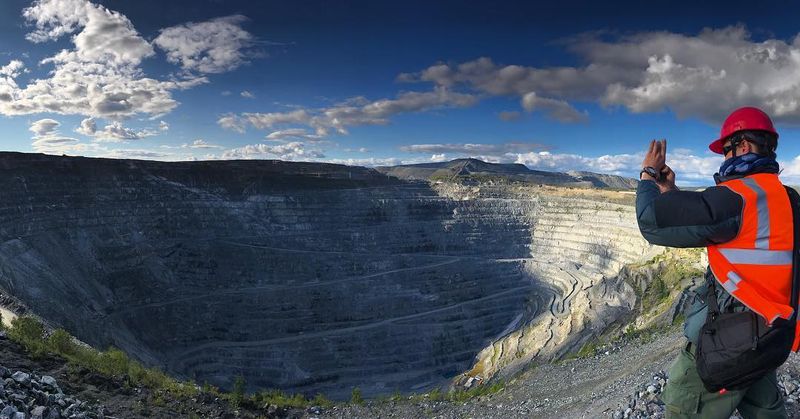
Picture Sparta Mountain in the 1890s without today’s thick canopy of oak, maple, and hickory. Instead of quiet trails, the slopes held mine cuts, industrial buildings, rail lines, conveyors, steam equipment, worker housing, and clouds of rock dust.
Edison did not simply purchase one hole in the ground and start digging. He assembled thousands of acres of mineral property, taking control of the Ogden Iron Company in September 1890 and folding several older mines and test pits into a much larger operation.
His New Jersey and Pennsylvania Concentrating Works had been organized in 1888 with one audacious goal: continuous, large-scale production of concentrated iron ore. The site soon became a company community known simply as Edison.
Houses stood near a post office, stores, a blacksmith shop, and a railroad station. Historical accounts describe more than 700 miners, tradespeople, and family members living around the operation, while the processing plant itself employed nearly 500 men at its busiest.
This was less a conventional mine than an enormous outdoor laboratory. Dynamite loosened boulders from the mountain.
Narrow-gauge railcars moved the rock toward the mill. Conveyors carried it between machines, and gravity helped move material through successive stages of crushing and sorting.
Edison wanted automation to replace as much slow, expensive manual labor as possible. The plant consumed his attention through most of the decade, overshadowing even his work with sound recording, motion pictures, and electrical technology.
For a man associated with tidy laboratories and glowing bulbs, it was an unusually loud, dirty obsession—and he kept expanding it even as machinery broke, expenses climbed, and profits remained stubbornly theoretical.
Magnetic separators and iron briquettes powered his bold plan to reinvent mining
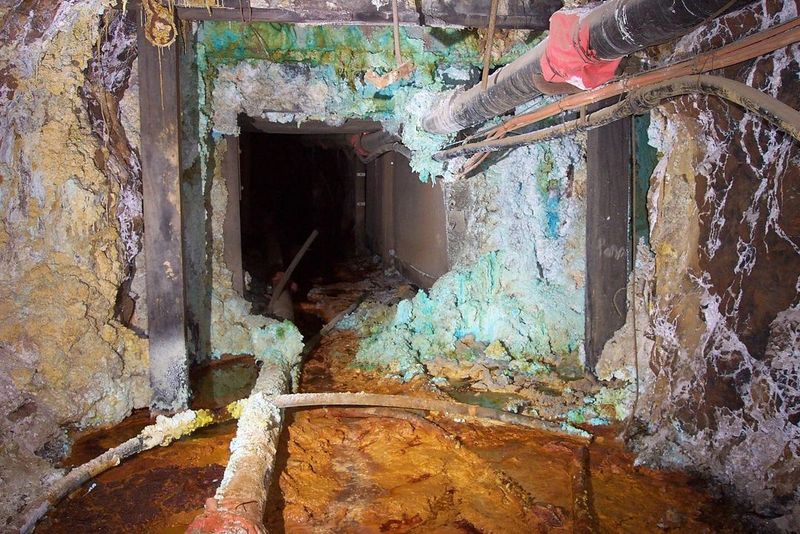
The clever part of Edison’s system began after the mountain had been reduced to powder. Crushers and heavy rollers broke large rocks into progressively smaller fragments until the material was fine enough to pass through magnetic separators.
The crushed rock fell from a hopper in a thin, broad curtain in front of an electromagnet. Magnetite-rich particles were pulled toward one collection point, while ordinary stone continued falling into another.
In theory, low-grade ore that steelmakers would normally ignore could be concentrated into something far more valuable. Edison had been experimenting with electromagnetic ore separation since 1880, initially trying to extract iron from black beach sand.
Sparta Mountain gave him a chance to apply the idea on a scale that bordered on outrageous. The plant was designed as a nearly continuous system of conveyors, crushers, screens, magnets, and railcars, with relatively little material handled by hand.
Unfortunately, producing iron powder was only half the battle. Fine concentrate was awkward to transport and difficult for furnaces to use efficiently.
Edison’s answer was to press it into dense briquettes suitable for shipment to Eastern steel mills. These compact blocks were intended to resist rain, remain in railcars, and behave more like conventional chunks of ore inside a furnace.
The process eventually worked well enough to create a marketable product, but getting there required years of redesign. Dust damaged equipment.
Rollers and crushers failed under heavy loads. Each weak link in the automated chain could stop everything behind it.
Edison and his assistants kept rebuilding, adjusting, and patenting improvements, confident that one more mechanical fix might finally make the entire operation economical. Technically, many parts of the system were ingenious.
Commercially, the mountain was running out of time.
Cheaper ore from Minnesota turned Edison’s multimillion-dollar gamble into a spectacular failure
The fatal problem did not come from a broken conveyor or an unreliable separator. It arrived by train from the Great Lakes.
As Edison struggled to make low-grade New Jersey magnetite competitive, huge deposits of richer iron ore were being developed around Lake Superior, especially in Minnesota’s Mesabi Range.
That ore was easier to extract, contained a higher concentration of iron, and could be shipped to steel producers at a price Edison’s heavily engineered process could not match.
One frequently cited comparison puts Minnesota ore at roughly $3 per ton while Edison’s concentrated product initially cost about $7. He reportedly lowered his figure to around $4.75, an impressive improvement that still left him on the wrong side of the arithmetic.
A magnetic separator could pull iron from stone, but it could not persuade steel companies to pay extra for it. Edison poured more than $2 million of his own money into the venture.
Broader estimates place the total investment near $2.9 million by the time the experiment was over, an extraordinary sum at the turn of the 20th century. The New Jersey and Pennsylvania Concentrating Works ended production permanently on September 30, 1900.
Edison’s response became almost as famous as the failure itself. Rather than pretending the decade had been wasted, he joked that the money was gone but that he and his team had enjoyed spending it.
The project also left him with valuable knowledge about crushing, grinding, and moving enormous volumes of rock. He redirected much of that technology into Portland cement manufacturing, although even that business took years to become profitable.
Sparta Mountain did not give Edison the iron empire he imagined, but it taught him how to process stone on a scale few manufacturers had attempted.
Forest trails now wind past abandoned rail beds foundations and flooded mine pits
Today, the racket has been replaced by birdsong, wind, and the occasional crunch of boots over loose stone. Sparta Mountain has reforested so thoroughly that it takes a little imagination to picture hundreds of workers and an industrial complex occupying the same slopes.
Trails pass through mixed woodland, across glacial debris, beside wetlands, and along sections of abandoned railroad grade once used to haul ore and equipment.
Near the former processing area, hikers can spot low stonework, concrete fragments, overgrown foundations, and changes in the terrain that make more sense once you know machinery and buildings stood there.
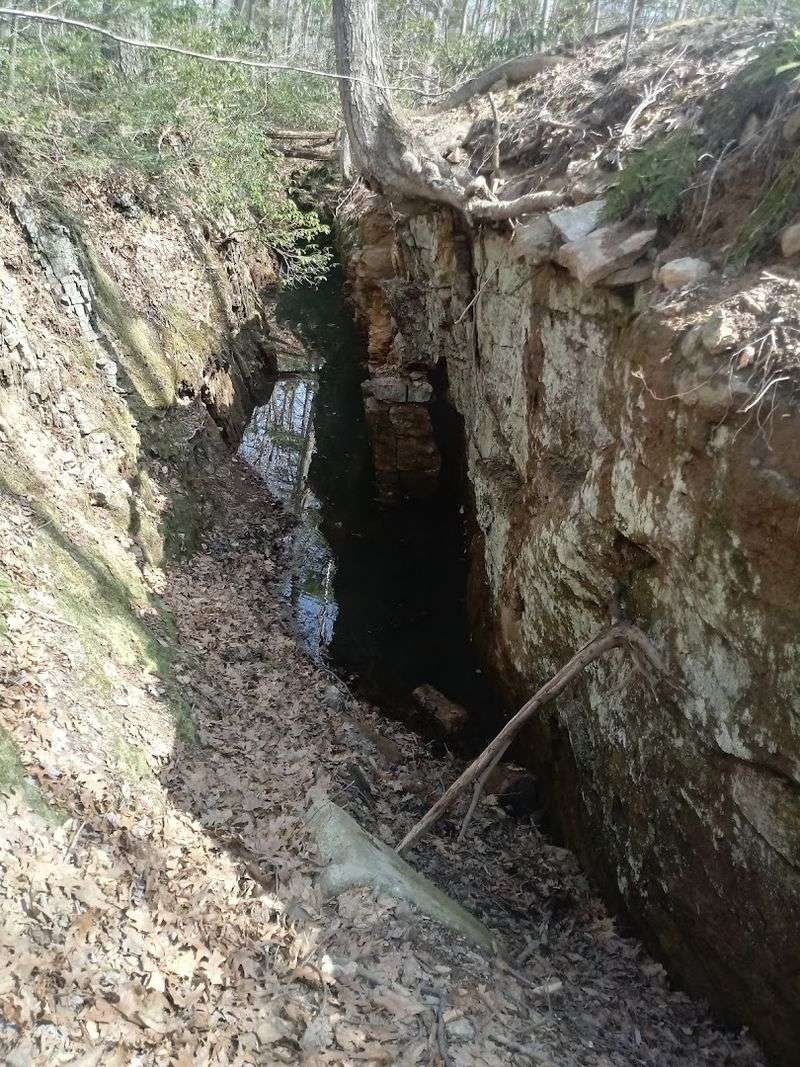
The most dramatic remnants are the mine openings. Some have become deep, water-filled cuts whose still surfaces conceal shafts descending hundreds of feet.
They are not swimming holes, caves, or places for improvised exploration. Fencing surrounds major hazards, and the old workings should be viewed from a safe distance.
The ruins are compelling precisely because the forest has not turned them into a polished attraction. There are no restored conveyor belts chugging for demonstrations and no recreated mining village selling the experience.
Instead, the mountain reveals itself in pieces: a rail bed that is too straight to be natural, a stone wall disappearing beneath leaves, or a flooded opening suddenly visible between the trees.
Princeton geologists who have studied the area describe hiking past mine entrances and industrial remnants across bedrock that was once part of a largely deforested worksite.
Now the landscape feels wild again, with wetlands, rocky slopes, deer, wild turkey, and black bears occupying ground once dominated by steam shovels and iron dust.
The Edison Monument marks the starting point for a hike through New Jersey’s industrial past
Today, the racket has been replaced by birdsong, wind, and the occasional crunch of boots over loose stone. Sparta Mountain has reforested so thoroughly that it takes a little imagination to picture hundreds of workers and an industrial complex occupying the same slopes.
Trails pass through mixed woodland, across glacial debris, beside wetlands, and along sections of abandoned railroad grade once used to haul ore and equipment. Near the former processing area, hikers can spot low stonework, concrete fragments, overgrown foundations, and changes in the terrain that make more sense once you know machinery and buildings stood there.
The most dramatic remnants are the mine openings. Some have become deep, water-filled cuts whose still surfaces conceal shafts descending hundreds of feet.
They are not swimming holes, caves, or places for improvised exploration. Fencing surrounds major hazards, and the old workings should be viewed from a safe distance.
The ruins are compelling precisely because the forest has not turned them into a polished attraction. There are no restored conveyor belts chugging for demonstrations and no recreated mining village selling the experience.
Instead, the mountain reveals itself in pieces: a rail bed that is too straight to be natural, a stone wall disappearing beneath leaves, or a flooded opening suddenly visible between the trees.
Princeton geologists who have studied the area describe hiking past mine entrances and industrial remnants across bedrock that was once part of a largely deforested worksite.
Now the landscape feels wild again, with wetlands, rocky slopes, deer, wild turkey, and black bears occupying ground once dominated by steam shovels and iron dust.