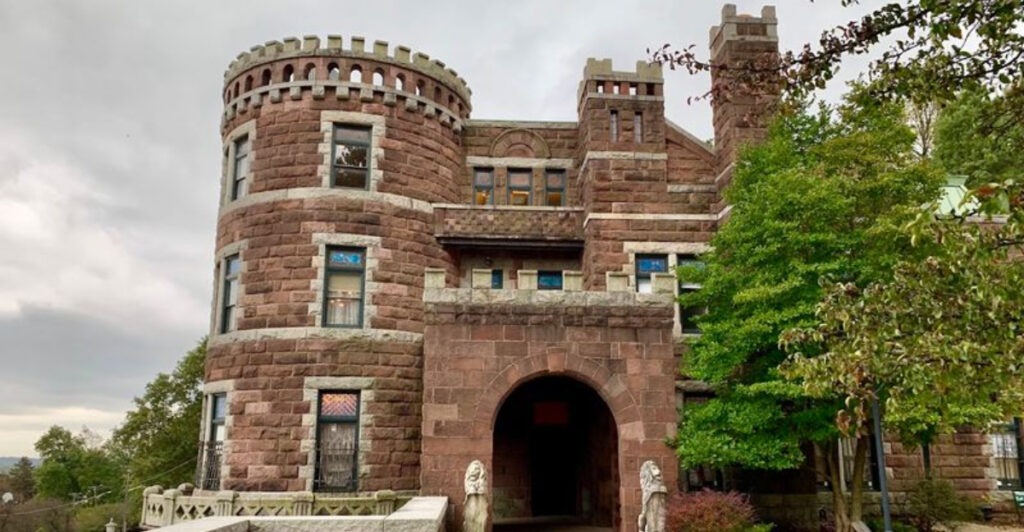
A row of stone battlements rises above Paterson, looking wonderfully out of place against the highways, rooftops, and old mill buildings below. This is Lambert Castle, a grand Gilded Age mansion perched on Garret Mountain, where an English immigrant with a silk fortune decided an ordinary house simply would not do.
Built in the early 1890s and originally called Belle Vista, the landmark has turrets, thick brownstone walls, ornate rooms, and the sort of hilltop setting that makes it seem older than it really is. Yet the castle is not a movie set or the remains of some forgotten European settlement.
It was a family home, an art gallery, a hospital, a government building, and eventually a museum devoted to Passaic County history. Following a major restoration and its public reopening in 2026, visitors can once again step through the doors and see how one of Paterson’s most ambitious industrialists lived.
It Has Watched Over Paterson Since the 1890s
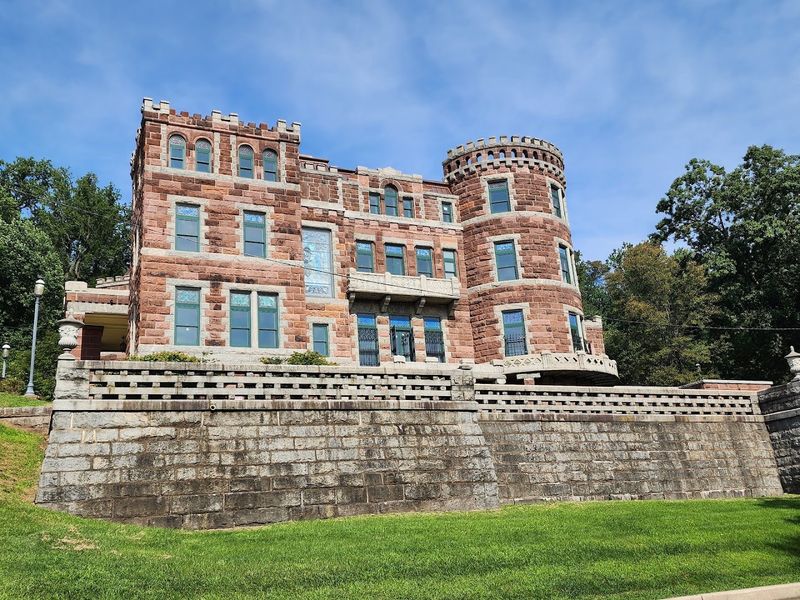
Drivers passing through Paterson can easily miss the castle above them. It sits along Valley Road near the edge of Garret Mountain Reservation, raised just high enough over the city to feel separated from the busy streets below.
The mansion was constructed in 1892 and 1893, during a period when Paterson was booming as an industrial center and earning its famous nickname, Silk City. Its owner, Catholina Lambert, wanted a residence that displayed both his success and his affection for the architecture of his native England.
The result became one of Northern New Jersey’s most recognizable historic buildings. The original property was much larger than the surviving castle suggests.
Lambert’s estate covered approximately 53 acres and included a gatehouse, carriage and greenhouse complex, formal Italianate gardens, a summerhouse, an art gallery, and a separate observation tower. The Lambert family remained there until Catholina’s death in 1923.
His son Walter sold the property to the City of Paterson in 1925, and the mansion briefly served as a tuberculosis hospital before becoming part of the county park system. The Passaic County Historical Society established a museum and library inside in 1934, beginning a new chapter that lasted for generations.
Some estate structures disappeared over time, including the enormous gallery wing, but the main residence continued to command the slope. Its importance has been formally recognized for decades.
Lambert Castle entered the New Jersey Register of Historic Places in 1975 and the National Register of Historic Places the following year. More than 130 years after the first brownstone blocks were assembled, the mansion still looks down on the same city whose silk mills paid for its construction.
Belle Vista Was Built as an English-Style Castle
Long before Catholina Lambert entertained hundreds of guests beneath carved ceilings, he arrived in America with five pounds, a Book of Common Prayer, and a remarkable amount of confidence. Born in 1834 in the Yorkshire village of Goose Eye, Lambert began working as an errand boy at an English mill when he was only 10.
After completing a seven-year apprenticeship, he crossed the Atlantic in 1851 and entered the American textile trade. He eventually joined silk manufacturers Benjamin Tilt and Walter Dexter, then became Dexter’s business partner with the help of a $5,000 loan.
Lambert repaid it within three years and later purchased Dexter’s share, though the company retained the name Dexter, Lambert & Company. Its growth made Lambert one of Paterson’s leading silk manufacturers.
By the early 1890s, his existing home was no longer large enough for his expanding collection of paintings, sculpture, antiques, and sacred music. Belle Vista was his very large solution.
The new residence was designed as both a family home and a showplace, combining the appearance of an English castle with the comforts expected by an extremely wealthy Victorian household. Lambert named the estate in honor of his wife, Isabella, while its elevated setting gave the name an appropriate “beautiful view” connection.
A grand reception held on January 31, 1893, reportedly included invitations for 400 guests. President William McKinley was among the notable figures who later visited the residence.
Lambert kept expanding after the housewarming. In 1896, he added a 100-by-35-foot gallery for his art and built the nearby 70-foot observation tower.
Financial troubles eventually forced him to sell much of his prized collection at a 1916 auction in New York’s Plaza Hotel, but he never abandoned Belle Vista. He remained in his castle until his death in February 1923.
The Brownstone Turrets Give It Storybook Charm
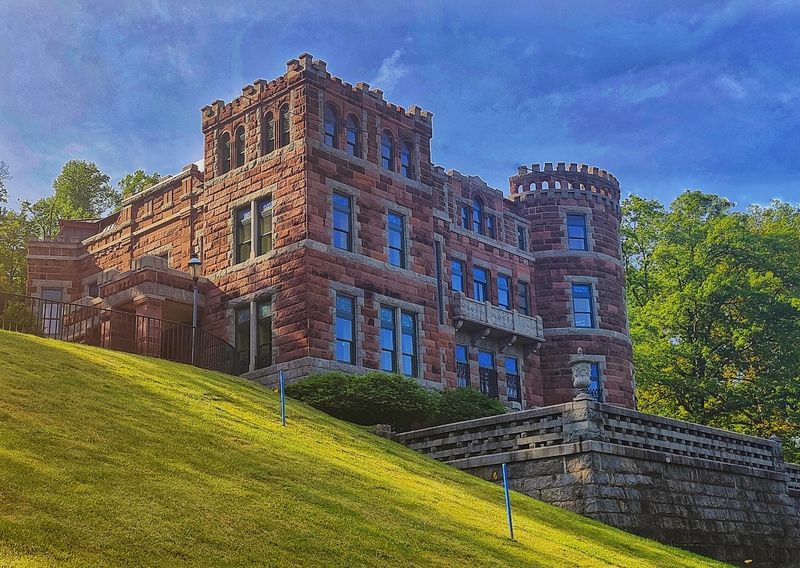
The castle effect begins before anyone reaches the front door. Uneven rooflines, squared towers, crenellated parapets, arched openings, and heavy stone walls create a silhouette that feels closer to the English countryside than Passaic County.
Lambert was not attempting to reproduce one particular medieval fortress brick for brick. Instead, he borrowed the visual language of British castles and wrapped it around a thoroughly luxurious late-19th-century mansion.
Much of the sandstone used in its construction came from local quarries, allowing the building to look surprisingly rooted in Garret Mountain even while its design pointed across the Atlantic.
The warm brown masonry is especially striking in late-afternoon light, when the walls pick up reddish and golden tones and the battlements cast sharp shadows.
Architectural historians describe the estate as a rare American example of fully developed castellated residential architecture. That distinction becomes easier to understand when considering the original complex rather than the surviving house alone.
Lambert arranged multiple buildings, landscaped grounds, gardens, an art wing, and a separate observation tower to create an entire aristocratic setting. The approach was theatrical, but not flimsy.
Stone, dark wood, ornamental plaster, and elaborate moldings gave the residence real weight. The recent restoration paid close attention to those details.
Exterior sandstone was stabilized, deteriorated wooden windows were replaced with historically accurate reproductions, and intricate finishes were repaired instead of being simplified.
Inside, restoration specialists worked with a decorative palette containing more than 100 paint colors, recreating the combinations Lambert selected for the rooms.
Not every piece of the estate survived. The huge gallery wing was eventually demolished, and the original grounds were altered as Garret Mountain became a public reservation.
Even so, the remaining castle, carriage buildings, and tower preserve enough of Lambert’s vision to make the property feel like a complete little kingdom tucked above Paterson.
Its Restored Rooms Revive Gilded Age Drama
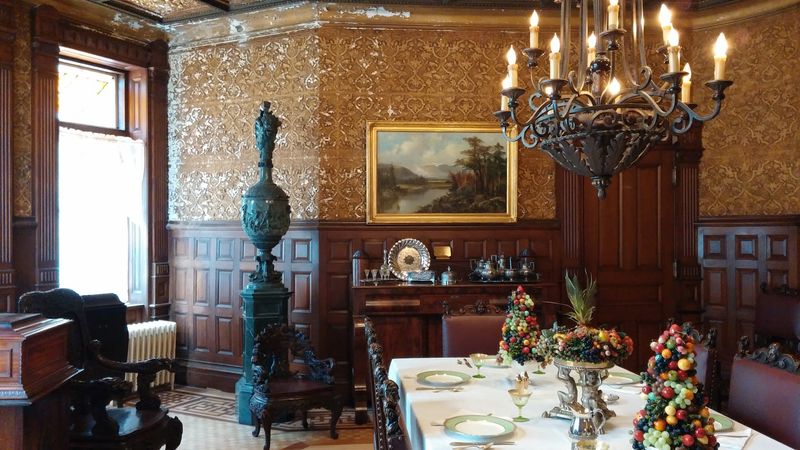
Inside, the building changes personality. The defensive-looking exterior gives way to polished wood, decorative plasterwork, patterned walls, formal furnishings, and rooms designed for entertaining rather than repelling invaders.
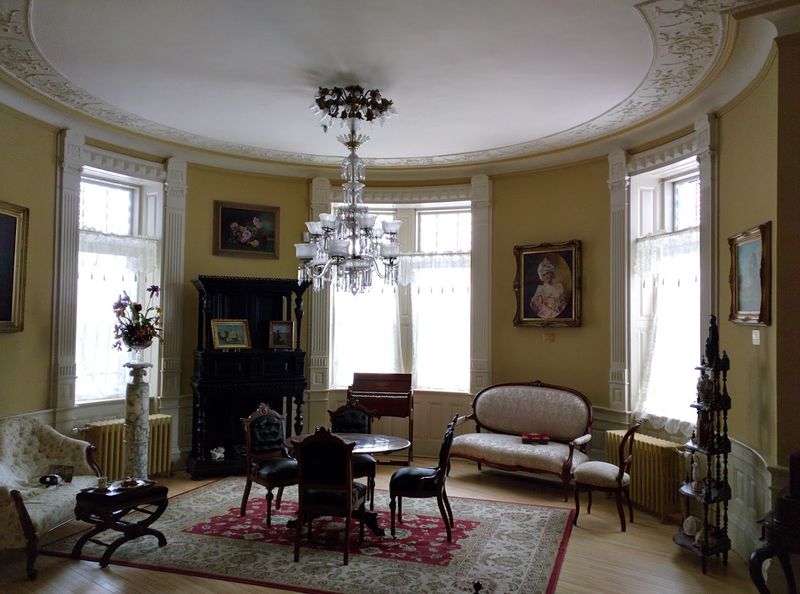
The main floor’s period spaces interpret the years when the castle served as Lambert’s private residence. Visitors move through rooms such as the parlor, breakfast room, and dining room, where original Lambert possessions appear alongside objects from Passaic County historical collections.
These interiors help explain why Belle Vista was more than an eccentric rich man’s house. Lambert used it as a setting for business relationships, artistic display, elaborate receptions, and family life.
His collection once included American and European paintings, sculptures, antiques, and rare decorative pieces, with the purpose-built gallery providing enough space to present them on an almost institutional scale. Today’s experience mixes the domestic story with broader exhibits on local art, industry, and history.
The restoration that began in 2021 went well beyond applying fresh paint. Crews completed structural repairs, restored interior finishes, upgraded climate-control systems, rewired historic-style lighting, and improved protection for delicate textiles, documents, and other artifacts.
Modern systems had to be worked into a building created decades before air conditioning, elevators, or contemporary accessibility standards.
The completed work includes elevator service, accessible facilities, expanded exhibit areas, and a new visitor center, allowing the castle to function as a public museum without erasing the features people came to see.
Even small procedures reinforce the preservation effort. Guests receive shoe covers during tours to protect the original historic floors, and indoor photography is prohibited to safeguard sensitive objects, meet loan requirements, and prevent crowded rooms from turning into photo shoots.
That may sound strict until the tour reaches the most ornate spaces, where the restored moldings, colors, and finishes make it clear exactly what is being protected.
The Hilltop Views Stretch Toward Manhattan
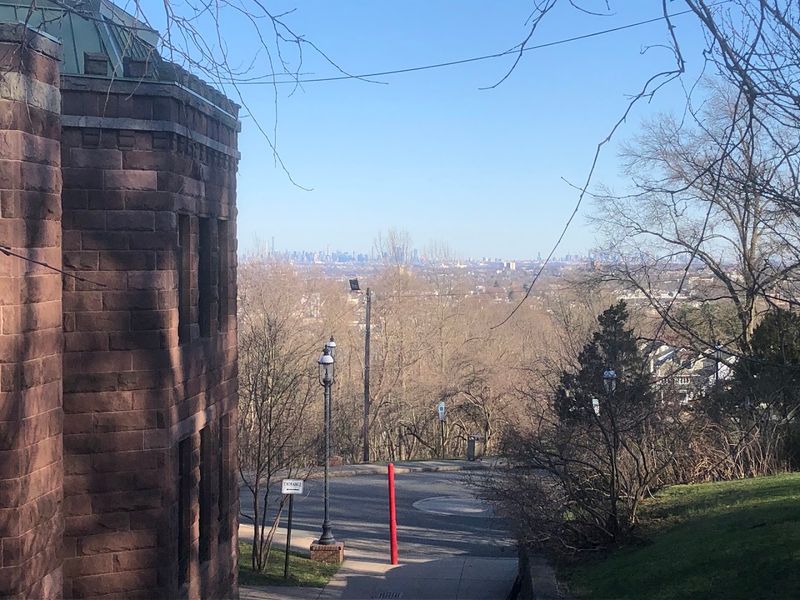
Step outside and Lambert’s choice of real estate makes immediate sense. Garret Mountain Reservation rises more than 500 feet above sea level, creating broad views over Paterson, the Passaic Valley, and, when conditions cooperate, the distant Manhattan skyline.
The contrast is one of the property’s best features. Close by are old industrial neighborhoods and the streets of one of New Jersey’s densest cities; farther out, the landscape opens into ridges, suburbs, and the thin outline of New York.
The surrounding reservation now covers roughly 310 acres and includes wooded trails, picnic areas, athletic facilities, an equestrian center, and Barbour Pond. That makes Lambert Castle easy to combine with a walk rather than treating it as an isolated museum visit.
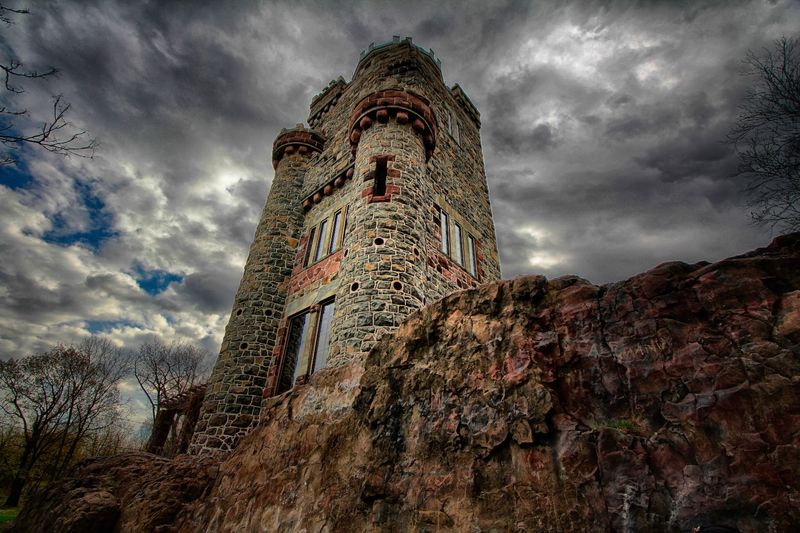
The estate’s most dramatic viewpoint, however, belongs to Lambert Tower. Built in 1896 as the industrialist’s personal observatory, the 70-foot stone structure stands near the castle on the mountain’s upper ground.
It was designed to recall the fortifications Lambert remembered from England, giving the estate a convincing watchtower in addition to its castle residence. The tower later served a very different purpose during World War II, when the United States Armed Forces used it as a lookout post.
Following a multi-year restoration costing $2.4 million, Lambert Tower officially reopened on June 30, 2026, reconnecting two major pieces of the historic estate for the first time in years.
The tower now includes interpretive material covering Passaic County’s formation, the geology of Garret Mountain, and the reservation’s development as a public park.
Guided access is offered Wednesday through Sunday from 10 a.m. to 5 p.m., and general admission to the tower is free. Between the mansion below and the lookout above, Lambert’s obsession with a good view is once again part of the experience.
The Reopened Museum Makes It Easier to Explore
For several years, anyone arriving at the castle found a historic landmark in the middle of a major construction project. Restoration work began in May 2021 and unfolded in multiple phases, addressing the mansion, surrounding site, carriage house complex, visitor facilities, and nearby tower.
Lambert Castle finally welcomed the public back in 2026, and more than 3,000 people visited during its opening weekend. The renewed museum operates from 3 Valley Road in Paterson and uses timed, guided tours rather than an open-house format.
Tours last about 90 minutes and run Wednesday through Sunday between 10 a.m. and 5 p.m., with the final tour beginning at 4 p.m. Adult admission is $10, tickets for children ages 7 through 17 cost $5, and children younger than 6 enter free.
Veterans, active-duty military members, and their families may receive free admission through the site’s participation in the Blue Star Museums program, though advance arrangements are recommended. The practical details are refreshingly straightforward.
The castle and grounds are ADA accessible, certified service animals are permitted, and the visitor center provides a clear starting point before guests enter the historic rooms. All tours remain accompanied by a guide, which suits a house packed with layers of industrial, architectural, and family history.
Guides can connect the extravagant details to the city below, explaining how Paterson’s silk industry allowed an English mill apprentice to build a castle on an American mountain. The experience is polished, but the building has not lost its oddness.
It is still a brownstone fortress above a busy North Jersey city, complete with battlements, formal rooms, and a companion tower in the woods. That unlikely combination is precisely what has kept Lambert Castle fascinating since the first 400 guests arrived for its grand reception in 1893.