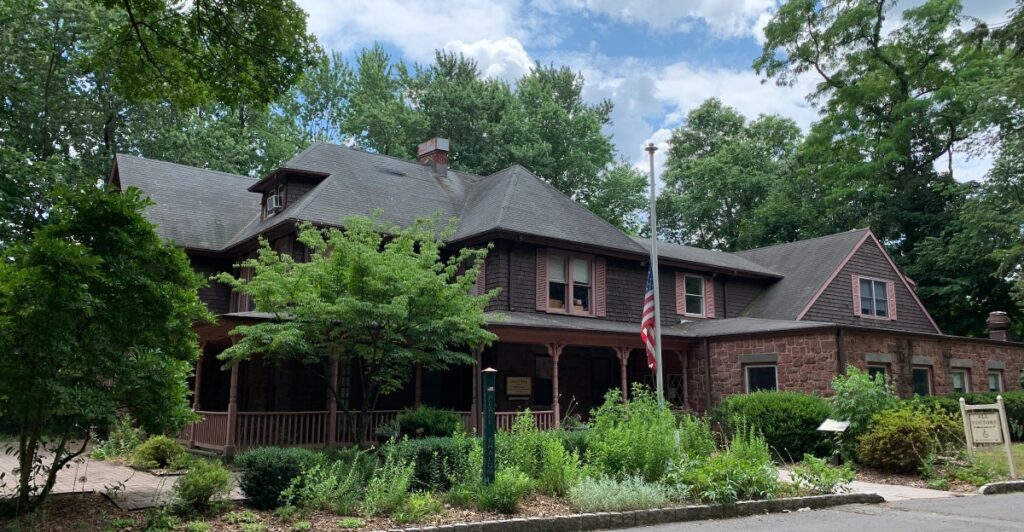
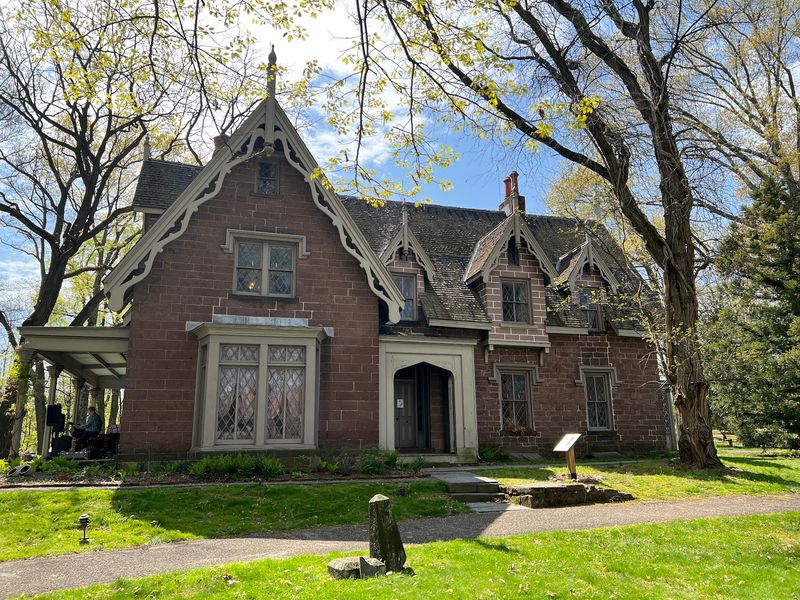
Pointed gables rise above the trees beside North Franklin Turnpike, looking like they belong in an illustrated storybook rather than a Bergen County neighborhood. That first glimpse of the Hermitage is enough to make you slow down.
The closer you get, the more curious the place becomes. Its dramatic exterior wraps around a much older house, one connected to George Washington’s Revolutionary War travels, Aaron Burr’s wedding, and a family that called the property home for generations.
Today, you can take a guided tour inside or wander the gardens without buying a ticket. That makes the Hermitage an unusually flexible stop: a quick look at remarkable architecture if you have little time, or a deeper visit if a house with more than 250 years of stories sounds like your kind of afternoon.
Either way, it gives you plenty to notice before you even reach the front door.
The Hermitage Turns Heads in Ho-Ho-Kus
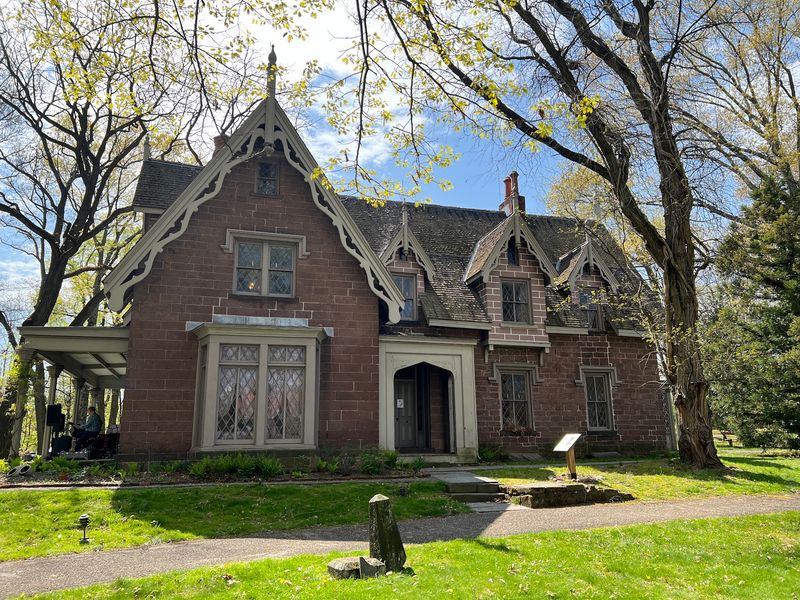
The surprise begins with the address. At 335 North Franklin Turnpike, the Hermitage sits in the middle of familiar Bergen County surroundings, where a drive through Ho-Ho-Kus is more likely to involve errands than a National Historic Landmark.
Then the house comes into view. Its steep rooflines and pointed gables make it difficult to mistake for another old home glimpsed from the road.
It has the sort of shape that makes a passenger ask you to slow down for a second look. There is plenty to discover once you pull in.
The property occupies 4.9 acres near the border of Ho-Ho-Kus and Waldwick, with the historic house, gardens, and another building known as the John Rosencrantz House.
That is a far smaller footprint than the estate once had, but it still leaves room to step away from the turnpike and get a good look at the building from more than one angle.
The Hermitage also rewards two different kinds of visitors. If you love historic architecture, you can spend a while studying the exterior and wondering how its parts fit together.
If you would rather hear about the people who lived here, a guided house tour takes the story well beyond the façade. Even a short grounds visit offers something more satisfying than a photograph snapped through a car window.
That is what makes this stop so appealing. You do not need to arrive with a deep interest in Gothic Revival design or Revolutionary War history.
The house supplies the first question all by itself: How did that end up here? By the time you have walked around it, you will have several more.
Gothic Gables Give an Older House a Dramatic New Look
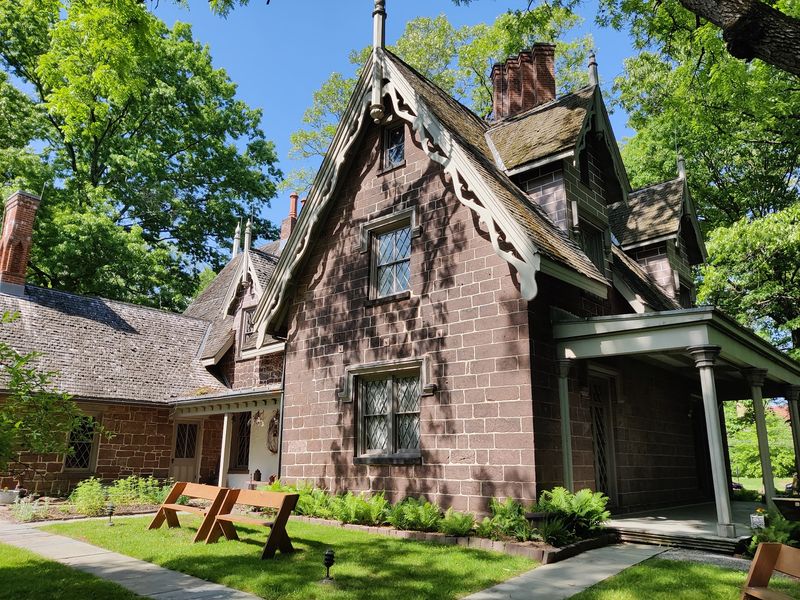
It would be easy to assume the Hermitage was built in one burst of Victorian imagination. The pointed gables, irregular shape, and romantic details make a convincing first impression.
In reality, architect William H. Ranlett remodeled an existing house in 1847 and 1848, incorporating parts of a structure that dated to the mid-18th century.
The building tells two architectural stories at once, even though its Gothic Revival personality gets most of the attention. That transformation is what makes the exterior fun to study.
Instead of the tidy symmetry you might expect from an older house, the Hermitage shifts direction as you move around it. Gables draw your eye upward.
The varied rooflines give the building a playful silhouette. Look longer, and the fact that an earlier house remains within the later design becomes more interesting than any single decorative flourish.
The changes reached beyond appearances. The remodeled home incorporated conveniences that would have felt thoroughly modern to a 19th-century household, including running water, indoor plumbing, and central heating.
Large ground-floor windows and porches also brought the surrounding landscape into daily life. The Rosencrantz family got a house designed to be enjoyed as well as admired, with a close connection between its rooms and the grounds outside.
Its architectural distinction helped earn the Hermitage recognition as a National Historic Landmark. You can understand why without knowing a single design term: few houses make their age, ambitions, and layers of change so visible from the lawn.
The building looks dramatic at first glance. The clever part is how much older history it carries beneath that look.
George Washington Once Stopped at This Revolutionary War Home
In July 1778, George Washington and the Continental Army were moving through northern New Jersey after the Battle of Monmouth. Their route brought them toward Paramus and Hopperstown, the area now known as Ho-Ho-Kus.
Theodosia Prevost sent an invitation for Washington to stay at the Hermitage, and he accepted. The army encamped in the area from July 11 to 14, turning this property into part of a much larger moment in the war.
Theodosia’s circumstances make that visit especially striking. Her husband, James Marcus Prevost, served in the British military.
Her household had Loyalist connections, while the surrounding region was pulled between competing forces. Managing the property through the war fell largely to Theodosia, her mother, Ann DeVisme, and her half-sister Caty.
At least two enslaved African Americans were also part of the household. This was a place where the pressures of war shaped daily life, not simply a picturesque backdrop for a famous guest.
Northern Bergen County was contested ground. Troops passed through, neighbors held opposing loyalties, and households faced real risks from both sides.
Theodosia had to protect her family and the estate while navigating those divisions. Her invitation to Washington is more revealing when you picture it against that tension.
Washington was far from the only notable visitor associated with the Hermitage during the Revolutionary era. The site also records visits by figures including James Monroe, the Marquis de Lafayette, Alexander Hamilton, and Aaron Burr.
It is a remarkable concentration of names for one Bergen County property, but Theodosia’s story gives them context. The house mattered because people were trying to live through a conflict that kept arriving at their door.
Aaron Burr and Theodosia Prevost Married Here
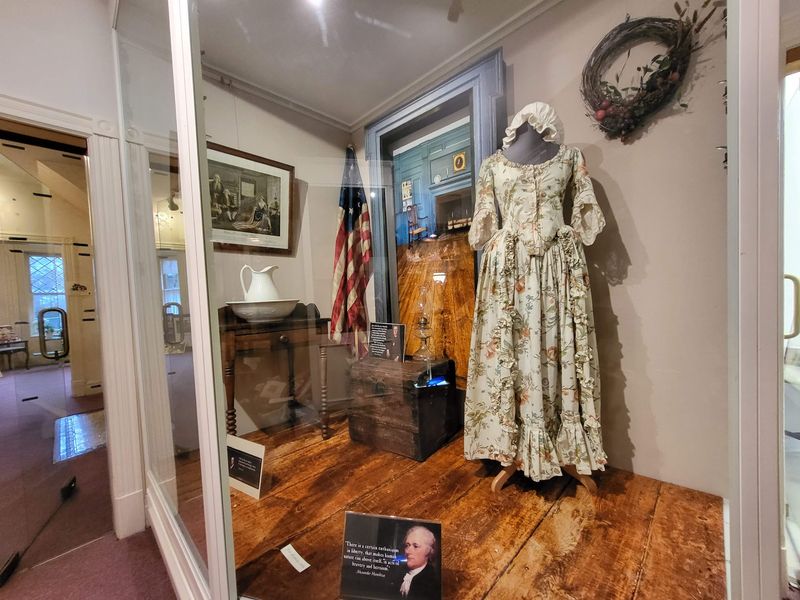
A wedding at the Hermitage in 1782 came together with surprisingly little ceremony. Aaron Burr had arrived for the marriage of Theodosia Prevost’s half-sister Caty to Joseph Browne.
While there, he and Theodosia decided to marry as well. The result was a double wedding.
According to the Hermitage’s account, Burr did not have time to get a new coat, and Theodosia borrowed gloves. Those small details make the event feel far more human than a line on a historical timeline.
The two had known each other for years. Burr came into Theodosia’s circle during the Revolutionary War, when the Hermitage was receiving visitors with very different allegiances.
In 1778, they spent time together on a voyage to British-held New York City. Burr continued to visit, and their relationship grew while war and illness complicated both of their lives.
Theodosia’s first husband died in 1781; she and Burr married the following summer. For many visitors, Burr’s name comes with later chapters of American history.
The Hermitage lets you encounter him at an earlier, more personal moment. Here he was a man arriving for one family wedding and leaving as part of another.
Theodosia, meanwhile, was no footnote to his story. She had already spent years managing a household and protecting its property in a region where loyalties could put a family in danger.
Knowing where the wedding happened changes the way you look at the estate. It held military visitors and political conversations, but it also held hurried plans, borrowed gloves, and relatives gathering for a celebration.
That mixture of national history and family life runs through the entire house.
A Guided Tour Reveals Generations of Family Life
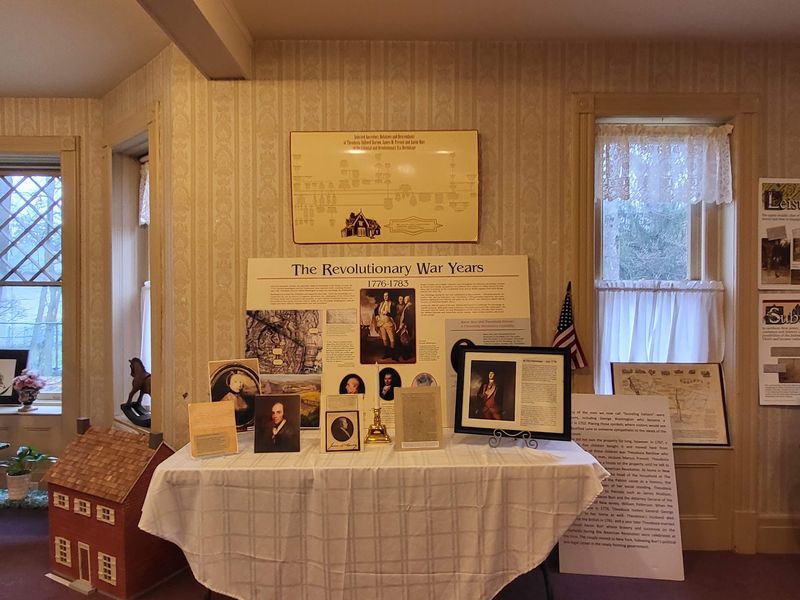
Inside, the Hermitage moves into a later chapter. The Rosencrantz family acquired the property in 1807 and remained connected to it until 1970.
The rooms are furnished to reflect its late Victorian period, after the Gothic Revival remodeling had given the house its present character. A guided tour shifts your attention from the famous people who passed through to the family members who stayed.
That longer view gives the house much of its warmth. The Rosencrantzes lived with the modern conveniences built into the remodel, but their days were filled with recognizable interests too.
Family photographs, letters, and artifacts tell of visits with friends, travel, sewing, books, music, and games. An upstairs billiard room was added over a reconstructed summer kitchen in 1888.
Those details give the impressive exterior a household behind it, with changing tastes and pastimes across generations. The tours last about an hour and are led by docents who connect the rooms to both the Rosencrantz and Prevost families.
There is no self-guided house tour, so it is worth checking the current schedule before making the trip. The Hermitage lists afternoon tour times and asks visitors to arrive 15 minutes early; regular tours can pause for special events.
Adult admission is listed at $10, with $5 tickets for children and free admission for those under five. One practical detail matters before you go inside: the historic house has stairs, narrow doorways, and uneven floors, and much of the tour is inaccessible to visitors with mobility impairments.
Contacting the museum ahead of time can help you understand the available options. For those able to take the tour, the reward is seeing how an eye-catching landmark functioned as a home for more than a century and a half.
The Gardens Make It Worth Staying a Little Longer
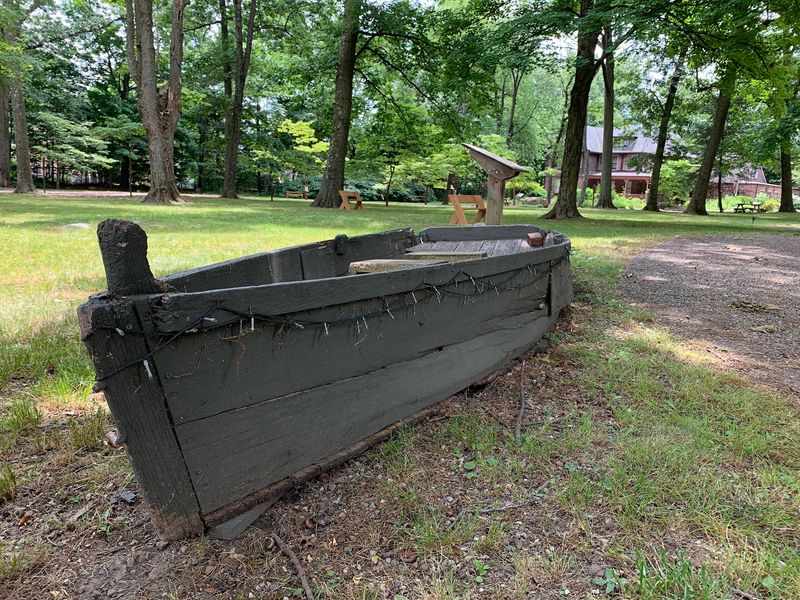
After an hour inside, the grounds give you a chance to see the Hermitage at a different pace. Walk away from the front door and the building becomes part of a wider scene, its Gothic outline rising above the gardens rather than filling your entire view.
It is also a good moment to notice how closely the house’s design is tied to its setting. Those large windows and porches made sense for a family that wanted to enjoy the landscape around it.
Today’s 4.9 acres are a small remnant of an estate that once covered nearly 300 acres. Along with the main house, the grounds include the John Rosencrantz House and gardens maintained by volunteers from the Master Gardeners of Bergen County.
The gardeners’ work gives the property a living element that changes with the seasons, even as the historic buildings hold their familiar shapes. The gardens and grounds are free to visit and open daily from 9 a.m. to 5 p.m.
On-site parking makes it easy to stop even when a house tour does not fit your schedule. You could make the gardens the quiet finish to a longer visit, or come simply to stretch your legs and take in the architecture from outside.
There is something pleasing about having that choice. The Hermitage can hold your attention through a full guided tour, with its Revolutionary War connections, Victorian household stories, and unexpected architectural details.
It can also offer a slower few minutes among the gardens. From out there, you get one last look at the gables before returning to the road, now knowing why the house is worth more than a passing glance.
Share this story